In the spring of 1864, Robert E. Lee understood the danger facing his army. North of the Rapidan River, the Army of Northern Virginia waited in the tangled forests of Virginia, having spent three years facing Union commanders who attacked, hesitated, maneuvered, retreated, and sometimes allowed the Confederate army to escape when destruction seemed within reach. But Ulysses S.
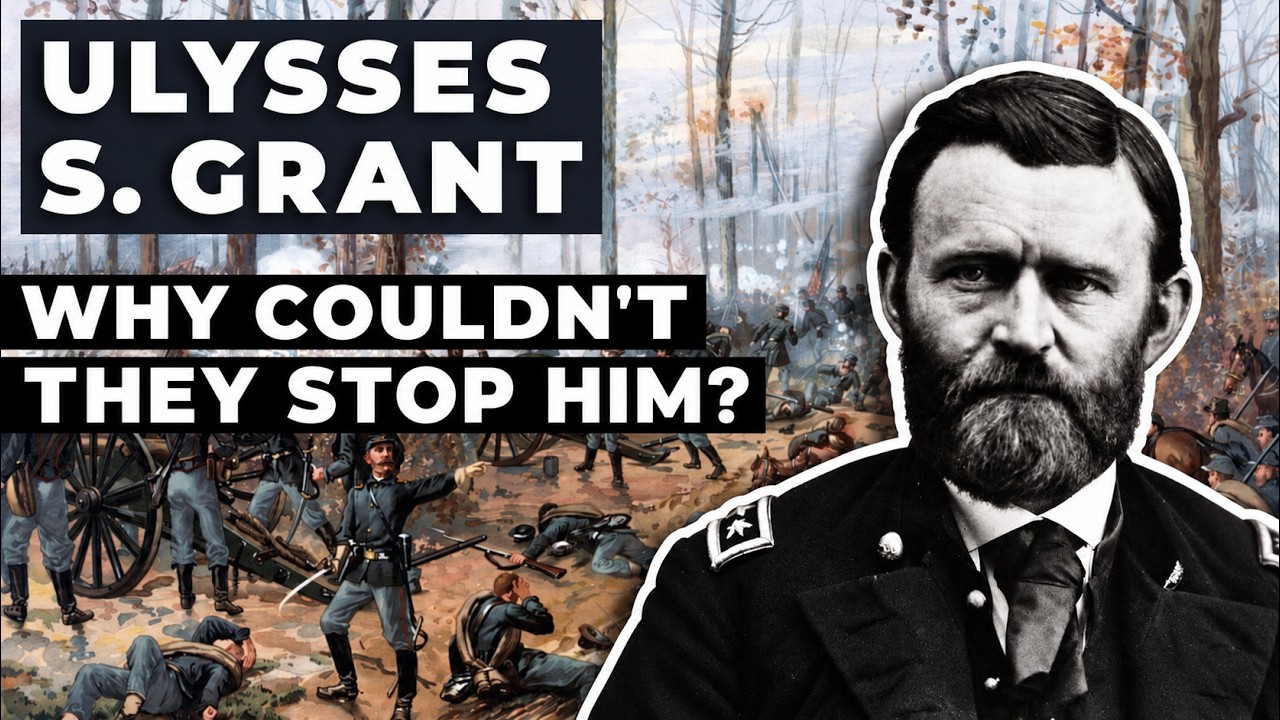
Grant had come east, and the deeper threat was not whether Grant could defeat Lee in a single battle. It was that Grant no longer needed to. Every battlefield setback could simply become another step toward the next attack. The true objective was not Richmond.
It was Lee’s ability to keep fighting. The story of Grant is often reduced to a familiar image: a Union general who accepted enormous casualties and kept attacking. But that explanation is incomplete. Casualties mattered enormously to Grant.
What changed was the way he understood the relationship between a battlefield, an army, and an entire war. To understand that transformation, one must go back before Virginia, before the great command in the East, back to a quiet moment in Missouri. In 1861, Grant was not yet the commander who would eventually direct the Union armies. He was a former army officer who had resigned years earlier and was working in his family’s leather business in Galena, Illinois.
The war brought him back into uniform, and his first campaigns exposed something that would become fundamental to his command style. Fear was not unique to the enemy. It existed on both sides. Grant later remembered approaching a Confederate force near the town of Florida, Missouri.
As his men moved toward the enemy position, he felt something very different from the calm confidence later associated with his name. He was afraid. Then he discovered that the Confederates had already withdrawn. The men he had feared had apparently been just as uncertain about him.
That experience did not make Grant fearless. It changed his understanding of fear. The enemy was not an unstoppable machine. The enemy was made up of men who could retreat, hesitate, miscalculate, and become exhausted.
That distinction would matter enormously later, because Grant’s great strength was not that he never encountered failure. It was that failure did not necessarily force him to abandon the larger operation. His early victories demonstrated this. At Fort Donelson in February 1862, Grant’s army and Union naval forces threatened a key Confederate position on the Cumberland River.
When Simon Bolivar Buckner asked for terms, Grant’s answer became one of the most famous statements of the war: no terms except unconditional and immediate surrender. But the importance of Donelson went beyond the famous sentence. The campaign demonstrated that Grant understood something many commanders struggled with. A victory mattered most when it changed the strategic situation.
The fall of Fort Donelson opened the way deeper into Tennessee. The Confederate position was not merely defeated. It had to be abandoned. Men, weapons, territory, transportation routes, and defensive positions were lost.
Grant was beginning to demonstrate a habit that would follow him throughout the war: once an enemy position became vulnerable, he tried to make the consequences permanent. Then came Shiloh, which complicates the Grant legend. On April 6, 1862, Confederate forces struck Grant’s army near Pittsburgh Landing. The Union position nearly collapsed.
The fighting was chaotic. Casualties mounted. Grant’s army was pushed backward. Measured only by the appearance of the first day’s battle, Shiloh could have been remembered as a Confederate triumph.
But the battle did not end there. Grant reorganized his forces, received reinforcements, and counterattacked on April 7. The Confederates withdrew. The battle had become an extraordinarily costly Union victory.
Shiloh taught a lesson that would become increasingly important: a battle could go terribly wrong without destroying the campaign. Grant did not need the first day to validate his strategy. He needed the army to remain capable of fighting the next day. Then came Vicksburg, where Grant’s method became much easier to see.
Vicksburg was not simply another Confederate city. Its position on the Mississippi River made it central to Confederate control of the Western theater. Grant tried approaches that failed. He changed his plans.
He experimented with routes that placed his army in increasingly unusual positions. Eventually, in the spring of 1863, Grant crossed the Mississippi south of Vicksburg and moved rapidly through Mississippi. The campaign became a chain of movement and battles rather than a single frontal assault. Grant defeated Confederate forces at Port Gibson, Raymond, Jackson, Champion Hill, and Big Black River Bridge before isolating Vicksburg.
The crucial point was not simply that Grant had won several battles. It was what those victories did to the Confederate army. Each defeat reduced its freedom to maneuver. Vicksburg became increasingly isolated.
Once the siege began, the Confederate position deteriorated until surrender became unavoidable. On July 4, 1863, Vicksburg surrendered. Grant had not discovered a magical battlefield formula. He had demonstrated something more consequential: he could turn movement into isolation, isolation into pressure, and pressure into surrender.
The Confederate army had to respond to each stage before it had time to recover from the previous one. That brings us to the real reason Grant became such a difficult opponent. It was not simply that he was aggressive. Other commanders had been aggressive.
It was not simply that he was willing to accept casualties. Other commanders had suffered catastrophic losses. It was that Grant increasingly understood how to connect separate Union operations into one larger problem. By March 1864, that problem became national in scale.
Congress restored the rank of lieutenant general, and President Abraham Lincoln placed Grant in command of the Union armies. Now Grant was no longer responsible for winning one theater. He had to make the Confederate armies fight simultaneously. In Virginia, Grant would confront Lee.
In Georgia, William Tecumseh Sherman would advance against Joseph E. Johnston. In the Shenandoah Valley, Confederate forces would be threatened. Along the coast and in other theaters, Union pressure would continue.
The objective was to stop the Confederacy from moving freely from one crisis to another. The Union armies were becoming parts of a single strategic system. Lee was about to discover what that meant. In May 1864, Grant crossed the Rapidan and entered the Wilderness.
The fighting was brutal, the terrain difficult, and the Union army suffered heavily. But then something happened that had repeatedly happened to previous Union commanders. Lee expected the Army of the Potomac to withdraw after a major confrontation. Grant did not.
Instead, the Union army moved south. The armies fought at Spotsylvania, then North Anna, then Cold Harbor. The map changed repeatedly, but the direction of movement did not. Grant kept shifting the army toward the next position.
This is where the familiar image of Grant becomes misleading. People sometimes imagine that Grant simply attacked Lee again and again without regard for consequences. But the campaign was more complicated. Grant was maneuvering, attempting to turn Lee’s position, searching for opportunities.
When Lee blocked one route, Grant frequently shifted toward another. The objective was not to win every battlefield in spectacular fashion. The objective was to prevent Lee from regaining the strategic initiative. A commander can lose a battle and still win the campaign.
A commander can win a battle and still lose the war. Then came Cold Harbor, one of the darkest episodes of the Overland Campaign. Union attacks failed against strong Confederate defenses, and the casualties were severe. The disaster became part of Grant’s historical reputation.
But the important question is what happened afterward. Grant did not simply retreat back across the ground he had already fought over. He changed the direction of the campaign. The Army of the Potomac crossed the James River and moved toward Petersburg.
Petersburg was more than another battlefield. It was a transportation problem. Several major railroads and roads connected there, making it a crucial logistical center for Richmond and the Confederate army. Grant’s objective was not to defeat Lee at one particular place.
It was to make Lee’s position progressively harder to sustain. Cut the railroads. Threaten the supply network. Force Lee to stretch his defenses.
Then wait for the pressure to accumulate. Grant had shifted the war from the question of whether Lee could defend Richmond to whether Lee could continue supplying an army capable of defending Richmond. An army can survive a battlefield defeat. It is much harder to survive the destruction of the system that keeps the army in the field.
This was where Grant’s war became increasingly connected to logistics. Railroads mattered, food mattered, horses mattered, replacements mattered, communications mattered, industrial production mattered. The North possessed enormous advantages in population and industrial capacity, although those advantages did not automatically produce victory. Grant’s job was to convert those resources into sustained military pressure while preventing the Confederacy from exploiting its own advantages.
Lee had interior lines around Richmond and Petersburg. Grant had a larger pool of resources, but resources only mattered if they could be organized into continuous pressure. And this was not limited to Virginia. In the Shenandoah Valley, Grant placed Philip Sheridan in command and gave him a mission that extended beyond simply defeating Jubal Early’s army.
The Valley was an agricultural resource for the Confederacy. Grant wanted Confederate forces there destroyed and the region’s ability to sustain them damaged. The battlefield was only one part of the problem. An army also depended on the landscape around it: food, horses, railroads, factories, roads, bridges, communications.
Once those systems were threatened, the army’s tactical strength could begin to decline even before another major battle occurred. This was happening across multiple theaters. Sherman was advancing toward Atlanta. Sheridan was operating in the Shenandoah.
Grant was holding Lee around Petersburg. The Confederacy could no longer assume that a crisis in one region could be solved simply by shifting troops from another. Every movement had consequences somewhere else. That was perhaps the greatest change Grant introduced.
He made the Confederacy solve several problems at once, with fewer and fewer resources. Still, Grant was not infallible. The Petersburg campaign itself demonstrated that. When Union forces first approached Petersburg in June 1864, the city was more lightly defended than it would soon become.
But delays allowed Confederate forces to reinforce the position. A Union assault on June 18 failed to break through. Later came the infamous explosion of the mine beneath the Confederate line, followed by the failure at the crater. Again, Grant’s army suffered heavily.
Grant did not always make the right decision. The stronger argument is that his mistakes did not restore the Confederacy’s strategic freedom. Grant could fail tactically and still continue the larger operation. Lee could successfully defend one section of his line and still find his army increasingly trapped.
The Confederacy needed a major reversal. Grant needed continued pressure. By the winter of 1864-65, the imbalance was becoming increasingly visible. The Petersburg line stretched for miles.
Lee’s army remained dangerous, but it was operating under growing logistical pressure. Grant continued extending the Union lines. The Confederates had to defend more ground. Every extension created another potential weakness.
The final Petersburg and Appomattox campaign brought the collapse of Lee’s lines on April 2, 1865, followed by the evacuation of Richmond and Petersburg and the seven-day retreat that ended at Appomattox. Grant did not destroy Lee’s army in one spectacular battle. He had spent months reducing its options. When Lee finally attempted to escape, the Confederate army was already operating under enormous constraints.
Grant pursued. Sheridan’s cavalry moved ahead. Confederate routes narrowed. Supplies became increasingly difficult to obtain.
The army that had defended Richmond for years was now trying simply to get away. On April 9, Lee surrendered at Appomattox Courthouse. The famous meeting between Lee and Grant has often been remembered as a moment between two great commanders. Strategically, the surrender represented something larger.
The Confederate army had reached a point where continued resistance could no longer restore its position in Virginia. Grant had changed the question. Earlier in the war, Confederate commanders often asked whether they could defeat a Union army. By 1864, the more important question was becoming whether they could survive the next Union operation.
Grant understood that the Confederacy’s armies were connected to a larger system. Destroy the system, and the armies become harder to sustain. Cut the railroads and movement becomes more difficult. Destroy supplies and soldiers cannot remain in the field indefinitely.
Force Lee to stretch his lines and opportunities multiply. Keep Sherman advancing and Confederate troops cannot all be concentrated in Virginia. Keep Sheridan active and the Shenandoah becomes less useful as a source of Confederate supplies. Keep pressure on Lee and eventually even a brilliant defensive army has fewer places to go.
That was the real transformation. Grant did not make war simpler. He made it harder for the Confederacy to escape the consequences of its own shrinking resources. When Grant took command of the Union armies, the Confederacy was no longer facing one Union army with one objective.
It was facing a coordinated war effort. The Confederacy could still win battles. It could still inflict enormous losses. It could still surprise Union commanders.
But every victory had to accomplish something more than killing Union soldiers. It had to change the strategic situation. And that became increasingly difficult. Grant created a contest in which the Union’s ability to recover became part of the strategy.
The North could absorb setbacks and continue mobilizing. The Confederacy had fewer replacements, fewer industrial resources, and an increasingly strained transportation network. This did not make Union victory automatic. It made Grant’s ability to sustain pressure increasingly consequential.
That is the part of Grant’s story often lost behind the mythology. He was not simply the general who would not stop. He was the general who increasingly understood why stopping mattered. If the army stopped, Lee could recover.
If Lee recovered, Confederate forces could shift. If Confederate forces shifted, Union advantages elsewhere could disappear. So Grant kept the pressure connected. At Appomattox, the final result became visible.
But the real story had been unfolding for years. It began with a relatively unknown officer learning that the enemy was afraid too. It continued through Donelson, Shiloh, and Vicksburg. And it reached its fullest expression in 1864, when Grant stopped treating the Union war effort as a collection of separate campaigns and began directing it as one interconnected struggle.
Grant did not simply learn how to fight Robert E. Lee. He learned how to make the entire Confederate war effort harder to sustain. Once that happened, the question was no longer whether the Confederacy could win another battle.
The question was how many more battles it could survive. By April 1865, there were not many left. At Appomattox, the answer finally arrived.