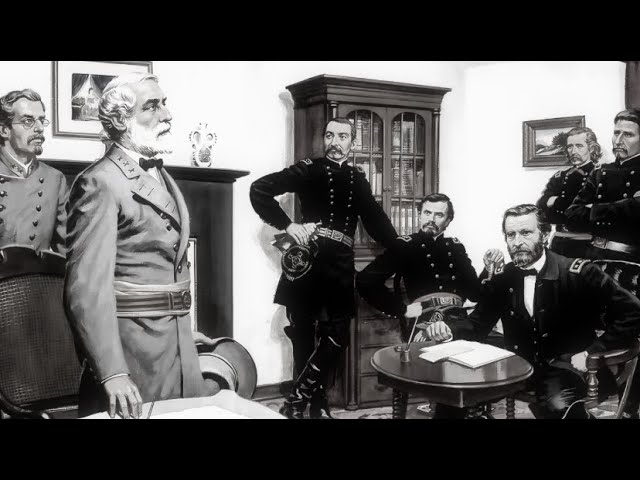
On April 9, 1865, two generals sat across from each other in the parlor of a quiet Virginia farmhouse. One wore a freshly pressed gray uniform. The other arrived in muddy field clothes with no sword at his side. The image of that room became one of the most reproduced in American history, but the version of the story handed down through textbooks and classrooms quietly left out the parts that were complicated, contradictory, or politically inconvenient.
By early April 1865, the Army of Northern Virginia was a shell of what it had once been. Months of siege warfare at Petersburg had ground the Confederate force down to between 50,000 and 60,000 men on paper, but the reality was far grimmer. Desertions drained the ranks daily. Soldiers went without shoes and adequate rations.
The Confederate supply network had essentially stopped functioning. On April 2, Grant’s forces broke through the Petersburg lines, and Confederate President Jefferson Davis fled Richmond that same night as the capital was evacuated in chaos. Lee did not immediately decide to surrender. His plan was to move his remaining forces west, link up with General Joseph Johnston’s army in North Carolina, and continue the fight.
As a professional soldier operating under a code of duty to his government, he did not take unilateral surrender lightly. What changed his calculations was the speed of Union pursuit. Philip Sheridan’s cavalry kept cutting off the Confederate column at every turn. When Union forces captured a massive Confederate supply train at Appomattox Station on April 8, the last realistic hope of feeding the army vanished.
That evening Lee convened a council of war. Some of his generals still argued for a breakout attempt at dawn. Lee was not convinced it would succeed, but he let them try. In the pre-dawn hours of April 9, Confederate infantry managed to push Union cavalry aside, and for a brief moment it looked like the escape corridor was open.
Then Union infantry appeared behind the cavalry in mass. When Confederate officers rode to the crest of a hill and looked out, they saw not an opening but the rest of Grant’s army. The corridor was a closing trap. It was General John Gordon who rode back and delivered the assessment that ended the debate.
The situation was hopeless unless artillery support could be brought forward, and it could not be. Lee listened. There was reportedly a long pause. Then he said there was nothing left to do but go and see General Grant, and that he would rather die a thousand deaths.
That phrase has been quoted endlessly, but what gets quoted less often is what came immediately after. Lee straightened himself, put on his best uniform, and went to surrender with every bit of the dignity and formality he could muster. The meeting place itself had followed Wilmer McLean, who had moved his family from Manassas to get away from the war. His farm there had been used as a Confederate headquarters during the first Battle of Bull Run in 1861.
He relocated to the quiet village of Appomattox Courthouse, and the war followed him anyway. His parlor became the room where it ended. Grant arrived after Lee, still in his field uniform, muddy and informal. He later wrote that he felt somewhat embarrassed by his appearance compared to Lee’s immaculate dress.
Lee’s uniform was not vanity. It was a statement. He understood this moment would be written about, painted, and remembered, and he was dressing to communicate to his own men that he was not coming in as a defeated man asking for mercy, but as the commander of an army conducting a formal military transaction on behalf of his soldiers. Grant’s casualness signaled something too.
This was not to be a punitive spectacle. Grant later recalled that the sight of Lee’s army, its condition and suffering, made him feel more sad than triumphant. The two men exchanged pleasantries about having met during the Mexican-American War, though Grant admitted he could not remember Lee’s face from that time. Then they got to business.
Grant wrote out the terms by hand. The Army of Northern Virginia would surrender its arms, artillery, and supplies. Officers could keep their sidearms and personal horses. Soldiers who owned horses or mules could take them home for the spring plowing.
All officers and men would be paroled, meaning they would give their word not to take up arms again, and then they would be free to go home. Grant did not demand that Lee’s officers be arrested or tried for treason. He offered no explicit language about what would happen to Confederate leadership politically. And he inserted one line that became either the most generous or the most consequential act of leniency in American history.
He wrote that each officer and man would be allowed to return to their homes, not to be disturbed by United States authority so long as they observed their paroles and the laws in force where they resided. What Grant wrote in that room was a military parole agreement. What many people later read into it was a blanket amnesty. Those are not the same thing, and the difference would matter enormously in the years after the war.
The popular version of Appomattox is a story of gracious national reconciliation. Grant generous in victory. Lee dignified in defeat. Two honorable men binding the nation’s wounds.
The narrative is not entirely false. Grant’s terms were genuinely lenient by the standards of 19th-century warfare. On April 12, at the formal surrender ceremony, Union General Joshua Chamberlain ordered his men to salute the passing Confederate columns, and Confederate General John Gordon reportedly returned the salute. These things happened.
They are documented. But the surrender at Appomattox was not the end of the Confederate war effort. It was the surrender of one army. Jefferson Davis was still at large, still issuing proclamations calling for guerrilla resistance.
Johnston’s army in North Carolina did not surrender until April 26, seventeen days after Appomattox. Confederate forces west of the Mississippi under Edmund Kirby Smith did not surrender until June. The last Confederate general to surrender, Stand Watie of the Cherokee Nation’s Confederate forces, did not lay down arms until June 23, two and a half months after Appomattox. The war did not end on April 9, 1865.
The mythology of the war ended on April 9, 1865. The elevation of Appomattox as the symbolic end point gave both North and South a clean, dignified moment to point to. It gave the Lost Cause narrative a poignant, romanticized ending, and it filed away the messier, longer reality of the weeks that followed and the failed promise of Reconstruction into smaller chapters. Grant’s generous parole terms have been debated for over 150 years.
The argument in favor of leniency is straightforward. Grant was trying to end the war as quickly as possible with minimum additional bloodshed. If surrendered Confederate soldiers believed they would be arrested or executed, many would have scattered into the countryside and continued fighting as guerrillas. The leniency was strategic, and in the immediate sense it worked.
Lee’s army went home. But the lenient terms did not strip Confederate officers of the political rights needed to reenter civil life and resume power in southern states. They did not prevent former Confederate generals from running for office. They contained no mechanism to protect the formerly enslaved people whose freedom the Union Army had supposedly just secured.
Within a decade of Appomattox, many of the men who had fought to preserve slavery were running southern state governments again. The Black Codes, the convict leasing system, and the systematic disenfranchisement of Black voters were not aberrations from the peace Grant offered. In some ways they were made possible by it. Lee went home to Richmond.
He applied for a pardon from the federal government and became president of Washington College in Lexington, Virginia. He counseled former Confederates to accept the outcome of the war and return to civil life. But his pardon application sat in a government file for more than a century. He was never officially pardoned during his lifetime.
His full citizenship rights were not formally restored until 1975. On the day Lee surrendered, there were approximately four million Black Americans in the South who had been enslaved. Many had already self-liberated, walked off plantations, followed Union columns, and enlisted in the United States Colored Troops. Over 180,000 Black men served in the Union Army during the war, and about 38,000 of them died.
The surrender at Appomattox has been framed in the dominant cultural narrative as a story about two white generals and their armies, but it was also a story about whether the freedom proclaimed by the Emancipation Proclamation and secured by Union victory would be made real. Reconstruction gave Black Americans the franchise and seats in Congress. Counterrevolution took them away again. The promise of Appomattox, if it was ever fully made, was not kept.
Why did the simplified version stick? After four years of catastrophic war that killed approximately 620,000 people, Americans on both sides were exhausted. The image of two generals shaking hands in a quiet parlor offered closure. Part of the answer is political.
Reconciliation of North and South became a governing priority by the 1870s, and keeping the wound of racial injustice fully open was politically inconvenient. And part of the answer is that the people with the most at stake in a fuller telling, Black Americans, were systematically excluded from the institutions that produced history. It was not until the civil rights movement and the explosion of social history scholarship in the 1960s and 1970s that the fuller, messier account of what Appomattox meant and did not mean began to enter the mainstream. Lee and Grant did sit across from each other in that parlor, and something genuinely important happened there.
The largest Confederate army stopped fighting, and a level of bitterness and retribution that could have poisoned the peace for decades was avoided. Those things are real. But the story does not end when Lee rides away from the McLean House. It continues in the contraband camps, the Freedmen’s Bureau, and the Republican legislatures of Reconstruction.
It continues in the white supremacist paramilitary groups that dismantled those legislatures by force. The surrender happened. The peace in the fullest sense was not achieved. In April 1865, the cessation of violence was achieved.
The construction of justice was not.