On a gray March afternoon in 1943, a man in a fedora and dark overcoat walked along the Illinois Central Railroad tracks in North Riverside, Illinois, a quiet stretch of suburban rail line west of Chicago. He reached into his coat, pulled out a . 32 caliber Colt revolver, and fired three shots into his own head. When police identified the body, the city went silent.
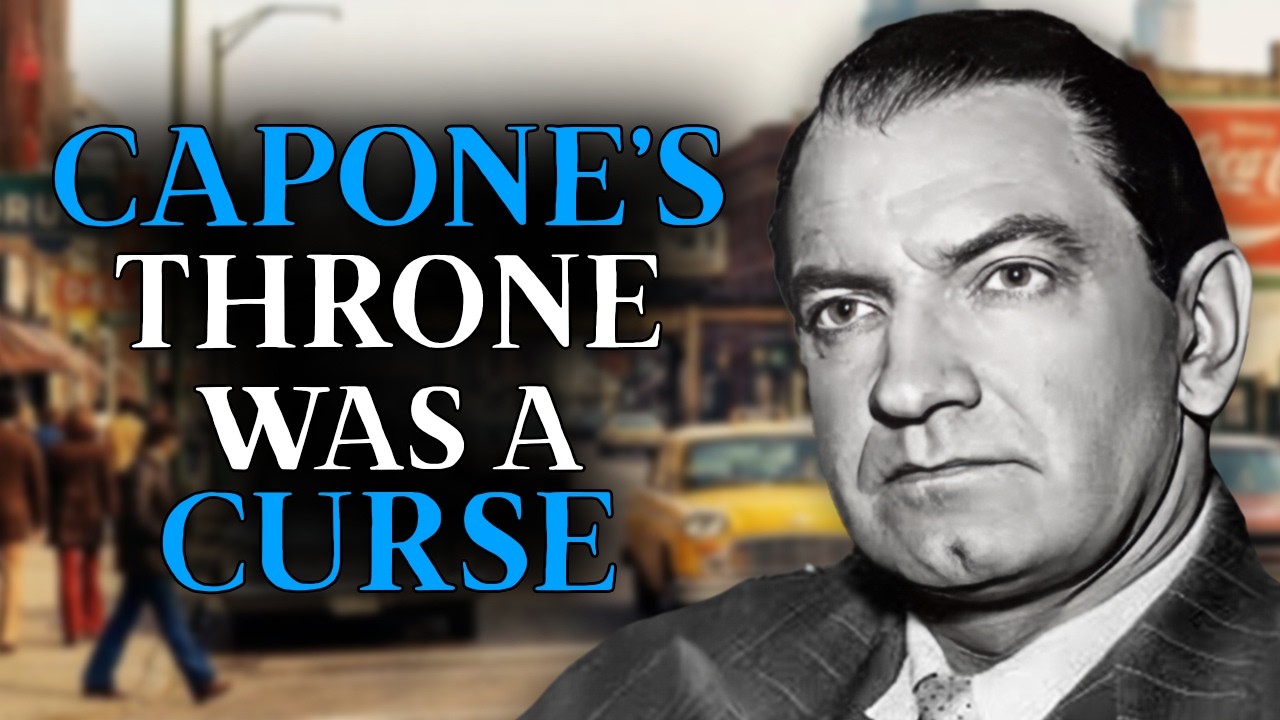
The dead man was Frank Nitti, the most powerful mob boss in America, the man who had inherited Al Capone’s empire. A man at the peak of criminal power had chosen death over everything he had built. Nitti had eaten lunch at home with his wife Anna that Friday. He told her he needed to take a walk, needed to think.
She watched him leave their house on Selborne Avenue wearing his best suit under his overcoat. He walked nearly a mile to the tracks, stood for a moment looking down the rails, and then drew the revolver. The first shot grazed his head. The second entered his skull but did not kill him.
The third, fired as he fell, struck him in the neck. He bled to death on the cold gravel before a railroad worker found him around three in the afternoon. In his pocket was a brief, matter-of-fact note that essentially said he could not face prison, that he was sick, and that this was his choice. By five o’clock, radio stations were interrupting programming and newspaper extras were on the streets.
Chicago, a city hardened to mob murder, could not quite believe it. Mobsters did not kill themselves. They killed each other or they went to prison. But Frank Nitti was not like other mobsters.
He was born Francesc Raffaele Nitto on January 27, 1886, in Angri, a small town in southern Italy near Salerno. His family was desperately poor, and when he was still a child his father brought them to America. They settled in the Navy Yard section of Brooklyn, crowded into tenements where Italian immigrants worked brutal hours for pennies. His mother died young, his father remarried, and the family never escaped poverty.
Frank grew up on streets where you learned to fight, to steal, and to trust that the law protected the rich and hunted the poor. By his early twenties he had moved to Chicago, and by 1913 he was opening a barber shop on South Halsted Street. It was legitimate, but the barber shop was a front. In the back room, Nitti fenced stolen goods—jewelry, watches, anything that could be moved quickly for cash.
He had a talent for it, a head for numbers, an understanding of value. In 1917 he was arrested for receiving stolen property and paid a fine. Two years later, another arrest, another fine. The police knew who Frank Nitti was.
They just did not know who he would become. In 1919, Prohibition became the law of the land. For men like Frank Nitti, it was the greatest opportunity in American history. Millions of people wanted something the government said they could not have, and whoever supplied that demand would make a fortune.
By the early 1920s, Chicago was carved up among criminal gangs fighting for control of bootlegging. The largest gang was run by Johnny Torrio and his rising star, Al Capone. They controlled the South Side, running breweries, speakeasies, brothels, and gambling dens. They were making millions, and making millions meant managing millions.
That required people who understood both violence and business. Capone recognized those skills in Frank Nitti almost immediately. Most enforcers were muscle who could break legs and intimidate rivals. Nitti could do that, but he could also keep books, understand profit margins, hide money, and make it look legitimate.
Capone put him in charge of enforcement and finances, a combination almost no one else in the outfit could handle. Nitti reported directly to Capone. When someone needed to be dealt with, Nitti handled it. When money needed to be counted or hidden, Nitti handled that too.
Capone trusted very few people: his brother Ralph, his cousin Charlie Fischetti, his bodyguard Phil D’Andrea, and Frank Nitti. By the late 1920s, Nitti was one of the most feared men in Chicago—not because he was the strongest or the craziest, but because he was smart, efficient, and utterly loyal. He did not enjoy violence the way some mobsters did. To Nitti, violence was a tool, a business expense, used exactly as much as the situation required.
That made him more dangerous than the psychopaths, who were unpredictable. Nitti was certain. By 1930, he was Capone’s right hand. When Capone traveled, Nitti ran Chicago.
When Capone was in court, Nitti handled the outfit’s business. He was not the underboss in title, but he was in function. Then everything changed. On October 17, 1931, Al Capone was convicted of tax evasion in federal court.
The government could not get him for bootlegging, murder, or extortion, but they got him for not paying taxes on illegal income. Capone was sentenced to eleven years in federal prison, first in Atlanta and later at Alcatraz. The Chicago outfit suddenly had no boss. In the mob, power vacuums are dangerous, and the outfit could have fractured into warring factions.
It did not, because Frank Nitti stepped up. The underboss, Paul Ricca, was smart enough to know the outfit needed a leader who commanded immediate respect, someone Capone had trusted completely. Ricca deferred to Nitti. Not everyone was happy.
Some older capos thought Nitti was too cautious, too focused on business. But Nitti understood something they did not: the days of flashy mobsters making headlines were over. The government had taken down Capone with accountants and tax law, and the outfit had to adapt. Nitti consolidated power quietly.
He ran the outfit like a corporation, settling disputes through mediation rather than murder when possible. Under Nitti, the outfit stayed stable and profitable, transitioning from Prohibition-era bootlegging into labor unions, gambling, prostitution, and extortion. His rise came with a target on his back. On December 19, 1932, two Chicago police detectives and two Treasury agents raided his office in the LaSalle-Walker building and arrested him on tax evasion charges, the same charge that had taken down Capone.
What happened next depends on who is believed. According to Detective Harry Lang, Nitti reached for a gun and Lang fired in self-defense, hitting Nitti in the neck and back. According to Nitti and later witness testimony, there was no gun. Lang walked in and shot Nitti in cold blood in an assassination attempt ordered by Chicago Mayor Anton Cermak, who wanted to eliminate Nitti and install his own mob allies in power.
Nitti survived; the bullets missed major arteries. Then the story grew stranger. Six weeks later, on February 15, 1933, Cermak was in Miami for a political event when an Italian immigrant named Giuseppe Zangara fired shots into a crowd. Cermak was hit and died nineteen days later.
The official story was that Zangara had been trying to assassinate President-elect Franklin Roosevelt, who was also in the crowd, and hit Cermak by accident. But in Chicago, many believed Nitti had ordered the hit in revenge. Zangara was executed before he ever talked, and the truth was never established. As for Detective Lang, he was eventually convicted of assault with intent to kill, served a short sentence, and was kicked off the police force.
Nitti walked out of the hospital more powerful than ever. From 1932 to 1943, he ran the Chicago outfit with an iron grip disguised in a velvet glove. Where Capone was loud and flashy, Nitti was quiet and efficient. He divided the city into territories controlled by trusted capos, settled disputes in meetings rather than shootouts, and treated violence as a last resort.
The outfit controlled labor unions, especially in the service and entertainment industries, and ran extensive illegal gambling operations. Nitti also expanded beyond Chicago, forming alliances with New York’s five families, Kansas City, and Detroit, and invested in legitimate businesses that laundered money and provided cover. He learned from Capone’s mistakes. The government had taken Capone down because he was too visible, too arrogant.
Nitti would not make the same mistake, or so he thought. In the late 1930s, the outfit found a gold mine in Hollywood, and Nitti approved the operation that would eventually destroy him. The scheme was simple and brilliant. The outfit controlled the International Alliance of Theatrical Stage Employees, the union representing movie projectionists.
If projectionists went on strike, theaters could not show films and studios would lose millions. Two Chicago mobsters, Willie Bioff and George Browne, ran the operation. They would approach a studio and threaten a strike. The studio would panic, and then they would offer a solution: pay us and there will be no strike.
The studios paid. MGM paid one million. Paramount paid one million. Warner Brothers, RKO, and 20th Century Fox all paid.
Over several years, the outfit extorted more than two and a half million dollars from Hollywood, an enormous sum for the era. The scheme was untraceable because the studios were complicit and the union members did not know the books were being controlled. Nitti, sitting in Chicago, collected his cut without ever setting foot in California. Then Willie Bioff made a mistake.
Bioff was flashy, buying expensive cars and throwing lavish parties, and in 1941 a Hollywood labor organizer started asking questions about how a union representative could live like a millionaire. The questions reached the FBI, and the pressure was applied to Bioff. In 1941, he flipped. He agreed to testify against the outfit and laid out the entire extortion scheme in detail, naming George Browne, Paul Ricca, Louis Campagna, Phil D’Andrea, and Frank Nitti.
By early 1943, federal prosecutors were building their case, and Nitti knew that indictments were coming. He also knew what that meant: federal prison, likely Alcatraz, probably years behind bars, maybe the rest of his life. At fifty-seven years old, having spent more than twenty years in the mob, he had survived assassination attempts, gang wars, and police raids. His health was failing.
The bullets from the 1932 shooting had left him with chronic pain, severe headaches, and trouble sleeping, and some accounts say he was claustrophobic, terrified of enclosed spaces. The thought of prison was unbearable. He had seen what prison had done to Capone, who went in as the most powerful gangster in America and came out a broken man. Nitti was old school.
In his world, you took responsibility. You did not rat, ever. So he made his decision. He would go out on his terms.
On the morning of March 19, 1943, he had breakfast with his wife and seemed calm, resigned. After lunch, he told her he needed a walk. He walked to the railroad tracks, stopped near a crossing, and pulled out the revolver he had carried for years. He died alone on the tracks.
The autopsy confirmed three self-inflicted gunshot wounds. The funeral was held at Mount Carmel Cemetery, a quiet affair with no procession or crowds. Within weeks, the federal indictments came down. Paul Ricca, Louis Campagna, Phil D’Andrea, and others were charged in the Hollywood extortion scheme, tried in December 1943, and convicted.
Ricca was sentenced to ten years. The outfit’s leadership was gutted, but the outfit survived. It always did. Ricca, even from prison, continued to wield power, and on his release in 1947 he resumed control alongside Tony Accardo, another Capone veteran who would become the longest-serving boss in outfit history.
The organization continued operating for decades, moving into Las Vegas and skimming millions from casinos, adapting from street crime to corporate crime. But they never forgot Frank Nitti. His name is most widely known today from the 1987 movie The Untouchables, where he is thrown from a courthouse roof by Eliot Ness. That version is fiction.
Ness and Nitti barely crossed paths. The real Nitti was never a screaming, sneering thug. He was intelligent, calculating, and low-key. He ran the Chicago outfit for over a decade, managed millions of dollars, negotiated with other crime families, survived assassination attempts and political conspiracies, and when the end came, he did not go out in a hail of bullets or a dramatic confrontation.
He walked to some railroad tracks and shot himself. Alone, quiet, final. In the mob, the source of his rise was also the trap that confined him. The life does not offer retirement or escape.
It offers two exits: prison or death. Frank Nitti chose death, refusing to give the government the satisfaction of taking him alive, in control until the very last second.