Patient, ordinary, accurate: he had been given 10 grains of calomel, a mercury chloride compound, because the tumor was blocking his intestines. The first dose produced what Bertrand described as the largest stool in a month, black as tar, stinking of blood and decay. The internal bleeding had turned his waste into something like roofing tar. The doctor saw this as progress and prescribed another 10 grains.
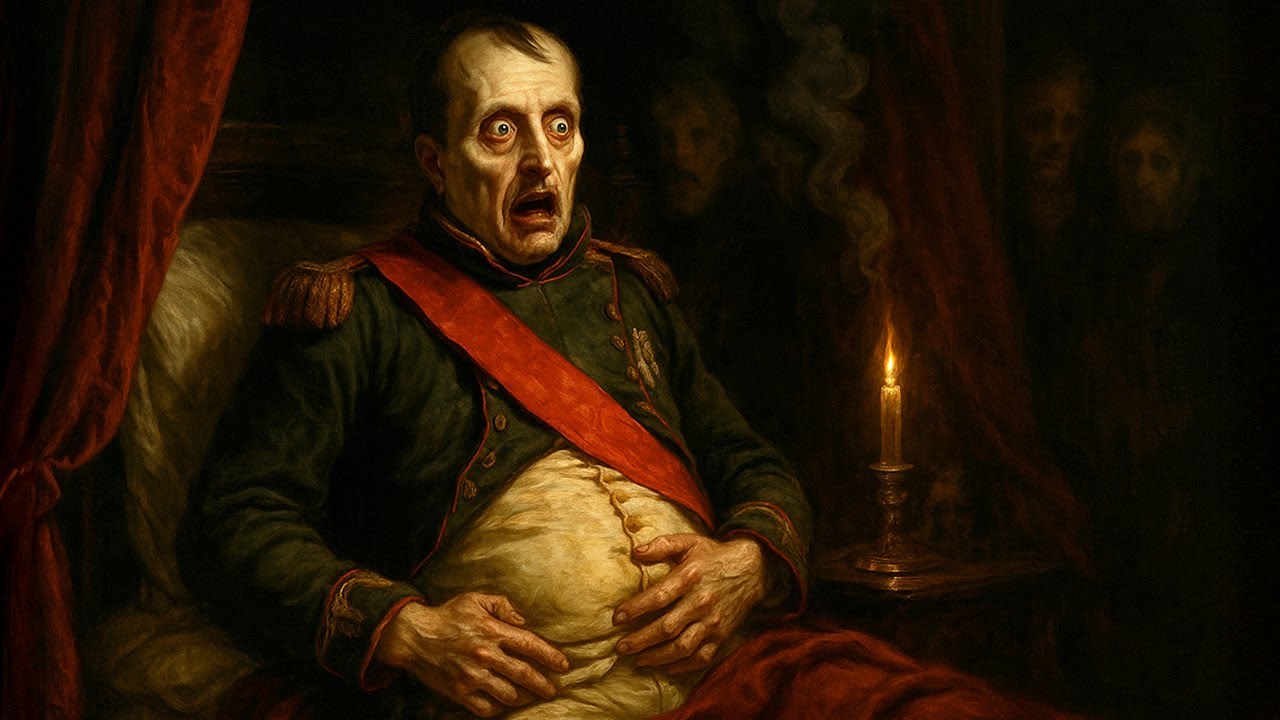
By April 28th, Napoleon’s mind, the same tactical machinery that had beaten every army in Europe, began to fracture. It did not break quietly. He fell into hallucinations so vivid that everyone in the room could follow along. He would bolt upright, his skeletal arms waving invisible troops forward, screaming for the cavalry, ordering the guard to advance.
He was back at Austerlitz, redeploying formations against formations of Austrians who had died fifteen years earlier. Marchand wept openly as the emperor clawed through ghost battles in a body that could no longer control its own bowels. Sometimes he called for Josephine, who had died seven years before. Sometimes he thought he was in Egypt, demanding water, while his actual body heaved in its own fluids.
On May 1st, he demanded to walk. Emperors did not lie in bed. Two servants lifted him up. He made three steps; on the fourth his legs buckled.
As he fell, his stomach convulsed so violently that everyone in the room believed he was dying on the spot. Ali, his Mameluke servant who had been with him since Egypt, caught him. When they carried him back to bed, Napoleon fought to rise again. My army, he gasped.
Where is my army? Four grown men had to hold the emperor of France down while he ordered troops that existed only in his dying brain. The doctors decided on more aggressive treatment. They applied blistering plasters soaked in crushed beetles, chemical burns designed to draw disease from within.
They covered his chest, feet, and calves with them. His skin, already yellow from liver failure, now darkened with weeping red welts. They were burning the surface of his body while the cancer ate him from inside. On May 3rd, they gave him 20 grains of calomel, enough to poison a healthy man, and followed it with an enema so violent that Napoleon, who had walked through grapeshot without flinching, screamed.
Not a cry of pain, but of humiliation. The man who had redrawn the borders of Europe was held down while strangers pumped mercury-laced water into his rectum. When it ended, he turned his face to the wall and would not look at anyone for hours. What followed was worse.
His body expelled stool after stool, each blacker and more putrid than the last, and mixed with the waste were chunks of tissue, pieces of his stomach lining. His digestive system was coming apart in pieces while he was still alive. At dawn on May 4th, the mercury reached a catastrophic point. Napoleon began vomiting with such force that blood vessels burst in his eyes.
The whites turned red. The vomit contained not just blood but pieces of his stomach. Between convulsions, he tried to speak, and blood frothed from his mouth with his words. France, my son, the army.
Even as his organs liquefied, his mind was still fixed on country, son, and soldiers. The smell in the room had become apocalyptic, the odor not of death but of active decomposition. The tumor had perforated the stomach wall completely. Only a mass of scar tissue adhering to his liver kept the contents of his stomach from pouring into his abdominal cavity.
He was technically alive, with a hole in his stomach large enough to push a finger through. On May 5th, at 3:00 a. m. , Napoleon entered the period the doctors called the death spiral.
His breathing became Cheyne-Stokes, rapid gasps followed by long, terrifying silences, his brain forgetting how to regulate oxygen. Between the hiccups and the groans of his destroyed digestive system, witnesses heard his last recognizable words, though no two accounts agree. Montholon heard France, army, Josephine. Marchand heard France, son, army.
Bertrand recorded head of the army. Each servant heard what they expected from their emperor, or Napoleon, even while dying, spoke to all of them at once. By 5:30 a. m.
, his throat had swollen shut. He could no longer speak. The sounds that came out of him were animal-like, guttural noises from deep in his chest. His gray eyes, the eyes that had made whole armies hesitate, were fixed on something beyond the room.
When morning came, sixteen people crowded into his bedroom and stood around the bed like courtiers, watching him die by degrees. Antommarchi, desperate, pressed hot water bottles against the swollen stomach. The heat against the tumor drove his back arching off the bed in a silent scream, his throat too swollen to make a sound. One last procedure followed: mustard plasters on his feet, designed to stimulate him back to life.
The smell of mustard mixed with decay made even the doctors gag. His skin, where it wasn’t yellow with jaundice or red with burns, had turned mottled purple from lack of oxygen. At 5:49 p. m.
, after seventeen hours of final agony, Napoleon Bonaparte stopped breathing. There were no last words, no final gesture. His body, pushed past every limit, simply quit. The autopsy the next morning revealed the full scope of the horror.
When the doctors opened the abdomen, several had to leave the room. The sweet, rotten smell of cancer filled the house. The tumor had not simply grown; parts of it had been dying and rotting while Napoleon still lived. His stomach was nearly entirely cancerous, hard as leather.
The perforation was exactly where the doctors had predicted, near the pylorus, and Antommarchi demonstrated it by pushing his finger straight through the hole. Worse still, white nodules dotted his intestines, metastatic pearls of cancer strung through his gut. Napoleon had been dying for years. Every moment of his exile, every escape plan, every dictated memoir had happened while this growth consumed him cell by cell.
Remains were taken as souvenirs. The heart and stomach were sealed in silver vessels to be buried with him; Antommarchi quietly snipped rib fragments when the British weren’t looking. Locks of hair were clipped, and it was rumored that his penis was removed and smuggled away, eventually ending up in the collection of an American urologist, where it allegedly remains, resembling, in one observer’s phrase, a piece of leather shoelace. The body was dressed in his green uniform, his bicorn hat placed at his feet.
Nineteen years later, in 1840, when his remains were exhumed for return to France, the tomb revealed something inexplicable. Napoleon was perfectly preserved, not skeletal, not decomposed. His features were recognizable, his skin white as marble, his uniform intact. Nineteen years in the ground and he looked as though he had been buried the day before.
The preservation was too perfect, sparking theories of arsenic acting as a preservative or secret embalming. Like so much of his life, his death left one last unexplained mystery. In the end, the horror of Napoleon’s death was not only the cancer, the mercury, or the brutal medicine of his time. It was the destruction of everything he had once been.
The tactical genius became delirious, the iron will dissolved into childish begging, the body that had conquered Europe rotted from within while still breathing. His last coherent thought was of France and his army. Not glory, not power, just a dying soldier calling for his troops one last time. The emperor who had made Europe tremble died trembling himself, not from fear but from the uncontrollable spasms of a body destroying itself.
The massive red tomb in Paris’s Les Invalides may appear to visitors as glory carved in stone, but beneath it lies a man who died vomiting pieces of his own stomach. The emperor who conquered nations could not conquer the cancer in his gut. In the end, death came for him the same way it comes for all, indifferent to what he had built, what he had ruled, and everything he had been.