The man most responsible for defining the sound of rock and roll was not the man on the microphone. When Elvis Presley walked into Sun Studio in July 1954, he was a shy 19-year-old truck driver. The revolutionary sound that emerged from that session belonged to the world, but the architecture behind it belonged to a quiet guitarist from Tennessee named Scotty Moore. Moore was born in 1931 in Gaden, Tennessee, during the depths of the Great Depression.
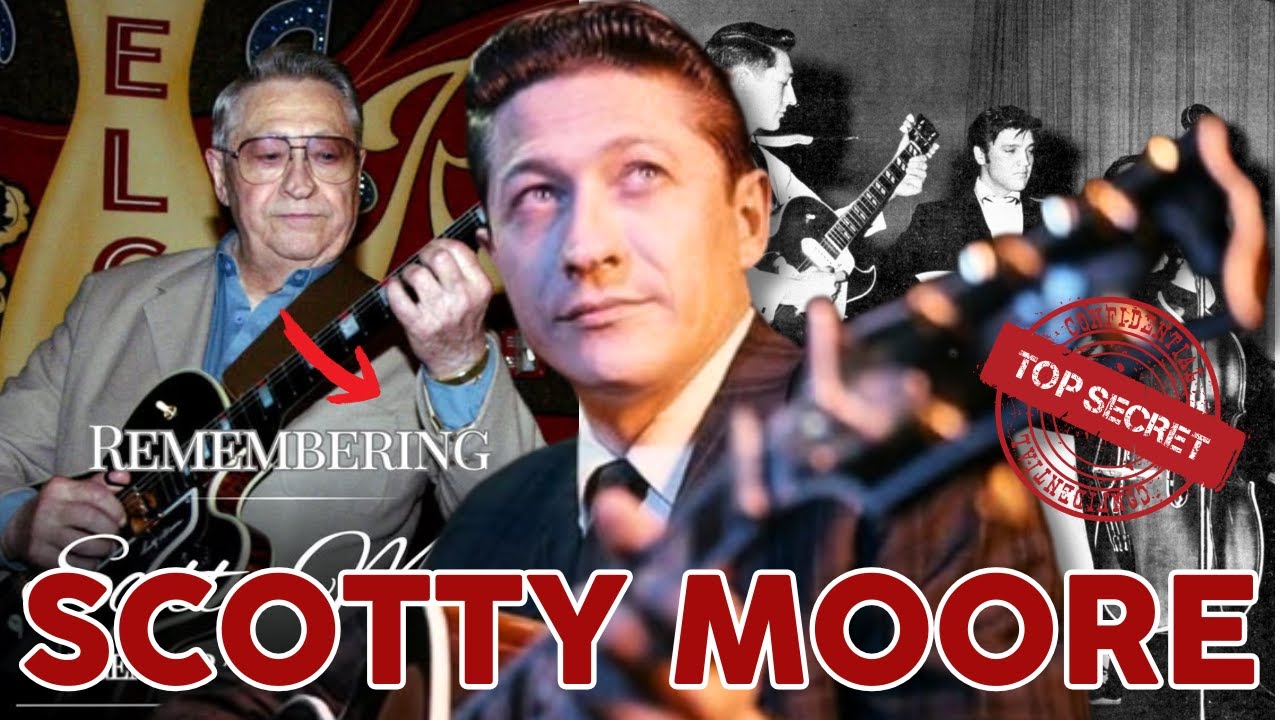
Raised in rural isolation, he learned the guitar not as a path to fame but as a way to participate in family gatherings. His father played banjo, his brothers played fiddle, and young Scotty absorbed the radio signals drifting in from Nashville and Chicago. He studied the jazz guitar of Tal Farlow and the melodic style of Chet Atkins, developing a precision that would define his career. Before he ever backed Elvis Presley, Moore served in the U.
S. Navy during the Korean War era. The discipline of military life shaped his character. He was stoic, reliable, and allergic to drama, traits that would later prove both his strength and his undoing.
After his discharge in 1952, Moore moved to Memphis and took a job at his brother’s dry cleaning business. He formed a hillbilly band called the Starlight Wranglers with bassist Bill Black. The group was competent but unexceptional, playing safe country hits for factory workers in local honky-tonks. They were a rhythm section looking for a reason to exist.
That reason arrived in the form of a phone call from Sun Records owner Sam Phillips. The producer mentioned a young man with a ballad voice who had recorded a demo a year earlier. The kid worked at Crown Electric and wore his hair in a defiant ducktail. His name was Elvis Presley.
The first meeting took place in Moore’s living room in early July 1954. The contrast between the two men was stark. Moore was a 22-year-old married veteran with a business. Presley was a painfully shy teenager in pink slacks who mumbled yes sir and no sir while twisting his hat in his hands.
Presley sang ballads by Bing Crosby and Hank Snow. Moore listened and reported to Phillips that the boy had a good voice, but he was not sure it was what the producer was looking for. Phillips said to bring him in anyway. On the night of July 5, 1954, the session was a disaster for three hours.
Phillips was trying to record a ballad, and Presley was stiff and terrified. Then, during a break, the restless young singer picked up his guitar and began frantically playing an old blues song by Arthur Big Boy Crudup called “That’s All Right. ” Bill Black grabbed his bass, and Moore made a critical decision. Rather than stopping the chaos, he listened and played a lead line that wove around Presley’s voice.
Phillips stuck his head out of the booth and told them to do it again. Without drums, Moore carried the rhythm, melody, and harmony simultaneously. The microphone captured a sound that did not have a name yet. It was not country.
It was not blues. It was the moment rock and roll was invented. When Phillips played the recording on Memphis radio the next night, the switchboard lit up with confused callers. The commercial success was immediate.
The trio called themselves the Blue Moon Boys and hit the road, traveling in Moore’s 1951 Chevy. For the next 18 months, the three men lived in that car, playing high school gymnasiums and honky-tonks across the South. Moore served as the designated adult, booking gigs, tuning guitars, and keeping Elvis grounded. The reception was not universally warm.
When the band played the Grand Ole Opry in October 1954, the audience sat on their hands, and an Opry talent manager told Presley he ought to go back to driving a truck. Elvis cried on the way home. It was Moore who stiffened his spine, telling him they had something the establishment did not understand. By 1955, the success attracted predators.
Colonel Tom Parker, a former carnival barker whose real identity was Andreas Cornelius van Kuijk, a Dutch illegal immigrant, began circling the camp. Parker saw Presley not as a musician but as a phenomenon, and he saw Moore and Bill Black as overhead. In November 1955, Phillips sold the Sun contract to RCA Victor for $35,000. The family laboratory became a corporate factory.
With Parker’s control, the original partnership dissolved. In the early days, Elvis received 50 percent and Moore and Bill Black split the other half. Under the Colonel, the contracts were rewritten. Elvis was the star.
Moore and Black became employees. While the hits poured in and Presley was buying Cadillacs and Graceland, Moore was making a reported $200 a week. In late August 1957, facing a grueling West Coast tour with no pay raise, Moore and Black drafted a letter of resignation. They delivered it personally to Elvis, hoping the boy who once shared hamburgers with them would intervene.
He did not. He told them he would not stop them. The Colonel later offered to hire them back on a per-diem basis with no guarantees. Moore swallowed his pride and accepted, but the music had changed.
The joy of the Sun sessions was replaced by grim professionalism. When Presley was drafted into the Army in 1958, Moore was suddenly without work. He moved deeper into the Nashville studio scene, started a record label, and produced a hit record by Thomas Wayne. When Elvis returned from Germany in 1960, the magic was largely gone.
Elvis was surrounded by a wall of yes-men, and Moore was no longer the primary guitarist on many tracks. A rare moment of old chemistry flared during a blues recording, but the spell broke as soon as the red light went off. The live band ended in March 1961 after a benefit concert in Hawaii. Moore would not play live with Elvis Presley again for seven years.
Bill Black died in 1965 of a brain tumor at age 39. Elvis did not attend the funeral, sending a card instead. For Moore, the loss of his rhythm partner marked the end of the Blue Moon Boys. In 1968, the phone finally rang.
Elvis was doing a television special and wanted Moore there. Producer Steve Binder had decided to film the singer simply jamming with the old boys rather than performing a Christmas show. The result was the famous 1968 comeback special, filmed on a boxing-ring-style stage with the audience sitting inches away. The chemistry was undeniable.
Elvis was electric, sweating, laughing, and telling the crowd that Moore had taught him everything. Afterward, Elvis promised they would tour together again, just the rhythm section in small places like the old days. Moore said he was ready and waited for the call. It never came.
The Colonel had other plans. He wanted Las Vegas, a 30-piece orchestra, and spectacle. He did not want the old band, reminders of a time when Elvis had equals. When Presley began his Vegas residency in 1969, he hired James Burton instead.
The 1970s were painful for Moore to watch. He stayed in Nashville, building a quiet life as a studio engineer. He rarely spoke about Presley. When friends passed messages, Moore would simply say he was there, but Elvis never called.
The end came on August 16, 1977. Moore was in his Nashville studio when a friend called to say Presley was dead at 42 of heart failure. Moore did not go to the funeral. He later said he had said his goodbye a long time ago and did not want to be part of the spectacle.
In the decades that followed, recognition finally arrived. Guitarists like Keith Richards pointed to Moore as one of the true architects of the rock guitar language. In 2000, Moore was inducted into the Rock and Roll Hall of Fame with a musical excellence honor. The triumph was tainted by the old injustice.
The contracts signed under the Colonel’s influence never rewarded Moore financially. While the Presley estate generated hundreds of millions of dollars annually in licensing and sales, Moore received no royalties. In his later years, struggling with medical bills and arthritis, Moore sold several prized guitars, including a Gibson Super 400 associated with his era. Scotty Moore died on June 28, 2016, at age 84.
Guitarists across the world paid tribute, including Paul McCartney and Jimmy Page. The king was gone, and so was the architect. What remains is the sound of the modern world, heard every time a guitarist plugs in and strikes a chord.