In the spring of 1862, George Brinton McClellan commanded the largest, best-equipped army the Western Hemisphere had ever seen. One hundred thousand men, drilled to a shine and backed by the full industrial weight of the Union, called him the Young Napoleon and meant it with complete sincerity. The Army of the Potomac was his creation, and he was rightfully proud of it. He was also, by that spring, terrified of using it.
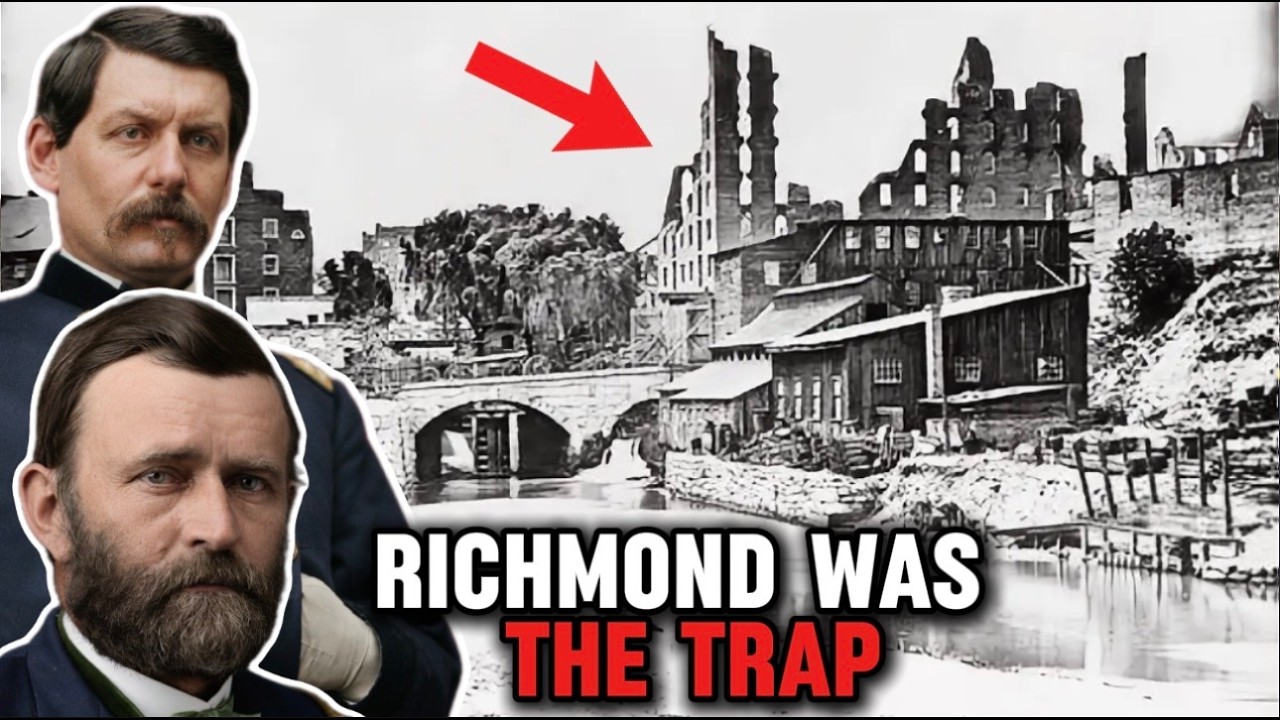
The Peninsula Campaign opened with genuine promise. McClellan moved his army down the Chesapeake Bay to Fort Monroe, bypassing the Confederate lines across northern Virginia, and marched up the peninsula between the York and James Rivers toward Richmond. His conviction was absolute: capture Richmond, and the rebellion would collapse. That conviction, immovable in his mind, would cost the Union two more years of war.
The first sign of trouble appeared at Yorktown. Confederate General John Bankhead Magruder commanded barely 13,000 men, but he was a theatrical genius. He marched his battalions in loops through clearings visible to Union observers, cycling the same troops past the same openings to create the impression of an enormous army. He ordered his artillery to fire at deliberate intervals and moved wagon columns just close enough to show wheels and dust.
McClellan, relying on Allan Pinkerton’s inflated intelligence reports, became convinced he faced over 100,000 Confederates. Even after Joseph Johnston’s army arrived, the Confederates numbered only about 50,000, still vastly fewer than McClellan held in hand. He possessed an overwhelming advantage and didn’t know it—or didn’t want to know it, because knowing it would have removed the last justification for inaction. He settled in for a formal siege.
He requested more troops, more artillery, more time. When Union forces finally advanced in early May, the Confederates had slipped away in the night, leaving heated campfires and wooden artillery pieces painted black. McClellan reported the evacuation as a victory. He chased Johnston up the peninsula, fought a costly, inconclusive engagement at Williamsburg, and by late May his army was close enough to Richmond that soldiers claimed they could hear the city’s church bells.
Johnston attacked McClellan’s exposed flank at Seven Pines in a poorly coordinated assault so badly executed that Confederate units fired on each other in the Chickahominy bottomland. Johnston himself was severely wounded. Robert E. Lee, unimpressive in the war’s opening months, assumed command of what he would soon name the Army of Northern Virginia.
McClellan, five miles from Richmond, held his ground and asked for reinforcements. Then Lee came to him. The Seven Days Battles, fought from June 25 to July 1, were tactically ragged. Lee’s staff work was uneven, and Stonewall Jackson performed so far below his reputation that historians still debate what rendered him essentially absent.
Confederate assaults repeatedly went in late, into the wrong positions, against prepared defenses. McClellan’s men fought effectively, especially at Gaines’s Mill. On a tactical scorecard, the Army of the Potomac was not beaten. But McClellan ordered a retreat anyway, calling it a change of base.
His dispatches to Washington read less like military correspondence than the communications of a man unraveling. He blamed the administration and Secretary of War Edwin Stanton, whom he despised. In one remarkable message, he told Lincoln directly that Washington’s political decisions bore responsibility for his army’s failures—a communication so close to insubordination that the telegraph operator reportedly omitted the most inflammatory passages. McClellan pulled his entire army back to Harrison’s Landing and entrenched with his back against the river.
Lincoln came down the James on a steamship to confer with him, and the meeting accomplished nothing. McClellan handed the president a letter outlining his political views on the war’s aims. What McClellan would not permit himself to see was that his entire strategic premise was flawed. Richmond was not the war.
The Confederacy was not a monarchy that would capitulate once its capital fell. It was a rebellion sustained entirely by armies in the field. Take Richmond, and Lee’s army remained intact. The army was the throat of the rebellion, not the city.
Ulysses Grant had understood this for years before he crossed the Potomac. His education came not from theory but from watching what actually worked. At Fort Donelson in February 1862, when Confederate General Simon Bolivar Buckner asked for terms, Grant replied with a sentence never before said in this war: no terms except immediate and unconditional surrender. Fifteen thousand men removed from the board.
At Shiloh that April, after a surprise Confederate assault drove parts of his line back to the Tennessee River, Grant told William Sherman there would be no retreat. They would attack in the morning. They did, and drove Albert Sidney Johnston’s army from the field. At Vicksburg, Grant moved down the Mississippi’s western bank, crossed the river south of the fortress, severed his own supply line, and drove into the interior.
In seventeen days he fought five engagements and appeared before Vicksburg from the east, the one direction Pemberton had never prepared to defend. When the garrison of 30,000 surrendered on July 4, 1863, the entire Mississippi came under Union control. Grant thought about war as a problem of structure. The Confederacy had a finite capacity to replace losses, a shrinking industrial base, and an increasingly occupied territory.
The Union, with nearly twice the population and expanding industry, could absorb casualties at a rate the South could not match. Every sustained engagement that destroyed a Confederate brigade, every siege that compelled surrender, moved the war toward its only available conclusion. The variable was Northern will. The Confederacy’s best hope was exhaustion—that the Northern public would tire of the dying before the Southern army ran out of the capacity to cause it.
Grant understood this with a clarity that shaped every decision after March 1864, when Lincoln gave him command of all Union armies. He planned simultaneous offensives on every major front. Sherman would drive into Georgia. Butler would threaten Richmond from the south.
Sigel would push up the Shenandoah. And Grant himself, traveling with Meade’s Army of the Potomac, would move not toward Richmond but directly against Lee’s army. The distinction sounds minor. It was everything.
Every previous Virginia campaign had measured progress in geography. Grant measured progress by how much of Lee’s army he had destroyed. The Overland Campaign opened in the Wilderness on May 5. Two days of fighting in scrub oak and tangled undergrowth where artillery was useless and men fought at close range in thickets that caught fire from muzzle flashes.
Grant lost nearly 18,000 casualties. The veterans who had fought every previous Virginia campaign knew what came next: retreat north of the Rappahannock, regroup, draw. Instead, the night after the Wilderness, the army turned south. Officers passed the order down through the columns: not north toward the river crossings, south toward Lee.
The men understood before anyone articulated it. In the darkness, tired and bloodied, they began to cheer—not loudly, but steadily down the line, recognition that their sacrifice would not be wasted. Spotsylvania followed immediately, producing on May 12 the Bloody Angle, one of the most horrifying close-combat actions in American history. Men fought across a narrow earthwork for nearly twenty hours in driving rain so compressed that the dead could not fall.
Grant reported his losses honestly, asked for replacements, and kept moving. He sent a message to Washington that has become the most revealing document of his command: he proposed to fight it out on this line if it took all summer. Cold Harbor arrived in early June, and there Grant made a decision that would trouble him for the rest of his life. The frontal assault on Lee’s entrenched positions on June 3 produced somewhere between five and seven thousand Union casualties in under an hour.
Grant acknowledged the mistake plainly in his memoirs. But he did not stop. Two weeks later he moved the entire army across the James River in one of the most complex operations of the war—over 100,000 men, artillery, wagon trains, and cattle crossing a 2,000-foot pontoon bridge built in eight hours. Lee failed to understand where the army had gone for nearly three days.
By then Grant was closing on Petersburg, the rail junction through which almost everything sustaining Lee’s army moved. McClellan had stood at the James with 100,000 men two years earlier and concluded there was nothing to be done. Grant built a city around Petersburg over the following nine months—37 miles of siege lines, forts, telegraph networks, and field railroads—while Sheridan destroyed the Shenandoah Valley’s agricultural capacity so thoroughly that a crow flying over it would need to bring its own provisions. Sherman’s march through Georgia and the Carolinas collapsed Confederate supply lines entirely.
Lee could not respond. He could not shift troops to stop Sherman because Grant’s lines required every man he had. The moment he weakened the Petersburg front, Grant would break through. By the winter of 1864, Confederate soldiers were deserting in numbers that alarmed Lee personally—desertion born of starvation.
The daily ration had fallen below the level of sustaining combat. Lee wrote to Jefferson Davis warning that the army could not hold unless the supply situation was remedied. It could not be remedied because Grant had cut off the remedies. The end came in April 1865 with speed that surprised even Grant’s staff.
The assault at Five Forks broke the Confederate right flank. The entire Petersburg line unraveled the following day. Richmond was evacuated on the night of April 2, set alight by the retreating Confederate government that had sworn it would never fall. Lee’s army fled west, with Grant moving to cut off every escape route—not pursuing from behind, but getting ahead.
At Appomattox Courthouse on April 9, surrounded on three sides and out of rations, Lee sent out a flag of truce. Richmond fell not because Grant had taken it by assault but because the army defending it was destroyed. And that army was destroyed because a man with mud on his boots had spent eleven months executing a campaign built on a premise as simple and ruthless as arithmetic: find the army, fix the army, and finish the army every day without pause until it had nothing left to give.