On a winter night in 1900, nine people prepared to sleep in a single room of a wooden cabin at the edge of a cotton field in southwest Georgia. A father, a mother, a grandmother born into slavery, and six children shared two beds and one fireplace. Wind slipped through the cracks between the boards strongly enough to make the flame of a kerosene lamp tremble. The mattresses were sacks stuffed with dried corn husks that rustled with every movement.
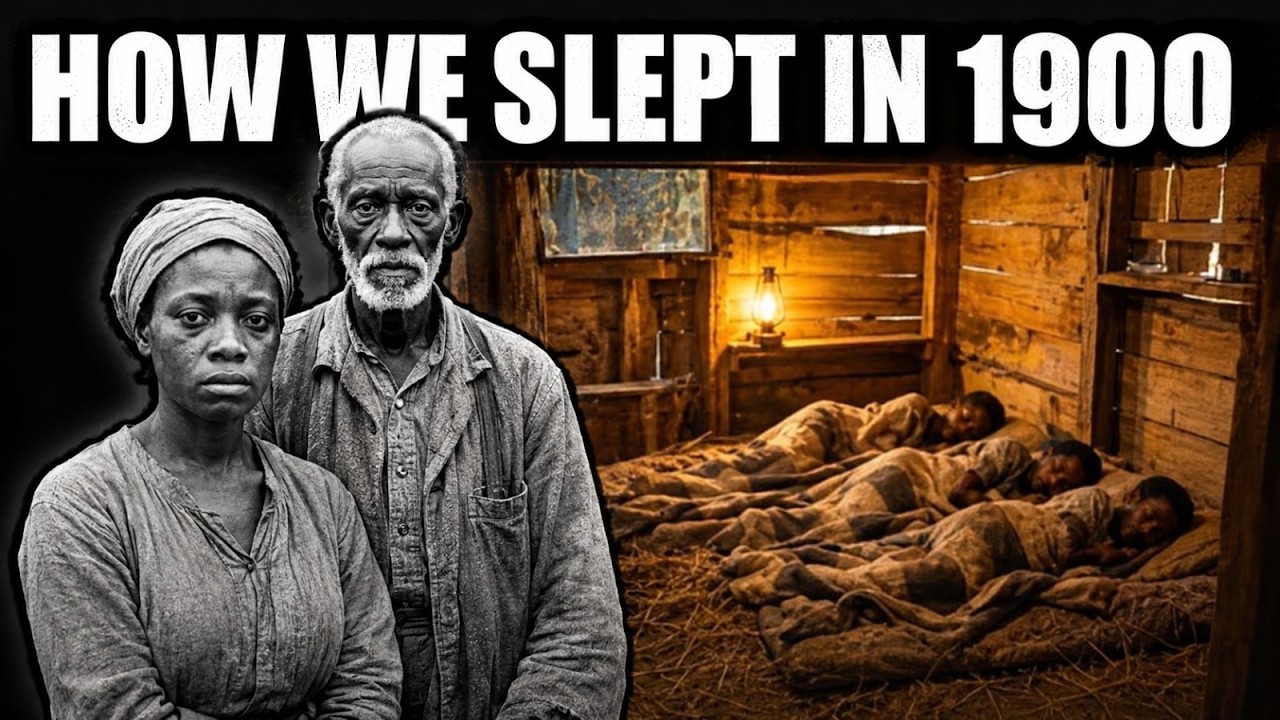
This was not unusual for the time. Nine out of ten Black Americans lived in the South in 1900, most of them in rural areas, many in one- or two-room cabins. This is the story of how Black families in the rural South actually slept at the turn of the century, 35 years after slavery ended, often in the same cabins and on the same land where their parents and grandparents had been enslaved. To understand those nights, consider one family.
Their names are not important because their lives were lived by millions of Black families across the South. Call them the Freeman family. Jesse Freeman was 38. His wife Hannah was 34.
Jesse’s mother, called Aunt Phoebe by everyone, was 68 and had been born into slavery on a plantation just a few miles away. Jesse and Hannah had six children, from a baby to a boy of 14. They worked cotton as sharecroppers on land owned by a white farmer in Dougherty County, Georgia. Their story is based on the real homes, real families, and real nights of Black families in the rural South in 1900.
The Freeman family lived in what people called a cabin. It was built of rough pine boards on a wooden frame set on short brick or stone pillars, raised a foot or two off the ground. The roof was made of wooden shingles, or in some cabins, rusty tin sheets. There was one room, roughly sixteen by eighteen feet.
At one end stood a fireplace with a chimney made of sticks and clay that had to be repaired after every heavy rain. There was one door and one window. The window had no glass, only a wooden shutter that could be closed at night. Many Black families in the rural South lived in cabins much like this one.
Some had two rooms with an open breezeway, called a dogtrot, between them. A few fortunate families had three rooms. Many of these cabins had been built before the Civil War as slave quarters on plantations. After emancipation, the same families often continued living in the same cabins, now as sharecroppers and tenants rather than property.
Around that time, a young Black scholar named W. E. B. Du Bois traveled through this part of Georgia, the region known as the Black Belt, and wrote about what he saw.
He described the small overcrowded cabins, bare floors, poor furniture, and families of eight or ten people living in one or two rooms. He wrote that overcrowding in these homes was one of the great burdens of life for Black people in the rural South. Inside the Freeman cabin, almost everything was homemade. There were two beds, one in each corner facing the fireplace.
There was a table Jesse had built from boards, with two long benches. There was a trunk where Hannah kept the family’s good clothes, quilts, and Bible. Shelves on the walls held tin plates, cups, a coffee pot, and some jars. There was a spinning wheel that had belonged to Aunt Phoebe’s mother.
Iron pots hung by the fireplace. A wash basin leaned against the outside wall. Nails in the walls held clothes, hats, and a lantern. The walls inside were covered with newspapers and pages from mail-order catalogs, pasted on with a paste made of flour and water.
Hannah had done this the previous fall. The paper kept out some of the wind. It also gave the cabin its only decoration, and it gave the children something to read. Many Black children in the rural South learned their letters in those years from the newspapers on their walls.
They would lie in bed at night and read the headlines by firelight. The bed where Jesse and Hannah slept had a wooden frame with four posts. It had no springs. Instead, rope was woven back and forth across the frame in a cross pattern to support the mattress.
Over time, the rope stretched and sagged. Jesse had to tighten it from time to time, pulling each section of rope with a wooden tool until it was taut again. Many believe this is the origin of the old saying, “Good night, sleep tight. ” The second bed was smaller, a simpler frame nailed together from boards with slats underneath.
Aunt Phoebe slept there, usually with the two youngest girls. Under the big bed was a trundle bed, a low frame on small wheels that was pulled out at night and pushed back underneath during the day. Two of the boys slept there, while the remaining children slept on pallets on the floor. A floor pallet was simply a pile of quilts and blankets spread on the floor, folded thick enough to soften the hard boards.
In the morning, the pallets were folded and stored away so the floor could be swept and the room used for cooking, eating, and work. In many Black homes in the rural South, the floor was where children slept for most of their childhood. What were mattresses made of? Almost nothing was bought from a store.
The mattress was called a “tick. ” It was a long sack sewn from heavy fabric, sometimes striped ticking if the family could afford it, often sewn together from flour, fertilizer, or feed sacks. The sack was then stuffed with whatever the family had. The most common filling in cotton country was dried corn husks, called “shucks.
” In the fall, after the corn harvest, the family saved the husks, dried them in the sun, and tore them into thin strips. Then they stuffed them into the sack. A shuck mattress was firm, but it made a rustling sound with every movement. People who grew up sleeping on them remembered that sound all their lives.
When a child turned over at night, everyone in the room could hear it. In some places, families stuffed their ticks with straw or dried grass. In Louisiana, Mississippi, and along the Gulf Coast, many families used Spanish moss, the gray moss that hangs from oak trees. They gathered it, boiled it or buried it to kill insects, then dried it and stuffed it into the ticks.
Moss made a softer mattress than shucks. In cotton country, some families stuffed their mattresses with cotton, usually the lower grades or leftover crop from the fields or gins. It was an irony: Black families picked millions of pounds of cotton every year, yet many could not afford to sleep on it. The finest mattress of all was a feather bed.
Over the years, women saved the feathers of every chicken, duck, and goose the family slaughtered, sorting out the soft down and storing it in sacks. When enough had been gathered, they sewed a feather-filled comforter and laid it over a shuck mattress. A feather bed was warm and soft, and it was a treasure. It was often the most valuable thing a poor family owned.
When a daughter married, her mother might give it to her, and saving its feathers could take years. Aunt Phoebe had one, and she had promised it to her eldest granddaughter. Every spring, the women emptied the mattresses, washed the fabric, aired it in the sun, and restuffed it with fresh corn husks or moss. It was one of the hardest chores of the year.
Then there were the insects. Bedbugs were among the most miserable aspects of life in Southern cabins. They hid in cracks in the walls, in the seams of mattresses, and in the joints of bed frames. At night, they came out to bite.
Children woke with their bodies covered in itchy red welts. Families fought them with everything they had. Once a week, Hannah took the bed frames outside and poured boiling water over every joint and crack. She scrubbed the frames with lye soap.
She greased the joints with kerosene, because bedbugs would not cross it. She also used a trick common among Southern women: she set each bed leg in a small can or jar filled with kerosene or water so the bugs could not climb up from the floor. In summer, there were also mosquitoes. In swampy lowlands, they carried malaria, which people called “chills and fever.
” Families built smoky fires near the door in the evening, feeding them green leaves and rags to produce smoke that drove the mosquitoes away. Those who could afford it hung thin netting over the beds. Most could not. Now follow the Freeman family through a single night.
A day on a cotton farm in 1900 began before sunrise and ended after sunset. People called that work “from can see to can’t. ” So bedtime came early. As the sun went down, Jesse and the older boys came in from the fields.
Hannah had supper ready, cooked in iron pots on the hearth. That night, supper was cornbread, a pot of field peas cooked with a small piece of salt pork, and sweet potatoes roasted in the ashes. The family ate at the table and benches, while the little children sat on the floor. After supper there was a brief time before bed.
Hannah washed the dishes in a basin of water heated on the fire. Aunt Phoebe sat by the fireplace in her rocking chair, smoking a clay pipe and sewing quilt pieces in her lap. Jesse mended a harness. The older children bent over the few schoolbooks they had or read the newspapers pasted on the walls, while the younger ones played on the floor.
Almost every night before bed, the family gathered for prayer. Jesse read a few verses from the Bible slowly, because he had only a few years of schooling. Then everyone knelt on the floor, and Aunt Phoebe prayed. She prayed for the crops, for the sick at church, for the children, and for the day when conditions would improve.
She always ended her prayers the same way, thanking God that she had lived to see her grandchildren born free. Then came the bedtime ritual. There was no bathroom. The outhouse was a small wooden shack in the back, about fifty feet behind the cabin.
At night, especially in winter or during rain, no one wanted to go out there in the dark. So every cabin had a chamber pot, often called a slop jar, a covered bucket kept in a corner or under the bed. In the morning, one of the children had the hated job of carrying it out and emptying it. There was no running water.
Water came from a well or spring, sometimes a long distance away, carried in buckets. Before bed, Hannah made sure there was a bucket full of water inside with a metal dipper hanging on its side, so anyone who woke up thirsty could drink. Before bed, the children washed their faces, hands, and feet in a basin of water. Their feet especially, because most children in the rural South went barefoot from spring to fall, and their feet were covered in dust and mud by the end of the day.
Hannah would not let anyone into bed with dirty feet. No one owned pajamas. The children slept in their underclothes or old shirts. Women slept in simple cotton shifts or nightgowns, often made from flour sacks.
Men slept in their long underwear. In winter, everyone slept in more layers of clothing. Sometimes, in the coldest weather, they slept in the same clothes they wore during the day. Then everyone took their places.
Jesse and Hannah slept in the big bed with the baby between them. Aunt Phoebe slept in the small bed with the two little girls. The two middle boys slept on the trundle bed. The oldest boy and his sister slept on straw mattresses on the floor, near the fireplace in winter and near the door in summer.
In many families, children slept three or four to a bed, packed head to foot so that one child’s feet touched another’s face, fitting more of them into the bed. This closeness meant everyone knew everything about each other: every cough, every snore, every whisper, every nightmare. Children who grew up in those cabins later said they never had a moment of privacy until they grew up. But they also said they were never lonely.
The last thing Hannah did every night was bank the fire. She pushed the burning wood to the back of the hearth and covered the red coals with ashes so they would smolder slowly through the night and stay alive in the morning. Matches cost money, and starting a fire from nothing on a freezing morning was difficult. A well-banked fire could be revived with a few breaths and some small kindling.
Then she blew out the kerosene lamp, and the cabin went dark. Winter nights were the hardest. People often imagine the South is always warm, but winters in Georgia, Alabama, Mississippi, and the Carolinas could be harsh, with freezing rain, ice, and nights well below freezing. The cabins had no insulation at all.
Wind crept through cracks in the walls and gaps in the floorboards, because the cabins sat on pillars and air moved underneath them. Families fought the cold with knowledge passed down from mothers and grandmothers. They slept close together because bodies warm each other. They heated bricks or flat stones by the fire in the evening, wrapped them in scraps of cloth, and placed them under the covers at the foot of the bed.
They filled jugs with hot water and put them beside the children. They stuffed cracks in the walls and gaps around the door with rags and old paper. They hung quilts over the windows and piled under many more. Quilts were the heart of the Black rural Southern home.
Women made them from every scrap of fabric they could find: old shirts, worn dresses, work clothes, flour sacks, feed sacks, and trouser legs that no longer fit. Nothing was wasted. They sewed the scraps into patterns, some passed down through generations, some invented on the spot, sewing them by hand in the evenings by the fire, often with other women from church or the neighborhood at quilting bees. A family might sleep under five or six quilts on a freezing night, so heavy that a child could barely turn over.
Aunt Phoebe’s quilts told the family’s story. One contained a square cut from the dress she wore the day she gained her freedom, when she was still a young woman. Another held a piece of her husband’s Sunday shirt, the shirt he was buried in. A third held scraps from the first clothes Jesse wore as a baby.
When she covered her grandchildren at night, she would sometimes point to a square and tell them where it came from. On the coldest nights, someone had to get up to put more wood on the fire. Usually it was Jesse. He would slip out from under the quilts, stir the coals, add a log, and hurry back to bed with his feet frozen against the floor.
Summer nights were difficult in a different way. In July and August, Georgia heat did not break after sunset. The cabin, with its tin or shingle roof, held the sun’s heat all day like an oven. The air inside was heavy and still, and mosquitoes buzzed in the dark.
So in summer, many families slept outside, or as close to the open air as possible. They carried their pallets to the porch if the cabin had one, or to the yard under a tree. They slept with the door and shutter wide open, hoping for a breeze. Children slept on quilts spread on the ground and looked up at the stars.
Some families believed night air was unhealthy and could cause sickness. So in some homes, even on the hottest nights, the mother insisted on shutting the shutters, and the family sweated through the night. In other homes, the heat won the argument. Hannah kept a bucket of cold water and a cloth by the door.
When the baby could not sleep from the heat, she wet the cloth, wiped the baby’s body, fanned her with a piece of cardboard or a palm leaf fan, and hummed the old songs Aunt Phoebe had taught her, until the baby finally fell asleep. Sickness made nights even longer. When a child came down with fever, croup, or whooping cough, there was no doctor to call. The nearest doctor might be miles away in town, and many white doctors would not come to a Black family’s cabin, or charged fees a sharecropper could not pay.
So the mother and grandmother became the doctors. Hannah stayed up all night beside a sick child, wiping a hot forehead with a cool cloth, rubbing the child’s chest with a mixture of lard and turpentine, and propping the child up so he could breathe. Aunt Phoebe brewed teas from roots and leaves she gathered from the woods, remedies she had learned from older women on the plantation when she was a girl. The others in the room tried to sleep around them, listening to the cough in the dark.
Births happened in that same room. When Hannah’s children were born, there was no hospital. A Black midwife from the community, an elderly woman who had delivered half the babies in the county, came to the cabin. The other children were sent to a neighbor’s house or out to the porch.
The midwife hung a quilt to make a small screen of privacy around the bed. By morning, there was a new baby sleeping between Jesse and Hannah, and the children came back inside to meet their new brother or sister. In the rural South in 1900, most Black babies were born exactly this way, in the same bed their parents slept in, delivered by a woman who may herself have been born into slavery. There was always the fear of fire.
Wooden cabins, open hearths, kerosene lamps, and piles of quilts and straw mattresses made a dangerous combination. A spark from the fireplace or a lamp knocked over in the dark could turn a cabin into flames in minutes. Mothers taught their children never to leave a lit lamp when everyone was asleep, never to put quilts too close to the fire, and always to know the way to the door in the dark. Some nights, Hannah woke just to check the fire, as her mother and grandmother had done before her.
The nights were also full of sounds. The cabin groaned in the wind. Rain drummed on the roof. When the roof leaked, Hannah set pots on the floor and the family slept to the sound of dripping water.
Outside, owls called, whippoorwills sang, frogs croaked at the creek, and dogs barked in the distance. Sometimes there were other sounds, sounds that made Jesse sit up in bed and listen: horses on the road late at night, the voices of men. In the rural South in 1900, Black families knew the night could bring danger as well as rest, and there was no one to call for help. On those nights, Jesse kept his shotgun by the bed and did not sleep until the sounds faded.
But on most nights, the sounds were just the sounds of the countryside and the family: the breath of children, Aunt Phoebe’s quiet snoring, the rustle of a shuck mattress, the crackle of banked coals. And sometimes, in the dark, there were stories. Before the children fell asleep, Aunt Phoebe told them tales. Some were old stories passed down from Africa and from slavery times: stories about Br’er Rabbit, the small clever animal who outwitted the larger, stronger animals that tried to catch him.
The children loved those stories. The adults understood their real meaning. The rabbit represented the enslaved person, while the fox and the bear represented the enslavers. Survival depended on being smarter than those who held power.
Other stories were about Aunt Phoebe’s own life: the plantation where she was born; her mother, who had been sold away from her parents as a child; the night the enslaved people on the plantation heard the war was over and sang until sunrise; the northern soldiers who marched down the road; and the first time she went to church as a free woman. The children listened in the dark until their eyes closed. A little after midnight, the baby usually woke. Hannah never slept deeply.
Like all mothers, part of her stayed awake, listening. When the baby stirred, she reached for her before her first cry, so the crying would not wake the whole room. She nursed her in the dark, sitting propped against the wall with a shawl around her shoulders, rocking gently. Those quiet minutes were the only ones Hannah had to herself all day.
Everyone was asleep. The glow of the fire was faint under the ashes. Through the cracks in the window, she could see a thin thread of moonlight falling on the floor, across the faces of her sleeping children on their pallets. In those minutes, she thought of many things: how much cotton they would need to pick to pay their debt at the plantation store this year; whether the cornmeal would last until spring; her oldest son, now 14, who was starting to talk about leaving to work in the sawmills, or even going north as some young men from church had done; and her daughter, the best reader in her class, who, if given the chance, might one day become a teacher.
She thought of Aunt Phoebe, asleep in the corner, who had been born in a cabin like this one, as someone’s property. Hannah’s children had been born free. That was something important. It was not everything, but it was something.
When the baby was full and asleep again, Hannah put her back in her place between herself and Jesse, pulled the quilt over them, and closed her eyes for a few more hours. Morning came early. Long before sunrise, Hannah was awake. She stirred the coals in the fireplace, blew on them, added wood, and brought the fire back to life.
She made coffee and began preparing cornbread. Jesse went out to feed the mule and the hog. The older children folded up the pallets and quilts and put them away. The trundle bed was pushed back under the big bed.
One child carried the slop jar outside. Another went for water. The beds were made. The quilts were smoothed flat.
As the sun rose over the cotton fields, the cabin became a kitchen, dining room, and workshop again, and the family headed out to the fields. Saturday night was different from the rest of the week. On Saturdays, field work ended a little early. In the evening, Hannah heated large pots of water on the fire and poured them into the wash tub set in the middle of the cabin floor.
Then, one by one, starting with the youngest, everyone bathed. The water was changed only a few times, so the older children often bathed in water that had already been used. Hannah scrubbed their necks and ears with a cloth and homemade soap. She washed the girls’ hair and braided it to be neat for church.
Jesse polished the only good pair of shoes the family owned. The Sunday clothes were brushed and laid over the trunk. That night, everyone slept clean, a feeling that was a luxury. On Sunday morning, the family went to church together in their best clothes, spending the whole day in singing, prayer, eating, and visiting.
For people who worked six days a week from dawn to dusk, Sunday was the only day the body could rest. Some Black men in the South in those years did not sleep in their homes at all for long stretches of the year. To earn extra money, men left their families to work in sawmills, turpentine camps, railroad crews, and levee camps. They slept in rough barracks or cabins, crowded together on wooden bunks, sometimes for months at a time.
In the turpentine forests of Georgia and Florida, many workers were trapped by debt to the camp store and could not leave. Their wives and children stayed in the cabins, keeping the fire going and waiting for the men to come home. Not every Black family in the South slept like the Freemans. In 1900, about one in four Black farmers in the South owned the land they worked.
That was a remarkable achievement only 35 years after slavery, built on years of saving, sacrifice, and determination. Families that owned their land often built better homes with more rooms, glass windows, and proper beds. In towns and cities, Black teachers, ministers, doctors, and business owners lived in comfortable houses with spring mattresses and iron beds. But for the majority of Black families in the rural South, nights resembled those of the Freeman family: crowded rooms, homemade beds, shuck mattresses, quilts made of scraps, cold in winter, heat in summer, and a fireplace that had to be kept burning through the night.
Those conditions did not change quickly. For many families, they lasted until the 1930s and 1940s. They were one of the reasons so many Black families eventually left the South. During the Great Migration, when they wrote letters home from Chicago, Detroit, and Philadelphia, some spoke of the first time they slept on a real spring mattress, in a room with glass windows and a stove that stayed warm all night.
For people who had grown up on shuck mattresses and floor pallets, it seemed like a miracle. So what happened to the Freeman family? Like the families they represent, their story had many possible endings. Aunt Phoebe lived another ten years and died in her little bed, under the quilt with the patch from the day freedom came.
She left her feather bed to her eldest granddaughter, as she had promised. Jesse and Hannah worked the same land for another 15 years, until the boll weevil destroyed the crop, and then they joined the Great Migration north. Their children grew up to become factory workers, teachers, preachers, and nurses. Some bought homes of their own, and many kept at least one old quilt all their lives, folded at the foot of a modern bed with a real mattress.
If your family comes from the rural South, your grandparents or great-grandparents may have slept exactly this way. They may have slept three to a bed, head to foot. They may have slept on a pallet on the floor. They may have remembered the rustle of shuck mattresses, the smell of kerosene on bed legs, the weight of five quilts on a bitter cold night, or the stars overhead in the yard on a hot summer night.
Maybe your family still keeps one of those quilts. Those nights were hard. They were cold, crowded, and uncomfortable. But they were also full of prayer, stories, songs, and closeness.
In those cabins, children learned who they were and where they came from. They learned it from grandmothers born into slavery, from mothers who banked the coals every night, and from fathers who got up in the cold to keep the fire going. And from those small, crowded rooms came the people who built the future.