In 1947, a teenage girl was carried through the doors of Danvers State Hospital, a sprawling gothic asylum on a hill north of Boston. She was misdiagnosed, drugged with experimental medication at near-lethal doses, and staff members reportedly began making quiet bets on how long she would survive if ever released. Nobody inside believed she had a chance. The hill itself carried centuries of dark history.
In 1637, Puritan magistrate William Hathorne received a land grant of roughly 200 acres in Salem Village, a settlement that would later be renamed Danvers. His son, Judge John Hathorne, became one of the most aggressive prosecutors of the 1692 Salem witch trials, pressuring defendants into confessions that cost 20 people their lives. Unlike fellow magistrate Samuel Sewall, who later apologized publicly, Judge Hathorne never expressed remorse. The mansion built by the Hathorne family stood on the land until the 1870s.
When Massachusetts purchased the farm to build a new hospital, the old house was cleared away, though the iron door knocker was preserved and later mounted on the hospital’s nurses’ cottage with an inscribed plaque. By the early 1870s, Massachusetts faced a crisis. Existing psychiatric hospitals were overcrowded, and more than 1,200 mentally ill people sat in jails, almshouses, and other unsuitable facilities. On April 23, 1873, the legislature approved a new state hospital for the northeastern part of the Commonwealth.
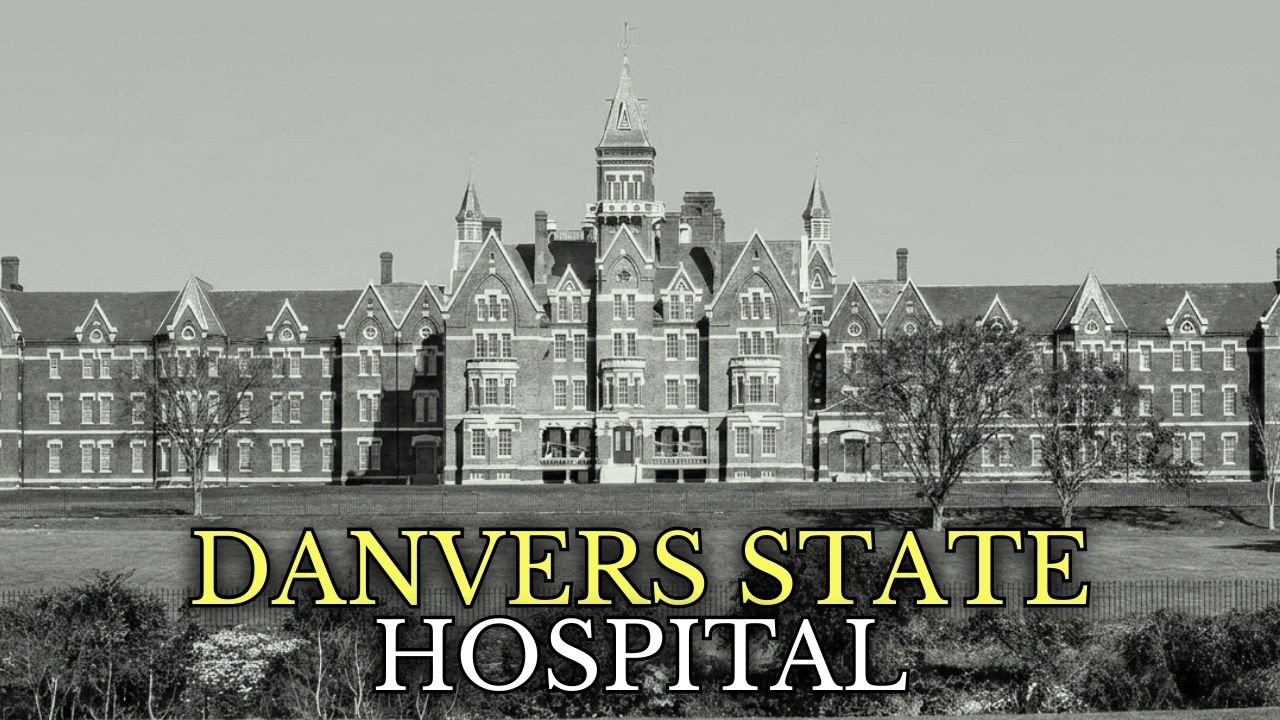
Architect Nathaniel Jeremiah Bradlee designed the facility based on the principles of physician Thomas Kirkbride, who believed beautiful surroundings, sunlight, fresh air, and dignity could serve as medicine. Construction began on May 1, 1874, using Cape Ann granite, locally fired red brick, and Gothic spires. When finished four years later, the structure stretched 1,100 feet with a central administration tower rising more than 100 feet, at a cost of $1. 5 million, well over the original budget.
Locals called it the “castle on the hill,” while critics in the legislature called it the “hospital palace at Danvers. ”
The first patient arrived on May 13, 1878. Under its first superintendent, Dr. Calvin May, the hospital refused to use mechanical restraints.
Patients worked the farm, learned trades, played baseball, and attended musical performances. In 1879, Danvers became the first mental hospital in Massachusetts to hire a woman physician. In 1889, it established a nursing training school, and in 1895, a pathological research laboratory. The hospital worked, at least at first.
But it was built to house roughly 450 patients, and the numbers quickly climbed past that ceiling. By 1881, the population had reached 626. By 1885, it was 788, and the trustees filed a report warning that “the crowded condition of the hospital was not provided for in its design or construction. ” Nobody listened, and the numbers kept climbing.
Patients eventually slept on floors of hallways and basements. They went without clean clothing for days due to staff shortages. The straitjackets Dr. May had refused to use became an everyday tool again.
The 1939 Trustees report repeated almost word for word the same warning issued in 1885, noting the hospital was receiving nearly 1,000 new admissions per year. Violence and scandal followed. In 1934, a patient died after sauce in the hospital kitchen became mixed with insecticide. In 1938, State Auditor Thomas Buckley disclosed that eight patients had been killed by fellow patients at Danvers and nearby facilities.
Investigators found that 400 patients had died from causes other than natural ones across the hospital’s history. In the 1950s, two patients were beaten to death, and a laundry superintendent was robbed and murdered inside the facility by two young patients. During this era, the hospital also became known for the prefrontal lobotomy. The procedure was not invented there, but doctors and visiting specialists performed it at Danvers with the crude transorbital method popularized by neurologist Walter Freeman.
Visitors described lobotomized patients wandering corridors in a dim, unresponsive state. The procedure eventually declined when Thorazine arrived around 1955, a drug some medical professionals called a “chemical lobotomy. ”
Marie Balter entered Danvers around 1947 or 1948 as a frightened 17-year-old who had already been diagnosed with a psychoneurotic condition and deemed at risk of harming herself. At Danvers, doctors concluded she had schizophrenia, a far more severe diagnosis that would later be considered inaccurate.
Her condition would more properly have been described as severe anxiety and recurrent psychotic depression. An anxious, traumatized teenager, Marie was placed on an experimental antipsychotic medication at doses later described as nearly lethal. The drug deepened her symptoms. She spent eight years in a closed ward, where she turned to faith, shuffled playing cards to feel something in her fingers, scrubbed floors, and eventually asked her doctor for permission to walk outside.
To the amazement of attendants, her doctor agreed. After eight years in the closed ward, Marie asked to be moved to an open ward. Staff members reportedly placed bets on how long it would take before she was sent back behind locked doors. She did not fail.
In 1968, Marie Balter walked out of Danvers for the last time as a patient, after spending her entire 20s and most of her 30s inside the institution. She went on to earn an associate’s degree at North Shore Community College, a degree in psychology at Salem State College, and a master’s degree at Harvard University. In 1984, Salem State awarded her an honorary doctorate. Then she returned to Danvers State Hospital as an employee, serving as director of community affairs and chief spokeswoman.
She founded the Balter Institute, focused on patient-led mental health care. In 1987, she co-authored an autobiography titled “Nobody’s Child,” which was adapted into a television film in 1986 starring Marlo Thomas. Marie Balter died in August 1999 at the age of 68. A memorial bench in the Danvers State Hospital Cemetery remembers her today.
The hospital itself was slowly closing. Through the 1970s and 1980s, wards shut down one by one, and in 1970 the central tower had to be removed due to decay. In February 1991, Governor William Weld appointed a commission that found roughly 47% of the mental health department’s budget was spent on hospitals serving only about 6% of patients. On June 24, 1992, the last patients were transferred to Tewksbury State Hospital, and Danvers closed after 114 years.
The promised community-based care was never fully built. Researchers later called the result “transinstitutionalization,” as patients moved from hospitals into homelessness, shelters, and some cases, prison. For 13 years, the building sat abandoned, with medical equipment and patient records left behind. Two hospital cemeteries disappeared beneath overgrowth.
In 1997, a woman named Patricia Degan stumbled across the forgotten burial ground while walking her dog. She founded the Danvers State Memorial Committee in 1998, and over the following years the committee identified the names of more than three-quarters of the 770 people buried there, erecting granite markers and bronze plaques. The abandoned hospital also developed a strange second life. H.
P. Lovecraft, who died in 1937, had created the fictional Massachusetts town of Arkham in his horror fiction, drawing directly from the Salem-Danvers region. His literary executor described Arkham simply as Lovecraft’s version of “legend-haunted Salem. ” Lovecraft’s Arkham Sanitarium appears most prominently in “The Thing on the Doorstep,” written in 1933.
Literary historians have pointed to Danvers as its most likely physical model. In 1974, DC Comics editor Jack Harris suggested using Lovecraft’s fictional asylum as the model for where Batman’s disturbed villains should be sent. Arkham Hospital first appeared in Batman issue No. 258 in October 1974.
In 1989, the graphic novel “Arkham Asylum: A Serious House on Serious Earth” cemented the institution in the Batman mythology, and the “Batman Arkham” video game series has sold more than 32 million copies worldwide. Danvers also faced its own destruction. In 2005, Virginia-based developer Avalon Bay Communities purchased the 77-acre property for $12 million. A preservation group filed a last-minute lawsuit, but in November 2005 a judge denied an injunction, and demolition began in January 2006.
Six of the eight original wards were torn down. The brick facade of the central administration building was preserved as a shell with new structure built behind it. On April 7, 2007, a four-alarm fire broke out on the construction site around 1:50 in the morning, destroying four newly built apartment buildings. Firefighters from eight communities responded.
The Massachusetts State Fire Marshal said he would not categorize the blaze as suspicious but stopped short of ruling out a cause. No official explanation was ever confirmed. Construction eventually resumed, and the property opened as Avalon Danvers, later renamed Bradley Danvers, after the original architect. The two cemeteries holding roughly 770 graves remain, maintained and marked with names.
The hill that once held the hospital now holds apartments. But the story of the girl who was never supposed to make it out, and who came back through the front door as an employee, remains the final word on what the institution failed to see.