Sharon Tate was 26 years old, eight and a half months pregnant, and two weeks from her due date when followers of Charles Manson broke into her rented home on Cielo Drive in Benedict Canyon on August 9, 1969. She had never met Manson and had nothing to do with the grudge that brought his followers to her door. The house had previously been rented by music producer Terry Melcher, who had rejected Manson’s demo tape. Sharon simply happened to be living there.
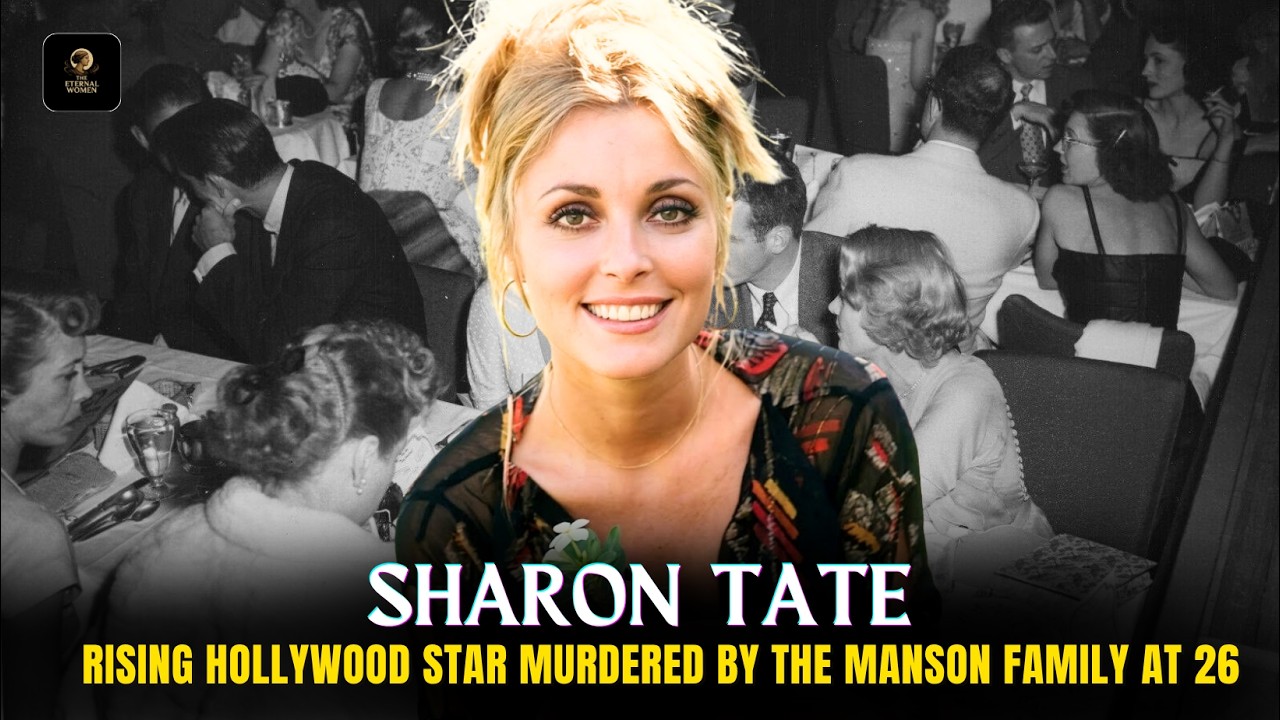
A Golden Globe nominee and star of one of the highest-grossing films of 1967, Sharon had been building a serious Hollywood career for roughly seven years. On the morning of August 9, her housekeeper arrived and called the police. Sharon had been stabbed 16 times. Her unborn son died with her.
In the decades since, the world has largely told this story through Charles Manson and his trial. But Sharon Tate’s own story deserves far more attention. Sharon Marie Tate was born on January 24, 1943, in Dallas, Texas. Her father, Colonel Paul James Tate, was a career officer in U.
S. Army Intelligence, and his assignments moved the family repeatedly. Her mother, Doris Willett Tate, would later become one of California’s most formidable victims’ rights advocates. Sharon was the eldest of three daughters, followed by Patty and Debra.
Her childhood was defined by movement: Dallas, San Francisco, Verona, Italy, Fort MacArthur in California, and Tacoma, Washington. Each posting meant a new school and a new community. Rather than making her withdrawn, it gave her an unusual ease with strangers. People who knew her before she had any career to protect described her in the same warm terms as those who knew her at the height of her fame.
From a very young age, her beauty drew attention. At six months old, she was named Miss Tiny Tot of Dallas. Throughout her life, she fought to be recognized for her abilities rather than simply her appearance. While the family was stationed in Verona, Italy, in the late 1950s, she attended Vicenza American High School and was elected homecoming queen.
After the family settled in the Tacoma area in 1961, a family friend introduced her to actor Richard Beymer, who had recently appeared in West Side Story. He encouraged her to pursue acting and introduced her to his agent. Her parents were initially reluctant, but Sharon was determined. At 19, she moved to Los Angeles.
Her early Hollywood years are rarely discussed, but they reveal a disciplined professional. She took small parts, appeared in television commercials, and landed a recurring role on The Beverly Hillbillies from 1963 to 1965, playing secretary Janet Trego. She also took acting classes seriously, working with coaches and studying technique. In 1964 and 1965, she appeared in small roles in The Americanization of Emily and The Sandpiper.
In 1965, she traveled to London for Eye of the Devil, a psychological thriller starring David Niven and Deborah Kerr. It was her first significant feature role, and she held her own against established actors. It was during production of that film that she met Roman Polanski. She was 22 and he was 31.
Those around them described a relationship of genuine mutual love and intellectual respect. Their professional collaboration produced The Fearless Vampire Killers in 1967, which cast her as the Rabbi’s daughter and showed a comedic and physical range that surprised critics. In 1967, Sharon was cast in Valley of the Dolls, the film adaptation of Jacqueline Susann’s best-selling novel. She played Jennifer North, a woman whose beauty is her primary currency in an industry that values it above all else.
Sharon was aware of the irony of the role, as she was fighting the same perception in her own career. She was nominated for a Golden Globe for New Star of the Year for her performance. The film was one of the highest-grossing films of 1967. Sharon Tate and Roman Polanski were married in London on January 20, 1968.
She was 24; he was 34. The guest list included notable figures from both British and American film worlds. In the final 18 months of her life, Sharon was not a fading star. She was a working actress with genuine momentum.
In 1968, she starred in The Wrecking Crew, a Dean Martin spy comedy in which she played a clumsy secret agent, showcasing real comic timing. The film was a commercial success. In early 1969, while two months pregnant, she filmed 12 + 1, an Italian comedy produced in France and Italy. It was the last work she would ever do.
She returned to Los Angeles, prepared the house for the baby, rested, and spent time with close friends Jay Sebring, Abigail Folger, and Wojciech Frykowski. Her baby was due August 26, 1969. The house at 1050 Cielo Drive was not chosen for any sinister reason. It was a rented property that suited the couple’s needs.
What they did not know was that the house had previously been rented by Terry Melcher, the music producer and son of Doris Day. Charles Manson had auditioned for Melcher and believed a recording career would follow. Melcher declined to sign him and moved on. Manson sent his followers to that house not because of Sharon, but because of the address, which he associated with the music industry that had rejected him.
Sharon was murdered because she was renting a house Manson associated with someone else. The randomness of it is one of the most difficult parts of the story to hold. On the night of August 8, 1969, Manson instructed Charles “Tex” Watson, Susan Atkins, Patricia Krenwinkel, and Linda Kasabian to go to the house and kill everyone there as gruesomely as possible. The instruction was about fear and territory, tied to Manson’s conviction that a race war he called Helter Skelter was coming.
Kasabian drove the group to the property but did not enter the house. She later became the prosecution’s star witness. The details of what happened inside the house are documented in the trial record and in Vincent Bugliosi’s account, Helter Skelter. Steven Parent, an 18-year-old friend of the caretaker, was shot and killed in his car as he was leaving the property.
He was the first to die. Inside the house, the killers attacked Jay Sebring, Wojciech Frykowski, and Abigail Folger, all of whom fought. Frykowski and Folger made it outside before being killed on the lawn. According to testimony, Sharon begged for her life and for the life of her baby.
She suffered 16 stab wounds. The official cause of death was massive hemorrhage from the stab wounds. The baby boy she had named Paul Richard Polanski died with her. Their bodies were discovered the following morning by housekeeper Winifred Chapman.
Roman Polanski, who was in London, would not return to the house. Sharon’s parents were notified in circumstances beyond articulation. Charles Manson was born on November 12, 1934, in Cincinnati, Ohio. He spent most of his childhood and adolescence in juvenile detention and later served time in federal prison for crimes including forgery, pimping, and armed robbery.
By the time he was released from Terminal Island Federal Penitentiary in March 1967, he had spent more than half of his 32 years incarcerated. He founded a group known as the Manson Family and settled at Spahn Ranch in the Chatsworth area of Los Angeles. He was not a figure of dark charisma so much as a manipulative man with a specific skill: identifying vulnerable people and exploiting them through drugs, isolation, sleep deprivation, and coercive control. He was arrested in October 1969 on unrelated charges.
The investigation that followed connected him and his followers to the Tate murders and to the murders of Leno and Rosemary LaBianca the following night. He was convicted and sentenced to death, a sentence commuted to life when California briefly abolished the death penalty in 1972. He died in prison on November 19, 2017, at age 83, after being denied parole 12 times. He never expressed genuine remorse.
The story of what happened after Sharon’s murder is, in significant part, the story of her mother, Doris Tate. She was 52 when Sharon was killed. The murder of her eldest daughter did not break her; it mobilized her. Doris began attending parole hearings for the Manson family members.
Her first appearance at a hearing for Leslie Van Houten in the late 1970s was a watershed moment. The parole board was not accustomed to having victims’ family members present, articulate, and prepared. Doris told the board who Sharon was and described what had been lost. She attended hearing after hearing, year after year.
In 1982, she was instrumental in the passage of Proposition 8 in California, the Victims’ Bill of Rights, which formalized the right of crime victims and their families to participate in criminal proceedings. Before Proposition 8, victims were largely invisible in the process. After it, they had a legally recognized place. Doris also spoke publicly, without sentimentality, about who Sharon was as a person.
She refused to let public memory of her daughter be entirely determined by the manner of her death. Doris Tate died of a brain tumor on July 10, 1992, at age 68. She had spent 23 years fighting for her daughter and for the rights of crime victims. Sharon’s father lived until 2005 and was buried with military honors.
Sharon’s sister Debra has continued the family’s advocacy work. None of the convicted Manson family members have been released. Patricia Krenwinkel, Leslie Van Houten, and Charles Watson remain incarcerated. Susan Atkins died of brain cancer in prison in September 2009.
Charles Manson died in Corcoran State Prison in November 2017. Sharon Marie Tate was 26 years old when she died. She had been acting professionally for roughly seven years, moving from decorative supporting roles to a Golden Globe nomination to lead parts in international productions. She was not at the peak of her career; she was in its early stages.
People who worked with her described an actress far more serious about her craft than the public understood. She read widely, prepared carefully, and asked intelligent questions. She was also, by every account from those who knew her personally, one of the warmest people in her professional circle. Jay Sebring, her former boyfriend, remained one of her closest friends after their romantic relationship ended.
Abigail Folger, also murdered that night, was a close friend who valued Sharon’s openness and lack of judgment. Roman Polanski later said Sharon was the only true happiness he had known in his life, a statement received with awareness of everything complicated about its source. Sharon was eight and a half months pregnant. The baby, a boy who would have been named Paul Richard Polanski, was due on August 26, 1969, 17 days after his mother was killed.
He died with her in the house on Cielo Drive. Sharon’s death was used in the immediate aftermath primarily as a vehicle for a story about Charles Manson. That meant she became the context for his story rather than the subject of her own. To be known primarily as someone’s victim is to be defined by someone else’s act.
She deserved more than that definition. Doris Tate understood that the people who die in crimes are not supporting characters in the stories of those who killed them. They are the main characters. Their lives were interrupted.
Their futures were foreclosed. They had plans, friends, babies coming, films to make, and conversations to have with the people they loved. Sharon Tate had all of those things. She was going to give birth to her son, call her parents, hold the baby, and begin the chapter of new motherhood.
She was going to join Roman in London and make more films. None of that happened because Charles Manson, who had never met her and did not know her name, sent three people to a house associated with someone else. She happened to be there. There is no meaning in that.
There is no lesson and no redemption arc. It is simply the worst kind of random, arriving without warning and without any relationship to who she was or what she deserved. Sharon Tate deserved to be alive. She deserved to meet her son.
She deserved the career she was building and every morning of the future she was planning. She was 26 years old, warm and funny and serious and devoted and curious, still in the early morning of everything she was going to be. This story is not about the man who took her.
It is about the person she was.