Sun Valley, Idaho, was built for one purpose: to get ordinary Americans onto Union Pacific trains. Today, a modest house in Ketchum, the small ranching town that Sun Valley swallowed, costs more than most Americans will earn in a lifetime, and the workers who keep the resort running sleep in their cars because there is nowhere left they can afford to rent. The ski resort that invented the chairlift, brought Hollywood to Idaho, and hosted Hemingway while he wrote one of the great American novels became something its creator never imagined—a private club for billionaires disguised as a town. The strangest part isn’t that it happened.
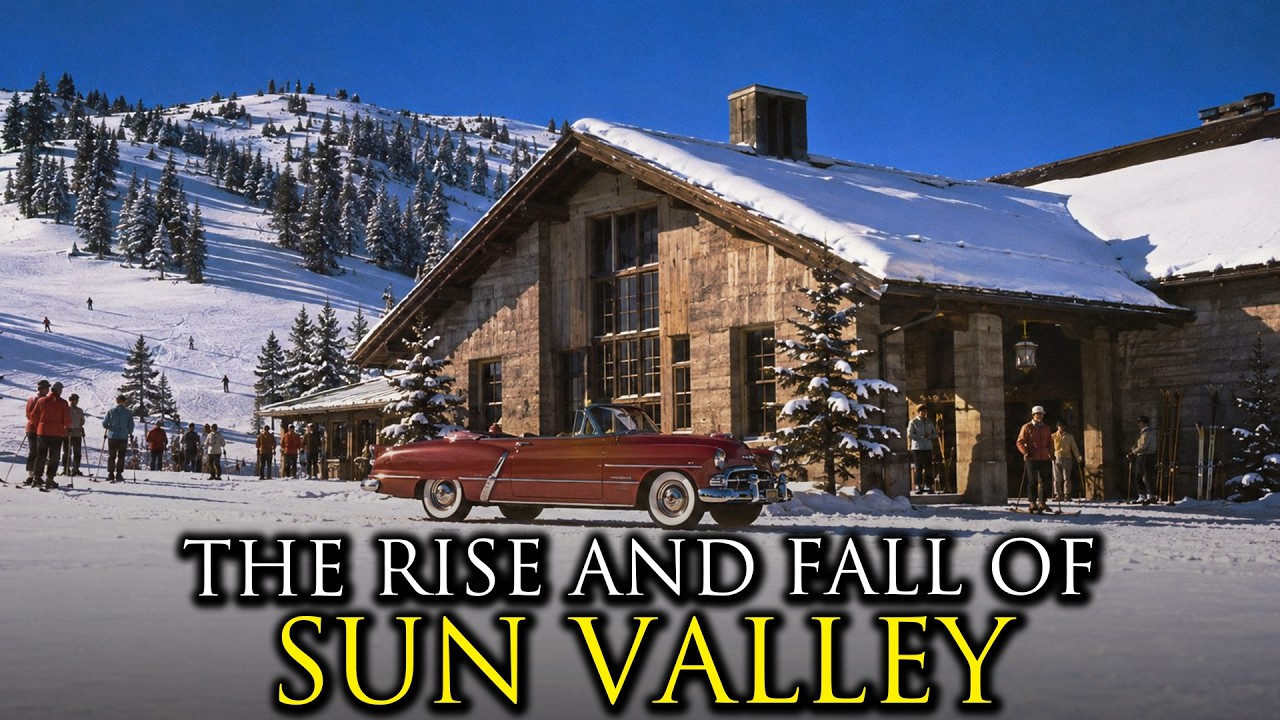
The strangest part is that every single step made perfect sense at the time to someone. The man who started it all was not a skier. He was not an outdoorsman. He was not from Idaho, and had probably never sheared a sheep or set foot in a silver mine or spent a winter anywhere that didn’t have room service.
William Averell Harriman was the son of E. H. Harriman, the railroad titan who had built one of the largest transportation empires in American history—a man whose wealth and power had been compared to J. P.
Morgan’s. The younger Harriman inherited not just money but a railroad. By the early 1930s, he was chairman of the board of the Union Pacific Railroad, and he had an expensive problem that had nothing to do with mountains. The problem was passengers—or rather, the disappearance of them.
The automobile was eating the railroad industry alive. Henry Ford’s assembly line had put cars in the hands of millions of Americans, and every year, fewer of those Americans bothered buying a train ticket. Union Pacific had thousands of miles of track running through some of the most spectacular landscape in the American West, and fewer and fewer people sitting in the seats to see it. Harriman needed to give Americans a reason to ride his trains.
Not just any reason—a destination so glamorous, so thrilling, so unlike anything else in the country that people would buy Union Pacific tickets specifically to reach it. He had seen what worked abroad. The great alpine resorts of Europe—St. Moritz, Kitzbühel, Chamonix—had been filling European train cars for decades.
Wealthy travelers rode rail into the Swiss and Austrian mountains by the thousands. When they arrived, they spent lavishly. Those resorts didn’t just sell skiing. They sold a world.
Elegant hotels, fine dining, celebrity sightings, the intoxicating feeling of being somewhere that mattered. America had the mountains. America had the snow. America had the wealth, even during the Depression—the upper classes still traveled, still spent, still craved novelty.
What America did not have was a single destination ski resort. Nowhere in the country could you arrive at a luxury hotel, step onto a ski slope, and feel like you were at the center of anything. Harriman decided to build that place from nothing. But where?
This is where the story takes its first strange turn. Harriman did not send an American to find the site. He sent an Austrian count. Count Felix Schaffgotsch was a nobleman, a seasoned mountaineer, and by most accounts a man of exacting standards and limited patience for anything that fell short of the Alps.
Harriman gave him a straightforward assignment: travel the American West, inspect every plausible location for a ski resort, and report back with a recommendation. The count set off in late 1935 with a list of requirements that would have disqualified most of the continent. He needed deep, reliable snow. He needed sunshine—overcast mountains meant depressed skiers and ruined photographs.
He needed terrain that offered variety—enough steepness for experts, enough gentleness for wealthy beginners who had never stood on a ski. And this was the part Harriman cared about most: he needed a location that Union Pacific trains could actually reach without building a hundred miles of new track through impossible terrain. Schaffgotsch rejected site after site. He dismissed locations in Colorado, California, Utah, and elsewhere in Idaho.
Mount Rainier had devastating wind. Yosemite had access problems and unpredictable snow. He looked at places that are now world-famous ski destinations and walked away from them. By some accounts, the count was growing frustrated, and Harriman was growing impatient.
The search was costing time and money. The Austrian was difficult to please, and the window for construction was narrow. Then someone—and the historical record is a little hazy on exactly who—suggested a former mining town in central Idaho called Ketchum. Ketchum sat in the Wood River Valley, a broad open valley sheltered by mountains on nearly every side.
The Sawtooth range rose dramatically to the north. To the east stood Bald Mountain, which locals would eventually call Baldi—nearly 9,000 feet high, with long open bowls that caught full sunlight for most of the day. The valley floor was wide and flat enough to build on without engineering miracles. The critical detail for Harriman: the Union Pacific branch line already ran through Shoshone, roughly 50 miles to the south.
A spur line could reach Ketchum without bankrupting the railroad. Schaffgotsch arrived in the Wood River Valley, studied the terrain, tested the snow, measured the wind, and sent a telegram back to Harriman. The exact wording has been repeated in various forms over the years, and different sources phrase it slightly differently, but the message was unmistakable: this was it. Of all the mountains in the American West, this valley, this town, this particular slope was the place.
Now understand what Ketchum actually was in 1935. It was not glamorous. It was not a destination. It was a small, weather-beaten, high-altitude town that had peaked decades earlier during a silver and lead mining boom in the 1880s.
At its height, the Wood River Valley Mining District had produced millions of dollars in ore, and Ketchum and the surrounding towns—Hailey, Bellevue, Bullion—had briefly bustled with miners, saloon keepers, merchants, and the usual cast of a western boom. But by the early 20th century, the mines had largely played out. What replaced mining was sheep. By the 1930s, the Wood River Valley was deep sheep country.
Vast herds moved through the valley on seasonal drives. Basque and Scottish herders worked the high pastures through the summer. Wool was sheared and loaded onto rail cars. Ketchum’s population had dwindled to perhaps a few hundred permanent residents.
The winters were brutal and long. Nobody was coming to Ketchum for fun. Harriman looked at this dying sheep town and saw St. Moritz.
He committed somewhere in the range of $1. 5 million—some contemporary and later reports suggest the total may have been higher—to build a luxury resort from scratch. In Depression-era dollars, for a hotel in a place most Americans had never heard of and couldn’t find on a map, that was a breathtaking gamble. He hired architect Gilbert Stanley Underwood to design the centerpiece, the Sun Valley Lodge.
Underwood was the man behind some of the most iconic structures in the American national parks: the Ahwahnee Hotel at Yosemite, the lodge at Bryce Canyon, the North Rim Lodge at the Grand Canyon. He understood how to build big without making it feel like an intrusion. The lodge Underwood designed was massive by Idaho standards and ambitious by any standard. Built of poured concrete faced with local stone and timber, it had nearly 300 rooms with a great central hall, elegant dining rooms, and a movie theater.
Harriman wanted his guests to have entertainment beyond skiing—and remarkably for a mountain lodge in the 1930s, heated outdoor swimming pools. The idea of swimming outside in Idaho in January, surrounded by snow while mountains rose on every side, was absurd and magnificent and perfectly calculated to appear in photographs. But Harriman’s most consequential decision at Sun Valley was not the lodge. It was something far more mechanical, far less glamorous, and far more important to the history of recreation in the Western world.
He invented the chairlift. Before Sun Valley, there was no such thing as a ski chairlift anywhere on Earth. Skiers got up mountains the hard way, or they were pulled up by crude rope tows—essentially loops of heavy rope powered by a motor that dragged skiers up the slope through the snow, ripping off gloves, burning hands, and depositing beginners in humiliated heaps at every bump and turn. For the kind of wealthy, comfort-seeking clientele Harriman wanted to attract, the rope tow was a deal-breaker.
You could not build America’s St. Moritz around an experience that left guests cold, exhausted, and bruised before they’d made a single run. So Harriman told his engineers to solve the problem. A Union Pacific Railroad engineer named James Curran came up with one of the most improbable solutions in the history of American invention.
Curran had worked around—or perhaps simply remembered—a system used at banana plantations and shipping ports in Central America. To load heavy bunches of bananas onto cargo ships, overhead conveyor hooks carried the fruit along a moving cable, swinging in a continuous loop from plantation to dock to deck. Curran realized that the same principle could carry people. Hang a chair from a moving overhead cable, let the skier sit down, lift their feet off the ground, and ride smoothly up the mountain while the cable did all the work.
No climbing, no dragging, no rope burns—just a seat, a view, and a gentle ride to the top. It sounds so obvious now that it’s almost hard to believe nobody had done it before, but nobody had. The world’s first ski chairlift, adapted from a banana-loading machine, was built and installed at Sun Valley in time for the resort’s opening in late December 1936. The initial chairs were simple single-seat designs mounted on Dollar Mountain, the smaller, gentler slope near the lodge that suited beginners.
Riders sat one at a time, were scooped up at the base, and carried upward while the valley spread out beneath them—the lodge growing smaller, the surrounding peaks rising into view. The effect was immediate and transformative. For the first time in the history of skiing, the trip up the mountain was not a punishment. It was a pleasure.
Skiers arrived at the top rested, warm, ready to ski instead of ready to collapse. They could make more runs in a day. They could enjoy the scenery. That chairlift changed everything—not just for Sun Valley, but for skiing globally.
Within a few years, chairlifts began appearing at resorts across the United States, Canada, and eventually Europe. The technology that started as a banana hook at a tropical port became the mechanical spine of a worldwide industry worth billions. Every chairlift at every ski resort in the world descends from James Curran’s idea, tested first at Sun Valley. The Sun Valley Lodge officially opened on December 21, 1936.
Even before the first guests arrived, the scale of what Harriman had attempted was staggering. Here was a world-class resort with hundreds of rooms, heated swimming pools, a dining room that could seat an army, a bowling alley, a skating rink, tennis courts, and a complete movie theater—all built in roughly a year in a remote Idaho valley that had been sheep pasture twelve months earlier. Harriman had also imported an entire ski school from Austria. He understood that most of his target guests, wealthy Americans from cities, had never skied before.
They would need instructors who looked and sounded like they belonged at a European resort. The Austrian and German ski instructors brought not just technique but atmosphere—their accents, their confidence on the mountain, their easy European charm—all of it part of the package. But Harriman had not left publicity to chance. He had made another brilliant hire: Steve Hannagan, quite possibly the greatest public relations man in mid-century America.
Hannagan understood fame as a mechanical process. He had taken the Indianapolis Motor Speedway and turned its annual race into a national obsession. He had taken Miami Beach, a mosquito-infested sandbar that barely existed in the public imagination during the 1920s, and transformed it into the most glamorous winter destination in the country, almost entirely through celebrity placement and photography. His genius was simple and repeatable.
Get the right famous people to show up, make sure the photographs look irresistible, and let ordinary Americans do the rest. People didn’t want information about a resort. They wanted to see that the people they admired went there. For Sun Valley, Hannagan deployed the full machine.
He brought Hollywood to Idaho—by invitation, by train, by every inducement a luxury resort could offer. The celebrities came, and the cameras were ready. Clark Gable arrived and was photographed skiing, grinning in the sunshine. Gary Cooper came, Ingrid Bergman, Claudette Colbert, Errol Flynn.
Dozens of movie stars and socialites passed through the lodge in those early seasons. Every visit produced photographs that went everywhere: movie magazines, newspaper society pages, newsreels shown in theaters across the country. Beautiful people in pristine snow, laughing, skiing, lounging beside heated outdoor pools in bathing suits while Idaho mountains rose behind them in golden light. No American resort had ever looked like this.
Sun Valley wasn’t just a place to ski. It was a place to be seen skiing. Hannagan also arranged for the resort to host film premieres at its on-site movie theater—another publicity tool, another reason for photographers and gossip columnists to pay attention to a place geographically in the middle of nowhere. Through the publicity machine, millions of Americans who would never come to Idaho could see it, want it, dream about it.
Sun Valley became not just a destination but an idea. Then a writer arrived who would become more associated with the place than any movie star ever was. Ernest Hemingway came to Sun Valley for the first time in 1939 at the resort’s invitation. He was given suite 206 at the lodge, on the second floor, with windows that looked out toward the mountains.
Something about the place seized him in a way few places ever had. Hemingway had lived in Paris, Key West, Spain during a war, and Africa on safari—but Sun Valley was different. The hunting was extraordinary. Silver Creek offered some of the finest trout fishing he had ever encountered.
The valley was quiet, the air clean, the light sharp. In that room, at the desk with those mountains outside, Hemingway worked on and finished the manuscript of “For Whom the Bell Tolls”—one of the great American novels of the 20th century, completed in a luxury hotel a railroad company built in a former sheep town. Hemingway didn’t just visit. He came back again and again over the next two decades, hunting birds in the hills, fishing Silver Creek obsessively, drinking at the lodge bar and local clubs.
He made friends with local outfitters, ranch hands, bartenders, and hunting guides who treated him like anyone else. He eventually bought a house in Ketchum, a solidly built concrete house on a quiet road near the Big Wood River. By the early 1960s, Hemingway was falling apart. His physical health was deteriorating; his mental state was worse.
He had been hospitalized at the Mayo Clinic and treated with electroshock therapy. On the morning of July 2, 1961, Ernest Hemingway died in the foyer of that Ketchum house from a self-inflicted shotgun wound. He was 61 years old. There is a memorial to him now along Trail Creek, on a path through the trees and willows not far from the lodge where he’d written in suite 206.
The inscription comes from something he wrote about a different place: “Best of all, he loved the fall. The leaves yellow on the cottonwoods, leaves floating on the trout streams, and above the hills the high blue windless skies. ”
Before the valley transformed, however, came an interruption most people have forgotten. In 1942, less than a year after Pearl Harbor, the United States Navy requisitioned the Sun Valley Lodge—not as a command center or an intelligence post or a weapons depot, but as a hospital.
The Navy converted Harriman’s luxury resort into a convalescent center for wounded servicemen, primarily sailors recovering from severe injuries sustained in the Pacific theater. The transformation was jarring. The heated swimming pools where actresses had lounged in bathing suits became therapeutic rehabilitation pools where young men with shattered legs and burned skin worked to regain movement. The guest rooms that had hosted the wealthiest people in America were fitted with hospital beds, their mountain views now visible to boys from Nebraska and Mississippi.
The strangest part of the Navy’s use of Sun Valley was the skiing. Military doctors discovered that putting recovering soldiers on skis had remarkable therapeutic benefits. The physical demands of skiing rebuilt strength and balance; learning something new pulled men out of the psychological darkness that often accompanied severe wounds. Patients who had been despondent showed improvement that amazed the medical staff.
The lodge was closed to civilian guests from 1942 until 1945. By some estimates, several thousand servicemen passed through the Sun Valley Naval Convalescent Hospital. When the war ended and the resort reopened, many remembered the valley and some stayed permanently, becoming part of the small, tight-knit community of Ketchum. The post-war years brought Sun Valley back as a resort, but the ground was shifting.
The resort added lifts on Bald Mountain, opening terrain that was steeper, longer, and more challenging than anything on Dollar Mountain. But the railroad—the entire reason Sun Valley existed—was dying. Passenger rail across America was collapsing. People drove or flew now.
Sun Valley didn’t need Union Pacific anymore, and in 1964, Union Pacific sold the resort to the Janss Investment Corporation. The transfer severed the last link between Sun Valley and the railroad that had built it. Through the 1960s and 1970s, the resort remained recognizable. Families came for vacation, skiers came for Baldi, young people came to work a season and lived cheap in shared apartments.
Ketchum itself was still recognizably a real town—Main Street had a hardware store, bars where a carpenter sat on the same bar stool as a visiting stock broker, and a school teacher could rent a decent house. That distinction—the people who powered the economy living inside the community—turns out to be the whole ball game. Starting in the 1970s and accelerating through the 1980s and 1990s, the Wood River Valley began attracting wealthy Americans looking for second homes in the Mountain West. Sun Valley had a particular quality that amplified the effect: it was remote.
The nearest major commercial airport was in Boise, more than 150 miles away. The local airport in Hailey couldn’t handle large commercial jets. That remoteness became, for a certain class of buyer, the single most attractive feature of the entire valley. If you were wealthy enough to fly private, Sun Valley’s isolation meant privacy.
Land was limited, and demand from outside wealth began pushing prices up—slowly at first, then with a steady acceleration. The fast movement was the Allen & Company Sun Valley Conference. In 1983, investment banker Herbert Allen Jr. held the first of what would become the most exclusive annual gathering in American corporate life.
Allen, whose family controlled the boutique Wall Street investment bank Allen & Company, began inviting a small, carefully chosen group of media and business executives to Sun Valley every July for informal conversation, outdoor activities, and the part nobody talked about publicly: dealmaking. The guest list was invitation-only and ferociously guarded. No press was allowed inside the meetings. Within a decade, the Sun Valley Conference had become the single most important off-the-record gathering in the world for the media and technology industries.
The deals reportedly discussed or initiated at the conference are staggering in scale. The Disney acquisition of Capital Cities/ABC was reportedly advanced during Sun Valley conversations. The merger that created AOL Time Warner had roots in Sun Valley meetings. Comcast’s acquisition of NBC Universal, major tech partnerships, billion-dollar handshakes—they happened on hiking trails, on the banks of Trail Creek, at dinners where the dress code was fleece.
The names that eventually appeared on the guest list read like a roll call of global power: Jeff Bezos, Bill Gates, Warren Buffett, Mark Zuckerberg, Bob Iger, Rupert Murdoch, Tim Cook, Oprah Winfrey. Each July, private jets descended on the Friedman Memorial Airport in Hailey, sometimes dozens at once. The conference didn’t just make Sun Valley famous. It made Sun Valley functional to the most powerful class of people in the country.
It became the place where the people who controlled American media and technology came every year to do their most important thinking. Through the 1990s and 2000s, the real estate market in the Wood River Valley climbed at rates that had no connection to local wages. A house on a quiet Ketchum street that might have sold for $200,000 or $300,000 in the late 1980s was suddenly worth $700,000, then a million, then two million. Custom homes began appearing on hillsides—walls of glass facing the peaks, heated driveways, wine cellars blasted into bedrock.
Properties changed hands for eight figures. Gated communities appeared on former ranch land. By the early 2010s, the median home price in Ketchum had long since crossed a million dollars. Rental housing was scarce and wildly expensive.
When the pandemic arrived in 2020, the situation detonated. Wealthy remote workers flooded into mountain communities. Home prices in Blaine County surged by double-digit percentages in a single year. Properties were snapped up in bidding wars, often by cash buyers, often by people who intended to use the house for a few weeks a year.
The workers who kept the community functioning found themselves in an impossible position. A restaurant cook earning $15 or $18 an hour could not compete for housing against a tech executive offering cash for a second home. Studios had been converted to nightly vacation rentals that earned more in a week than a housekeeper could pay in a month. Reports surfaced of workers sleeping in their vehicles in parking lots.
Others lived in campgrounds during warmer months, moving into overcrowded trailers when temperatures dropped. Some doubled and tripled up in single apartments. Some simply left. The consequences cascaded.
Restaurants couldn’t find cooks, servers, or dishwashers, so they cut menus, shortened hours, or closed entirely. Hotels ran at reduced capacity because there weren’t enough housekeepers. The fire department struggled to recruit because a firefighter’s salary couldn’t cover housing. The school district watched enrollment decline as families with children were squeezed out.
The irony cuts in every direction. Harriman built Sun Valley to attract as many people as possible to fill train seats. It worked so spectacularly for so many decades that the accumulated force of fame, beauty, and concentrated wealth made the place too expensive for the very people it was designed to attract. The resort that invented accessible skiing became one of the least accessible places in the country.
Today, walk through Ketchum in the off-season, and the paradox is visible on every block. Real estate offices anchor the commercial blocks, their windows filled with photographs of properties listed for $10 million, $15 million, $25 million. Some of the most expensive homes are dark, clearly unoccupied. There is a specific kind of silence in a wealthy resort town in the off-season, the sound of a stage set between performances.
People use a phrase across resort communities in the West: a town without a town. A place with addresses and zip codes and gorgeous views, but without enough permanent year-round middle-class residents to give it the friction and continuity that make a community feel alive. Aspen has this problem. Jackson Hole has it.
But Sun Valley carries a particular weight because Sun Valley was never an accident. It was designed. Ketchum existed before Harriman arrived, but the resort replaced its dying economy with something that contained from the very beginning a fatal structural flaw: the new economy ran on attracting outside wealth. There have been efforts to address the crisis.
Blaine County and the cities of Ketchum and Hailey have implemented workforce housing programs, deed-restricted units, and density incentives. Local nonprofits have raised money for affordable housing developments. There have been debates about short-term rental regulations. These programs have helped at the margins, but the fundamental math is merciless.
Land values are driven by global wealth chasing a finite number of buildable acres. Some people in the Wood River Valley will tell you the community is fighting back. Others will tell you the fight is already over—that Sun Valley became a brand name, and what remains is a very beautiful, very expensive, very quiet stage set. And the chairlift keeps running.
When it was invented, the chairlift was a democratic machine. Its whole purpose was to remove the barrier that separated ordinary people from mountains that had previously belonged only to the wealthy and athletic. Now, to sit in that chair at Sun Valley, a single-day lift ticket costs hundreds of dollars. A season pass costs thousands.
A house within walking distance costs millions. The machine that was invented to open the mountain to everyone became the centerpiece of a community that most Americans can’t afford to enter. Nobody planned this. Not Harriman, who wanted to sell train tickets.
Not Hannagan, who wanted beautiful photographs. Not Hemingway, who wanted to fish and write. Not Allen, who wanted a pleasant setting for discreet conversations. Each made a decision perfectly rational for what they were trying to accomplish.
The lodge still stands at the base of Dollar Mountain in the shadow of Bald Mountain. The pools are still heated. Suite 206 is still there. Outside the windows, the mountains don’t care about real estate values or conference guest lists or labor shortages.
On a clear morning in the Wood River Valley, when the light hits the snow on Baldi, you can almost see what the Austrian count saw in 1935. The chairlift starts its first run. The cable moves.
The chairs swing forward one after another, climbing the mountain in a long, slow mechanical procession—built from a banana loader, designed for everyone, carrying almost no one who lives there anymore.