On Christmas Eve 1909, in a large and suddenly empty house in Connecticut, an old man with disordered white hair stood at the doorway of his library. His youngest daughter lay in a coffin that servants had placed near the piano. Snow fell against the tall windows. Hours earlier, she had been alive, wrapping Christmas gifts, laughing, making plans.
Now she was gone at twenty-nine, the last of his children to die before him. He did not weep as other men weep. He stood very still and said quietly that this was the bitterest of all his losses. Then he went upstairs and did the only thing he had ever known how to do with pain.
He wrote. The world knew him as Mark Twain, the funniest man in America, and perhaps in the world. He was the creator of Tom Sawyer and Huckleberry Finn, the white-suited humorist who could make a hall of a thousand strangers weep with laughter. Behind those jokes for forty years, he had been silently becoming the loneliest father in America.
The empty house in Connecticut had been built to be a joyful home, yet it became a gathering place for grief. How did a man who gave the world so much delight end up standing over the coffins of three of his own children? The answer lies in everything he wrote, hidden deliberately inside the laughter. His real name was Samuel Langhorne Clemens.
The fate of his four children is the story that the Mark Twain legend was built to cover. It was never forgotten; it was buried under a mountain of jokes. He came into the world marked from the start, born under a comet, and part of him always believed he would leave the same way. In November 1835, in a small Missouri village, a sickly premature child was born to a struggling family named Clemens.
Two weeks earlier, Halley’s Comet had blazed across the sky, a great fireball that returns only once every seventy-five years or so. The baby was weak, and no one expected him to survive his first winter. But he lived, growing into a restless boy on the banks of the Mississippi, in a world of steamboats and forests and freedom that he would one day turn into the most beloved American stories ever written. Death was his companion from the beginning.
He watched his father die when he was eleven. He lost siblings in childhood. In one of the most painful losses of his early life, his younger brother Henry was killed in a steamboat boiler explosion, a disaster Samuel claimed he had foreseen in a vivid dream days earlier. He blamed himself for Henry’s death for the rest of his life, convinced that he could have prevented it.
This was the pattern of his entire existence. He did not merely suffer loss; he absorbed it personally. Again and again, he believed that the deaths around him were somehow his fault, that if he had been wiser or more careful, the people he loved would still be alive. By his thirties, he had remade himself.
The riverboat pilot and failed silver prospector had become a writer, then a phenomenon. He took a pen name from his riverboat days, Mark Twain, the call meaning that the water was safe to cross. Under that name he became the most humorous voice in America. Then he fell in love, completely and devoutly, with a woman who was his opposite in every way.
Her name was Olivia Langdon. He called her Livy. She came from a wealthy, refined, deeply religious family in Elmira, New York. In 1870 they married, and Samuel Clemens, the boy from the Missouri mud, joined with refinement and love at once.
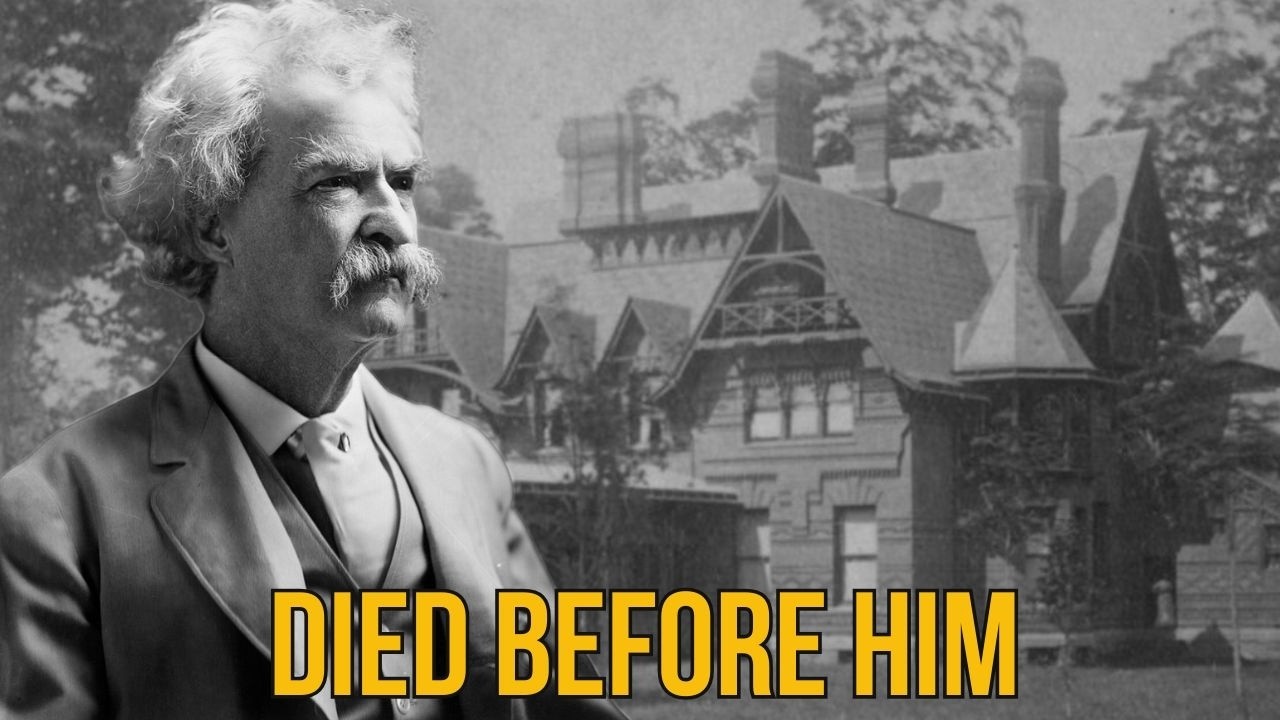
For thirty-four years, Livy was the center of his existence, his editor, his conscience, his anchor. They built their life in Hartford, Connecticut, in a fantastical mansion of red brick and colored gables, part steamboat, part cathedral, with nineteen rooms, a towering entrance hall, a greenhouse overflowing with plants, and a billiard room upstairs where Twain wrote and smoked his endless cigars. For years it rang with the voices of children. First came a son, Langdon, born in 1870.
Then three daughters, one after another: Susy in 1872, the brilliant one, whom her father loved beyond all measure; Clara in 1874, the strong fighter; and little Jean in 1880. For a brief golden period, Mark Twain had everything a man could wish for. He was rich, world-famous, married to the woman he adored, and surrounded by daughters who found him the most enchanting creature on earth. By all accounts, he was a wonderful father in those golden years, inventing elaborate stories on demand, staging plays with the girls, letting them dress him up.
Susy, as a teenager, secretly began writing a biography of her father, a small book full of admiration and clear-eyed humor. When he discovered it, it became one of the treasures of his life. But there was a detail from the beginning of the family that no one paid much attention to at the time. The firstborn son, little Langdon, was weak, premature, and fragile.
One cold spring morning in 1872, Twain took the infant for a ride in an open carriage. The boy was about a year and a half old, still fragile, wrapped in furs and blankets against the cold. Twain, a man who lived half his life inside his head, always writing, always elsewhere, let his mind wander. The blanket slipped.
The furs fell away from the child’s legs. Twain did not notice for a long time. The infant caught cold, and for a child so fragile in that era, a cold was a gateway to death. Langdon developed diphtheria, that savage killer of nineteenth-century children.
On June 2, 1872, the little boy died at nineteen months. Medically, the carriage ride almost certainly did not kill Langdon. Diphtheria is a bacterial disease. But medicine had nothing to do with what happened inside the father.
Mark Twain believed immediately, absolutely, and for the rest of his life that he had killed his son. He carried that conviction in silence. The funniest man in America emerged from 1872 with a dead child and a certainty of guilt that no one could persuade him to abandon. Because grief does not stop the world, the family continued.
There were three small daughters to raise. For more than twenty years, the Clemens family climbed back into the sunlight. The Hartford house filled with laughter again. Susy grew into a brilliant, sensitive girl.
Clara became strong-willed and musical. Jean grew up bright and warm and loving of animals. Twain wrote his masterpieces in the upstairs billiard room. By every measure, they were one of the most fortunate families in America.
But two slow catastrophes were forming in secret. The first was money. Mark Twain, for all his genius, was a disastrous businessman. He poured a fortune into one obsession, a mechanical typesetting machine called the Paige compositor.
It was an engineering marvel, a machine with thousands of moving parts that could set type automatically. Twain believed it would make him one of the richest men on earth. He poured money into it for years. The machine never worked reliably.
While Twain fed it his wealth, a simpler competitor swept the market. By the mid-1890s, the failure of his publishing house left him effectively bankrupt, deeply in debt, his fortune gone. The beloved Hartford home became a place they could no longer afford to live in. The second catastrophe was quieter but far worse.
At some point during those years, little Jean, the bright warm child of the family, began suffering strange attacks. She was diagnosed with epilepsy, a condition poorly understood in the nineteenth century, carrying a terrible social stigma and no real treatment. With bankruptcy upon him at nearly sixty years old, Mark Twain made a decision that was admirable and catastrophic. He refused to declare bankruptcy.
His pride and honor would not allow it. He resolved to repay every creditor in full, dollar for dollar. In 1895, exhausted and humiliated, he set off on an exhausting lecture tour around the entire world, through America, across the Pacific to Australia and New Zealand, to India, South Africa, and England, standing on stage night after night to be funny, to be Mark Twain, and reclaim his fortune ticket by ticket. Livy went with him.
Clara went too. But Susy, now twenty-three, sensitive and fragile in her own way, stayed in America with her aunt and with Jean. The family scattered across the earth to pay for a machine that never worked. The tour was a great success.
By the summer of 1896, Twain had nearly clawed his way back to solvency. The family made plans to reunite. Susy and Jean were to sail from America to join their parents in England. Susy never boarded the ship.
In late summer 1896, back in America, she fell suddenly and violently ill with spinal meningitis, a brutal, fast-moving infection of the brain and spine. She was taken to the only place that still felt safe, the big empty Hartford house, now closed and unoccupied. There, in the home where she had spent her golden childhood, Susy Clemens lay dying in fever and blindness while her parents and sister were thousands of miles across the ocean. By the time frantic telegrams reached England, by the time Livy and Clara rushed to board a ship back across the Atlantic, it was too late.
Mark Twain, unable to secure a berth, remained in England alone in a rented house when the telegram arrived that his beloved Susy, the daughter he loved more than anyone in the world, had died at twenty-four. She died in the empty Hartford house, with her father an ocean away, just as his infant son had died of a cold he blamed himself for causing. Susy’s death did not break Mark Twain. It did something worse.
It emptied him from the inside. He still told jokes, still wore his white suit, still was Mark Twain before a laughing world, while the man inside would never be the same. He found ways to make Susy’s death his fault too. The debts, the tour, the separation.
If he had been a better businessman, the family would never have scattered. If they had not scattered, Susy would not have died alone. Livy returned to an empty house and a dead daughter, and something in her began to crumble from that day forward. She had never been strong.
The parents moved through the wreckage of their family. They sold the beloved Hartford house. They could not bear to live in it again. Now the family was four children and two parents in a mansion full of light.
Langdon had been gone since 1872. Susy was gone since 1896. Only Clara and Jean remained. And Jean was sick.
Her epilepsy grew worse. She was sent again and again to sanatoriums and rest cures, separated from the family for long stretches in a kind of medical exile. Clara became, by grim necessity, the daughter who had to hold what was left together. In the summer of 1903, the family made a final desperate move for Livy’s health.
Her heart was failing. Doctors recommended the mild air of Italy. They went to a villa outside Florence under the Tuscan sun. Livy declined through the winter and into the spring.
She was so fragile that Twain, the husband who had adored her for more than three decades, was often allowed to see her only a few minutes at a time, for fear that strong emotion would strain her heart. On June 5, 1904, Olivia Langdon Clemens died. Twain entered afterward, looked at her face, and said that in death she had regained her youth. Thirty-four years of marriage, the center of his world, were gone.
The family was now a father and two daughters, one of them severely ill. After Livy’s death, the broken family tried to piece itself together. Clara collapsed from years of managing everyone’s grief and illness. Jean’s epilepsy continued without control.
Twain settled at last in a final great house he built in Redding, Connecticut, called Stormfield. For a time, Jean seemed stable enough to come home and live with her father. She managed the household, looked after his correspondence, cared for the animals she loved. For the first time in years, father and youngest daughter were together, building a small, quiet, ordinary home life.
Twain allowed himself to hope. Perhaps that was the most dangerous thing a man who believed himself cursed could do. He allowed himself to believe that Jean, at least, would stay with him. It was December 1909.
Jean was twenty-nine, home at Stormfield, happily preparing for Christmas, buying and wrapping gifts, planning the holiday. On the morning of December 24, Christmas Eve, Jean drew a bath. The seizure came while she was in the water alone behind a closed door. The epilepsy that had pursued her all her adult life finally caught her.
She lost consciousness and slipped beneath the surface. By the time she was found, Jean Clemens was dead. The last of Mark Twain’s children had drowned in a few inches of bathwater on Christmas Eve, in the house where she had just finished wrapping her father’s gifts. He was upstairs when they told him.
The old man came down and stood at the doorway and looked at the body of his youngest child, the small one, the last one, the one he had allowed himself to believe he would keep. Langdon in the carriage, Susy in the empty house, Livy in Florence, and now Jean on the bathroom floor on Christmas Eve. Three of his four children. He had outlived three of his four children, his wife, his brother, nearly everyone he had ever loved.
He stood over Jean’s coffin in the library and watched the snow fall outside the tall windows. He said this was the bitterest thing of all, but in a terrible way he felt some satisfaction, because Jean was now free of the disease that had tormented her, finally with her mother and sister and brother. He could not even attend her funeral. His health was failing now.
The doctors would not allow the winter journey to the grave in Elmira, where they laid Jean beside Livy, beside Susy, beside little Langdon. So Mark Twain went upstairs in the empty house and did the last thing his hands knew how to do. He picked up his pen and wrote alone through Christmas the story of Jean’s death. After Jean’s death, almost nothing was left of the man in his private life, only the public monument, and that monument was crumbling too.
Twain was seventy-four. His heart was failing in the literal sense. His only surviving daughter, Clara, had married a pianist named Ossip Gabrilowitsch just weeks before Jean’s death and left for Europe. The great house at Stormfield, built to be a refuge for his old age, had become the emptiest place on earth.
Of the six people who once made up his family, only two remained alive: Mark Twain and Clara. In these final months, his mind turned increasingly toward the thing that had surrounded his entire existence. The comet. He had been born in 1835, two weeks after Halley’s Comet blazed across the sky.
He had known this fact all his life and made it a kind of private prophecy. Halley’s Comet returns every seventy-five years or so, and it was due to return in 1910. Mark Twain said aloud, more than once, that he had come in with the comet, and expected to go out with it. He said the Creator had probably said, there go those two unaccountable freaks; they came in together, they must go out together.
He claimed the greatest disappointment of his life would be if he did not die with Halley’s Comet. It was a joke, as everything with Twain was a joke, a joke laid over the deepest possible seriousness. His angina worsened through the early months of 1910. He traveled to Bermuda, hoping the mild island air would ease his failing heart.
It worked no better for him than Italy had for Livy. By April he was so weak that his condition was clearly hopeless. He was brought home to Stormfield to die in his own bed. His only remaining daughter, Clara, rushed across the Atlantic to be at her father’s side in his final days.
Mark Twain, who had blamed himself for the lonely deaths of his son and beloved daughter Susy, did not die alone. Clara was there, the last of his daughters sitting beside her last parent. As the end approached, the comet kept its appointment. Halley’s Comet reached its peak brightness at perihelion in mid-April 1910, blazing in the sky exactly as it had blazed when the sickly Clemens child was born seventy-four years earlier.
On April 21, 1910, one day after the comet’s closest approach, Samuel Langhorne Clemens, known as Mark Twain, died at Stormfield of heart failure, aged seventy-four. He came in with Halley’s Comet and went out with it, just as he had promised, one of the strangest and most dramatic endings in American literary history. The nation went into mourning. Thousands lined up to pay their respects in New York.
By universal agreement, he was the most American writer in history, the voice of the country’s laughter. They returned him to Elmira, to the family plot on the hill, where Livy, Susy, and Jean were waiting, and where little Langdon had waited since 1872. They buried Mark Twain beside his wife and his three dead children. The family that had scattered across oceans and decades and disasters was finally reunited in the only place left to them all: the earth.
Mark Twain spent the last fourteen years of his life in nearly unbroken mourning, burying those he loved one after another. Susy in 1896, Livy in 1904, Jean in 1909, and himself in 1910. Four coffins in fourteen years, plus the son buried in 1872. The funniest man in America died as one of the most grief-stricken fathers in America.
The laughter and the loss were bound together, and the man who gave the world so much joy paid for it silently with a private currency of sorrow. Only one of his children survived him. Clara Clemens, the strong one, the fighter, carried the entire Twain legacy alone. She lived a long life, gave birth to a daughter of her own, Nina, Mark Twain’s only grandchild.
For decades she was the guardian of her father’s memory, deciding what the world would see and not see of his private life. She withheld some of his darkest, most despairing, most anti-religious writings for decades. The most famous of these was a book called Letters from the Earth, a scathing, witty, angry dismantling of any god who rules over a world where a father buries three of his four children. It was not published until 1962, the same year Clara herself died.
Only when the last guardian of the laughing legend had passed away could the grieving Twain finally speak. Clara lived until 1962, fifty-two years after her father’s death, to the age of eighty-eight. She was the last living person with direct memory of any of it, Susy’s laugh, Jean’s warmth, her mother’s gentleness, her father’s voice spinning stories in the library. When Clara died, the living memory of the Clemens family tragedy went silent.
Her only daughter, Nina, lived a troubled life and died in 1966 without having children. The direct line of Mark Twain simply ended. The family that once filled the Hartford house with light had shrunk over ninety years to a row of graves on a hill in Elmira, and then to nothing at all. What remains is the work, and now at last the full truth behind it.
The laughter and the graves beneath the laughter, both together, exactly as he lived them. The mark of the comet stayed with him to the end, and he made his death fit the pattern he had always believed governed his life. He gave the world a happiness he could not keep for himself, and he did it while standing over grave after grave. Whether he was truly cursed as he believed, or merely a nineteenth-century father confronting the terrible cruelty of that era, the result was the same.
The white suit was always hiding something. The funniest man in American history was, in his private life, one of its most bereaved fathers, and he turned that unbearable sorrow into the greatest comedy the country ever produced. The jokes were not the opposite of the grief.
They were made from it.