In the late summer of 1982, a queen stood at a Portsmouth quayside and waited for a ship to bring her second son home from a war. When Prince Andrew came down the gangway, tanned and grinning, she was there among the crowd, visibly moved, a woman who guarded her feelings as a matter of lifelong discipline letting them show because her boy had come back alive. That scene entered the national memory, and for a few short years, Andrew was the golden boy of the royal family. The story began on the 19th of February 1960, when Queen Elizabeth II gave birth to her second son inside Buckingham Palace, the first child born to a reigning British monarch in more than a century.
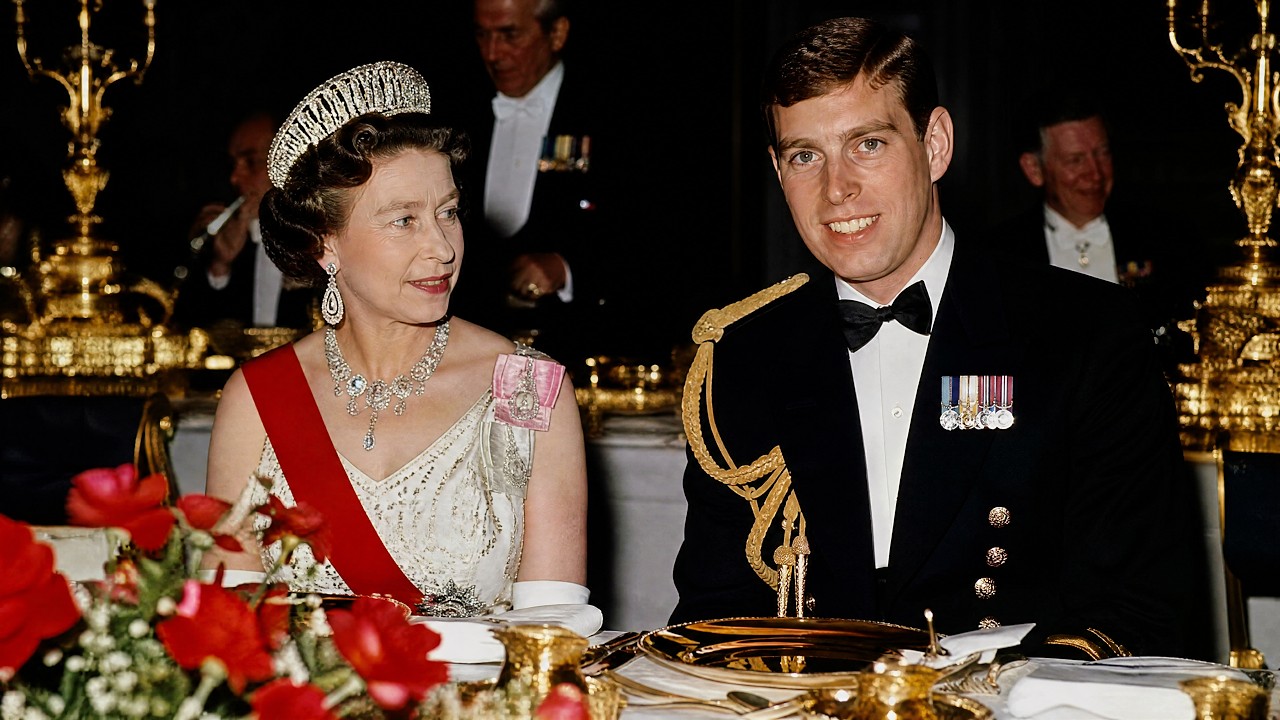
Andrew was born second in line to the throne, directly behind his elder brother Charles, and he would hold that position for more than 22 years. Biographers have long observed that the queen was warmer and more forgiving with Andrew than with her other children, indulging him as she never did the older ones, and tracing to that indulgence the easy confidence he carried through his whole life. Whether he was truly the favorite is a claim biographers repeat but the queen never confirmed, and some royal historians dispute it entirely. The father saw something else in him.
Prince Philip, a former naval officer who had given up his career to be prince consort, found in Andrew the hard, capable, uncomplicated temperament he had hoped for in a son, one who might follow him into the one world he had loved and been forced to leave. In 1979, Andrew joined the Royal Navy and trained as a helicopter pilot. The service was the one place where being a prince counted for less than being competent, and he took to it, earning a skill that gave him an identity the position of second son had never provided. In the spring of 1982, Argentine forces seized the Falkland Islands, and Britain assembled a task force to take them back.
Andrew sailed toward the fighting as a Sea King helicopter pilot aboard the aircraft carrier Invincible. There was pressure to keep him home because he was second in line to the throne, but the queen refused to pull her son back from the front line, saying that serving officers went where they were sent. He flew anti-submarine patrols, casualty evacuations, and most strikingly, flown as a decoy, hovering behind the fleet to draw incoming Exocet missiles away from ships full of men. It was a job that put his life on the line to protect others, and by any measure he shared the danger.
In June 1982, while he was at sea, the birth of Charles’s first child quietly moved Andrew down the line of succession, but the war made him a hero. As the conflict ended, the task force returned home, and the Queen’s public relief at Portsmouth revealed what those weeks of waiting had cost her. Andrew came back a hero, the most admired member of his generation of the royal family. On the morning of his wedding in 1986, the queen gave him a dukedom that carried special weight, the title of Duke of York, which had belonged to her own father before he became King George VI.
She also made him Earl of Inverness and Baron Killy, but the dukedom was the personal gift, a direct line of feeling running back to the father she had adored and lost too young. The wedding to Sarah Ferguson at Westminster Abbey was watched by hundreds of millions, and the young Duke and Duchess of York seemed to promise the cheerful continuity the monarchy badly needed. Two daughters, Beatrice and Eugenie, followed in 1988 and 1990. The marriage, however, was built on a fault line.
Andrew was a serving naval officer who was absent at sea for months at a time, while Sarah, who had entered the royal family from the outside, found its rules cold and its scrutiny merciless. The press that had adored her turned on her with speed. In 1992, the year the queen called a horrible year, the couple separated, and the divorce was finalized in 1996. Then they did something almost no one expected.
They went on sharing a home, raising their daughters side by side, defending each other in public for decades. The marriage failed, but the friendship endured. By the start of the new century, Andrew was a divorced royal duke, no longer a serving officer, drifting into middle age with no purpose. In 2001, the palace invented one for him, appointing him the United Kingdom’s special representative for international trade and investment.
He became a traveling salesman for British business, opening doors that no civil servant could, meeting heads of state, foreign royalty, and the managers of vast state investment funds. But the role sent a man with a deep taste for luxury into the most luxurious and least supervised circles on earth, a world of private jets, grand estates, and hospitality extended by men who understood exactly what the friendship of a prince was worth. The deeper trouble was the company he kept. Across the trade years, Andrew formed friendships with controversial figures, including links to the family of the Libyan leader Muammar Gaddafi and dealings with shadowy businessmen.
But one friendship stood apart from the rest, and in time it would swallow everything. He had known Ghislaine Maxwell since his university years, and through her he was drawn into the orbit of an American financier named Jeffrey Epstein. To Andrew, Epstein was a rich friend who opened his homes and his aircraft, a convenience for a prince with expensive tastes. To Epstein, the friendship with the queen’s son conferred a respectability that money alone could not buy.
People who tried to warn Andrew found a man who would not hear it. He had spent his whole life being treated as right, and he did not readily accept that his own judgment might be poor. In 2008, Epstein was convicted in Florida of a soliciting offense involving a minor and served a lenient sentence, but the essential fact was now a matter of public record. Andrew did not walk away.
In December 2010, more than two years after the conviction, he was photographed strolling through Central Park with Epstein, an image that did more damage than a thousand words of allegation. He later explained that he had traveled to New York to end the friendship in person, but the optics were catastrophic. In July 2011, he stood down from the trade role. Behind the friendship lay far graver allegations.
A photograph reportedly taken in 2001 at Maxwell’s London house showed Andrew with his arm around the waist of a young woman named Virginia Roberts, later Giuffre, who alleged that she had been trafficked by Epstein and made to have sexual encounters with Andrew when she was a teenager. Andrew denied the allegations completely and consistently. He was never charged with any criminal offense, never convicted, and no court ever made a finding of fact against him. Those allegations were never tested in a criminal trial, and that distinction must be held onto.
In the summer of 2019, Epstein was arrested on federal sex trafficking charges, and then in August he died in custody. The scrutiny that could no longer fall on him fell instead on his famous friends, and no friend was more exposed than Andrew. The old strategy of waiting was impossible now. The scandal was global, and the House of Windsor itself was paying the price.
Andrew, confident as ever, decided he could fix it by going on television. On the 16th of November 2019, he sat down with journalist Emily Maitlis inside Buckingham Palace for nearly an hour. It was one of the most catastrophic interviews ever given by a public figure. He defended having stayed at Epstein’s homes, expressed no real sympathy for the victims, and offered strange defenses, claiming he was physically unable to sweat and that on one relevant date he had taken his daughter to a Pizza Express in Woking.
The country recoiled. Within four days, it was announced that Andrew would step back from public duties for the foreseeable future. His patronages fell away one after another. In January 2022, as a civil claim brought by Virginia Giuffre advanced, it was announced that Andrew’s military affiliations and royal patronages had been returned to the queen, and he would no longer use the style His Royal Highness.
In February 2022, he reached an out-of-court settlement with Giuffre. The settlement contained no admission of liability, and no court found the allegations true or false. It involved a payment widely reported to be in the region of twelve million pounds, and a statement acknowledging that Giuffre had suffered as a victim of Epstein. It was widely reported, though never confirmed, that the queen herself helped fund the settlement.
On the 29th of March 2022, at the memorial service for Prince Philip, the Queen chose Andrew to escort her into Westminster Abbey, leaning on the arm of her disgraced son in a deliberate, public statement. She would not cast him out. But the shield was mortal. In September 2022, Queen Elizabeth II died.
The protection that had stood between Andrew and the full weight of the world for 62 years came down, and it would not be rebuilt. King Charles felt first as a king. Within three years, the reckoning arrived. Virginia Giuffre died in the spring of 2025, and in October her memoir, published under her name, returned the allegations to the front pages with renewed force.
On the 17th of October 2025, Andrew announced he would no longer use his title, while maintaining his innocence. Days later, on the 30th of October, Buckingham Palace announced that the King had initiated a formal process to remove the style, titles, and honors of Prince Andrew. He would be known as Andrew Mountbatten-Windsor. Formal notice was served to surrender the lease on Royal Lodge, the grand house in Windsor Great Park that had been his home for more than twenty years.
The palace explicitly noted that these censures were deemed necessary notwithstanding the fact that he continues to deny the allegations. He was being removed not as a man found guilty, but as a liability the crown could no longer carry. In February 2026, Andrew moved to a house on the Sandringham estate. On the 19th of February 2026, the same date on which, 66 years earlier, the country had celebrated his birth, police arrested Andrew Mountbatten-Windsor on suspicion of misconduct in public office.
He was questioned, his properties were searched, and he was released under investigation. The allegation concerned his years as a trade envoy, that he had passed confidential information to Epstein in or around 2010. He was not charged, not tried, not convicted, and he denies any wrongdoing. Asked about the arrest, King Charles said that the law must take its course, and that the royal family would continue in its duty and service.
There was no defense of Andrew in those words. The story is not really about Epstein. It is about protection, and what happens to a person who is shielded from every consequence for 62 years. Andrew was never allowed to fail, and so he never learned how to stand.
The queen’s love was real, but it left him defenseless for the day the consequences came all at once. Within three years of her death, a brother who felt first as a king did what a mother who felt first as a mother never could. He let the institution act, and the institution took back everything it had given.
What remains is not a prince, not a hero, not even a royal highness, only a man under investigation, and the memory of a mother who could not stop loving him, and the ruin that her love, for all its warmth, could not prevent.