Richard II gave up his crown on the condition that his cousin Henry Bolingbroke swear to spare his life. Henry made that promise. He broke it. Richard’s end was not a quick execution, not a beheading or a hanging.
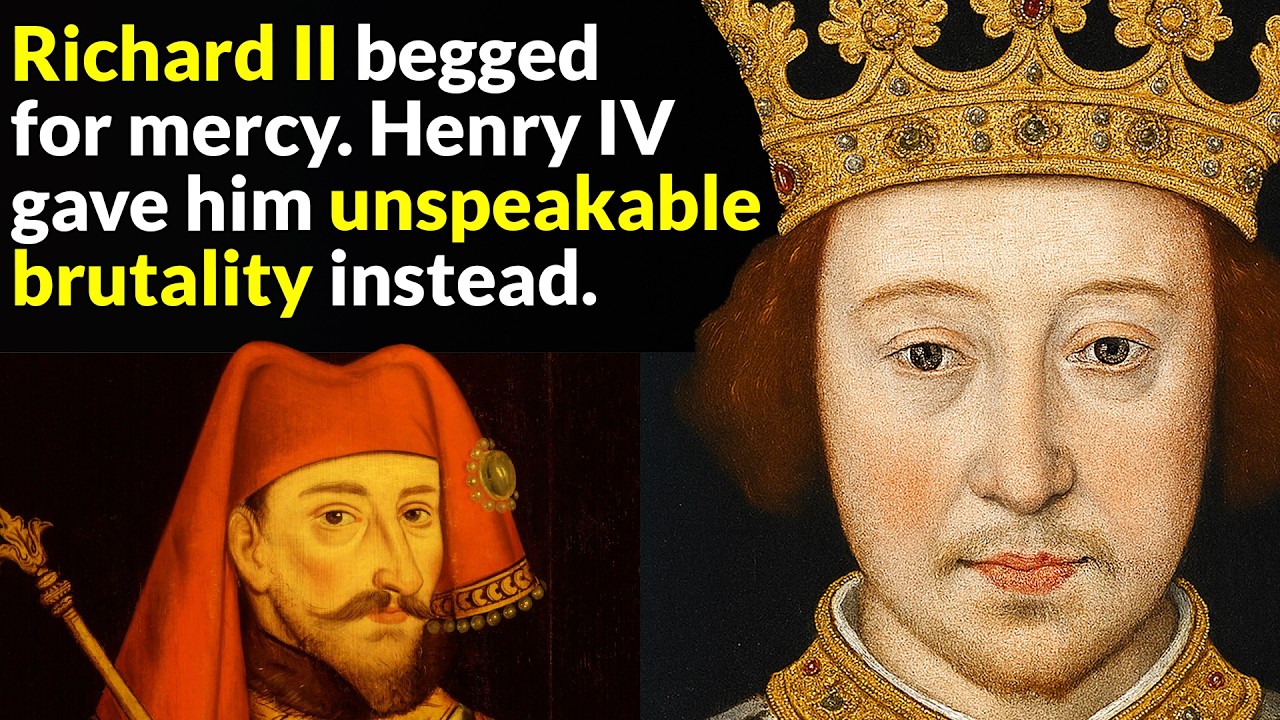
It was a slow, deliberate starvation inside a prison cell, a death designed to look like the quiet decay of a forgotten captive. When it was over, Henry displayed the emaciated body of the former king in St. Paul’s Cathedral, a grim proof that the Plantagenet line had passed into new hands. Richard’s path to that cell began in southwestern France.
He was born in 1367 in the port city of Bordeaux, the son of Edward the Black Prince, Prince of Wales, and Joan, Countess of Kent. He was not born a king’s son, because his father never became king. In fact, Richard should never have become king at all. He was the Black Prince’s youngest son, and it was his older brother Edward who stood to inherit the crown.
Then the bubonic plague struck. The elder Edward died at just six years old. The grief destroyed his father. Already suffering from dysentery, the Black Prince wasted away and died before ever reaching the throne.
Richard was left alone in the succession. He was only ten years old when he was crowned King of England. His coronation was a spectacle. London celebrated for two days, with wine flowing from the city’s fountains and a temporary castle erected in the center of the capital.
Inside its towers stood four maidens who showered the young king with gold as he passed. Richard, by all accounts, was a striking figure, tall and handsome, physically at least. He was also intelligent and well read, though he stammered when upset. Those close to him would come to recognize that stammer as an early warning sign of the tempests brewing inside him.
The first great test of his reign came in 1381, when he was only fourteen. After years of heavy war taxation, rebellion erupted across the countryside. The Peasants’ Revolt swept into London, and mobs burned and looted key buildings across the capital. Richard hid in the Tower of London at first.
Then he realized that hiding would cost him his crown. On June 13th, he took to the River Thames to meet the rebels face to face and negotiate. He granted them clemency, and the revolt dispersed. Then he revoked the pardon and personally led troops into the field to crush the remaining stragglers.
He was terrifyingly successful. The revolt, which might have destroyed a weaker king, instead baptized Richard in blood and taught him a dark lesson he never forgot: mercy was a tool to be used and discarded, and absolute authority had to be guarded at all costs. As Richard aged, that lesson curdled into something far uglier. He became convinced he was God’s chosen ruler.
He surrounded himself with favorites, insulated his court from the outside world, and proved ruinously susceptible to flattery. He was a patron of arts and culture, and his refined court helped English develop as a literary language. Geoffrey Chaucer, the father of English literature, worked in his court early in his career. Richard also had a taste for Gothic jewelry and extravagant textiles, and he spent vast sums on adornments for himself and his loved ones.
Some historians have since suggested he may have suffered from schizophrenia or, more recently, a narcissistic personality disorder. Whatever the clinical truth, his behavior grew increasingly tyrannical as his reign continued. His marriage initially softened him. At fifteen, he wed Anne of Bohemia, the daughter of the Holy Roman Emperor Charles IV.
On paper, the match was bizarre. Anne brought no dowry. Everyone opposed the union except the couple themselves. Richard had to pay her family for the privilege of marrying her.
They wed at Westminster Abbey on January 20th, 1382, and for twelve years, Anne was a steadying influence. Historians have widely credited her with making Richard more compassionate and moderating his violent tendencies in matters of state. He repaid her with near-total devotion. His political troubles, meanwhile, would not wait.
In 1387, a faction of Parliament called the Lords Appellant managed to strip all his favored courtiers from power. Richard bided his time, regained control, and then exacted a brutal revenge. He hunted down nearly every one of his enemies and executed them. Then he went into the countryside and executed the common people who had supported the Lords Appellant.
His tyranny had begun in earnest. In 1394, disaster struck. Anne fell ill with the bubonic plague, the same disease that had killed Richard’s brother and weakened his father. She died at Sheen Manor.
Richard was so devastated that he had the manor demolished so he would never have to look at it again. Without Anne, his behavior spiraled. On a campaign in Scotland not long afterward, he received news of his mother’s death. In what many would call an act of madness, he unleashed his men on Edinburgh, and they nearly destroyed the city.
Unwilling to risk love again, Richard arranged a strictly political marriage with the French princess Isabella of Valois. Isabella was six years old. Richard was twenty-nine. When his advisers objected, he dismissed them with a flippant remark: each day would make the problem go away.
But the problem did not go away. Richard remained childless, and his child bride could not produce an heir for years to come. That lack of an heir left him dangerously exposed. His final mistake was sparing his enemies.
After his purge of the Lords Appellant, he allowed a handful to live, including his cousin Henry Bolingbroke. Henry’s royal blood saved him from execution, but Richard went further. In a bizarre attempt to placate him, he made Henry a duke. Then he turned on him.
First, Richard exiled Henry. When Henry came into an inheritance, Richard seized all his property and extended the exile. Richard believed he was neutralizing a rival. In truth, he was creating one.
Henry Bolingbroke returned to England to claim his inheritance, and he could not have chosen a better moment. Richard was away in Ireland, and most of the nobles loyal to him were with him. Henry landed and gathered supporters as he marched. Richard was profoundly unpopular by then, and the tide had shifted.
At first, Henry swore he only wanted what was his, not the crown. It was Richard who changed everything. With his lifelong distaste for battle, he surrendered to his cousin almost immediately after returning from Ireland and desperately offered Henry the crown in exchange for his life. Henry accepted the crown, and Richard lost it.
The former king was imprisoned in the Tower of London, where he immediately regretted his capitulation and threw tantrums, demanding his crown back. On October 13th, 1399, Henry was officially crowned King Henry IV. The promise to spare Richard’s life quickly proved impossible to keep. A living former king was a dangerous political threat, a rallying point for anyone unhappy with the new regime.
Henry realized Richard had to die. But instead of a swift execution, he chose a slower and more terrible method. In his cell, Richard was starved, little by little, day by day, until the former king finally succumbed. Then, on February 17th, Henry displayed Richard’s cold, emaciated body in St.
Paul’s Cathedral for all of London to see. The message was unmistakable: Richard II was truly gone. Henry buried him hastily and without ceremony at King’s Langley Priary, an undignified end for a man who had once been so obsessed with royal pomp. It was not until more than a decade later that Richard finally received a measure of peace.
Henry’s own successor ordered the remains moved to Westminster Abbey, where Richard was entombed at last beside the woman he had loved, his Queen Anne of Bohemia.