On December 18, 1944, near the Belgian village of Stavelot, a column of German halftracks moved through the pre-dawn darkness. They were part of Kampfgruppe Peiper’s spearhead, driving deep into American lines during the opening phase of the Battle of the Bulge.
The lead vehicle was an Sd.Kfz. 251 halftrack, a Hanomag-built transport that had carried German infantry across Russia, North Africa, and France. Its 8 mm frontal armor was designed to stop rifle fire and shell fragments. The crew trusted the vehicle. It had brought them through three years of war.
Then the column reached an intersection. A low, angular shape blocked the road ahead. Six wheels. A turret with a small gun. It was an American M8 Greyhound armored car.
German intelligence had classified the M8 as a reconnaissance vehicle: lightly armed, fast, and fragile. The kind of vehicle that ran away when it encountered real combat power. The halftrack commander made a quick calculation. The armored car was alone. His column had three halftracks and heavier support behind. If the American crew had any sense, they would reverse and disappear.
The Greyhound did not move. Its turret traversed slowly, bringing its gun to bear on the lead halftrack.
The muzzle flash came first. Then the crack of a small-caliber gun. The 37 mm armor-piercing round struck the front plate of the Sd.Kfz. 251 at roughly 200 meters. The 8 mm armor offered no meaningful resistance. The round punched through cleanly, traveling through the crew compartment at over 2,000 feet per second.
The round struck the radio equipment behind the driver’s position and fragmented into dozens of pieces of shrapnel. The driver slumped forward. The vehicle coasted to a stop, engine still running, blocking the road.
The second halftrack tried to swing around the disabled lead vehicle. The Greyhound’s turret traversed again. Another shot. Another penetration. This round struck the halftrack’s side armor, only 6 mm thick. It went through both sides of the vehicle, entering the left and exiting the right, passing through the crew compartment in between.
By the time the third halftrack reversed and the column scattered for cover, two German vehicles were disabled and 11 men were dead or wounded. The American armored car had fired four rounds. Its commander, having accomplished exactly what he had been ordered to do, reversed smoothly and disappeared down a side road.
The surviving Germans spent the rest of that cold December morning trying to understand what had happened. They had been told American armored cars were scouts, observers, vehicles that avoided combat. No one had told them a scout car’s gun could kill a halftrack.
The Sd.Kfz. 251 was not an accident of design. It was the product of careful military thinking from the mid-1930s, when German planners recognized that mechanized warfare required infantry to keep pace with tanks. Traditional infantry moved at walking speed. Motorized infantry in trucks could move faster, but trucks were soft-skinned and vulnerable to small arms fire.
The solution was the armored halftrack: a vehicle that combined the road speed of a truck with enough armor to protect its crew from rifle fire and shell fragments. Hanomag received the development contract in 1937. The vehicle would carry 10 infantrymen plus a crew of two. It would be open-topped to allow infantry to fire while mounted and to dismount rapidly.
What German intelligence failed to calculate was whether a 37 mm gun could penetrate the halftrack’s armor. The mathematics were simple. The halftrack had 8 mm of frontal armor. The 37 mm armor-piercing round could penetrate 36 mm at 500 yards. The gun had four times the penetrating power necessary to defeat the halftrack’s best armor.
At typical combat ranges under 500 meters, the M8’s gun could punch through the halftrack’s armor as if it were sheet metal. The rounds would penetrate cleanly, travel through the crew compartment, and either exit through the opposite side or fragment inside, turning the interior into a killing zone.
By December 1944, thousands of M8 Greyhounds were operating across Western Europe. They had proven themselves effective reconnaissance vehicles. Their crews had learned the vehicle’s capabilities through months of combat. The German troops in the halftracks had learned nothing about the Greyhound’s lethality against their vehicles.
The M8 Greyhound that blocked the road at Stavelot was assigned to Troop B, 87th Cavalry Reconnaissance Squadron, part of the 7th Armored Division. The vehicle had been in service since August 1944. Its crew had been together for five months.
Staff Sergeant Robert Harper commanded the vehicle. He was 24 years old, from Michigan, a former automobile mechanic who had enlisted in 1942. His training at Fort Riley, Kansas, had been thorough. The Army taught reconnaissance crews to think of their armored cars as mobile observation posts, not fighting vehicles. But the training also emphasized that when combat was unavoidable, the 37 mm gun was a legitimate weapon.
Harper’s gunner, Corporal James Mitchell, had fired hundreds of practice rounds. He knew the gun’s ballistics, knew how to estimate range, knew which ammunition to select for different targets. Armor-piercing shot for vehicles. High explosive for infantry and soft targets. Canister rounds for close-range defense.
The gun could fire 15 to 20 rounds per minute with a skilled crew. The turret held 16 ready rounds, with another 44 stored in the hull. The armor-piercing shot weighed 1.61 pounds and had a hardened steel core designed to punch through armor plate.
German intelligence had assessed the 37 mm gun based on its performance against German tanks. A Panzer IV’s frontal armor was 80 mm thick. A Panther’s was 100 mm. Against these targets, a 37 mm gun was useless. Rounds would bounce off harmlessly.
What the assessment failed to address was the gun’s performance against lighter targets. The Sd.Kfz. 251 halftrack fell well within the penetration envelope of the 37 mm armor-piercing round. At ranges under 1,000 yards, the gun could penetrate the halftrack from any angle. At ranges under 500 yards, the rounds would overmatch the armor completely.
At 200 meters, the 37 mm round retained a velocity of approximately 2,600 feet per second. At this velocity, it could penetrate 48 mm of homogeneous armor plate. The halftrack’s 8 mm armor represented less than one-fifth of the gun’s penetration capability at that range.
Inside a halftrack, the crew compartment measured approximately 4 meters long and 1.8 meters wide. When a 37 mm round penetrated the front armor, it had 4 meters of space to travel before exiting through the rear. In that space were seated or standing up to 12 men. The round would strike the first solid object in its path, fragmenting into dozens of pieces of shrapnel, each traveling at lethal velocity.
German halftrack crews had no training for this scenario. Their doctrine assumed that if they encountered enemy armor, they would dismount and withdraw while heavier German vehicles engaged the threat. The halftrack was a battle taxi, not a combat vehicle.
But reconnaissance doctrine sometimes placed halftracks in exactly these vulnerable positions. German mechanized reconnaissance units used halftracks to transport infantry rapidly along roads, probing for enemy positions. When they made contact, the infantry would dismount while the halftracks provided covering fire with machine guns.
This doctrine worked well when the enemy followed predictable patterns. If American armored cars withdrew when they encountered German forces, the halftracks were safe. But if an American armored car chose to fight, the doctrine broke down catastrophically.
Harper’s training had included target identification. He knew halftracks were thin-skinned vehicles. He had been told explicitly that his 37 mm gun could penetrate halftrack armor at combat ranges.
When he saw the German column approaching in the pre-dawn light, Harper made a rapid tactical assessment. Three halftracks moving in column formation. No tanks visible. Range approximately 200 meters. His own vehicle was in a hull-down position with good fields of fire and a clear route for withdrawal.
The decision to engage took perhaps three seconds. Mitchell already had the gun laid on the lead vehicle. Harper gave the fire command.
The impact was visible even in the dim morning light. A flash of sparks where the round struck the halftrack’s frontal armor. The vehicle’s forward motion stopped immediately.
Mitchell was already loading the second round. The turret traverse motor hummed as Harper adjusted aim to the second vehicle. The German driver was attempting to maneuver around the disabled lead vehicle. Mitchell fired. Another hit. This time on the side armor.
The third halftrack reversed frantically, its driver throwing the vehicle into gear and backing away from the intersection. Unteroffizier Hans Weber, commanding the third vehicle, had watched in disbelief as both vehicles ahead of him were hit and stopped within seconds.
Weber screamed orders to his driver to get off the road. The halftrack backed into a side street. His machine gunner tried to acquire the target, but in the dim morning light, he could not find it.
At the intersection, Harper ordered Mitchell to hold fire. The third vehicle had withdrawn out of sight. Engaging it would mean exposing their position further. Harper’s mission was reconnaissance and screening, not sustained combat.
The radio operator called back to the troop command post. Three halftracks engaged. Two disabled. One withdrawn. The transmission took less than 30 seconds. Harper ordered his driver to back the Greyhound out of its position and move to an alternate position 300 meters south.
Behind them, German infantry were dismounting from vehicles further back in the column. Weber’s halftrack crew was attempting to recover wounded from the two disabled vehicles.
What they found was devastating. The first halftrack had the round enter just above the driver’s position. The armor-piercing shot punched through cleanly, traveled the length of the crew compartment, struck the radio equipment, and fragmented. The driver was dead. The vehicle commander was dead. Three of the 10 infantry passengers were dead. Four more were wounded.
The second halftrack was worse. The round struck the side armor at an almost perpendicular angle, penetrating just behind the driver’s compartment. It traveled through the crew area, passed through two men completely, and exited through the opposite side armor. Five dead. Three wounded.
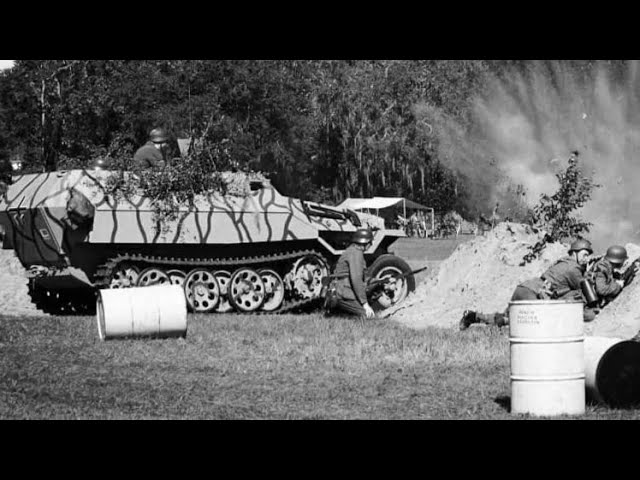
Oberleutnant Friedrich Steiner, the platoon commander, arrived within minutes. He had been riding further back in the column. What he saw shook him. Two vehicles disabled. Eight men dead. Seven wounded. Clean holes punched through the armor.
Steiner had been in combat since 1941. He had fought in Russia, where Soviet anti-tank rifles and 45 mm guns had penetrated halftracks many times. But those were dedicated anti-tank weapons. This was an armored car, a reconnaissance vehicle.
He examined the penetration holes carefully. The armor had been defeated completely. There was no evidence of glancing blows or partial penetration. The rounds had gone straight through.
Steiner realized immediately that every halftrack in the column was vulnerable to these weapons. The intelligence briefings had been wrong. Yes, American armored cars mounted 37 mm guns that were ineffective against German tanks. But those same guns were highly effective against halftracks and any other target with armor under 30 mm thick.
The psychological impact was immediate. If armored cars could kill halftracks, then halftrack crews were vulnerable every time they encountered American reconnaissance units.
Kampfgruppe Peiper’s war diary noted the engagement at Stavelot, recording the loss of two halftracks to enemy fire. The initial report characterized the attack as coming from anti-tank guns. Later reports, after examination of the vehicles, corrected this to armored cars.
The information was not new to German intelligence. The specifications for the M8 Greyhound were known. The capabilities of the 37 mm gun were documented. What had been missing was the analytical step of calculating whether these guns posed a threat to German vehicles.
American after-action reports from the same engagement were matter-of-fact. Harper filed his combat report on December 19th, noting that his crew had engaged three enemy halftracks at approximately 0330 hours, scoring two penetrating hits and causing one vehicle to withdraw. The report estimated eight to 10 enemy casualties. The entire engagement had lasted less than two minutes.
News of the Stavelot engagement spread through Kampfgruppe Peiper over the following days. Other units reported similar encounters.
Near Stoumont, a platoon of halftracks encountered two M8 Greyhounds blocking a crossroads. The American vehicles engaged from hull-down positions at approximately 300 meters. Three halftracks were hit before the column could withdraw and call for tank support. By the time a Panzer IV arrived, the Greyhounds had withdrawn. Seven more German soldiers were dead. Five were wounded.
Near Trois Ponts, a reconnaissance patrol in halftracks ran into an American cavalry screen. Three M8s opened fire simultaneously from different positions. The crossfire was devastating. Four halftracks were hit in the first 30 seconds. The surviving vehicles withdrew under smoke. 14 German soldiers died. Nine were wounded.
Each engagement followed the same pattern. German halftracks approached an American position. American armored cars engaged from covered positions at ranges between 200 and 500 meters. The 37 mm guns penetrated the halftrack armor cleanly. The halftracks withdrew and called for heavier support. By the time tanks or assault guns arrived, the American armored cars had displaced.
Within three days of the start of the German offensive, halftrack commanders throughout the attacking formations understood they faced a serious threat. Orders went out to battalion and regiment level. Halftracks were not to engage American armored cars without tank support. Reconnaissance patrols that encountered M8s were to report the contact and withdraw.
This represented a fundamental shift in German tactical doctrine. Halftracks had been aggressive reconnaissance vehicles, expected to push forward rapidly. Now they were being ordered to avoid contact with one of the most common vehicles in the American inventory.
German reconnaissance became more cautious. Halftrack patrols that previously would have pushed aggressively now held back when they suspected enemy reconnaissance vehicles were in the area. This slowed German tempo and gave American forces more time to respond.
Obersturmbannführer Joachim Peiper noted in his combat journal that American armored cars were proving unexpectedly dangerous to his reconnaissance elements. He requested additional tank support for his forward units, but tanks were needed for the main assault.
Some German units led reconnaissance patrols with a tank or assault gun, with halftracks following behind. This provided firepower to engage American armored cars effectively. But tanks were slower than halftracks on roads, consumed far more fuel, and were needed for primary offensive operations.
The impact on German infantry morale was subtle but real. The panzergrenadiers who rode in the halftracks had trusted these vehicles to protect them from small arms fire. Now they understood that American reconnaissance vehicles could penetrate their armor easily.
American reconnaissance units, meanwhile, gained confidence. The word spread through cavalry squadrons. The M8’s reputation grew from scout car to can fight if necessary. Commanders became more willing to order their armored cars to stand and fight when the tactical situation warranted it.
Training doctrine in the United States was updated. New crews arriving in Europe were explicitly taught that their 37 mm guns were effective against German halftracks, armored cars, and other light armored vehicles.
German planners, reviewing the combat reports, recognized they had made a fundamental miscalculation. They had designed the halftrack’s armor to resist the threats they expected in the late 1930s: rifles, machine guns, and artillery fragments. They had not adequately considered the threat from guns in the 37 to 45 mm range.
By the time this became apparent in combat, it was too late to redesign the vehicle. Germany’s industrial capacity was fully committed to existing production.
The United States Army Armor School at Fort Knox conducted detailed studies of cavalry operations in Europe after the war. The conclusion was that the M8 had been highly effective in its designed role. The vehicle provided excellent reconnaissance capability, had sufficient firepower to engage enemy light armor, and was reliable enough to operate far from supply lines.
German military historians reached different conclusions. The half-track had been a successful design for its intended purpose, but that purpose had been defined in the late 1930s. By 1944, the battlefield had evolved in ways that made the half-track increasingly vulnerable.
The Federal Republic of Germany, rebuilding its military in the 1950s, chose not to develop new half-tracks. Instead, they adopted fully tracked armored personnel carriers with thicker armor and enclosed crew compartments. The M113 had aluminum armor up to 38 mm thick on the frontal arc, twice the protection of the wartime half-track.
Weber, the German halftrack commander who survived the Stavelot engagement, immigrated to Canada after the war. In a 1982 interview with a military historian, he described December 18th, 1944 as the day he understood Germany would lose the war. Not because of the two halftracks destroyed, but because of what those destroyed vehicles represented.
American forces had equipment that worked in quantities that seemed endless, operated by crews who were well-trained and confident. German forces were making do with equipment that was increasingly inadequate.
Harper returned to Michigan after the war and resumed his career as an automobile mechanic. He owned a service station in Detroit for 35 years. In a 1976 newspaper interview commemorating the Battle of the Bulge, he described the December engagement simply: “We had a good vehicle, good training, and good equipment. We did our job. That’s all there was to it.”
Mitchell, Harper’s gunner, became a high school teacher in Ohio. His description of combat was clinical and unemotional. He had aimed the gun, pressed the trigger, and hit the target. The training had worked. The equipment had functioned as designed.
The difference in perspective between the German and American veterans was striking. German survivors remembered the shock, the disbelief, the realization that their equipment was inadequate. American veterans remembered confirming what they had been taught.
The broader historical significance of these engagements lies not in their immediate tactical impact, which was relatively minor, but in what they revealed about industrial warfare between modern nations. Victory in such conflicts depends on industrial capacity, logistical systems, training infrastructure, and the ability to produce reliable equipment in quantities sufficient to equip entire armies.
The M8 Greyhound was not a remarkable vehicle by the standards of World War II. It was not the fastest armored car, not the best armed, not the most heavily protected. But it was good enough for its mission, reliable enough to stay operational, and produced in quantities large enough to equip all the reconnaissance units that needed it.
The Sd.Kfz. 251 halftrack was also not a remarkable vehicle. It was adequate for the threats anticipated when it was designed, but those threats evolved faster than German industry could respond. The vehicle remained in service not because it was good enough, but because there was nothing better available in sufficient quantities.
The German soldiers who climbed into halftracks, knowing that American armored cars could kill them, faced a terrible choice. They could refuse to perform their missions, which meant abandoning their comrades and their duty, or they could continue, accepting the risk that inadequate equipment imposed. They chose to continue, and many died because of it.
The American crews who engaged these German vehicles faced no such dilemma. Their equipment worked. Their training prepared them. Their industrial base supported them. They performed their missions with confidence that their tools were adequate for the task.
When those first rounds penetrated the halftrack armor at Stavelot, they proved something that would echo through military planning for decades afterward. In modern industrial warfare, material matters. Production capacity matters. Logistical systems matter. No amount of tactical skill or battlefield experience can overcome fundamental material inadequacy when the disparity is large enough and sustained long enough.
The German troops who called the M8 Greyhound a scout car were not wrong based on the vehicle’s designated role. But they were catastrophically wrong about what that scout car could do to their vehicles. The 37 mm gun they had dismissed as obsolete was perfectly adequate for killing halftracks.
By the time they learned this lesson, thousands of German soldiers had already died in vehicles whose armor could not protect them from weapons their enemy considered standard equipment on reconnaissance vehicles.
The mathematics that determined the outcome of their encounters remains unchanged. Physics does not care about courage, doctrine, or national identity. A 37 mm round with sufficient velocity will penetrate 8 mm armor. That was true in December 1944, and it remains true today.