On June 6, 1944, at roughly 1:15 in the morning, a C-47 transport carrying the headquarters element of Easy Company, 506th Parachute Infantry Regiment, was struck by German anti-aircraft fire. Every man aboard was killed. Richard Winters, then a first lieutenant, jumped into the dark sky over Normandy, landed safely near Sainte-Mère-Église, and found himself without his weapon and without his company commander. Lieutenant Thomas Meehan, who had taken command of Easy Company earlier that year, was among those lost in the burning aircraft.
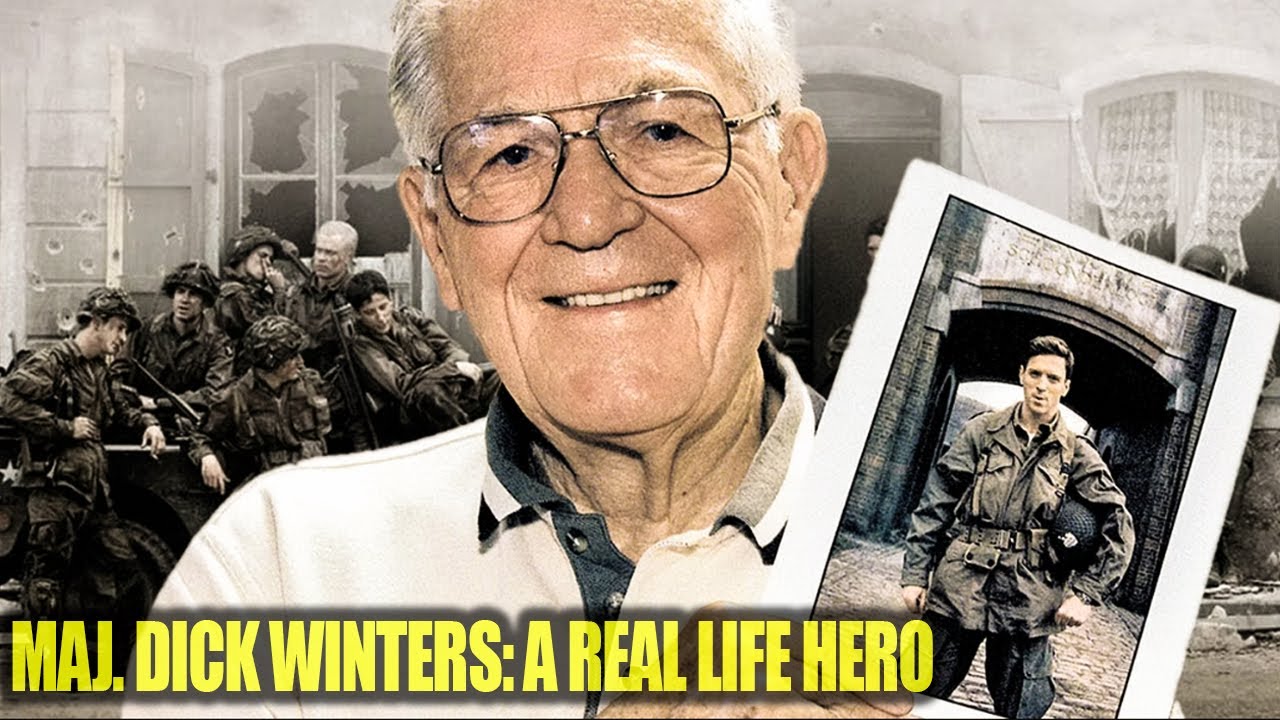
Winters immediately began gathering scattered paratroopers, some from the 82nd Airborne, and led them toward the unit’s objective near Sainte-Marie-du-Mont. He would remain the de facto commanding officer of Easy Company for the rest of the Normandy campaign. Winters was born on January 21, 1918, in Ephrata, Pennsylvania, and raised in nearby Lancaster. He attended Franklin and Marshall College, where he balanced his studies with part-time jobs and his favorite sport, wrestling.
He graduated from the business college in 1941, just as the war in Europe was expanding. He enlisted in the U. S. Army on August 25, 1941.
After basic training at Camp Croft, South Carolina, he was selected for Officer Candidate School at Fort Benning, Georgia, where he formed a friendship with a fellow candidate named Lewis Nixon that would last a lifetime. On July 2, 1942, he was commissioned a second lieutenant. Drawn to the parachute infantry, he joined the newly formed 506th Parachute Infantry Regiment at Camp Toccoa, Georgia, in August of that year. He was assigned to Company E, soon known as Easy Company, under the command of First Lieutenant Herbert Sobel.
Winters initially led the second platoon and was later promoted to first lieutenant and acting company executive officer. The training at Toccoa was brutal, and the 506th was the first regiment to undergo airborne training as a full unit. With little prior military experience among the volunteers, the attrition was severe. Only 148 of 500 officer candidates completed the course, and only 1,800 of 5,300 enlisted volunteers were accepted.
On June 10, 1943, the regiment was attached to the 101st Airborne Division. They sailed for England, arriving in Liverpool on September 15, 1943, and settled at Aldbourne in Wiltshire, where they trained intensively for the invasion of Europe planned for 1944. Tensions between Winters and Sobel reached a breaking point in late 1943. Winters had long questioned Sobel’s leadership, and the enlisted men had begun to look to Winters instead.
When Sobel brought formal charges against Winters for disobeying an order, Winters demanded a court-martial rather than accept the punishment. The battalion commander set aside the charges, but Sobel filed new ones the next day. During the investigation, Winters was transferred to headquarters company and given the unusual post of battalion mess officer. In the midst of this conflict, a group of noncommissioned officers confronted the regimental commander, Colonel Robert Sink, and presented him with an ultimatum: replace Sobel or lose their stripes.
Sink responded firmly, demoting and transferring several of the NCOs. But he also recognized that change was necessary. Sobel was reassigned to command a parachute training school, Winters’s court-martial was set aside, and Winters returned to Easy Company as leader of the first platoon. First Lieutenant Thomas Meehan then assumed command of the company in early 1944 and oversaw final preparations for the invasion.
In the chaos of the Normandy drop, Winters gathered his small force and moved toward the objective. The American command had estimated the German position near the village of Brécourt Manor and the causeways leading away from Utah Beach was defended by roughly fifty German troops. Winters had only thirteen men. He led the assault anyway, destroying a battery of German 105 mm howitzers that threatened the beach exits.
The attack south of Le Grand Chemin succeeded so completely that it later became a textbook example of an assault on a fortified position and was taught at the U. S. Military Academy at West Point. Winters also seized a map detailing German gun emplacements in the Utah Beach area.
On July 1, 1944, he was promoted to captain. The following day, General Omar Bradley, commanding the First Army, presented him with the Distinguished Service Cross. After the Normandy campaign, the 506th returned to Aldbourne to reorganize. In September 1944, the regiment took part in Operation Market Garden in the Netherlands.
On October 5, 1944, a German force struck the flank of the second battalion, and a patrol from Easy Company returned wounded, reporting a sizable German contingent at a crossroads just over a thousand yards east of the company command post. Winters took a squad from the first platoon and advanced toward the crossroads. They found a German machine gun firing southward toward the battalion headquarters. Winters led a direct assault on the gun crew, then came under fire from a German position across the way.
Estimating the enemy strength at more than a platoon, he called up the rest of the first platoon. Unbeknownst to them, they were facing roughly three hundred Germans. On October 9, Winters became battalion executive officer, a role normally held by a major, though he still carried the rank of captain. On December 16, 1944, the Germans launched their counteroffensive in Belgium that became known as the Battle of the Bulge.
The 101st Airborne moved to Bastogne on December 18. With Winters serving as executive officer of the second battalion, the unit stood fast against fifteen German divisions supported by heavy artillery and armor. It took nearly a week before the U. S.
Third Army broke through the encircling ring and offered relief to the defenders. On January 9, 1945, the second battalion went on the offensive at Foy. Winters was promoted to major on March 8, 1945, and soon became acting battalion commander. The second battalion saw little combat after that, taking up defensive positions along the Rhine and moving into Bavaria as the month drew on.
In early May 1945, the 101st Airborne was ordered to seize the Berghof, Hitler’s alpine retreat. The second battalion marched from Thalem, Germany, toward the objective, encountering only surrendering German soldiers along the way. By noon on May 5, 1945, they stood as the vanguard in the town near the Berghof. They remained there as sentinels when the war in Europe ended on May 8, 1945.
With hostilities over, Winters remained in Europe during the occupation and demobilization. He was offered a regular commission but declined. He returned home on November 4, 1945, and was officially discharged on January 22, 1946. His leadership at Brécourt Manor had earned him a recommendation for the Medal of Honor, but a quota system allowed only one recipient per division.
Since Lieutenant Colonel Robert G. Cole had already received that honor, the recommendation was reduced to the Distinguished Service Cross, the Army’s second-highest award for valor. After the Band of Brothers miniseries brought new public attention to Winters’s story, a campaign to upgrade the award to the Medal of Honor was launched. Congressman Tim Holden introduced a bill to that effect, but the effort had not succeeded.
After the war, Winters entered the private sector, working at the Nixon Nitration Works in Edison, New Jersey, alongside his wartime friend Lewis Nixon. He rose to general manager in 1950. On May 16, 1948, he married Ethel Estoppey. In 1951, the military called on him again during the Korean War.
He was ordered to join the 11th Airborne Division at Fort Campbell, Kentucky, but was allowed six months before reporting. He traveled to Washington to see General Anthony McAuliffe and asked the Army to reconsider sending him to Korea. McAuliffe understood his feelings but made clear the Army needed his command experience. Winters reported for duty and was assigned as regimental planning and training officer at Fort Dix, New Jersey.
He found the work disheartening, training officers who lacked discipline and skipped their classes. He volunteered for Ranger School, but his deployment orders arrived first. In Seattle, before deploying, he was given the opportunity to resign. He chose to leave the military, and his career in uniform came to an end.
He took a position as production supervisor at an adhesive plaster mill in New Brunswick, New Jersey. In 1951, he and Ethel bought a small farm, where they built a farmhouse and raised two children. In 1972, he started his own company selling animal feed products to farmers in Pennsylvania, eventually relocating the family to Hershey. He retired in 1997.
In the 1990s, his story entered the wider public consciousness. Historian Stephen Ambrose published Band of Brothers in 1992, chronicling Easy Company’s journey from Normandy to Hitler’s Eagle’s Nest. The book was adapted into the acclaimed HBO miniseries in 2001, produced by Steven Spielberg and Tom Hanks. Larry Alexander published Biggest Brother in 2005, and in 2006 Winters released his own memoir, Beyond Band of Brothers, written with retired Army colonel Cole C.
Kingseed. In retirement he lectured at the U. S. Military Academy on leadership.
On May 16, 2009, Franklin and Marshall College awarded him an honorary doctorate in humane letters. Through all the honors, Winters maintained a quiet humility. In an interview for the Band of Brothers miniseries, he recalled a question his grandson asked him: whether he had been a hero in the war. He said no, but he had served in a company of heroes.
Richard Winters died on January 2, 2011, in Hershey, Pennsylvania, after a long battle with Parkinson’s disease. In keeping with his wishes, the funeral was private and unannounced. He was laid to rest on January 8, 2011, in the Bergstrasse Evangelical Lutheran Church Cemetery in Ephrata, Pennsylvania, in the family plot beside his parents. His simple marker reads: Richard D.
Winters, World War II, 101st Airborne.