From the hills of Harlan County, Kentucky, a man emerged whose brutality became the stuff of legend. Near Clover Fork of the Cumberland River, in 1836, one of the most violent figures in American history was born: Devil Jim Turner. His name alone was enough to spread terror through the Appalachian Mountains. Devil Jim stood just under five feet nine inches tall, with blue eyes and sandy hair.
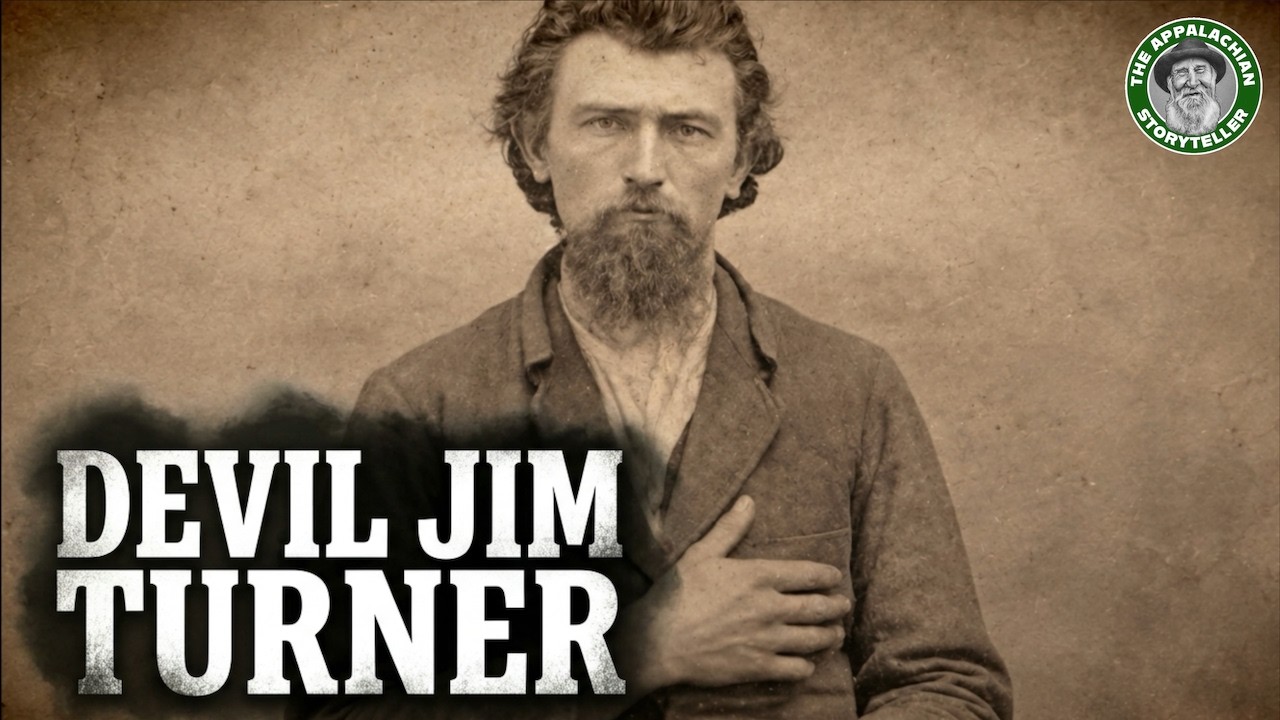
His grandfather had been among the first white settlers in the region, arriving only two generations earlier. The old man amassed more than five thousand acres and operated the county’s only general store. In time, Jim’s father inherited that wealth and kept the store running. In those days, general stores served as the center of every community, the gathering place for powerful landowners and politicians who controlled all trade flowing through the county.
Any man who dared open a rival store risked not only his own life but the lives of his entire family. Many competitors tried to encroach on Turner territory, but they were quickly driven out of the region, either fleeing on horseback or leaving inside a wooden box. Blood may be thicker than water, but that was hardly the case with the Turner cousins, the Middleton family. The Middletons were also wealthy landowners, and unfortunately for the Turners, their land bordered the Turner property since an old family estate had been divided.
Jim’s father’s sister had married into the Middleton family, and according to the Turner side of the story, that was the only reason those ruffians had any wealth at all. For years, a buried feud had simmered beneath the surface between the two factions. Everyone knew these families contained the most dangerous men in Harlan County, and a full-scale war between them seemed possible at any moment. Jim’s father was a stern, religious man, always seated in the front pew of the Methodist church every Sunday, praying for guidance in spiritual matters.
He kept the Bible close to his heart, but he also regularly turned to whiskey and bullets to settle worldly affairs. This explosive combination of scripture and bottle created a volatile household. Jim and his brother grew up tough as barbed wire, learning early the arts of gunpowder and lead. As a boy, Jim stuck close to his father and followed his methods.
In church, the young man devoted himself to the Bible like no other youth. Sometimes he was even allowed to stand before the congregation, pounding the scriptures and warning of vengeance against all their enemies. Outside that sanctuary, however, Jim was a different person entirely, an outlaw in the making. He drank whiskey and stole pigs just for the thrill of it.
Locals swore they saw the boy steal fourteen hogs from a man’s barn in broad daylight. On another occasion, he robbed an elderly man of ninety-four dollars, though he needed no money, and rumors claimed he shot and killed the man as well. A clever lawyer hired by his father managed to prove otherwise in court. Young Jim seemed to have an insatiable appetite for destruction.
He loved the feeling of it, and he relished the power of staring down a gun barrel at another man, the fear in their eyes feeding his hunger. Jim himself lit the initial fuse of the war between the Turners and Middletons. When he was fifteen, a strong storm knocked down a section of the fence separating the two properties. Unfortunately, some Middleton cattle wandered onto Turner land.
Jim took it upon himself to shoot every single one. The young Middleton men rushed out with their rifles and opened fire, wounding Jim in the arm and calling him a devil. In response, Jim shot each of them. From that day on, everyone called him Devil Jim Turner.
Jim reached manhood during a time of great upheaval in America. In the years before the Civil War, Kentucky was torn in half, with strong loyalties to both Confederate and Union forces, even within individual families. Both armies wanted the state for themselves, and both placed a star representing Kentucky on their flags. Soon each side constantly raided the mountains, trying to intimidate men into joining their cause through murder, theft, and destruction of property.
Because Virginia was the Confederate capital and Harlan County lay on the border between the two states, the region became a hotbed of the most lawless atrocities during that bloody war. It was literally a matter of kill or be killed, and only the strongest survived. Here, Devil Jim began his outlaw career. By the time fighting broke out, Jim was a grown man with a wife and children.
Like many men of that era, he wanted to join the fight. The Turner family aligned itself with the Union cause. On April 15, 1863, Jim enlisted as a soldier in Union forces, in Company D of the Forty-Ninth Kentucky Infantry. Meanwhile, it was no secret that many Middleton men had enlisted in the Confederate army.
Yet Jim soon realized military life was not for him. The training and taking orders were a waste of time. He wanted to be in the heart of the action, on the front lines. In truth, Devil Jim had no personal loyalty to the Union.
He was a maverick who made his own laws. Although he appreciated the free clothes, weapons, and ammunition the army provided, Jim deserted within months. Then the devil began his customary work of killing, robbing, and stealing horses throughout the war, with Confederate men suffering the most. He raided camps, stole horses, and burned barns and homes of Confederate sympathizers.
Once, he ordered a Black man to open his master’s meat house. When the man looked him in the eye and said he would rather die than hand over the key, Jim replied, Well, then you will die. He placed the muzzle of his rifle behind the man’s head and fired, blowing his skull apart. Devil Jim and his men lived off plunder, stealing whatever they needed and killing anyone who refused to give it up.
Another time, hiding from arrest and desperately hungry at his uncle’s house, Jim spotted a cow in the pasture. He walked up to the animal and knocked it unconscious with the butt of his pistol. Then he drew his knife and carved out a piece of meat while the creature was still alive. He ate the flesh raw as the cow ran bellowing back to the herd.
In 1863, a man named Hugh Ethridge, married to a Middleton, was found suddenly dead. Fingers pointed at Devil Jim. When Carr Middleton tried to bring Jim to justice, the devil simply shot him and left him crippled for life. Devil Jim Turner could not stand the Middleton family, and soon he set his sights on their old leader, James Middleton.
In late 1863, Jim and his gang declared they wanted the man dead. Middleton fled for his life to the mountains of Lee County, Virginia. It did no good. The outlaws tracked him down, seized him, and dragged him back across the Kentucky border.
They tied him to a tree in their camp, cut off his ears and nose, tore out his toenails, then sat and watched him die slowly while enjoying a meal of beans cooked over the campfire. In total, Devil Jim Turner was accused of thirteen murders. Although the official plaque at the Harlan County courthouse claims Confederate raiders burned it in October 1863, old-timers know the truth. They say Devil Jim and his gang burned it to the ground in broad daylight.
By the end of the war, the devil had made so many enemies and faced so many legal troubles that he transferred all rights to his land and property to his wife, hoping to keep it from being lost entirely. The Civil War might have ended, but the killing did not stop. In 1869, Jim killed his cousin. In 1872, when the Middleton family tried to prosecute him for that crime, Jim hid behind a tree stump on the road to the courthouse and ambushed the two key witnesses.
He shot William Middleton off his horse, and when his brother-in-law tried to flee, the devil shot him in the back and left his body in a ditch before either could testify. Finally, the justice system had enough and resolved to make this monster pay. In 1872, the sheriff of Clay County arrested Devil Jim and his brother for their atrocities. Jim posted bail, and while awaiting trial, he appeared in the courthouse yard one morning, drew his knife, stabbed the key witness and the court clerk, then drew his pistol and pulled the trigger three times at the judge’s face.
Astonishingly, the pistol misfired all three times, and the judge survived. Devil Jim Turner was sentenced to life in prison. In that era, prison was designed to break the toughest men. For the rest of his life, Jim was forced to break large rocks into small stones with a pickaxe from dawn to dusk.
Over the next sixteen years, the strong mountain man withered until he could barely lift a fork. Now that he no longer provided free labor, the state had no use for him. In 1890, after sixteen years, he was released on parole with the condition that he leave Kentucky and never show his face there again. The devil, along with several of his outlaw friends, moved out west to Washington, where they settled outside Toledo.
Their violence became so notorious that locals named the place Little Kentucky. For a man who had inflicted so much violence on others, karma played a role in his end. In 1910, Jim was a feeble old man. One cold morning, while standing over his wood stove cooking breakfast in his kitchen, he suffered a stroke and fell face-first onto the stove.
His clothes caught fire as he screamed for help. His young grandson came in and saw the old man’s face melting on the stove, but the boy was too terrified to touch him. He decided instead to run half a mile to the nearest neighbor’s house for help, leaving Devil Jim burning on the stove the whole time. When help finally arrived, the scene was gruesome.
As newspapers put it, Devil Jim had been slowly roasted, suffering in misery for roughly twenty-four hours before he died. A fitting end for such an evil man. The next day, as family members prepared Devil Jim’s body for burial, they found eight hundred dollars hidden in his boot. The family decided it might not be right to keep the money, since Devil Jim had likely obtained it through criminal means.
So they simply put it back in his boot and buried him. Apparently, the family could not rest easy that night, unable to stop thinking about the money. Two weeks after the funeral, it was discovered that Jim’s grave had been dug up and the coffin lid removed. The boot and the money were gone.
Along with the leg it was attached to, which had been sawed off.