On July 3, 1863, Major General George Pickett sat on his horse watching his division’s battle flags sway in the heat haze above the Pennsylvania farmland. Before him stretched nearly a mile of open ground, and at its far end a ridge bristled with Union cannon and rifles. Within the hour he would send about twelve thousand Confederate soldiers across that field, a decision that would carve his name into American history forever. But when the smoke cleared over his dead, Pickett did something far stranger than simply losing a battle.
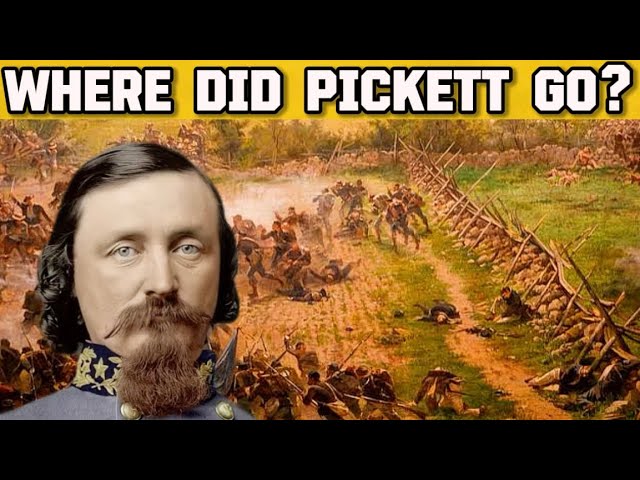
He vanished. Not from the earth, not yet. He vanished from his own life story. The charismatic, long-haired hero who led the most famous charge in American history would spend his final years as a hollow shell, haunted by ghosts that refused to die.
Born in Richmond, Virginia, in 1825, George Edward Pickett came from a family with money, land, and a respected name. He was a charming, confident, sociable young man with a gift for making friends and very little gift for studying. When he entered West Point, he arrived with a strong personality and almost no discipline. In the class of 1846, he graduated last, fifty-ninth out of fifty-nine.
Yet the ranking never seemed to hold him back. In the Mexican War, Pickett proved his courage under fire. He was wounded storming a fort at Chapultepec and was praised for carrying his regiment’s flag forward when the fight turned desperate. Courage was something he never lacked.
It was the kind of courage that drew attention, and in the end, the kind that costs men their lives. When the Civil War broke out, Pickett resigned his United States commission and joined the Confederacy. He rose quickly. By the summer of 1863, he commanded a division of fresh Virginia troops who had missed most of the brutal fighting that had drained the rest of Lee’s army.
They were rested, proud, and about to be thrown into battle. He was also known for his appearance. Pickett wore his hair in long, perfumed ringlets that fell to his shoulders. He dressed with great elegance even in the field, with polished boots, a tailored uniform, and a theatrical sense of style.
To some he looked like a gentleman from a storybook. To others he looked like a man who cared too much about how he appeared before men. On the third day at Gettysburg, that vanity and that courage faced their greatest test. After two days of bloody, inconclusive fighting, Robert E.
Lee made a bold and desperate decision. He would attack directly into the heart of the Union lines on Cemetery Ridge. His most trusted lieutenant, James Longstreet, begged him not to. Longstreet believed the attack was doomed and said so.
But Lee had made his final decision. It began with an artillery barrage. More than one hundred Confederate guns opened fire in one of the loudest bombardments ever heard on the North American continent. The roar was said to carry for miles.
When the guns finally fell silent, the infantry stepped out of the trees. Pickett’s Virginians, along with other brigades, lined up in perfect formation, their flags fluttering in the breeze. It was a breathtaking sight. Tens of thousands of men marched in regular order across open fields under the July sun toward a ridge where thousands of Union soldiers waited with loaded rifles and ready artillery.
Union cannon tore gaps in their ranks almost immediately. Shells burst overhead. Men fell by the dozens, then by the hundreds. The survivors closed ranks and kept marching.
As they drew closer, rifle fire began, and the gray and yellow lines began to dissolve. A small number of Confederates, led by General Lewis Armistead, actually reached the stone wall at the top of the ridge. Armistead placed his hat on the point of his sword and crossed the wall. It was the farthest point the Confederates reached.
Within moments, Armistead fell mortally wounded, and the attack collapsed. The charge was over in less than an hour, and Pickett’s division was destroyed. When the dust settled on Cemetery Ridge, nearly half of Pickett’s men were dead, wounded, or captured. His officer corps was shattered.
All of his brigade commanders had fallen, and nearly every colonel in the division was killed or wounded. The men who had trusted him to lead them toward glory were scattered across that field, while Pickett himself came through unscratched. His body was intact. His spirit was broken.
As the survivors staggered back toward the Confederate lines, Lee came out to meet them. He reportedly told the shocked soldiers that it was all his fault. When Lee asked Pickett to rally his division against a possible counterattack, Pickett is said to have replied with a sentence that echoed through history. “General Lee, I have no division now.
” Whether those exact words were spoken or not, they captured the truth. His division, that creation he had built, the men he had led, had simply ceased to exist. Almost immediately, Confederate leadership began shaping the story. Lee publicly took the blame, and in doing so helped build an image of noble, heroic sacrifice, a magnificent effort against impossible odds.
It was a story the South desperately needed. But Pickett refused to play the role assigned to him. When he looked at that field, he did not see glory. He saw a heap of dead Virginians.
He saw a slaughter, and that realization, as those close to him later noted, broke something inside him and separated him from the cause he had served. In the days that followed, Lee asked Pickett for an official report on the attack. What Pickett produced in return, according to legend, was not a polite military record. It was a bitter, angry document, full of criticism, aimed at the command structure itself that had sent his men forward.
The story goes that Lee read it, realized what it would do to army morale, and destroyed it. Pickett was ordered to write a second, milder version. Historians still argue over whether that story is entirely true. But whether the details are accurate or not, its core feels real.
This was the moment Pickett stepped away from the narrative his superiors wanted. This was the moment he began drifting away from the war, long before the fighting actually stopped. There was something else weighing on him, something that only became clear much later. Earlier that same year, in the middle of the Gettysburg campaign, Pickett had married a young woman named LaSalle Corbell.
She was much younger, lively, and devoted to him. Their marriage was still new when the charge took place. He had spent his honeymoon months chasing glory, and now he had nothing to show for it but grief. As the exhausted army limped back south into Virginia, those who knew him noticed a change.
This was the man famous for his perfumed ringlets, tailored coat, and theatrical manner. Now he spoke in short, clipped sentences. He avoided officers’ gatherings. He sat staring at the horizon for long stretches without a word.
His body was still with the army. That ambitious man who had desperately craved glory was gone. The war raged for about two more years, but Pickett moved through it like a spectator, watching his own slow execution. To be fair, he still took orders.
He continued to serve, but something had changed in how he served. His flame had gone out. Then, in early 1864, came a moment that would haunt him for the rest of his life. Pickett was stationed in eastern North Carolina, near the town of Kinston.
During fighting there, Confederate troops captured a group of men wearing Union uniforms. But many of them turned out to have served in the Confederate army and then switched allegiance. In Confederate eyes, they were not prisoners of war. They were deserters, and the penalty for desertion was death.
Pickett ordered twenty-two of these men hanged. It was brutal and swift. The condemned were led out and executed, and people soon forgot amid the greater horrors of the war. But the Union did not forget.
To Northern investigators, those hangings looked like murder, and Pickett’s name was placed on a wanted list. Then came the spring of 1865. The Confederates were starving, shrinking, and out of options. Lee’s army was entrenched around Petersburg and Richmond, weakening day by day, holding on by a thread.
Pickett was sent to a muddy crossroads called Five Forks, a vital position guarding the lines that protected the last supply route to the capital. If Five Forks fell, the Confederates’ lifeline would fall with it. Lee’s orders to Pickett were blunt and direct. Hold that ground no matter the cost.
What happened next remains one of the strangest and most controversial episodes of the war. At noon on April 1, as Union forces under General Philip Sheridan gathered for the attack, George Pickett was not at the front. He was miles away at a peaceful fish bake on a riverbank, sharing a meal with fellow officers. Historians believe a strange effect of terrain and weather, a kind of acoustic shadow, may have kept the sounds of battle from reaching them.
So while Pickett sat eating fish, his men were being routed. When he realized the distant firing was not a minor skirmish but a collapse of his entire line, it was too late. He rushed back to find his forces shattered, his soldiers fleeing in panic, thousands captured. Lee was furious.
The Battle of Five Forks broke the last defense of Richmond. Within days the Confederate capital fell, and the army was forced to retreat west in despair. Think about the cruelty of that moment. Three years earlier, Pickett had led his men into the war’s most famous slaughter and had been unable to save them.
Now, as the war approached its end, he had been absent when they needed him most. For a man still haunted by the ghosts of Gettysburg, it must have felt as though the universe was punishing him for a crime he could not quite name. A story survives from those final days. As Lee’s army neared its end at Appomattox, Lee reportedly glimpsed Pickett from a distance and coldly asked an aide, “Is that man still with this army?
” Again, historians debate how reliable the anecdote is, but it has endured for a reason. Whether Lee spoke those exact words or not, Pickett was effectively cast out. Lee never court-martialed him, but the verbal exile was complete. The commander who had sent Pickett’s men across that field no longer wanted any connection to him.
Pickett was isolated at the very moment the Confederacy took its last breath. His troubles were just beginning. With the war over and Lee’s rejection echoing in his ears, Pickett now faced a newer, far more personal threat. Rumors spread in the Northern press that the federal government intended to prosecute former Confederate officers, and Pickett had a serious problem.
Those twenty-two men hanged in North Carolina had not been forgotten. To Northern investigators, he was a man who might face trial for murder. Pickett knew exactly what that could mean: a trial, a rope. So the legendary general who had once led thousands of men slipped across the border and fled to Canada, settling in Montreal under an assumed name.
The man the world’s newspapers had celebrated for his charge now lived as an anonymous exile in a cold, drafty boarding house, terrified that every knock at the door was a federal agent. The bold commander of Gettysburg was hiding in the shadows, hundreds of miles from home. It was an unexpected protector who finally brought him back. Ulysses S.
Grant, now commanding general of the United States Army and Pickett’s former West Point classmate, argued that the terms of surrender at Appomattox must be respected. Those terms promised that released Confederate soldiers would not be punished as long as they obeyed the law. Grant raised the matter with President Andrew Johnson, and with his support, Pickett was finally safe. It is an astonishing irony.
The Union general whose armies had crushed the Confederacy was the man who saved George Pickett. While Lee had cast him out, Grant extended a hand. In 1866, Pickett returned home to Virginia. But the man who returned barely resembled the brilliant general who had marched north three years earlier.
His family’s property was in ruins. His money, social standing, and health had been consumed by the war. Then he did something that surprised nearly everyone. While other Confederate generals leveraged their wartime fame into university presidencies, railroad directorships, and political careers, Pickett largely turned away from all of it.
According to most accounts, he stayed out of the veterans’ spotlight and avoided the great public role the South was ready to offer him. Offers came, but he did not pursue them. He deliberately chose obscurity over the fame his contemporaries eagerly chased. To make a living, the former major general took a job as an insurance agent in Richmond.
The man who had once led thousands of soldiers across open ground now sat behind a desk writing policies for local merchants. He did not like to talk about the war. He stayed away from his old military comrades. His evenings were spent in near-total isolation.
Northern journalists and Southern historians alike were puzzled. They expected him to defend himself, to explain his decisions, to fight for his place in history. Instead, he said nothing. That silence broke at least once.
Years after the war, Pickett went to visit Robert E. Lee in Richmond shortly before Lee’s death. According to all accounts, the meeting was cold, awkward, and brief. When Pickett came out, someone asked him how it had gone.
According to one of the most famous stories about him, Pickett answered bitterly, “That man destroyed my division. ” Think about how much that single sentence carried. Years of grief, years of anger, the weight of thousands of dead, and the knowledge that the man he had obeyed was the one who sent them to their deaths. It was a rare, frank outburst from a man who mostly chose silence.
With the passing years, Pickett’s health began to fail. The loss of thousands of men, the exile, the financial ruin, all of it made him look far older than his true age. He suffered chronic illness, pain, and exhaustion that kept him from working long hours. He carried the faces of the men who had marched into that field, the sounds of the guns, the memory of the North Carolina hangings, the humiliation of Five Forks, his commander’s cold look, the years of hiding.
None of it ever left him, and there were no doctors in that era who could name his condition, let alone treat it. His health weakened, and in his final months he was mostly bedridden, cared for by his devoted wife, LaSalle. On July 30, 1875, George Pickett died in Norfolk, Virginia. He was just over fifty years old.
Twelve years had passed since Gettysburg, and in many ways his life had ended on that hot July afternoon in Pennsylvania. There were no great last words, no calls for military honors. He died quietly, in near obscurity and forgetfulness. Then something else happened.
His story was taken from him. LaSalle Pickett, along with a generation of Southern writers and mythmakers, reshaped the memory of George Pickett. In the decades after his death, she wrote books and gave lectures portraying her husband as a chivalrous knight and his charge as a heroic act of devotion. They polished his tragedy and turned it into something noble, something beautiful.
His charge became a symbol of courage and sacrifice, a cornerstone of what would later be called the Lost Cause. The silent, tormented man was replaced with a monument. So where can the real George Pickett be found? Not in the grand memorials, not in the imposing paintings of the charge with flags flying and bayonets gleaming.
The real man is found in the twelve silent years that followed. Twelve years in which a famous general chose to recede from view rather than serve as an instrument for a cause whose cost he had seen with his own eyes. His withdrawal from public life was, in its own way, his final statement. A quiet refusal to turn catastrophe into legend.
The man who led the charge on Cemetery Ridge proved something war rarely teaches us until it is too late. Sometimes the hardest loss to find after a war is the commander who survived it.