The legend of Jesse James only grew after the bullet that killed him in the spring of 1882. Living quietly under an assumed name in St. Joseph, Missouri, his life ended at the hands of his own accomplice, Bob Ford, who hoped to collect the large reward offered for his capture. The news swept the country, and crowds gathered to view the remains of America’s most notorious outlaw.
Entrepreneurs rushed to sell photographs of the corpse, turning the event into a commercial spectacle. His mother, Zerelda Samuel, fearing grave robbers and souvenir hunters, had her son buried on family land near Kearney, close enough to the house that she could watch over the site herself. As railroad travel expanded in the late nineteenth century, visitors began arriving in increasing numbers. Zerelda started charging a small fee for guided tours, telling stories about her son and offering keepsakes.
Historians generally agree these tours became an important source of income for the family, and they show how quickly frontier legends could be transformed into tourist attractions. Visitors often chipped away pieces of the original monument as mementos. By the early twentieth century, the damage was so severe the markers had to be replaced. Meanwhile, rumors persisted that Jesse James had never died in 1882.
Throughout the twentieth century, several men claimed to be the outlaw, most famously a Texan named J. Frank Dalton, who maintained the claim for decades. Modern science eventually provided a clearer answer. In 1995, forensic researchers led by Professor James Starrs examined remains believed to be James’s after they were exhumed from Mount Olivet Cemetery, where they had been reburied in 1902.
The scientists extracted mitochondrial DNA from the bone and compared it with maternal relatives of the James family. The results showed a very high degree of match, and the forensic examination aligned with historical accounts. Most historians now consider the study conclusive proof that the man who died in 1882 was indeed Jesse James. Billy the Kid met a different fate after his death.
Henry McCarty, known to history as Billy the Kid, was buried at Fort Sumner, New Mexico, on July 15, 1881, shortly after he was killed at the age of twenty-one. Local residents laid him to rest beside two of his close companions, Tom O’Folliard and Charlie Bowdre, in the military cemetery near the fort. Simple wooden markers were placed over the graves, reflecting the modest conditions of the frontier settlement. The greatest challenge to preserving the burial site came not from people but from nature.
In 1904, severe flooding along the Pecos River swept through the abandoned cemetery. The floodwaters destroyed the wooden markers, washed away the soil, and altered the landscape so significantly that the original graves could no longer be identified with certainty. Modern historians and archaeologists are unable to determine the precise location of Billy the Kid’s remains. In 1932, local residents and officials erected a shared granite monument near the estimated burial location, based on community memory.
The monument carried the inscription “Friends,” reflecting the belief that the three companions would remain linked in memory even after death. As Billy the Kid’s fame grew through books and films, the monument became a destination for visitors from across the country. It also became a target for thieves. In 1950, the marker disappeared entirely and remained lost for more than two decades.
It was recovered in California in 1976 and returned to New Mexico, only to be stolen again before being recovered once more. To protect the monument, authorities enclosed it in a sturdy iron cage anchored in concrete. The uncertainty surrounding the grave has encouraged theories that Billy the Kid survived 1881, most notably from a Texas man named Brushy Bill Roberts. In the early twenty-first century, officials investigated the possibility of using modern DNA analysis to answer these questions, but researchers concluded that flood damage and uncertainty about burial locations made reliable identification extremely difficult.
More than a century later, his exact resting place remains unknown, ensuring that one of the most famous figures of the Old West stays wrapped in questions and legend. Wild Bill Hickok’s final resting place became famous for a different reason. James Butler Hickok arrived in Deadwood during the Black Hills gold rush. On August 2, 1876, his life ended suddenly while he played cards in a local saloon.
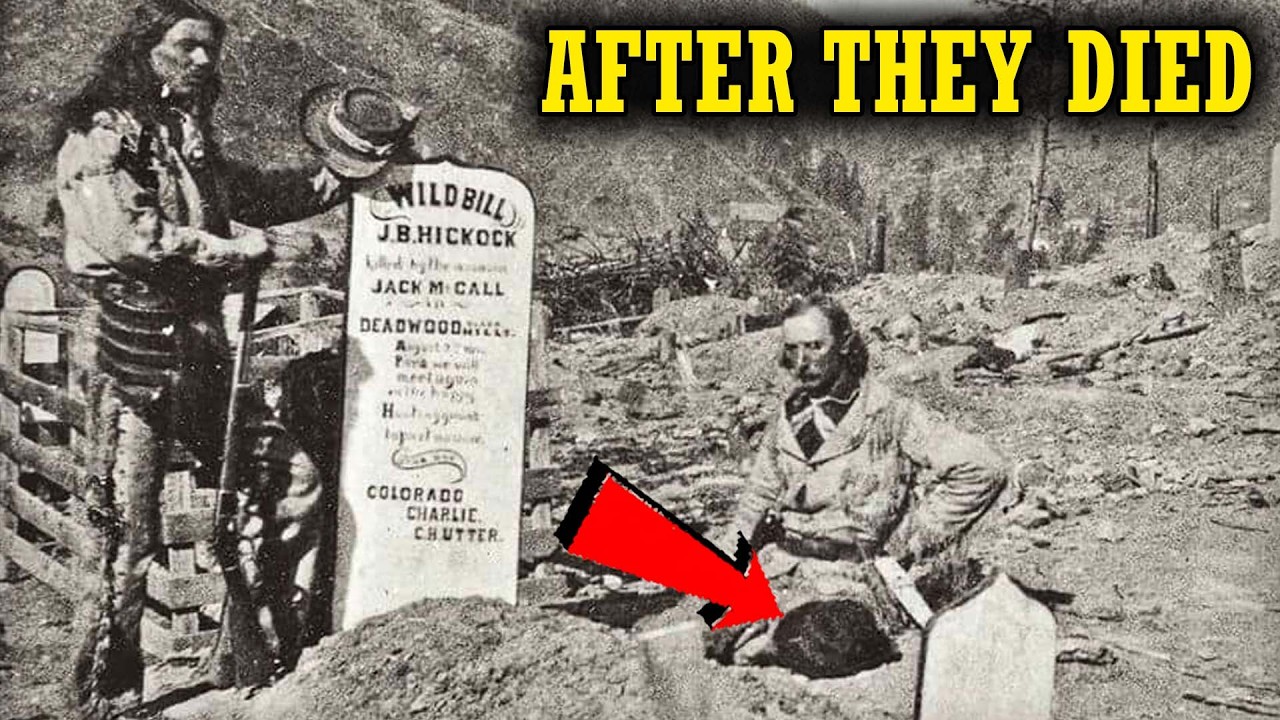
Contemporary accounts reported he was holding a pair of aces and a pair of eights, a combination later known in popular culture as the “dead man’s hand. ” He was initially buried in the original Ingleside Cemetery on a hillside above the rapidly growing mining town. His friend Charlie Utter arranged the funeral and placed a simple wooden marker on the grave. Deadwood expanded quickly, and by 1879 city leaders decided to move the cemetery to make room for further development.
Hickok’s remains were to be transferred to the newly established Mount Moriah Cemetery. When workers opened the grave during the transfer, they reportedly found Hickok’s remains far better preserved than expected. Local newspapers described the discovery in striking detail, generating widespread public interest. Historians believe environmental conditions in the original cemetery, including soil composition, moisture levels, and mineral content, played a significant role in slowing decomposition.
Researchers have pointed to the possibility of a natural chemical process known as adipocere formation, under which tissue can transform into a waxy substance that preserves physical features for long periods. While some newspaper reports likely exaggerated aspects of the discovery, most historians agree the unusual condition of Hickok’s remains contributed to his growing legend. The transfer to Mount Moriah only increased public interest. Visitors eagerly came to see the grave of one of the most famous scouts, lawmen, and showmen of the American West.
The original gravestone suffered damage from visitors seeking souvenirs, leading to efforts to create more durable markers. In 1891, a life-size sandstone monument was erected near the grave, but exposure to weather and visitor interference gradually damaged it as well. Today, Hickok’s grave remains one of the most visited historic sites in Deadwood. Modern fences and restoration efforts protect the monument while allowing visitors to connect with a figure whose reputation has endured for nearly 150 years.
Martha Jane Cannary, known as Calamity Jane, was one of the most unconventional figures of the American frontier. She built a reputation as a freight hauler, scout, performer, and storyteller, often defying the social expectations placed on women in the nineteenth century. By the time of her death on August 1, 1903, in Terry, South Dakota, years of hardship and declining health had taken their toll. She was fifty-one and had little material wealth.
According to accounts from those who knew her in her final days, she expressed a wish to be buried next to Wild Bill Hickok, the legendary frontiersman she had long claimed to admire greatly. Whether this request reflected a real personal relationship remains debated among historians. Historical evidence indicates the two knew each other, but many researchers doubt the romantic stories woven around them later. The decision about her burial ultimately rested with a committee of prominent Deadwood citizens.
By 1903, Deadwood had changed dramatically from the modest mining camp of earlier decades. With gold production in decline, community leaders increasingly recognized the importance of preserving and promoting the town’s frontier heritage. Local officials understood that placing Calamity Jane beside Wild Bill Hickok at Mount Moriah Cemetery would create an attractive historical landmark. The presence of two of the Old West’s most famous names side by side offered a compelling story capable of drawing visitors even after the mining boom had faded.
Her funeral became a major public event. Contemporary newspaper reports described large crowds in attendance, making it one of the most notable funerals held in Deadwood at that time. The burial arrangement proved highly successful in attracting attention, and over time the adjacent graves became among the most photographed and visited sites in the Black Hills. As with many famous frontier monuments, the grave soon faced preservation challenges, with visitors constantly removing small pieces of stone.
Officials eventually installed protective barriers similar to those used around Hickok’s grave. Today, Calamity Jane’s burial site remains one of South Dakota’s most famous historical landmarks, drawing thousands of tourists each year. John Henry “Doc” Holliday remains one of the most intriguing figures in American frontier history. A trained dentist, Holliday later became famous as a gambler and an associate of the Earp brothers.
He spent most of his adult life battling tuberculosis. By the time of the famous events in Tombstone in 1881, his health had already been declining for years. In the fall of 1887, hoping the mineral springs and mountain air of Glenwood Springs, Colorado, might bring some relief, Holliday traveled to the growing resort town. The cure did not work.
On November 8, 1887, Holliday died at the age of thirty-six in a Glenwood hotel. According to a popular local account, his last words reflected his astonishment at dying peacefully in bed rather than meeting the tragic end often associated with Old West legends. The accuracy of this quote remains uncertain, but it has become part of his story. Contemporary newspaper reports describe his funeral as modest, attended by only a few acquaintances.
After spending most of his money during years of illness, he was buried in a simple grave. The greater mystery surrounding Holliday’s burial concerns its actual location. Linnwood Cemetery sits on a steep hillside above Glenwood Springs, and late-autumn conditions in the Rocky Mountains could have made travel difficult. Historical researchers have noted that snow, frozen ground, and rugged terrain may have complicated burial arrangements during that period.
Some historians have suggested Holliday may have been temporarily buried in a more accessible location near town, with plans to move him later. However, no surviving records confirm this theory. Burial documents from the era are incomplete, and many original records have been lost. As Glenwood Springs developed, changes to the landscape, deterioration of grave markers, and loss of cemetery records made it increasingly difficult to determine the precise location of his remains.
Today, historians generally agree the burial site cannot be identified with certainty. To honor Holliday’s connection to the town, a monument was placed in Linnwood Cemetery. It serves as a symbolic tribute rather than a documented grave marker. One notable inscription notes that Holliday died in his bed, a detail that contrasts sharply with the legendary image later created in books, films, and television series.
The monument now attracts thousands of visitors each year, many of whom leave playing cards, coins, flowers, and other tokens, reflecting the enduring fascination with his life and legend. Wyatt Earp’s story took an entirely different path. The lawman closely associated with Tombstone, Dodge City, and the fading frontier spent his final years far from the landscapes that made him famous. Earp died on January 13, 1929, in Los Angeles, California, at the age of eighty.
By then, he had outlived most of the notable figures of the frontier era. His death symbolized the passing of a generation that had witnessed the American West transform from a collection of frontier settlements into a modern society. His funeral reflected another notable chapter of American history. It is said that several prominent figures of the early film industry, including silent Western stars William S.
Hart and Tom Mix, participated in honoring Earp. The presence of Hollywood celebrities showed how Earp had become a living legend, his fame extending far beyond the historical events he experienced. One of the great surprises for many admirers is his burial place. His wife, Josephine Marcus Earp, arranged for his body to be cremated, and his ashes were placed in her family plot at Hills of Eternity Memorial Park in Colma, California, a Jewish cemetery south of San Francisco.
The choice reflected Josephine’s family connections and personal wishes, but it contradicted popular expectations. Generations of Western enthusiasts assumed Earp would rest somewhere in Arizona, Kansas, or another frontier location closely tied to his career. Instead, the man whose name became synonymous with the Old West was memorialized hundreds of miles from Tombstone and Dodge City. As Earp’s fame grew through books, films, and television during the twentieth century, interest in his grave increased significantly.
Visitors traveled from around the world to Colma, making the cemetery an important destination for students of Western history. In 1957, thieves removed Earp’s original granite headstone, prompting concern among historians, family members, and cemetery officials. To prevent similar problems, cemetery management installed a larger headstone designed to be more secure and resistant to damage. The replacement monument still stands today and continues to attract thousands of visitors annually.
Modern visitors often leave small tokens at the site, including stones, coins, poker chips, and other symbolic objects, reflecting the enduring connection people feel to one of the West’s most famous lawmen. Elmer McCurdy’s story stands as one of the strangest episodes in American frontier history. His posthumous journey was so extraordinary it seems closer to fiction than documented fact. McCurdy was a second-rate outlaw whose criminal career was marked more by poor planning than success.
In October 1911, he took part in a train robbery attempt in Oklahoma. Historical records indicate the group accidentally targeted the wrong train and obtained only a small amount of money and property, far less than they had expected. Authorities soon captured McCurdy, ending his brief career as an outlaw. In ordinary circumstances, his story would likely have faded into obscurity.
But what followed turned him into one of the most bizarre figures associated with the American West. When no relatives came forward to claim the body, Joseph L. Johnson, an undertaker in Pawhuska, Oklahoma, embalmed McCurdy using preservation methods considered highly effective at the time. After weeks passed without any family appearing, Johnson decided to display the body in his funeral home.
Recognizing the public’s fascination with outlaw stories, he dressed McCurdy in cowboy clothes and promoted the display as a local attraction. Visitors paid a small fee to view what newspapers and advertisers described as an outlaw preserved as he appeared in life. The attraction remained popular for years. In 1916, two men arrived claiming to be McCurdy’s brothers and requested the remains.
Subsequent investigations revealed they were actually working for a traveling carnival. From that point, McCurdy’s preserved body began a journey lasting decades through sideshows, exhibitions, and entertainment venues across the United States. Over the following decades, ownership of the remains changed hands multiple times. McCurdy was displayed at carnivals, fairs, theaters, and amusement venues.
As the years passed and memories faded, many people no longer realized the figure on display was a real human body. Instead, it was widely believed to be a remarkably realistic wax figure. The truth remained hidden until 1976. During preparations for filming at an amusement park in Long Beach, California, workers handling what they thought was a wax figure made a startling discovery that prompted further investigation.
Authorities were called in to identify the remains. Forensic examination by the Los Angeles County coroner’s office confirmed the figure was human. Investigators discovered various artifacts associated with the body, including items dating to the early twentieth century. Comparing these findings with historical records, researchers were able to definitively identify the remains as those of Elmer McCurdy.
The discovery attracted national attention and revived interest in his unusual story. Historians, journalists, and forensic experts documented how his remains had spent more than six decades traveling through the American entertainment industry, becoming part of carnival and amusement park culture. In 1977, officials arranged for McCurdy’s return to Oklahoma, where he was finally buried at Summit View Cemetery in Guthrie. Additional protective measures were taken during the burial to ensure his remains would not be disturbed again.
Belle Starr’s final resting place was shaped by isolation, legend, and decades of public curiosity. Myra Maybelle Shirley Reed Starr, known as Belle Starr, became one of the most famous women associated with the American frontier. Sensational newspapers and dime novels portrayed her as an outlaw queen, often exaggerating her activities and turning her into a legendary figure. Historians continue to debate the extent of her involvement in organized crime, though there is no doubt she maintained connections with many well-known outlaws of her era.
Her life ended suddenly on February 3, 1889, near her home in Younger’s Bend, within the Cherokee Nation, in present-day Oklahoma. The circumstances of her death remain unclear, and historians have reached no definitive conclusion about who was responsible. Over the years, numerous theories have emerged, making the case one of the Old West’s unsolved mysteries. After her death, her daughter, Pearl Starr, arranged for her burial on family land near the cabin.
Rather than placing her in a distant cemetery, Pearl chose a site reflecting her mother’s close connection to the frontier landscape where she had spent most of her life. A distinctive monument was erected over the grave, featuring a stone pile and a marker carved with an image of Belle’s favorite horse, Venus. The grave bore an inscription celebrating her memory and reflecting the affection her family continued to hold for her despite the controversy surrounding her reputation. The greatest challenge in preserving Belle Starr’s grave came from the legends that spread after her death.
Sensational publications claimed she had possessed hidden treasures of gold, silver, and valuables, supposedly obtained through outlaw activities. Although historians have found little evidence to support these stories, the rumors gained wide acceptance in popular culture. As a result, treasure hunters and curiosity seekers repeatedly descended on the remote burial site. Convinced that valuable items might be hidden nearby, they dug up the area around the grave and gradually dismantled portions of the original monument in search of phantom wealth.
When no treasure was found, the site continued to suffer from vandalism and souvenir collecting. Visitors removed pieces of the monument over the years, and by the early twentieth century, much of the original marker had disappeared. What had once been an elaborate tribute had become a poorly preserved, difficult-to-identify burial site. Recognizing the historical significance of the location, preservation advocates and local historians intervened to protect what remained.
Efforts were made to clean the area, document the grave site, and install a more durable replacement marker to ensure Belle Starr’s burial place would not be completely lost. Today, the grave serves as a reminder of how quickly legend can overwhelm historical truth. Sitting Bull’s grave became the focus of extensive controversy. Tatanka Iyotake, known as Sitting Bull, was one of the most respected leaders of the Lakota people and played a pivotal role in Native American resistance during the nineteenth century.
He is perhaps best remembered for his leadership during the period surrounding the Battle of Little Bighorn in 1876, one of the most famous conflicts of the American frontier. His life ended on December 15, 1890, at the Standing Rock Reservation. Historical accounts describe a tense confrontation between reservation police and Sitting Bull that escalated into chaos and struggle. Sitting Bull did not survive the encounter.
His death came only weeks before the tragic events at Wounded Knee, during a period of intense uncertainty on the plains. Following his death, federal authorities moved quickly to maintain order on the reservation. Concerned about rising tensions, officials arranged for Sitting Bull to be buried at Fort Yates, in present-day North Dakota. His grave was modest and remained relatively unknown outside Native communities and local residents for many years.
The controversy over his burial arose decades later. By the mid-twentieth century, some members of Sitting Bull’s family and his supporters believed his grave at Fort Yates had not received the recognition and care befitting a leader of his historical importance. They argued he should be memorialized near the area associated with his early life and heritage. In 1953, supporters from South Dakota, including relatives and local activists, organized a campaign to move what they believed were Sitting Bull’s remains.
According to contemporary reports, materials from his burial site at Fort Yates were transferred to a location near Mobridge, South Dakota, overlooking the Missouri River. A new monument was later erected at the South Dakota site, which eventually became one of the most visited sites associated with Sitting Bull, featuring a prominent statue commemorating his legacy. The transfer immediately sparked widespread controversy. Critics questioned the validity of the remains transfer, citing the difficulty of identifying burial locations decades after the original burial.
North Dakota officials and historians argued the evidence supporting the transfer was inconclusive and maintained that Sitting Bull’s original burial site remained at Fort Yates. As a result, two sites emerged, each claiming a connection to the great Lakota leader. Both locations have erected monuments, historical markers, and educational programs dedicated to preserving his story. The controversy over which site contains his actual remains has never been definitively resolved.
Modern historians generally agree the documentary record surrounding the 1953 transfer leaves important questions unanswered. Because no modern forensic examination was conducted at the time, certainty remains difficult to achieve. The issue continues to be debated among researchers, tribal members, and local communities. Today, both North Dakota and South Dakota commemorate Sitting Bull’s legacy through monuments and historical interpretation.
Regardless of where his remains lie, his impact on American history is beyond dispute. He is remembered not only as a leader of the Lakota people but as a symbol of indigenous resilience, cultural identity, and the struggle to preserve sovereignty during a period of radical change.