On the morning of September 17, 1868, Major George Forsyth and his fifty scouts woke to a dull, rhythmic thudding that grew louder with every passing second. Before they could make sense of the sound, a sentry spotted feathers cresting a nearby hill. Both he and the major fired their rifles and shouted the alarm: Indians. Hundreds of Cheyenne and Lakota warriors came pouring over the ridges, mounted on ponies and screaming war cries.
The scouts, camped beside the Arickaree River in eastern Colorado Territory, had been tracking what they believed was a small war party of about twenty-five warriors. Instead, they had stumbled into the heart of a massive gathering of villages. In the chaos of the opening assault, the warriors swept through the camp, shouting and firing, trying to stampede the horses. The scouts had slept with their horses’ ropes within reach, and most of the mounts were saved, but the enemy made off with a handful of horses and all four mules carrying the extra ammunition, food, and medical supplies.
Outnumbered and nearly surrounded, Forsyth ordered his men to the only defensible ground in sight, a small sandbar in the middle of the shallow river. It would become known as Beecher Island. The fight that followed was not an accident. It was the result of years of mounting violence between the United States and the Cheyenne.
By 1868, the Cheyenne had been pushed from the Great Lakes region onto the Great Plains, then further west and south. Disease had ravaged them, most terribly a cholera epidemic in 1849 that may have killed as many as two-thirds of the tribe. Treaties had reduced their lands to a fraction of what they had once held. The Treaty of Fort Laramie in 1851 and the Treaty of Fort Wise in 1861 both stripped away territory, often signed by men who did not speak for the bands they supposedly bound.
The Americans rarely delivered the promised annuities. Settlers and railroads encroached further with each passing year. And on November 29, 1864, Colonel John Chivington’s Colorado cavalry attacked a peaceful Cheyenne and Arapaho village at Sand Creek, killing men, women, and children in a massacre that included deliberate mutilation and the murder of infants. The Cheyenne struck back, raiding settlements and travelers, and the United States military struck back again.
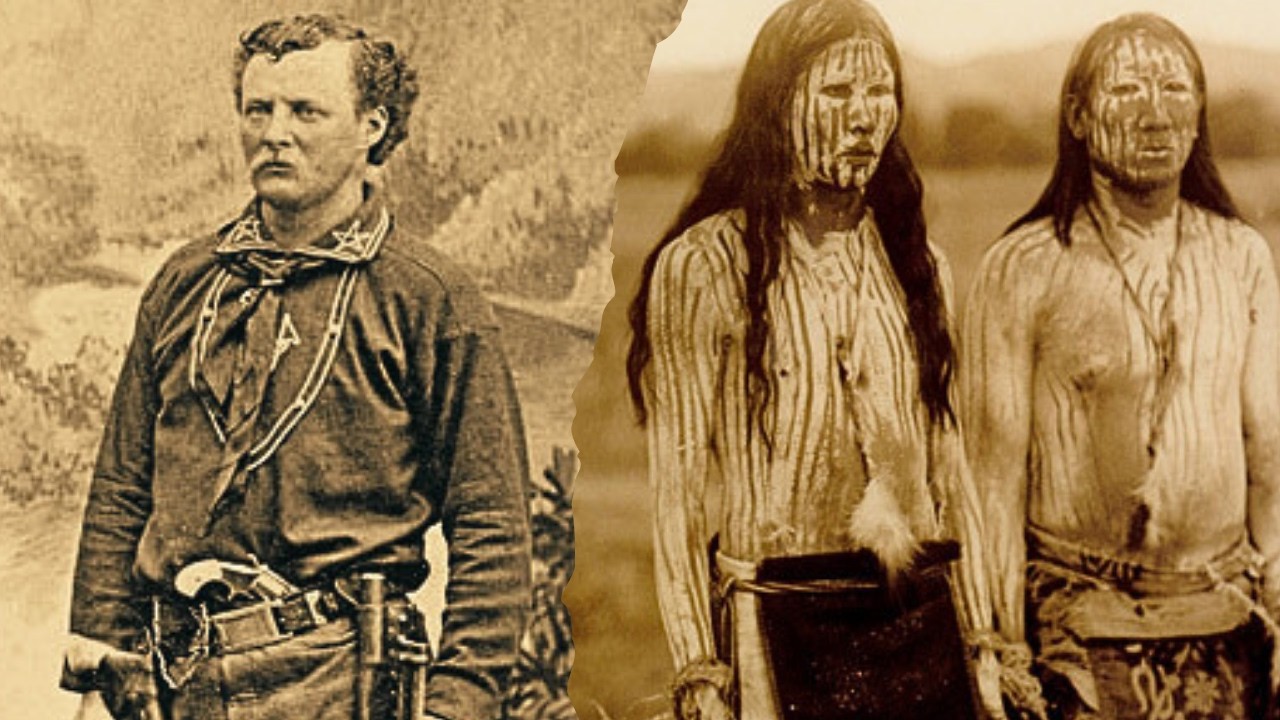
The violence had become an endless cycle of retaliation. One of the most feared warriors on the plains was Roman Nose, a Northern Cheyenne of the Crooked Lance Society. He was not a chief and held no formal authority, but his reputation as a fighter was unmatched. A military surgeon once described him as nearly six feet tall, powerfully built, and mounted on a fine horse, carrying four revolvers in his belt, a fine specimen of his race and a good representative of the god of war.
Roman Nose had led raids along the Solomon and Saline rivers that summer, burning and killing. The Cheyenne who had lost relatives at Sand Creek and the scouts who had lost relatives to Cheyenne raids now faced each other across a sandbar. When the warriors realized their ambush had failed, they launched a second assault. Bullets and arrows rained into the island.
Within minutes, one scout was dead and several wounded. Some of the men wanted to break for the opposite bank, but Forsyth shouted that he would shoot any man who tried to leave. The scouts dug in with whatever they had, their knives and tin plates and bare hands serving as shovels. Their fire discipline was disciplined enough that the warriors pulled back out of rifle range, and the sound of Cheyenne women wailing for their dead rose from the nearby villages.
During the lull, Forsyth moved among his men until a bullet struck him in the right thigh, knocking him down. Moments later, a second bullet shattered the bone of his left leg. Other scouts were hit, some so badly they could no longer fight. One unnamed frontiersman, who had bragged endlessly of his experience, buried his face in the sand and proved useless.
A nineteen-year-old Jewish immigrant from Philadelphia named Sigmund Schlesinger, who had never fired a gun before joining, fought through the entire day, later described by Forsyth as a gallant soldier among brave men. The dead and dying horses on the island became breastworks for the defenders, and the scouts used their carcasses for cover. The Cheyenne were well armed with Springfield breechloaders, many likely captured during the Fetterman Fight of 1866, along with Henry, Remington, and Spencer rifles. Among the enemy, Forsyth spotted a large warrior in a horned headdress who seemed to be leading the attacks, a man Forsyth believed was Roman Nose.
As the day wore on, the Cheyenne massed for a charge. A bugle sounded, once, then again, and mounted warriors galloped straight at the island. Forsyth held his men’s fire until the warriors were almost on top of them, then ordered volley after volley into the ranks. Horses and riders fell, and the charge divided around the island, the warriors passing so close the defenders could trade curses with them at point-blank range.
When it was over, all the scouts were still alive except one. Lieutenant Frederick Beecher, the nephew of Harriet Beecher Stowe, staggered to Forsyth’s position, told him he had his death wound, murmured, My poor mother, and died before sunset. The Cheyenne launched two more charges that day, both much smaller, and both were driven back. That night, Forsyth took inventory.
Lieutenant Beecher and Sergeant J. H. Moors were dead, along with several scouts. Eight men were severely wounded, nine more slightly wounded, leaving fewer than thirty men fit to fight.
Forsyth sent two scouts, Pierre Trudeau and teenager Jack Stillwell, to make the 110-mile journey to Fort Wallace for help. They crept off the island backward, blending their tracks with the moccasin prints in the sand. The next four days brought heat, thirst, sniper fire, and the growing stench of rotting horseflesh. The scouts ate raw horsemeat, then rotten horsemeat.
When the rations ran out, one scout shot a coyote and another found wild plums. Some warriors approached under a white flag of truce, but Forsyth, suspecting a ruse, ordered his men to fire warning shots. When the Cheyenne seemed to withdraw on the third day, Forsyth sent out two more scouts toward Fort Wallace, and two more after that. The wounded grew feverish, and gangrene set into Forsyth’s broken leg.
Horrified to find maggots crawling in his wounds, he called his men together and told the men who could travel to save themselves. Every one of them refused. We fought together, by God, if need be we’ll die together. That night, using a straight razor, Forsyth cut the bullet in his thigh cut out with his own hands.
On the morning of the ninth day, a scout spotted movement in the distance. Men began to cheer and weep and dance. A troop of the 10th Cavalry, the Buffalo Soldiers, had arrived under Lieutenant Colonel Carpenter. The scouts who had been sent out had made it through to Fort Wallace, and Trudeau and Stillwell, who had hidden inside the carcass of a dead buffalo to escape capture, had arrived soon after.
Jack Stillwell, feet swollen from cactus needles even as he traveled, joined a relief party riding back to the island. Six of Forsyth’s scouts died in the fight. Beecher, Farley, Culver, Wilson, Moors, and later Armstrong at the fort. The following spring, when soldiers returned to recover the bodies, the graves of three of the dead had been dug up and the remains stolen.
The Cheyenne casualties were never counted with certainty. Forsyth claimed to have counted thirty-two dead and later spoke with a Lakota warrior who told him nearly a thousand warriors had taken part in the fight. The man held up his fingers to signify seventy-five killed. Asked if it meant killed or wounded, the interpreter answered, killed only; there were heaps more wounded.
Before leaving, the Lakota warrior opened his shirt to reveal a bullet wound through both lungs. What he thought of the fight, he asked, asking if Forsyth had not gotten enough of it. Yes, Forsyth answered. All I wanted was my reply.
Forsyth never fully recovered. He carried a permanent dent in his forehead and headaches for the rest of his life. He was promoted to lieutenant colonel of the 4th Cavalry, served in Arizona during the Apache Wars, retired in 1890, and died in 1915 at age seventy-seven, buried in Arlington National Cemetery. The island was named Beecher Island in honor of the fallen lieutenant.
The Cheyenne would be forced onto reservations within a decade; eight years later many of the same warriors took part in the Battle of the Little Bighorn, but the free life of the plains was nearly over. The Northern Cheyenne Reservation was established in Montana in the 1880s, and the Southern Cheyenne and Arapaho remain in Oklahoma, where their warrior traditions continue. For the men who fought and died on that sandbar, the battle was the end of one life.
For the Cheyenne, it was one more brutal chapter in a war not yet finished with them.