On the night of September 21, 1996, on a remote island off the coast of Georgia, John F. Kennedy Jr. walked into the small white First African Baptist Church on Cumberland Island. The world’s media had been searching for them along the Eastern Seaboard, and they had no idea what was happening.
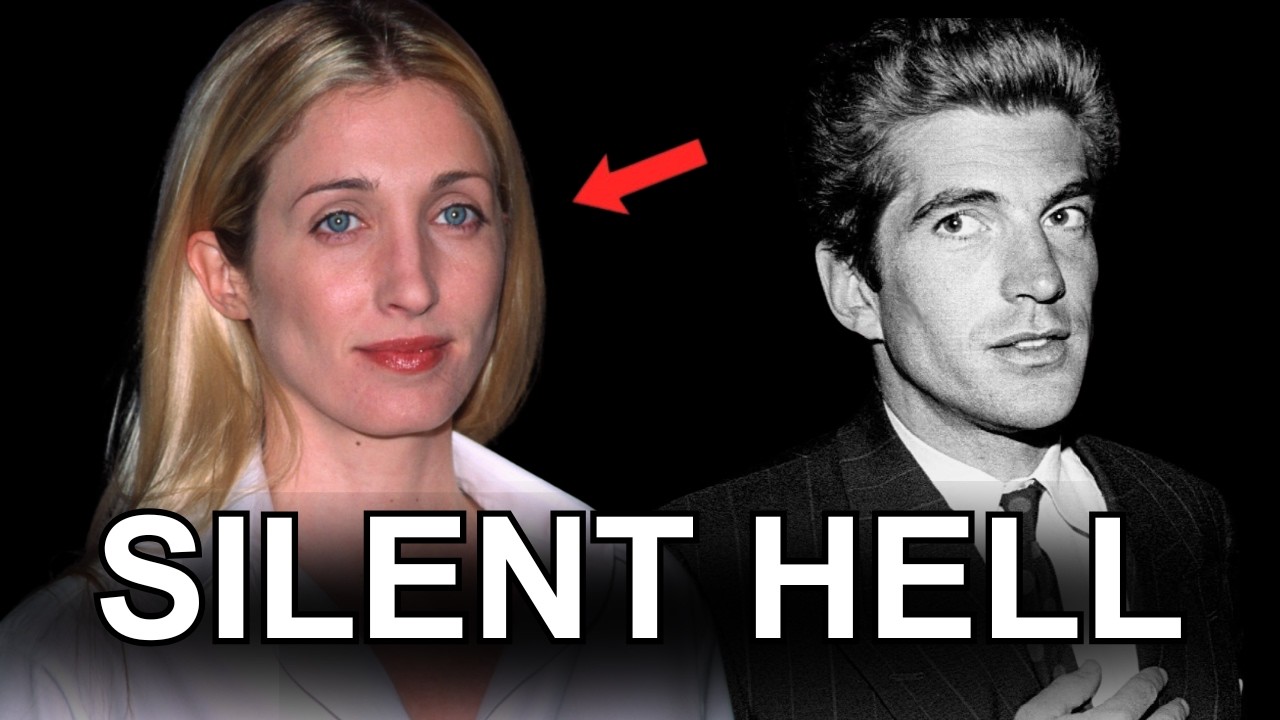
At thirty-five, America’s undisputed prince, the son of a slain president, was marrying Carolyn Bessette, a thirty-year-old former Calvin Klein executive with porcelain skin, striking blue eyes, and an unapproachable cool elegance. To the public, it seemed like a modern fairy tale. The most eligible bachelor in the world, the living embodiment of American royalty, was trading bachelorhood for a fashion icon in a simple white silk crepe dress. It was framed as the dawn of a new Camelot.
But inside the candlelit church, far from the inevitable media horde and the eyes of the world, the atmosphere was not one of relaxed romance. It was strained, tense, and heavy with unspoken dread. Look closely at the faces inside that small wooden church, and you would not see a traditional celebration. You would see a woman walking directly toward an invisible execution chamber.
Carolyn Bessette was not a socialite desperately seeking the Kennedy name. She was a fiercely private, self-made woman who had already spent months terrified of what this marriage would actually require of her. For the inner machinery of the Kennedy family and the predatory American media machine, Carolyn was not merely a bride. She was new political currency, an outsider brought in to anchor an unpredictable heir, and a visual prize expected to perform under constant, unrelenting scrutiny.
This was not simply tabloid infatuation or innocent celebrity culture. It was a brutal psychological collision between a woman’s desperate need for personal independence and the voracious, destructive appetite of an American political dynasty. She had not stepped into a golden fairy tale on Cumberland Island. She had signed away her peace of mind.
Carolyn Bessette did not grow up in the gilded, closed political circles of Hyannis Port or Palm Beach. She was raised in the suburbs of Connecticut, brought up by a mother who was a teacher and a stepfather who was a physician. She built her identity on her own terms. She was sharp, perceptive, fiercely independent, and possessed an innate sense of style without pretense.
When she entered the executive ranks at Calvin Klein in Manhattan, she did not simply climb the corporate ladder; she dominated it. She rose to become a senior publicity director, handling elite celebrity clients like Sandra Bullock and managing high-stakes corporate image strategies. In the fashion industry of the early nineties, Carolyn was in control. She understood the art of presentation, protected her private life relentlessly, and was accustomed to setting the terms of her own existence.
John F. Kennedy Jr. lived in a completely different reality. He had grown up inside a literal fishbowl.
From the moment he saluted his father’s casket in 1963 at the age of three, John was not a private citizen but public property. Jacqueline Kennedy raised him to adapt to the blinding light of global fame, but unlike his mother, who developed a cold, impenetrable armor, John tended toward openness. He was charming, athletic, carefree, and completely at ease with the lines of cameras that followed his every step. For John, the paparazzi were a nuisance, but ultimately as natural a part of his daily environment as the weather.
He had never known a world without them. When John began pursuing Carolyn in the mid-nineties, he saw an attractive, cultured woman who was not at all dazzled by his golden pedigree. She was not chasing him. In fact, she resisted his advances repeatedly, terrified of what entering his world would mean for her independence.
But for John, her resistance made her the more valuable prize. What John saw as a classic romantic conquest, Carolyn rightly sensed was a trap. When she finally accepted his proposal and left her successful career at Calvin Klein, the collision of their two worlds was catastrophic. Carolyn gave up her career and her personal boundaries to enter the Kennedy vortex, expecting that love would be her shield.
Instead, she found herself completely stripped of any protection. From the moment she moved into John’s apartment on North Moore Street in TriBeCa, Carolyn was subjected to a psychological war that no corporate job could have prepared her for. The sidewalk outside their door became a permanent camp of predators. Dozens of photographers camped around the clock, camera flashes exploding inches from her eyes every time she stepped onto the pavement.
They shouted insults at her to provoke a reaction. They chased her down the street, followed her into local coffee shops, and dissected every expression on her face in the morning papers. For the American media, John was the infallible golden boy, which meant Carolyn was immediately assigned the darker role: the cold, ungrateful woman stealing America’s prince. For a woman whose entire adult identity was built on absolute self-composure, this loss of privacy was not a minor inconvenience.
It was a violent, continuous erasure of her humanity. She began to lock herself inside the TriBeCa apartment for days at a time, drawing the curtains and refusing to go out. When she did leave, she wore thick sunglasses and oversized coats, keeping her head down toward the sidewalk in a permanent physical posture of defense. John, who had grown up in the eye of that very storm, completely failed to grasp the depth of her trauma.
He simply asked her to ignore it, to smile and laugh, to treat the press as a harmless tax on their extraordinary privileges. But Carolyn could not simply ignore it. She did not have the Kennedy name as protection, nor a lifetime of conditioning as John did. When John urged her to take on high-profile charity work or play the role of the radiant political wife to support his new political magazine, George, Carolyn flatly refused.
She understood the reality of that machine. She knew that once she gave a single interview or smiled for the official cameras, the political machinery would swallow her whole. To the extended Kennedy family and John’s inner circle, her refusal to submit to their demands read as coldness, hostility, and arrogance. They wanted a cooperative, photogenic political tool.
Instead, they got a hard-nosed outsider who refused to play the part. Then the friction inside the marriage escalated into volatile public outbursts. The turning point that revealed the true depth of their unraveling happened in February 1996, months before their wedding, in Washington Square Park. On a cold afternoon, paparazzi cameras captured John and Carolyn in an open, explosive confrontation.
The footage showed John lunging toward Carolyn, trying to snatch her engagement ring from her finger, while Carolyn screamed, pushed him away, and sat sobbing on the sidewalk. For the first time, the Camelot myth cracked on national television. The world did not see a fairy-tale romance; they saw two people destroying each other under unbearable psychological pressure. The Washington Square Park tape was a decisive turning point.
It proved to Carolyn that her private life was completely over, reduced to public entertainment for millions. Inside the walls of their TriBeCa apartment, paranoia became thick and suffocating. Carolyn began to suspect that her phone lines were tapped, that her friends were leaking personal details to the press, even that the staff at John’s magazine were secretly judging and betraying her. She began systematically cutting off her oldest, most trusted friends.
The confident, intelligent public relations executive from Calvin Klein was fading, replaced by an isolated, hyper-vigilant woman living behind closed curtains. Rumors began to spread among Manhattan’s media elite. Whispers of loud arguments lasting until dawn, claims of prescription drug use to cope with severe panic attacks, and long periods during which the couple lived in complete icy silence. By 1998, the machinery surrounding John was placing enormous pressure on his marriage.
George magazine was losing significant money, advertisers were pulling out, and John faced intense political pressure from the Kennedy family to move toward a career in public service, possibly running for the U. S. Senate. The dynasty needed John to fulfill his destiny, but his personal life was falling apart completely.
Carolyn refused outright to be dragged into a political campaign. She viewed the Kennedy political legacy not as an honor but as a dangerous machine that consumed lives, and it had already taken John’s father and uncle. Now it was threatening her own sanity. While John spent long hours at the George offices or traveled across the country trying to save his media venture, Carolyn remained in TriBeCa, sleeping in a separate room, imprisoned in a gilded cage of her own making.
The dynamic had entirely reversed. John, who had pursued Carolyn to bring stability and modern sophistication into his life, found himself bound to a woman crumbling under the weight of his own legacy. Carolyn, who entered the relationship believing she could maintain her fierce independence, realized that the Kennedy name was not just a family but an institution that erased everything it touched. By the spring of 1999, the marriage had reached a state of brutal attrition.
They no longer argued only about photographers or political obligations; they were fighting for their basic emotional survival. Close friends of the couple knew they were secretly attending marriage counseling sessions, desperately trying to repair a bond disintegrating under acute depression, mutual resentment, and relentless public scrutiny. John spent long periods at the Stanhope Hotel on the Upper East Side to escape the hostile, suffocating atmosphere of their TriBeCa apartment. He was physically exhausted, recovering from a broken ankle sustained in a paragliding accident, and under enormous financial pressure as the financial backing for George threatened to collapse entirely.
He was a man suspended between two impossible demands: the enormous historical weight of his family’s expectations and a wife who was openly refusing to continue participating in the spectacle. Carolyn was equally exhausted. Her world had shrunk to a narrow circle of trusted intimates, including her twin sister Lauren Bessette, an investment banker in Manhattan who served as Carolyn’s primary emotional anchor. Lauren was one of the few who could still reach Carolyn through the fog of isolation and paranoia, offering a lifeline back to reality away from the Kennedy storm.
Despite the physical distance, the separate bedrooms, and the constant whispers of an impending catastrophic divorce, Carolyn could not force herself to sever the bond completely. She was trapped in a classic psychological paradox. She loved John deeply as a man in his private life, but she despised the public entity known as JFK Jr. The tragic climax of this psychological war came on the damp Friday evening of July 16, 1999.
John’s cousin Rory Kennedy was marrying at the Kennedy family compound in Hyannis Port, Massachusetts. It was a mandatory family gathering, a high-stakes visual display of Kennedy family unity and dynastic continuity. Carolyn initially refused to go. She could not bear the idea of standing on the lawn at Hyannis Port under the cold gaze of extended family members, performing the role of the obedient, happy wife in another Kennedy tableau.
But her sister Lauren intervened to mediate. Lauren agreed to travel with them to Martha’s Vineyard, offering to sit between them to keep the peace and ease the unbearable tension that had gripped the couple for weeks. At Essex County Airport in New Jersey, the sun was setting quickly, replaced by thick summer fog covering the Atlantic coast. John, his leg still in a medical brace from his paragliding injury, prepared to pilot his single-engine Piper Saratoga into the twilight.
He did not hold a full instrument rating, the license that allows pilots to fly relying entirely on cockpit instruments when visibility is completely lost. He was relying entirely on visual sightlines over the dark ocean waters. Carolyn walked onto the tarmac, exhausted and terrified of flying, burdened by a deep, dark premonition of disaster that had haunted her for months. She did not want to board that plane.
She boarded it only out of love for her sister and as one final desperate attempt to keep her marriage from collapsing entirely before the eyes of the entire country. At 8:38 p. m. , the Piper Saratoga lifted into the dark sky, heading northeast toward the Massachusetts coast.
As they crossed over the open ocean toward Martha’s Vineyard, the horizon completely vanished into a black, featureless blend of fog and sea. There were no lights, no stars, no visible coastline to guide the human mind. Inside the cockpit, the pilot suffered spatial disorientation, a deadly physiological phenomenon in which the inner ear deceives the brain into believing the aircraft is flying straight when it is actually spiraling steeply. John lost the horizon.
He could not read the instrument panel in time to save them. The plane spiraled rapidly downward, plunging thousands of feet per minute into the dark, cold waters of the Atlantic. In one moment, the screaming stopped. The silence of the ocean swallowed John F.
Kennedy Jr. , his wife Carolyn Bessette, and her sister Lauren. The true tragedy of Carolyn Bessette was not that she was a doomed fashion icon, or an isolated, fragile woman consumed by a famous family, or a victim of bad luck on a foggy summer night. The real tragedy was that Carolyn Bessette was a deeply authentic, fiercely independent woman who refused to surrender her human identity to the insatiable myth-making machine.
She saw clearly what others ignored: that Camelot was not a fairy tale. It was a high-stakes grinding machine that devoured lives and demanded absolute submission from everyone who entered its orbit. John could not save her because he was born inside that machine, conditioned from childhood to regard constant public exposure as a natural tax on existence. Carolyn, coming from the outside, recognized the poison immediately, but she found no way out once the rings were exchanged.
In the immediate aftermath of the crash, as search teams combed the ocean floor off Martha’s Vineyard, the media machine executed its final deceptive maneuver. The same journalists and outlets that had hunted Carolyn through the streets of Manhattan, driven her into acute anxiety, and portrayed her as a cold, ungrateful interloper rewrote the narrative overnight. They transformed her into a passive, tragic appendage of John’s legend, a beautiful and silent silhouette in a white silk dress, buried carefully in the Kennedy family plots as another collateral loss. They sanitized her anger, erased her fierce resistance to the press, and flattened her painful, complex struggle into a simplified romance.
But her family, the Bessettes, knew the truth. They lost not one daughter but two in a single evening, swallowed by the endless vortex that seemed to pursue the Kennedy name. While the world mourned the fallen American prince, the Bessette family suffered in silence, dignified and heartbroken, refusing to participate in the public spectacle. The entire Kennedy political dynasty had built its immortal legacy on carefully managed public relations, soaring rhetoric, and a perpetual performance of perfection under the world’s brightest cameras.
Carolyn Bessette’s whole life was a quiet, desperate, heroic rebellion against that very performance. She chose silence over media statements. She chose isolation over fake smiles. She chose to protect her soul even as the world tried to tear apart her personal boundaries piece by piece.
In the end, Carolyn Bessette never belonged to the Kennedy myth, and she never surrendered her true self to their machine. She paid the highest possible price for getting too close to America’s most dangerous legend. But through her silence, her refusal to conform, and her fierce independence, she exposed the dark truth hidden beneath the golden surface of Camelot. She was not a passive victim of history.
She was the woman who looked directly into the sun of American fame, saw its hollow, destructive core, and refused to worship it.