In November 1961, off the coast of Dutch New Guinea, Michael Rockefeller, the 23-year-old heir to one of America’s greatest fortunes, slipped into the water and began to swim for shore. He had been clinging to an overturned catamaran for nearly two days. The boat was drifting out to sea, and the coast was a hazy line in the distance. He strapped two empty gasoline cans to his waist, told the Dutch anthropologist beside him, “I think I can make it,” and swam away.
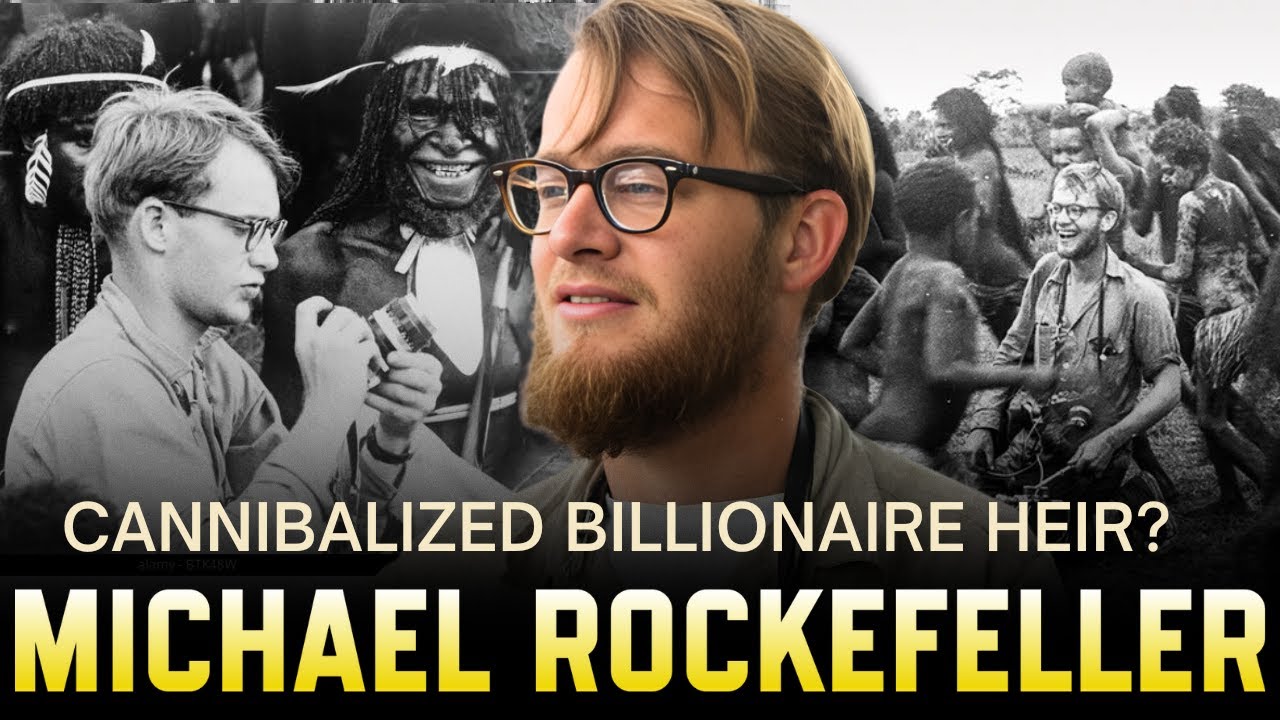
He was never seen again. Michael was born in 1938 into a family that functioned less like a dynasty and more like an institution. His father, Nelson Rockefeller, was a dominating force, an art collector, a politician, and a man whose presence overwhelmed every room he entered. Michael was the quiet one, a listener, an observer.
He graduated from Harvard in 1960 with degrees in history and economics, but he had no interest in boardrooms or political campaigns. He wanted connection, simplicity, and something genuine. What he inherited from his father was a passion for art, though not for the modern masters Nelson collected. Michael was drawn to the “primitive,” the ritual objects of indigenous cultures.
In 1957, Nelson founded the Museum of Primitive Art in New York, and for Michael, those galleries were a doorway. The masks, totems, and sculptures were not polite decorations. They were objects made to terrify, to protect, and to bridge the living and the dead. Michael wanted to go to the source.
In 1961, the most remote source on Earth was Dutch New Guinea. The western half of the island was a Dutch colony in the middle of a geopolitical storm. Indonesia, under President Sukarno, demanded control of the territory. The Dutch, arguing they were preparing the indigenous Papuan population for self-determination, were clinging to power.
The United Nations was watching. On the southern coast lay the Asmat region, a labyrinth of mangrove swamps, tidal flats, and winding rivers. It was a place of mud, oppressive heat, crocodiles, and malaria. Dutch administrators called it the green hell.
For the 30,000 Asmat people, it was the center of the universe. The Asmat lived by a strict spiritual law. Death was rarely considered natural. If a man died, his village blamed enemy magic.
A death created a cosmic imbalance that had to be corrected with a head. The Asmat were headhunters, and their violence was not chaos but a structured cycle of reciprocity and spiritual accounting. This violence was coupled with ritual cannibalism, not for food, but to absorb the power and vitality of the victim. These practices, however, were being suppressed by the Dutch colonial government.
In 1958, a Dutch patrol led by an administrator named Max Lapré entered the powerful Asmat village of Ochanep. The situation spiraled out of control, and Dutch police opened fire on Asmat warriors armed only with spears and arrows. Four or five of the village’s most important war leaders were killed. The Dutch retreated and filed a report minimizing the incident.
In Ochanep, the devastation was total. The universe was shattered. The Asmat could not attack the Dutch directly, so they waited, living in a state of spiritual debt. For three years, the spirits of the dead leaders demanded a white man’s head to balance the scales.
Michael Rockefeller entered this world unaware of its dangers. In the spring of 1961, he joined a Harvard expedition led by filmmaker Robert Gardner to the highlands of New Guinea, where he served as sound recordist and photographer. A side trip to the coast brought him face to face with Asmat art, and he was hooked. In October 1961, he returned as the leader of his own expedition, accompanied by René Wassing, a cautious 34-year-old Dutch anthropologist.
Michael was the engine, impulsive and eager. They traveled by catamaran along the coast, trading steel axes, knives, tobacco, and fish hooks for artwork. In three weeks, they visited thirteen villages and collected shields, drums, spears, and canoe prows. Michael was obsessed with the bisj poles, towering twenty-foot ancestor sculptures that were also pledges of war, and he was determined to find the best ones in the remote villages to the south.
On November 17th, 1961, Michael and Wassing set off from the Dutch administrative center of Agats with two Asmat guides, Leo and Simon. Their destination was Ochanep itself. The boat, a catamaran built from two lashed dugout canoes and powered by an 18-horsepower outboard motor, was designed for calm rivers, not the fury of the Arafura Sea. Approaching the mouth of the Betsy River, the weather turned.
The tide turned. A wave swamped the motor, and the boat lost power. The current twisted them broadside to the waves, water poured over the sides, and a massive swell flipped the vessel upside down. The four men scrambled onto the overturned hulls.
Leo and Simon, born to this environment, grabbed two empty jerry cans for buoyancy and urged the white men to swim for shore. Michael and Wassing hesitated, believing the boat was safer. Leo and Simon swam away. Michael and Wassing were alone.
Two nights passed. Thirst set in. Wassing faded, conserving his energy. Michael was restless.
Around 8 a. m. on November 19th, he stripped off his trousers, tied two empty gasoline cans together with his belt, and slid into the water. Wassing watched his head become a dot on the horizon, and then he was gone.
Wassing was rescued by a Dutch patrol boat on November 20th. News of the disappearance hit New York like a thunderclap. Nelson Rockefeller chartered a Boeing 707, filled it with aides and his daughter Mary, Michael’s twin, and flew to New Guinea. The search that followed was unprecedented.
The Royal Netherlands Navy deployed ships, the Air Force sent reconnaissance planes, President Kennedy offered American military assistance, and Australia sent helicopters. For ten days, the sea and the swamps were scoured. They found the catamaran. They found a paddle.
Then they found one of Michael’s red gasoline cans bobbing in the water. On November 30th, the Dutch announced the search was called off. There was no longer any hope of finding him alive. The official conclusion was that Michael had drowned, exhausted and dehydrated, perhaps taken by a shark.
In 1964, a judge legally declared Michael Clark Rockefeller dead by drowning. But the men on the ground were uneasy. The two Asmat guides had made the swim. The tide on November 19th was pushing toward shore.
Michael was a strong swimmer with flotation devices, and the jerry can found was pristine. Years of tidal analysis suggested a startling probability: Michael almost certainly made it to shore. He likely reached the mud flats off the coast of Ochanep territory in the late afternoon or early evening of November 19th, exhausted, crawling through waist-deep mud and the tangled roots of the mangroves. He had not washed up on a deserted beach.
He had washed up on the doorstep of the most aggrieved and spiritually indebted village in the Asmat. Michael arrived just as a group of roughly fifty Ochanep men were returning from a trading trip. These men were the sons, brothers, and nephews of the war leaders killed in 1958. The leaders of the canoe party were warriors named Pep, Ajim, and Finn.
Pep’s father had been one of the victims of the Dutch bullets. When they saw the pale, exhausted man in the water, they saw a gift. The spirits had delivered a white man to them. Michael likely waved, believing he was being rescued.
According to accounts later collected by Catholic priests, Pep drove an ironwood fishing spear into Michael’s ribs. He was dragged into the canoe and taken to a hidden creek, where the Asmat finished him with axes. They decapitated him, broke open his skull to access the brain, and mixed it with sago worms for a ritual meal. His bones were fashioned into daggers and spear points.
His blood was collected in bamboo tubes and used to consecrate the village’s new bisj poles. For the men of Ochanep, the death of the five leaders in 1958 had been paid for. The spirits were appeased. They named children born that month after the victim.
But the triumph was short-lived. Within days, the sky was filled with helicopters and planes. The villagers realized they had killed a big man of the white tribe. The village elders made a pact of silence, and the bones, the skull, and the glasses were hidden.
Two Dutch Catholic missionaries, Father Hubertus von Peij and Father Cornelius van Kessel, who spoke the Asmat language fluently, began hearing rumors. The villagers told them about the white man who swam from the sea, named the killers, and described specific forensic details they could not have known unless they had seen Michael. The priests wrote a detailed report to the Dutch administration, stating plainly that Michael Rockefeller had been murdered and eaten in revenge for the 1958 shooting. The Dutch should have raided Ochanep, found the bones, and made arrests.
Instead, they buried the report. In 1962, negotiations to transfer control of Dutch New Guinea to Indonesia were in their final delicate stages. A headline announcing that the son of the governor of New York had been eaten by headhunters in a Dutch colony would have been a diplomatic catastrophe. The file was marked secret, the priests were told to keep silent, and the Rockefeller family was told the rumors were baseless native gossip.
A hardened patrol officer named Wim van de Waal was sent to Ochanep quietly to find the truth. He lived among the villagers for months, and they eventually showed him the skull, the bone daggers, and Michael’s glasses. When his report reached the governor and the officials in The Hague, the order came down to bury it. Van de Waal was told to stand down and never speak of what he had seen.
The evidence was confiscated or destroyed, and Nelson Rockefeller was lied to by a crumbling empire trying to save face. The mystery mutated into myth. In 1969, a journalist and a photographer brought back film footage of a tall, bearded man standing in an Asmat war canoe, and the tabloids exploded with theories that Michael had survived and chosen to live in the jungle. The man was later debunked as a local with albinism, but the romantic fantasy distracted the world from the brutal truth.
Back in Ochanep, a cholera epidemic swept through the coast, hitting the village particularly hard. In the Asmat worldview, this was retribution. They had consumed a man too powerful, and his spirit was punishing them. The village was gripped by terror, and the ban on speaking of the event became absolute.
In 2012, an author and journalist named Carl Hoffman moved into Ochanep, not as an investigator but as a listener. He slept on the floor of the long house and watched. He noticed that the village lived under a cloud of fear. One day, while filming a group of men who were the sons and nephews of the original killers, they spoke in their local dialect, assuming the white man could not understand them.
Hoffman’s translator was listening. The men confirmed everything. They recounted the killing, mimed the thrust of a spear to the ribs, and named the killers: Pep, Ajim, and Finn. They discussed who had taken the head and who had the glasses.
One man warned another, “These are our secrets. If you talk, we die. ”
Today, the Michael C. Rockefeller wing of the Metropolitan Museum of Art in New York City displays a row of towering bisj poles, many collected by Michael himself.
In Asmat belief, a bisj pole is a pledge to avenge a death. Michael wanted to bring the spirit of the Asmat to New York. He succeeded. The official death certificate still reads drowning, and the Rockefeller family has never publicly accepted the murder theory.
But the weight of evidence, the tides, the priest’s reports, the secret police documents, and the confessions on tape, points to a single conclusion. The ocean did not claim Michael Rockefeller. He made it to shore.
And in doing so, he walked out of history and into the myths of the long houses.