Four faces rise out of a granite wall in South Dakota, each one taller than a six-story building, sixty feet from chin to crown. Washington’s nose alone runs twenty-one feet long, longer than a full-grown giraffe is tall. His mouth is eighteen feet across. And the men who made those faces did not chip them out of the rock with hammer and chisel in the way the word “carving” suggests.
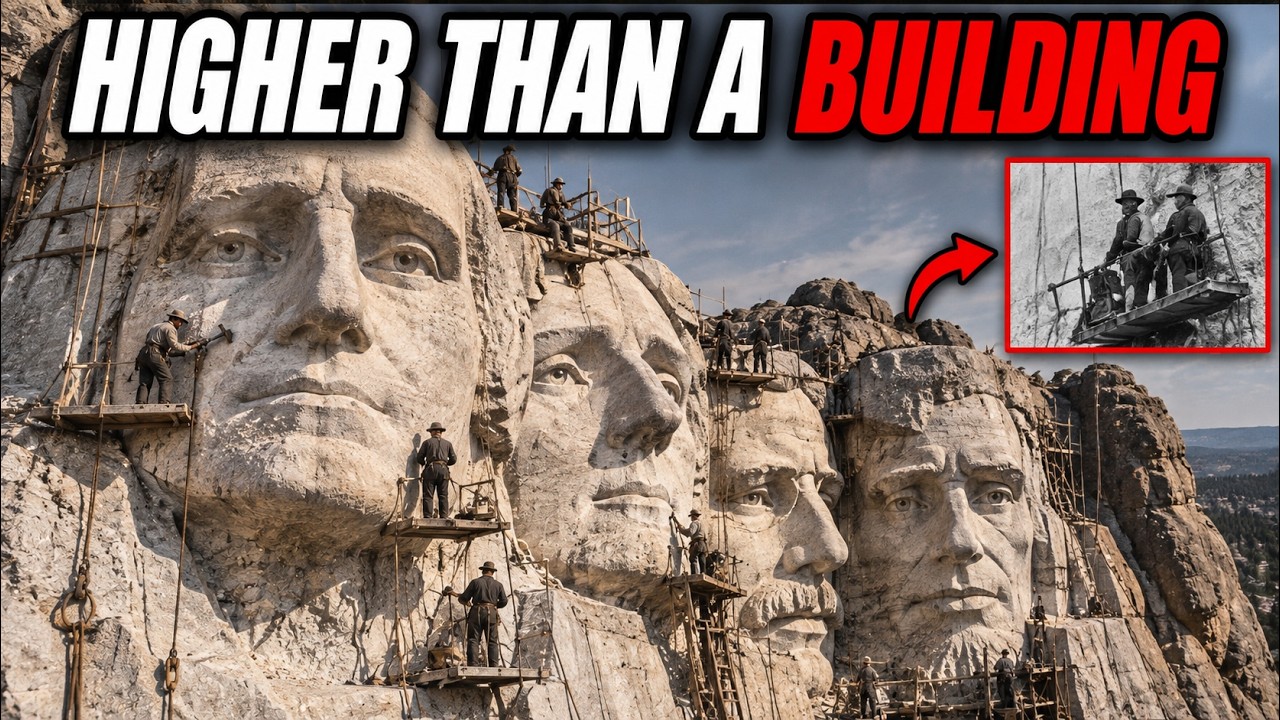
They blew the stone off the mountain with dynamite. Roughly ninety percent of everything a visitor sees at Mount Rushmore was removed with high explosives, about 450,000 tons of solid granite blasted loose and left piled at the base by some four hundred workers hanging off the face of a cliff on steel cables. For fourteen years they swung over a five-hundred-foot drop with charges going off around them all day. Not one of them was killed on the mountain.
The men who set those charges became so skilled that a single worker with a stick of dynamite could shape the curve of a president’s lip and stop three inches short of ruining it. The idea began in 1923, and it did not begin with an artist. It began with Doane Robinson, the state historian of South Dakota, who had a practical problem. South Dakota was empty, poor, and off to the side of every road that mattered.
Robinson wanted a reason for tourists to drive into the Black Hills and spend money. His first thought was to carve giant figures of western heroes, men like Lewis and Clark and the Lakota leader Red Cloud, into tall natural granite spires in the hills. To make it real, he needed a sculptor who was not afraid of scale. There was really only one man in America like that: Gutzon Borglum.
Borglum was the son of Danish immigrants, stubborn, grand, and difficult to work with by most accounts. He had just come off a huge carving project in Georgia that ended in a bitter falling out, and he was looking for the biggest thing he could possibly do. When Robinson wrote to him, Borglum did not want western heroes. He wanted presidents, so the monument would mean something to the whole country.
He wanted a single massive wall of granite, and he found it in a cliff facing southeast, catching the morning sun for most of the day on a peak rising to about 5,725 feet. The rock was a hard, fine-grained granite with fewer cracks than the stone around it. Borglum chose four presidents to tell a story about the country: Washington for the founding, Jefferson for its growth through the Louisiana Purchase, Lincoln for holding it together through the Civil War, and Theodore Roosevelt for the modern nation and its rise onto the world stage. Before a single charge went off, one problem had to be solved.
Borglum worked from a plaster model in his studio about five feet tall. The mountain face would be twelve times that size. A human face is unforgiving. Move an eye a few inches, thin a lip, get the distance between nose and mouth slightly off, and the eye reads it as wrong even from a mile away.
Borglum could not stand back, check his work, and adjust. The answer he used went back to the ancient Greeks, a method called pointing. On top of the studio model he mounted a flat steel plate over the crown of the head, and from the center of that plate swung a horizontal arm that could rotate like the hand of a clock. Hanging from the arm was a plumb line with a weight.
With that setup, he could measure any point on the model with three numbers: the angle the arm was turned to, the distance out along the arm, and how far down the plumb line hung. Three numbers located a single point on a face in space. They built the same device on a far larger scale on top of the mountain, sitting right over where each head would be. Every measurement read off the little model was multiplied by twelve and marked on the rock.
A point one foot out on the model became twelve feet out on the cliff. Borglum could stand on the mountain and, using nothing more complicated than a protractor, a tape, and a weight on a string, transfer a face he had made with his hands onto a wall of granite the size of a building. Every feature visible on the mountain is a set of three numbers off a five-foot model multiplied by twelve. The dynamite was not a crude first step.
It was the precision instrument. The men who set those charges, the powdermen, were the most skilled workers on the mountain, in some ways more skilled than the sculptor, because Borglum could imagine the face but the powdermen had to remove exactly enough rock to reveal it. Once a section was marked out with the pointing measurements, the drillers bored a pattern of holes into the granite. Then a powderman looked at the rock, judged how much had to come off to reach the final surface, and cut sticks of dynamite down to size.
Halves, thirds, slivers. Each charge was trimmed by hand and by eye to blow off a specific depth of stone in a specific spot. A charge here would take three feet. A smaller one there would take six inches.
They learned to shape blasts so precisely that they could blow away the bulk of a cheekbone and leave the rock standing within three to six inches of the finished face, all done by feel. Borglum said a good powderman was worth more to him than any carver. When blasting brought the rock down to those last few inches, the dynamite stopped and finishing began. The drillers cut a dense grid of holes packed close together, sometimes only an inch apart, so the surface looked like a honeycomb.
Once the rock was weakened, a worker could knock the thin walls between the holes away and peel the granite off in a controlled layer. At the very end, they ran a tool called a bumper over the stone, pounding the granite into a final smooth surface. A cheek that started as a rough cliff face was blasted to rough shape, honeycombed to near finish, and bumped smooth. The entire sequence had to be judged by men who could not see the full face while they worked because they were hanging inches from it.
Most of the workers were not artists. They were local men from the Black Hills, hard-rock miners and ranch hands and laborers who happened to be nearby and need the work. In the early 1930s, in the depths of the Depression, they needed it badly. Mount Rushmore paid around eight dollars a day, very good money at a time when a quarter of the country was out of work.
Men who had drilled for gold and tin in the hills came and drilled for a president instead. Their day began with a climb up hundreds of wooden stairs bolted to the rock. At the top, a row of hand-cranked winches sat in a small winch house. From each winch ran a steel cable only three-eighths of an inch thick, about as thick as a finger.
The worker sat in a leather strap seat on the end of that cable, a seat called a bosun’s chair, the same kind sailors used to go over the side of a ship. Another man, the winch operator, hand-cranked him over the edge and lowered him down the front of a five-hundred-foot cliff until he dangled in front of a stone eye with a thirty- or forty-pound jackhammer in his hands. The winch operator could not see the man he was lowering. The whole system ran on a chain of shouting.
Teenage boys, called callboys, relayed instructions by voice: up or down a few feet, stop. A man’s position on the face of the cliff was controlled by a relay of shouted human voices. There were no radios, no safety harness beyond the seat itself, no net underneath. They worked six days a week in wind that could swing a man on his cable, in cold that froze the machinery.
The fourteen years were not fourteen years of steady work. The money kept running out. Funding came in fits, first from private donors, then from the federal government. Again and again the checks stopped and the mountain went quiet.
Men were laid off. Winches sat still, sometimes for months. Then a new appropriation would come through and the crews would climb back up and pick up where they had left off. The days when men were actually out on the cliff added up to only a fraction of that time.
The rock itself forced a major change. The original plan put Washington in the center and Jefferson to Washington’s right as the viewer looks at the mountain. They spent roughly a year and a half carving Jefferson on that side. Then the granite betrayed them.
As they cut deeper, they kept hitting seams of soft, crumbling feldspar, veins of quartz, and cracks running through the stone, rock that would never hold a fine surface. Borglum had them dynamite Jefferson off the mountain. The whole partly finished head, a year and a half of dangerous work, was blasted away and erased. They moved Jefferson to Washington’s left, tested the stone, found it sound, and started the entire face again.
The Jefferson visible today is the second attempt. The layout of the monument was forced on Borglum by the rock itself. The faces came out of the cliff one at a time. Washington was dedicated first in 1934.
The recarved Jefferson followed in 1936, with President Franklin Roosevelt himself driving into the hills to watch the flag pulled off it. Lincoln was unveiled in 1937, and Theodore Roosevelt in 1939. The oft-repeated fact that nobody died building Mount Rushmore is true and remarkable. But there was a quieter cost.
The work filled the air with fine silica dust from drilling granite, and the men drilled into it for years with no masks and little idea of what it was doing to them. Breathing fine silica dust over years scars the lungs, a disease called silicosis, and it does its damage slowly, long after the job is over. Nobody kept a careful count of how many of the Rushmore men carried that home and died of it years later. There is an older cost as well.
Before it was Mount Rushmore, the peak had a Lakota name: the Six Grandfathers. The Black Hills, which the Lakota called Paha Sapa, are sacred ground, the spiritual center of their world. In 1868, the Treaty of Fort Laramie recognized the Black Hills as part of the Great Sioux Reservation, set aside for the Lakota for all time. In 1874, an expedition led by George Custer found gold in those hills.
Within two years, the treaty was worth nothing. Prospectors poured in. In 1877, Congress passed an act taking the Black Hills back, breaking the treaty it had signed nine years earlier. About fifty years after that, the carving began on the very peak they called the Six Grandfathers.
In 1980, the Supreme Court ruled in United States v. Sioux Nation of Indians that the seizure had been unlawful and that the Sioux were owed compensation. The court ordered payment, and the Lakota refused to take the money. It has sat in a federal account ever since, growing with interest past one hundred million dollars, untouched.
To accept payment would be to agree that the hills were for sale. To the Lakota, they were never for sale. Borglum did not live to see the work finished. He died on March 6, 1941, in a Chicago hospital after surgery, with the faces very nearly complete.
His son, Lincoln Borglum, who had grown up on the project, took over and carried it to the end. The monument as it stands was not what Borglum planned. He meant to carve the presidents down to the waist, with hands and coats and detail. He also planned a great chamber cut into the canyon wall behind the faces, a Hall of Records meant to hold the founding documents of the country and the story of why the mountain was made.
Workers drove a tunnel about seventy feet into the granite behind the heads. Then the money ran out, the Second World War was coming, and Congress wanted funds spent on finishing the visible faces. Work on the hall was stopped, and the torsos were never carved. In 1998, a titanium box holding porcelain enamel panels with the texts Borglum wanted preserved was placed in the floor of the unfinished hall, a promise kept sixty years late.
The mountain was declared complete on October 31, 1941, less than eight months after Borglum died. In the end, the project cost around $990,000. The granite wears away at a rate of about one inch every ten thousand years, which means those four faces blasted out of a mountain by a few hundred men on cables in a single human lifetime will still be recognizably there long after almost everything else we have built has turned to rubble.
The mountain carries both truths at once: one of the proudest engineering feats in American history, and ground that was promised to another people and then taken from them.