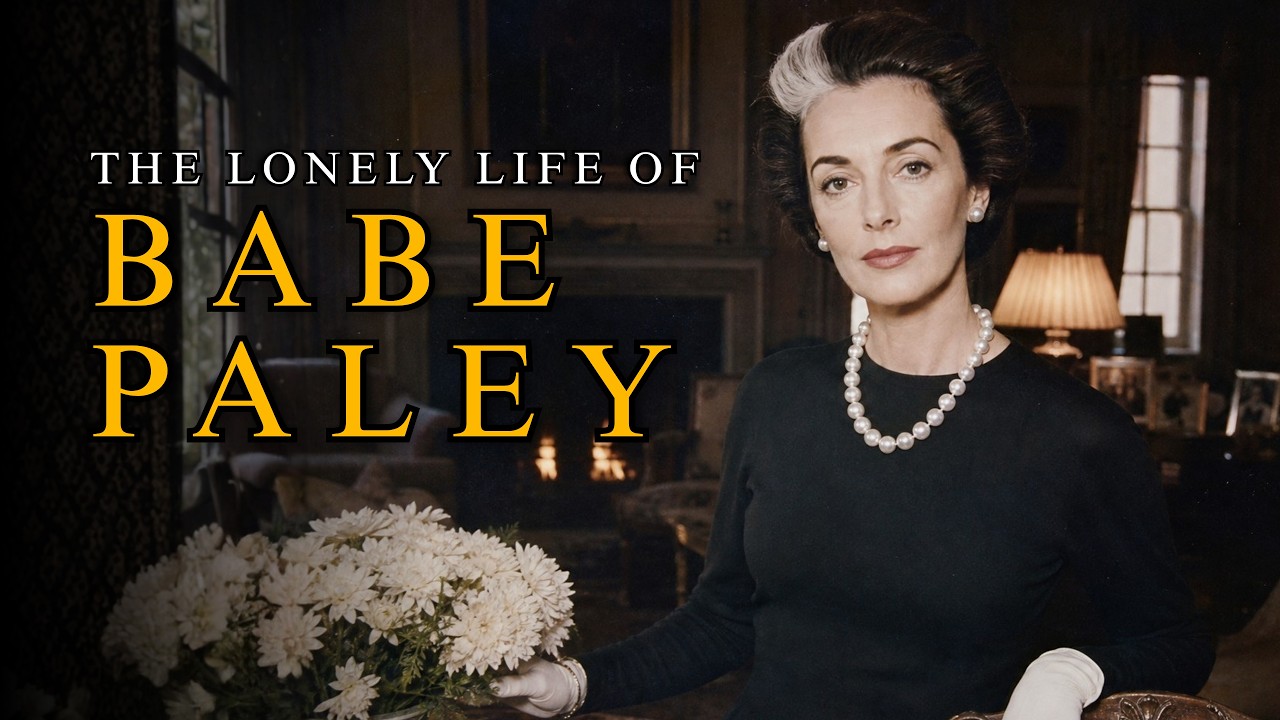
Barbara Cushing Paley, known to the world as Babe, was voted the best-dressed woman in America so often that she was placed in a Hall of Fame to stop the voting. For three decades in the middle of the 20th century, she was the standard against which fashionable America measured itself.
She did not sing or act or paint or hold any office. Her public art was the arrangement of surfaces: a room, a table, a wardrobe, a life. When she walked into a party, designer Bill Blass once said, "You noticed Babe and nothing else."
The most famous sentence ever spoken about her came from Truman Capote, who loved her and later did her the greatest harm of her life. "Babe Paley had only one fault," he said. "She was perfect. Otherwise, she was perfect."
The perfection was the thing that trapped her. It was the role, and the role was the whole of what the world required of her.
In 1941, when she was 26 and married to her first husband, Time magazine ranked her the second best-dressed woman in the world behind only Wallis Simpson. She appeared on the International Best-Dressed List again and again until the appearances numbered 14. In 1958, the list retired her into its Hall of Fame.
Her influence reached down into the way ordinary women dressed. She tied a scarf to the handle of her handbag one afternoon, and the gesture was copied by thousands of women. She let her hair go gray at an age when every woman of her class fought the gray, and gray hair became for a season the mark of the truly confident.
She mixed real jewels from the great houses with frank costume pieces so that no one could ever be entirely sure which was which. The whole fashion establishment imitated the trick.
To be that woman was also to be alone. An emblem is looked at rather than known. People studied Babe Paley the way they studied a beautiful room, appreciatively, from the doorway. She was the most looked at woman in America and one of the least accompanied.
Underneath the surface ran a marriage to one of the richest and most powerful men in America. The money was his. The houses were his to run. His attention was given generously and repeatedly to other women. She was expected to know it and to keep the table beautiful anyway.
Before she was anyone's wife, she had a job. By 1939, she had become a fashion editor at Vogue. The job asked her to do professionally the one thing she did better than almost anyone alive: look at clothes and rooms and arrangements and know without hesitation what was right and what was wrong.
In September 1940, she married Stanley Grafton Mortimer Jr., an heir to a Standard Oil fortune. They had two children. The war took him and returned a different one, withdrawn and drinking heavily. The marriage dissolved in fact, and in 1946 it ended in divorce.
She left with two young children and a settlement drawn from a trust, enough to be comfortable and nowhere near enough to be free.
In 1946, she met William Paley, called Bill, the founder and chairman of the Columbia Broadcasting System. He was self-made where she was pedigreed. He was rich on a scale that made her first husband's oil money look like a modest inheritance.
Bill Paley was Jewish, and the old Protestant society of New York kept its doors closed to a Jewish man, however large his fortune. Money had made him powerful. It had not made him belong.
Babe had that currency in her bones, and she had no fortune of her own. Each of them held precisely what the other lacked.
They married in 1947. Society understood the speed of it and the shape of it. A woman did not step out of an oil heir's household and into the life of the most powerful man in broadcasting within a season by accident.
She had traded the one asset a woman of her time was permitted to sell, her social self, for the one thing she could not otherwise obtain, which was money and the security that money bought.
The houses were stages, not homes. They had a farm on Long Island called Kiluna that became one of the most reproduced private houses in the country. Babe made its gardens a serious and sustained work of years.
During the week, they lived in an apartment at the St. Regis Hotel that decorator Billy Baldwin had made into one of the most admired interiors in the city. Here the famous Paley entertaining happened, evenings composed with the same exactness Babe brought to everything.
In 1957, they added Kiluna North on Squam Lake in New Hampshire. There was also a villa at Round Hill in Jamaica. Four houses, each of them beautiful, each of them photographed, and all of them held in her husband's name.
The Paley children grew up in large part at Kiluna among the staff while their mother and father kept to the city and the season. The house held the children. The parents held the calendar.
The perfection people admired was a day's work she did every day. A young helper named Carol Prisant spent a summer inside the Paley household and watched the performance from close range. Babe walked and spoke like a queen and almost never raised her voice. She did her correspondence every single morning in her own hand. She would not eat or smoke without first offering whatever it was to whoever else was present.
The details the fashion world worshipped were products of relentless attention passed off as instinct. The table set to an exactness that guests remembered for the rest of their lives. The great jewels by Fulco di Verdura and Jean Schlumberger worn beside frank costume pieces.
She had a genius, and the genius was real and rare, and it expressed itself entirely in the arrangement of appearances.
The money was never hers. Bill Paley controlled the money, the whole of it. Babe, mistress of four houses, dressed by the finest designers alive, was in the exact and literal sense financially dependent on her husband's continuing goodwill.
She had a modest trust from a first marriage and no claim of her own on any of the rest of it. Everything she touched was worth more than everything she owned.

When Babe spoke of leaving, Truman Capote talked her out of it. "Look," he told her, "you don't have any money and you've got four children." Then came the sentence that contained her whole position: "Bill bought you."
It was a savage thing to say and it was true.
The infidelity was no secret to their friends. It was kept only from the cameras. Across the length of the marriage, Bill Paley conducted affairs openly enough that their entire social circle understood the pattern perfectly, quietly enough that it never reached the newspapers.
Babe knew. Their friends knew. The whole gilded world that envied the marriage knew what the marriage actually contained.
She confided the truth of her marriage to a single person. She chose Truman Capote.
The one room she could not arrange to perfection was the nursery. Her daughter, Amanda, the child of her first marriage, was asked late in her life about her relationship with her celebrated mother. The relationship, she said, had been virtually nonexistent. The distance her mother had kept, she said, was her choice, not mine.
The children were, for much of their childhoods, raised amid a staff while their mother kept to the city. Babe herself had been raised at a certain cool distance from her own busy parents, and she reproduced the ration in her own house.
There was one person she told the truth to. Truman Capote had become the closest confidant of Babe Paley's adult life. He called his circle of beautiful, best-born women his swans. Babe was the first of them and the finest.
Over long lunches at a French restaurant called La Côte Basque, she told him things she told no one else on Earth. The private texture of her marriage. The loneliness folded inside the gilded life.
He was, all through those years of confiding lunches, quietly at work on what he intended to be the great novel of his life, assembled out of the secrets of the precise people who had taken him in and fed him and loved him.
In 1974, the doctors found lung cancer. Babe Paley had smoked heavily for most of her adult life. She was in her late 50s. She had roughly four years left.
She went on dressing perfectly. She went on entertaining beautifully. She went on being Babe Paley while the illness worked quietly inside her.
She continued to put on a full and careful face of makeup even as the end drew close. She would meet even death composed.

In November of 1975, a magazine appeared on the newsstands with her marriage inside it. The magazine was Esquire. The piece was called "La Côte Basque, 1965," an excerpt from the great novel Capote had been building in secret.
It was fiction in the thin sense that the names had been altered. To anyone inside the world it described, it was a massacre conducted in plain sight. Among the figures displayed on the page was a wife whose husband's infidelities were laid out in specific, recognizable detail. It was Babe's marriage.
She never spoke to him again. The most forgiving of all the swans cut him off completely and finally and without appeal.
The piece detonated Capote's entire social world. The beautiful people closed their doors against him as one.
When she understood that she was dying, she did not fall apart. She made a list.
She planned her own funeral in complete detail down to the food and the wine that would be served at the luncheon afterward. And then she turned to her possessions.
Room by room, house by house, object by object, she decided who was to receive what. The great jewels. The furnishings. The keepsakes. The small perfect things chosen over 30 years.
She wrapped them and labeled them each with the name of the person who was to have it. She created a system of files and written directions specifying exactly how everything was to be distributed once she was gone.
The labeling of her belongings was the final and fullest exercise of the only power she had ever truly held. The power to arrange things beautifully, correctly, and completely.
On the 6th of July, 1978, one day after she turned 63, she died in the apartment that had never quite been hers. The New York Times recorded that Barbara Cushing Paley, the wife of the chairman of the Columbia Broadcasting System, had died of cancer after a long illness.
Her funeral was held at Christ Episcopal Church in Manhasset, near the Long Island house whose gardens she had made with her own labor. The service was the one she had planned herself, down to the luncheon that followed it.
Bill Paley did not remarry. He lived on for another 12 years until 1990 without ever taking another wife.
The most envied woman in America owned the most beautiful life anyone could name, and almost none of it. She owned the admiration of an entire nation, and she did not own her own bank account. She owned the most photographed houses in America, and she owned none of them.
She had been handed a surface to keep, and keep it she did, with a genius and a discipline that the world mistook for ease.
She spent her life being perfect because perfect was the only thing she was ever allowed to be. And she spent her death being perfect, too. Walking her own beautiful rooms in the last spring of her life with a roll of paper labels and a pen, writing a name on everything she owned, assigning it, wrapping it, filing the instructions, arranging one final time the only thing that had ever truly been hers to arrange.