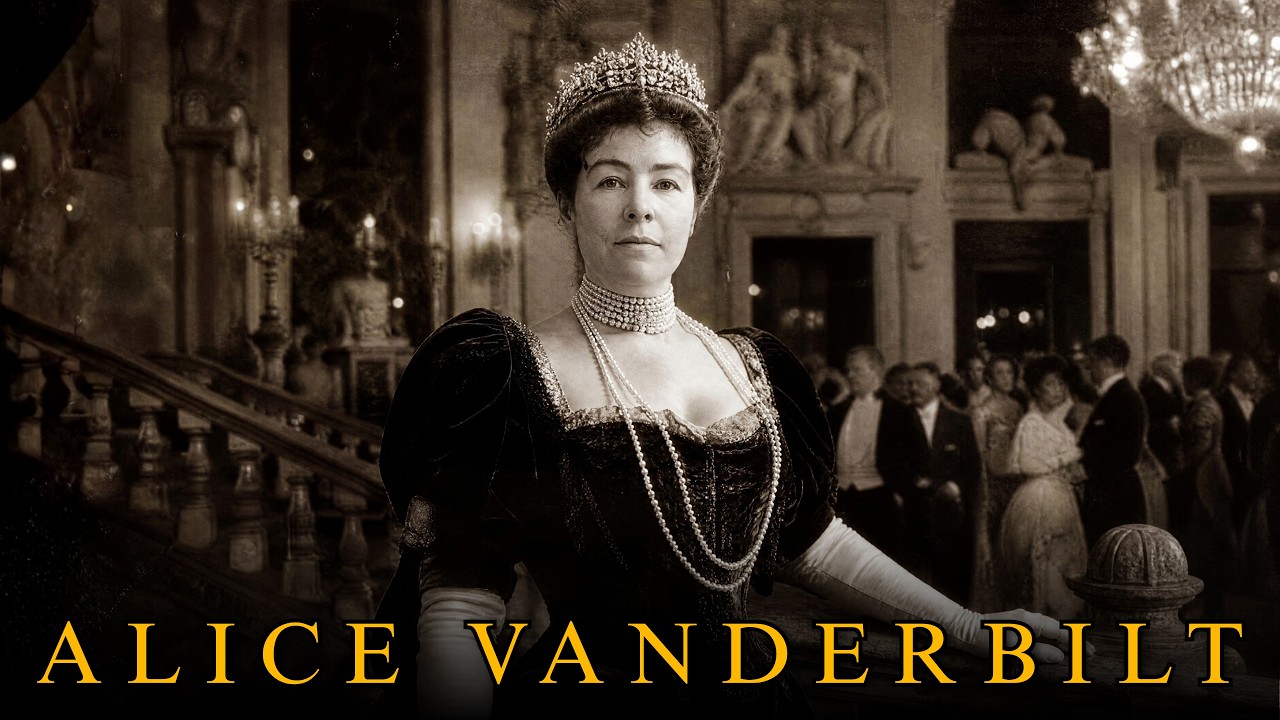
The Breakers in Newport opened its doors to more than 300 guests on August 14, 1895. A mother watched her daughter lead the cotillion in the grand new house.
Within 11 months, her eldest living son had walked out of the house to marry a woman his parents opposed. Her husband lay struck down by a hemorrhage of the brain.
Alice Vanderbilt had already buried a little girl of five and a son at Yale. Before she was finished, she would bury her husband and two more sons. One was lost in the Atlantic. One was lost to drink at 45.
Her house would outlast every one of them.
She was born in Cincinnati in November 1845. Her father was a lawyer named Abram Evan Gwyn. He died in 1855 when Alice was nine years old.
Her mother remarried. The household was educated, respectable, and Episcopalian. There were painters in the family, and the lineage reached back to Roger Williams, the founder of Rhode Island.
Alice moved to New York and went to teach Sunday school at St. Bartholomew’s Episcopal Church. There she met Cornelius Vanderbilt II, the grandson of the Commodore.
He had been raised to work. At 16, he began as a clerk at the Shoe and Leather Bank. He was serious, religious, and stern. One witness said no one ever recalled seeing him smile.
They married on February 4, 1867. Alice was 21. Cornelius was 23.
The children came quickly. Their first child was a daughter, also named Alice. Then came William Henry, called Bill. Then Cornelius III, called Neily. Then Gertrude. Then Alfred Gwyn. Then Reginald Claypoole. And finally, years later, Gladys.
Seven children in all.
Little Alice died when she was about five years old. A childhood illness took her. It was the first of five graves.
The Commodore died in 1877, leaving a fortune of about $100 million. William Henry, Cornelius’s father, roughly doubled it in eight years.
When William Henry died in December 1885, Cornelius inherited about $70 million. He became chairman and president of the New York Central Lines. Alice was 40 years old.
Cornelius gave money away as fast as it grew. He gave to the YMCA, the Red Cross, the Salvation Army, and to churches. One modern account says he did not increase the wealth left to him at all.
In October 1885, he bought a wooden summer cottage at Ochre Point in Newport from Pierre Lorillard. The house was already called the Breakers. It had cost $90,000 to build. Cornelius paid more than $400,000 for it.
He kept spending. A dining room 40 feet by 70 was added, then the largest in Newport.
In 1886, Alice gave birth to her last child, Gladys Moore Vanderbilt, in Newport. Alice was 40.
The family expected the eldest son, Bill, to carry everything. He went to Yale. In 1892, in his junior year, he fell ill with typhoid fever. He was 21 or 22 years old.
Alice had now buried two of her children.
The family gave Yale a building in his memory. Vanderbilt Hall was finished in 1894. It housed about 130 students. One account called it the costliest and most magnificent college dormitory in America.
Grief in Alice’s hands took the form of something that could be built, named, and endowed.
On November 25, 1892, a fire began in the kitchen of the wooden Breakers. The house was gone by morning. The New York Times put the loss at $700,000. Insurance covered only $210,000.
In the ruins, two safes were found. They held Alice’s jewelry. They had come through the fire largely undamaged.
The family decided to rebuild at once. They commissioned Richard Morris Hunt to design a new structure of steel, brick, and limestone. It must not burn.
The new Breakers was an Italian Renaissance palace. The great hall rose 50 feet to a ceiling painted as a sky. The music room was built in France, taken apart, shipped across the ocean, and reassembled inside the house.
The morning room walls were paneled in leaf so bright that conservators assumed it was aluminum. It was platinum. That was only discovered in 2006.
The dining room rose two stories with 12 columns of rose alabaster and two chandeliers of Baccarat crystal, each 12 feet tall. The kitchen was in a separate wing. The boilers were placed away from the house entirely.
The house had 70 rooms, 33 of them for servants. The cost is usually given at somewhere between $7 million and $12 million.
At the same time, the Vanderbilts doubled their New York house on Fifth Avenue and 57th Street. It grew to about 130 rooms and cost about $3 million. It was the largest private house ever built in New York City.
Richard Morris Hunt died on July 31, 1895, about three weeks before the new Breakers opened.
The house was inaugurated on August 14, 1895, with Gertrude Vanderbilt’s debut. More than 300 guests came. Gertrude led the cotillion.
Alice was 49. She had lost her first daughter and her first son. She had watched her summer house burn. Now her daughter was dancing in the great hall of the house that had risen in its place.
That summer, Neily, the eldest living son, met Grace Wilson. She was three years older than he was. Her family was considered the wrong kind of family.
Richard Thornton Wilson had started as a store clerk in Georgia. He made money handling Confederate cotton in London during the Civil War. Old New York called the family the Marrying Wilsons.
One Wilson daughter married Ogden Goelet. A son married Carrie Astor, daughter of Mrs. Astor herself. Another daughter married the brother of the Earl of Pembroke.
Neily and Grace were engaged by early 1896. His parents were against it from the start.
On June 11, 1896, the New York Times printed the headline: “Against Mr. Vanderbilt’s Wish. His Son Cornelius Will Marry Miss Grace Wilson Soon.”
On June 18, 1896, Cornelius Vanderbilt II signed his will. Neily, the eldest living son, was cut down to almost nothing. He would receive $500,000 outright and the income from a trust of $1 million.
The bulk of the fortune would pass to his younger brother Alfred. One newspaper said the difference between the shares was the measure of a father’s disapproval.
Neily did not think again. Early in July, he left his father’s house.
On July 14, 1896, Cornelius Vanderbilt suffered a cerebral hemorrhage. He was 52. He lay at the point of death for several days. He survived but was partially paralyzed and never worked again.
On August 3, 1896, Neily married Grace Wilson in New York. It was a quiet wedding at the Wilson house. No member of the Vanderbilt family attended.
On August 25, 1896, Gertrude Vanderbilt married Harry Payne Whitney at the Breakers. She wore her mother’s bridal veil. Bishop Potter took part. Gladys, age nine, was a maid of honor.
One son married without her. One daughter married in her veil.
Cornelius and Alice went abroad for nearly a year. He recovered somewhat but never took an active part in business again. He spent most of his time at the Breakers.
On September 12, 1899, in New York, he woke his wife before dawn. He said, “I think that I am dying.” He died within minutes of a cerebral hemorrhage. He was 55.
Alice was prostrated. She had to be placed under a doctor’s care.

The estate was appraised at $72,999,867. Alfred received tens of millions. Gertrude, Reginald, and Gladys each received more than $6 million. Neily received his small share.
Alice received $2 million outright and an income of $250,000 a year for life. She received the use of the two great houses for the rest of her life. She did not own them.
She could live in the Breakers until she died. She could not sell it.
In October 1899, it was reported that Alfred had given $6 million of his own inheritance to Neily. It did not heal anything.
Alfred married Elsie French in 1901. Their son was born in November 1901. They named him William Henry Vanderbilt III, after the uncle who had died at Yale.
In March 1908, Elsie filed for divorce. The other woman was Mary Agnes O’Brien Ruiz, a former Broadway showgirl married to a Cuban diplomat. She had been traveling with Alfred in his private railroad car.
Agnes Ruiz followed Alfred to London. He refused to marry her. In May 1909, she killed herself in her apartment.
Alice left no recorded word about the scandal.
In January 1908, Gladys married Count László Széchényi at the house on 57th Street. The ceremony lasted barely 10 minutes. The count was known as a spendthrift, a gambler, and a hothead. Days before the wedding, he was arrested for assaulting a photographer.
But he had an old name. The wedding went ahead.
Alfred remarried in 1911 to Margaret Emerson, an heiress to the Bromo-Seltzer fortune. They had two sons.
On May 1, 1915, Alfred boarded the Lusitania in New York. He was 37 years old.
On May 7, off the coast of Ireland, the ship was struck by a torpedo. She sank in 18 minutes.
A steward saw Alfred on deck, attempting to rescue a hysterical woman. The most famous story holds that he gave his own life belt to a young mother with a baby and went down with the ship. It has never been proven.
His body was never found. The family offered a reward of $5,000. It was never claimed.
Alice was 69. She had now buried her first daughter, her first son, her husband, and the son who had inherited the family. This time there was no body to carry to the tomb.
Reginald was the youngest son and the one who spent his inheritance the fastest. He left Yale without a degree. He received about $7.5 million outright. Something like $25 million passed through his hands in 14 years.
He spent it on horses, gambling, and drink. He founded the Association of American Horse Shows.
In January 1922, he met Gloria Morgan. She was 17. He was 43. They married in March 1923.
The most famous story about Alice belongs here. At lunch one day with Reggie and his new young wife, Alice asked whether Gloria had received her pearls. Reggie said he had not bought any because the only pearls worthy of his bride were beyond his price.
Alice sent for a pair of scissors. She took her own pearl necklace, a rope said to be worth $70,000, and cut off about a third of it. She handed the pearls to her son’s wife.
“There you are, Gloria. All Vanderbilt women have pearls.”
Their daughter Gloria was born in February 1924. She would never know her father.
Reggie died on September 4, 1925, at Sandy Point Farm. He was 45. One account said cirrhosis of the liver brought on by countless brandy milk punches ended his dissipated life.
It was the fifth grave. His daughter was 18 months old.
Alice was 79. Of her four sons, three were dead. The only one left alive was the one estranged from her for nearly 30 years.
In 1926, the largest private house ever built in New York was sold for about $7 million. Alice sold it. It was pulled down, and Bergdorf Goodman rose on the site.
Before the wreckers came, Alice gave away pieces of the house. The great fireplace by Augustus Saint-Gaudens went to the Metropolitan Museum of Art. The iron carriage gates, 10 feet high, went to Central Park. They stand there still at the entrance to the Conservatory Garden.
Alice moved to 857 Fifth Avenue.
The accounts agree that Neily and his mother lived for years in silence. One account says it was 27 years after his father’s death before he finally reconciled with his aging mother. That brings the reconciliation to around 1926.
Neily had become a brigadier general in the Great War. He had won the America’s Cup in 1903. Grace, the woman Alice had refused, had become the reigning hostess of New York.
At Newport, the great house went on. In the mid-1920s, it took 33 indoor servants and 25 outdoor servants to run it. The boilers burned more than 150 tons of coal a year.
Alice died in April 1934 at 857 Fifth Avenue. She was 88.
The New York Times headline read: “Mrs. Vanderbilt Senior Dies in Home at 89. Widow of Financier, Long Ill, Was a Leader in Brilliant Era of New York Society.”
She was carried to Staten Island, to the family tomb at New Dorp, where her husband lay.
Her will had been written on June 8, 1928. Her net estate was about $9.3 million.
To Gertrude, she left $150,000. To the children of Alfred, $500,000. To the two daughters of Reginald, about $881,000 each. To Gloria Morgan, Reggie’s widow, $100,000. To her sister Setti, $100,000. To Newport Hospital, $80,000. To St. Bartholomew’s, $50,000.
To Gladys, the youngest, she left about $3.5 million, the house at 857 Fifth Avenue, and the Breakers.
To Neily, the son she had not spoken to for so long, she left the Gwyn Building in Cincinnati, the property that carried her own father’s name. And she left him the residue of her estate in trust for his lifetime.
Five months after she died, the family broke apart in public. In October 1934, Gertrude went to court against Gloria Morgan Vanderbilt for custody of 10-year-old Gloria. Gertrude won.
In June 1948, Gladys leased the Breakers to the Preservation Society of Newport County for $1 a year. On July 1, 1948, the doors opened to the public. A ticket cost $1.25.
In 1972, the Preservation Society bought the house from her heirs for $365,000.
The family kept the third floor. For decades, descendants of Alice Vanderbilt lived on the third floor of the Breakers while visitors walked the rooms below them. The third floor was opened to the public in 2024.
The Breakers outlived the architect who died three weeks before it opened. It outlived the man who built it. It outlived the son who might have inherited it, dead at Yale before it was begun. It outlived the son who did inherit the fortune, lost at sea. It outlived the youngest son, who drank himself to death a few miles down the road.
It outlived the woman who ruled it for 39 summers and never owned a single stone of it.
Alice Vanderbilt lost a daughter before the fortune came and a son before the house was built. She lost her husband before she was 54. She lost one son to the Atlantic and one to the bottle.
She did not lose the house. She did not lose the forms. She did not lose the rules.
The rules were the one thing the losses could not take. And they were the one thing that kept her from the son who was still alive.
There is no letter to tell us whether she regretted any of it. There is only the shape of what she did, the doors she opened and the doors she kept shut, and the house that stands on the cliff above the Atlantic with her life written into its rooms.