In 1978, the beer of Baltimore stopped being made in Baltimore. The trucks kept rolling, the bars kept pouring, and cans of National Bohemian still showed up at crab feasts and corner taverns, but the beer had quietly stopped belonging to the place that made it. It had not been brewed in the city since 1978, and it had not been brewed anywhere in Maryland since 1996. Yet nearly ninety percent of every can sold in America is still sold within a few miles of a brewery that no longer exists.
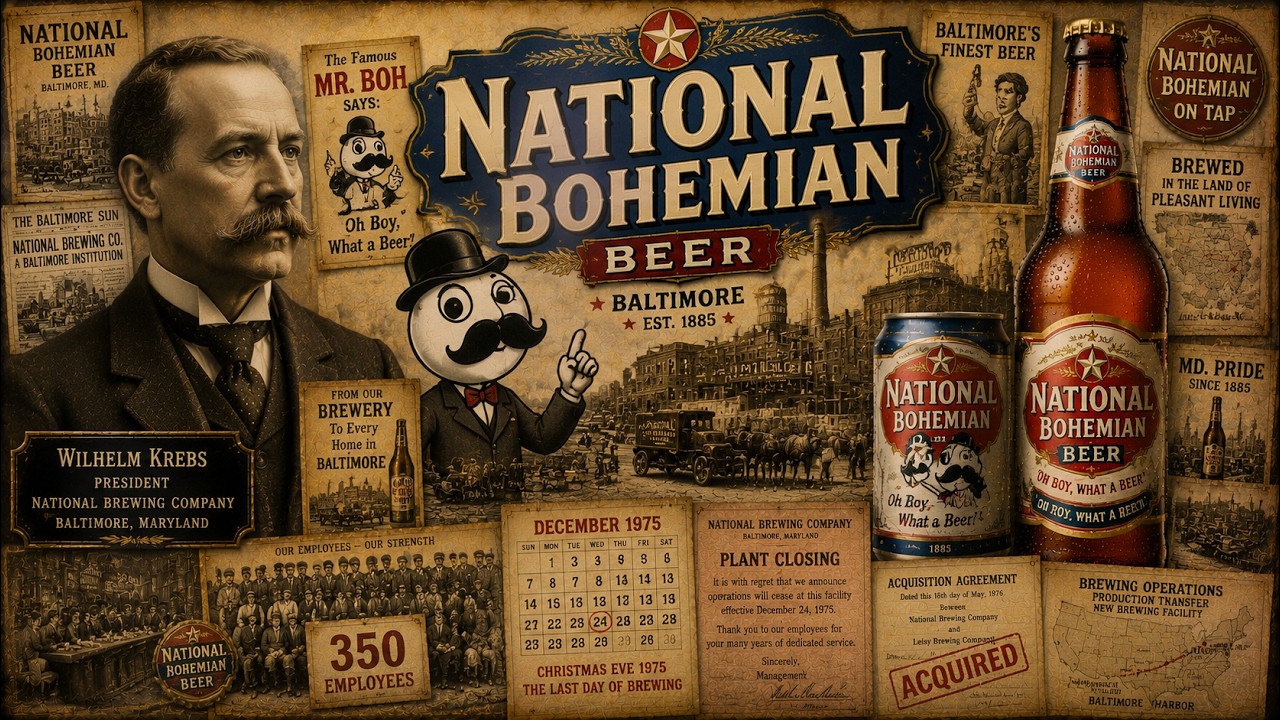
This is not a story about a beer that died. It is a story about a beer that got left behind, and a city that refused to let go of it anyway. The story begins in Baltimore in 1850, when German immigrants were pouring into the city by the boatload, bringing with them a trade older than the country itself. More than a hundred breweries would eventually operate within the city limits, most of them small, family-run operations that left almost nothing behind except a name on a foreclosure notice.
One of those immigrants was Johan Byer, a brewer with a trade in his hands and nothing else. In 1850, he leased a patch of land on the eastern edge of the city on high ground locals called Loggerbeer Hill. The earth there was good for digging, and Byer cut storage cellars straight into the hillside by hand, cool, dark chambers where his beer could age the old-world way. There was no factory and no brand, just a leased hillside, a hand shovel, and a batch of beer waiting to be sold a barrel at a time to the taverns of a city that could not get enough of it.
Byer ran that operation for sixteen years. When he died in 1866, the brewery did not die with him. His widow, Anna, took it over, remarried a man named Frederick Wonder, and together they grew the business. By 1872, they had put up a real brewery at the corner of O’Donnell and what would later become Conkling Street, with Byer’s original hand-dug cellars still underneath it as the foundation.
Locals called it the Highlandtown Brewery, later the Dillon Street Brewery. The name kept changing, but the hillside never did. For a while, it worked. The Wunder brewery became a steady midsized operation feeding Baltimore’s endless thirst.
But by the early 1880s, the Wonders were in trouble. The details of what went wrong have not survived in the record, but the outcome is clear. They could not keep up with their own suppliers, two men named Joseph and William Strauss. The Strauss brothers were not brewers at all.
They were maltsters, supplying the raw grain that turned water into beer. By the mid-1880s, the brewery owed them more than it could pay back. In 1885, the debt came due, the Wunder Brewery was sold at a foreclosure sale, and the men who ended up holding the deed were the very suppliers who had been feeding it grain all along. The Strauss brothers became brewers because a brewery defaulted on them, and taking the collateral was cheaper than writing off the loss.
The first time this brand changed hands, it was because of who held the debt, not because someone built something better. That same year, the Strauss brothers began brewing a new flagship lager, a beer they called National Bohemian, styled in the Bohemian tradition that was sweeping American breweries at the time. Within a few years, the growing company took a new name to match its new ambitions, the National Brewing Company, formally adopted in 1889. The timing mattered.
National Bohemian was not launching into an empty market. It was launching into one of the most crowded beer markets in the country, a city that already supported well over a hundred breweries. What the market did not have yet was a beer with a face, a beer a working man could ask for by name at a tavern instead of just ordering a lager. That gap, identity rather than just liquid, was what National Bohemian was built to fill.
Growth came in fits and starts. In 1892, a fire tore through the plant, and rather than shrinking from the damage, the operation rebuilt bigger, adding a new grain storage building. Further expansions followed at the turn of the century, designed by a Philadelphia architect who specialized in breweries. Four steam boilers with five hundred horsepower combined went in to power a plant that was no longer just surviving on Loggerbeer Hill.
It was starting to dominate it. By the early twentieth century, the site had grown into the largest brewery in Baltimore, sprawling across roughly five city blocks and employing several hundred workers. What had started as one immigrant’s hand-dug cellar had become one of the largest industrial employers in East Baltimore. In 1899, National did what smart regional players in a fragmented industry have always done.
It joined forces, merging with fifteen other Baltimore breweries to form the Maryland Brewing Company, a combined operation with a production capacity of 1. 5 million barrels a year. It was not a merger built on friendship. It was a merger built on arithmetic.
Sixteen small brewers understood that alone, any one of them could be squeezed out, but together they controlled enough of the city’s beer supply that nobody could squeeze all of them at once. It worked for a while. And then in 1920, the federal government made the entire business illegal. When Prohibition took effect on January 16, 1920, beer, all of it, became illegal to make, sell, or transport.
Roughly 130 breweries were operating across the United States going into that year. When the ban finally lifted thirteen years later, no more than a hundred were still standing. The ones that survived shared one thing in common. They had the capital and the flexibility to become something other than a brewery for thirteen years.
Anheuser-Busch turned its equipment toward non-alcoholic near beer, truck bodies, and frozen food. Pabst literally struck the word brewing from its own name and started selling processed cheese. National Brewing did not have that balance sheet. It did not pivot to near beer.
It did not find a side business to carry it through the dry years. National simply closed. For thirteen years, the site where Johan Byer had dug his first cellars by hand sat idle. It was not cleverness that killed National’s independence.
It was the same force that would come back for this brand decades later. Companies with enough capital to weather a total shutdown survived. Companies without that capital just waited and hoped someone with money would eventually want what was left of them. Someone did.
When Prohibition ended in April 1933, National Brewing did not reopen under the men who had run it going in. It reopened under Samuel Hoffberger, a Baltimore lawyer and businessman who saw exactly what a dormant brewery on Loggerbeer Hill represented: a piece of real estate, equipment, and a dormant trademark sitting there for the taking. Hoffberger modernized the plant, poured money into new equipment, and relaunched National Bohemian as the company’s flagship product. The first time in the story, but not the last, that National Bohemian’s survival would depend entirely on who was willing to write the check.
Then came the man who would turn National Brewing into the biggest brewery Baltimore had ever seen. Gerald Hoffberger, Samuel’s son, came home from World War II in 1945 and joined the company at twenty-six years old. Two years later, he was named president, a position he would hold for the next twenty-eight years. Under Gerald Hoffberger, National industrialized.
High-speed can and bottle lines went in. New fermenting and lagering cellars were added year after year. In 1951, the company completed a ten-story brewhouse with an annual production capacity of 1. 25 million barrels, a building so large it would remain the visual anchor of the Baltimore skyline for the next quarter century.
It was a statement to every larger out-of-state brewer eyeing the Baltimore market that National had no intention of staying small. By 1966, that ambition had a national footprint to match it. National acquired a brewery in Phoenix, Arizona, complete with its own regional beer label, folded into the growing portfolio. Combined with Baltimore and its other facilities, the company’s total annual brewing capacity now stood at 2.
6 million barrels. A regional Baltimore brewery from a foreclosed hillside was now shipping beer from coast to coast. But size alone has never been what makes a beer immortal in the memory of a city. Numbers build a company.
They don’t build a mascot. In the 1930s, National introduced a new figure to the label: a cartoon man with a jaunty handlebar mustache, a bowler-tilted grin, and one eye. Nobody ever gave an official explanation for why the character was drawn with only one eye visible. Baltimore didn’t wait for one.
A joke started making the rounds built around National’s biggest local rival, a brewery called Gunther, whose slogan was “Gunther’s got it. ” Ask a Baltimore drinker what happened to Mr. Boh’s other eye, and the answer has been the same for the better part of a century: Gunther’s got it. That is not a marketing campaign a company can buy.
That is a city writing the joke itself and handing it back to the brand for free. In the 1950s came the slogan that would end up meaning more to Maryland than the beer itself: “from the land of pleasant living. ” It wasn’t just a tagline. National leaned into it as a full lifestyle identity, even commissioning a Chesapeake Bay skipjack named after a cartoon pelican from the brand’s own ad campaigns.
The deepest cultural embedding came from baseball. In 1954, Gerald Hoffberger bought a stake in the Baltimore Orioles. As he rose to become the team’s principal owner through the 1960s, he made the connection between his ball club and his beer unmistakable. Natty Boh was sold at Memorial Stadium as the Orioles’ unofficial house beer.
In 1965, National Bohemian was formally declared the official beer of Baltimore. It wasn’t just a marketing claim. It was closer to a civic fact. At a moment when Baltimore’s identity was wrapped up tightly in its baseball club, rooting for the Orioles and drinking a Natty Boh weren’t two separate choices for a Baltimore fan in 1965.
They were the same choice made once at the concession stand. But underneath the surface, the ground the company was standing on had already begun to shift. National’s strategy through the 1950s and 1960s had been expansion by acquisition, buying up smaller regional breweries in cities outside Baltimore and using them to push National Bohemian into new markets. On paper, it was smart.
But every one of those distant plants was still at its core a regional operation trying to compete in someone else’s home market, and every one of them needed continuous capital to stay modern and profitable. National was no longer just defending Baltimore. It was trying to defend Detroit, Miami, and Phoenix at the same time. Then in 1970, a federal ban on cigarette advertising went into effect, and Philip Morris, the parent company of Miller Brewing, redirected the television ad budget it could no longer spend on cigarettes straight into beer.
Anheuser-Busch had been building its Baltimore presence aggressively for years, backed by a production scale National could never hope to match. National wasn’t just fighting local rivals anymore. It was fighting two of the largest advertising budgets in American consumer history. In 1970, Pabst passed National Bohemian to become the bestselling beer in Maryland.
Five years later, Budweiser did the same. National had scaled itself into a genuinely national footprint at exactly the moment national scale stopped being an advantage and started being table stakes. The Detroit brewery closed in early 1974. The strategy that had carried National Bohemian to its highest point was the same strategy that left the company thin everywhere.
In 1975, ninety years after Joseph and William Strauss foreclosed on a failing brewery, the Hoffberger family sold National Brewing. The buyer was Carling O’Keefe, a Canadian brewing conglomerate, for more than sixteen million dollars. On paper, it looked like a merger of equals. But sales began dropping almost immediately.
Just three years later, in 1978, Carling National was sold again, this time to G. Heileman Brewing Company, a Wisconsin-based brewer that had built its own growth strategy around buying up struggling regional labels. This is the pattern the story keeps repeating: a beer changing hands every few years, each new owner a little further from Baltimore, each a little less invested in the hillside where Johan Byer once dug his cellars by hand. Heileman didn’t invest in modernizing the aging equipment it now owned.
When the brewery’s large kettle needed major repairs, engineers welded raised sides onto it rather than replacing it. A patch job dressed up as a fix. In 1978, Carling closed the original Highlandtown site and moved production to Halethorpe in Baltimore County, just a few miles away. Close enough that most drinkers barely noticed the difference.
Then in 1996, Stroh Brewing Company bought G. Heileman outright and made the decision that finally ended production of National Bohemian anywhere in the state that gave birth to it. On a November day in 1996, the last brewery still making beer in Maryland shut its gates for the last time. There was no press conference, no farewell tour, no ceremony marking the end of 111 years of Maryland-brewed beer.
More than four hundred workers lost their jobs. Some of them had already survived one closure eighteen years earlier. This was the second one, the one with no plant left standing anywhere in the state to absorb them. There was no single villain standing at the gate that day.
Just a spreadsheet somewhere in a Detroit corporate office that said an aging kettle patched together with welded steel plates wasn’t worth the capital it would take to replace it. Not when the same beer could be brewed somewhere else, by someone else, for less. Ten years later, in October 2006, the old Carling National Brewery building on Conkling Street was torn down. There was no ceremony for that either, just a demolition crew and then an empty lot where a brewery had stood for 121 years.
National Bohemian did not die in 1996. The company that owned it kept selling cans under the name. But something else died that November: the last living connection between the beer on the label and the ground it was born on. Today, National Bohemian is owned by Pabst Brewing Company, the same Pabst that Carling National had once tried and failed to merge with in the 1970s.
Pabst doesn’t own a single physical brewery of its own anywhere in the country. It contracts out production to other companies’ plants. Today, the beer that carries Maryland’s unofficial slogan on its label is brewed under agreement at Molson Coors facilities in Albany, Georgia, and Trenton, Ohio. States that have never had anything to do with the land of pleasant living, run by a corporation whose name has never appeared on a Natty Boh can.
And yet nearly ninety percent of every can and bottle of National Bohemian sold in America is still sold in and around Baltimore. This is not a brand clinging to relevance through nostalgia. This is a beer that a city keeps choosing actively every single day, decades after the last drop of it was brewed anywhere near that city’s limits. Around 2009, Pabst announced that National Bohemian had returned to its original recipe.
Then in 2011, after more than fifteen years available only in bottles and cans, Natty Boh returned to draft in Baltimore taverns and inside Oriole Park at Camden Yards. The clearest monument to all of this doesn’t pour beer at all. The old National Brewing complex in Brewers Hill still stands, converted decades ago into offices. On top of it sits the Natty Boh Tower, and on top of that tower sits Mr.
Boh himself, an enormous illuminated sign of the one-eyed, mustachioed mascot visible for miles, greeting drivers on Interstate 95 as they roll into the city. The beer left that site in 1978. The mascot never did. Pabst can buy the name National Bohemian.
It can buy the recipe, the trademark, the mustache, the wink. What it cannot buy is the water tower on the skyline, the crab feast where somebody hands you a cold one without asking what you want, the joke about Gunther that Baltimore has been telling itself for nearly a century. A corporation can own everything about a beer except the place the story actually happened. Baltimore kept that part for itself.
National Bohemian did not lose because the beer was bad. It did not lose because Baltimore stopped loving it. It did not even lose because its owners were careless or foolish. What National Bohemian lost to was scale it could never match on terms it never got to set.
A federal ban on cigarette advertising sent Philip Morris’s television budget straight into Miller beer. Anheuser-Busch built production capacity large enough to hold prices down deliberately long enough to starve out competitors who couldn’t survive on thin margins. That isn’t a story about better beer winning. That’s a story about which company could afford to lose money longer.
Somewhere tonight in a rowhouse bar at the edge of a Baltimore neighborhood built on the wages of shipyards and steel mills that don’t run anymore, someone orders a Natty Boh. The bartender pulls it from a cooler stocked with cans brewed a thousand miles away. The person drinking it isn’t thinking about Johan Byer’s hand-dug cellars or the Strauss brothers’ foreclosure or a welded-together kettle in Halethorpe. They’re just having a beer the same way their father did, and his father before him.
That’s the part nobody managed to sell. That’s the part still standing on Loggerbeer Hill long after everything else was sold, moved, or torn down.