An angry crowd swept through the streets of Medellín, carrying the coffin of Pablo Escobar toward its grave. To those who came to grieve, he was the leader of one of the most powerful criminal organizations the world had ever known, a figure who had turned his country into a battlefield. Two great cartels had risen from the same soil, fed by the same product, built on the same combination of money and violence. At their peak, they controlled a dominant share of the global cocaine supply.
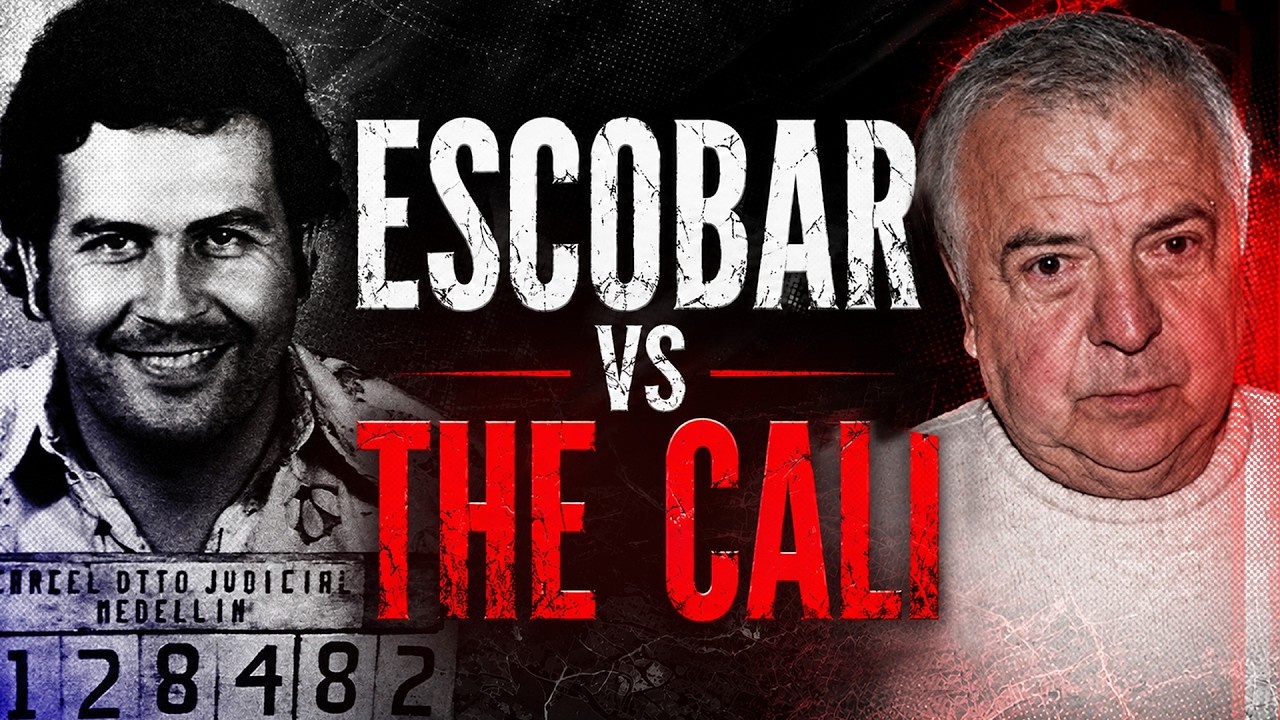
But two forces that powerful cannot occupy the same space forever. Eventually, one must break. The war between Escobar’s Medellín Cartel and the Cali Cartel was not a simple gang dispute. It became one of the defining criminal conflicts of the twentieth century, a collision between two opposing philosophies of power that reshaped the Colombian state, transformed the international drug trade, and cost tens of thousands of lives.
One side operated through terror. The other through infiltration. One believed fear could make any enemy bend. The other believed money could make any enemy disappear.
Both were wrong, and the proof of that error would take years to become clear. Pablo Escobar was born in 1949 in Rionegro, Antioquia, and grew up in the poor neighborhoods outside Medellín. His criminal career began early, with theft, contraband, extortion, and kidnapping. He understood that the formal economy had nothing to offer a man from his background, and he built relationships with other young men who saw the same opportunities in lawlessness.
By the late 1970s, he had recognized cocaine as the route to wealth, power, and the status that Colombian elites had always denied him. What made Escobar different from earlier traffickers was not the scale of his operations, though that scale was staggering. It was his understanding that trafficking was a political problem as much as a logistical one. He knew the real obstacle was not moving cocaine across borders, but the state itself, with its judges, politicians, extradition treaties, and press.
His strategy was simple. Those who could be bought would be bought. Those who could not be bought would be killed. Plata o plomo, silver or lead, was not a slogan invented for television.
It was the operating philosophy of an organization that murdered a justice minister, a presidential candidate, a governor, and hundreds of police officers. At the height of the cartel’s power in the mid-1980s, the organization reportedly shipped fifteen tons of cocaine into the United States every day. The cash flowing back was so vast that the cartel reportedly spent tens of thousands of dollars a month on rubber bands just to hold it together. Yet Escobar also wanted legitimacy.
He ran for Congress and briefly won a seat before his eligibility was challenged. He funded housing projects and built football pitches in the poorest neighborhoods of Medellín, cultivating an image of the outlaw as benefactor. When the government pursued extradition agreements with the United States, he launched a campaign of terror designed to frighten the political establishment into abandoning the policy. For a time, he succeeded.
Five hundred kilometers to the southwest, a different kind of organization was forming in Cali. The Cali Cartel was not a single enterprise under one leader but a coalition of criminal entrepreneurs, each running independent networks while sharing infrastructure, intelligence, and political connections. The dominant figures were the Rodríguez Orejuela brothers, Gilberto and Miguel, along with José Santacruz Londóno and Helmer Herrera, known as Pacho Herrera. The DEA administrator of the era, Thomas Constantine, described the organization as the biggest, most powerful crime syndicate the agency had ever known.
Gilberto, whose nickname was El Ajedrecista, the chess player, thought several moves ahead. He invested in banks, pharmacies, legitimate businesses, and political campaigns. He preferred corruption to confrontation, building the Cali organization into something that resembled the fabric of Colombian commercial life rather than an armed insurgency. Miguel managed the machinery that moved the product.
Santacruz ran a powerful distribution network in New York. Pacho Herrera, the youngest and most aggressive, would become Escobar’s most direct personal antagonist. The two groups were not always enemies. Through the late 1970s and early 1980s, they shared the same pipelines and divided territory.
The cocaine boom created enough money for multiple players, and neither side had any interest in a war with another powerful organization. But their visions were incompatible. Escobar wanted to dominate, to make everyone understand that challenging him had consequences. Cali wanted to operate, to accumulate wealth without attention.
Tensions over distribution corridors, particularly in Los Angeles, built for years beneath the surface of their functional relationship. And between Escobar and Pacho Herrera, the rivalry had become personal. The spark that turned rivalry into open war came in the early morning hours of January 13, 1988. A car packed with dynamite exploded outside the Monaco apartment building in El Poblado, one of the most exclusive neighborhoods in Medellín, where Escobar’s wife and children were staying.
Escobar was not there. His daughter Manuela suffered permanent hearing damage. Three people were killed, at least ten wounded, and the building was devastated across a four-block radius. Escobar had built his reputation on the principle that he could not be touched.
Someone had just tried to kill his family in his own city. The era of managed tensions was over. The war that followed was fought through assassinations, kidnappings, and bombings. Medellín targeted the Drogas La Rebaja pharmacy chain associated with Cali leadership, killing workers and customers who had no connection to the drug trade.
Cali responded with its own targeted killings of Medellín personnel. The violence was not random, but it produced randomness in its effects. A bomb meant for a building killed bystanders. A squad sent to one address struck people who happened to be there.
Between the two cartels, hundreds died. The conflict never stayed within criminal space. Escobar’s anti-extradition campaign escalated into open terrorism against the state. In August 1989, presidential candidate Luis Carlos Galán, a vocal supporter of extradition, was assassinated at a political rally.
On November 27, a bomb detonated aboard Avianca Flight 203 just minutes after takeoff from Bogotá, killing all 107 people on board and three more on the ground. The bomb was intended to kill presidential candidate César Gaviria, who had not boarded the flight. In December, a truck bomb carrying roughly five hundred kilograms of dynamite exploded outside the intelligence headquarters in Bogotá, killing sixty-three people and wounding more than two thousand. These were attacks on the state itself.
The Cali Cartel watched with growing concern. Escobar’s violence was generating exactly the kind of international pressure that threatened everyone in the drug trade. The more chaotic his war against the state became, the more scrutiny fell on Colombian trafficking networks and financial flows. Cali wanted to keep earning billions, and that required institutional stability, something Escobar was systematically destroying.
In 1991, under a new constitutional framework, Escobar surrendered and was confined to La Catedral, a prison outside Medellín that he had essentially designed. Reporters and officials soon described conditions that bore no resemblance to incarceration. He had comfortable furnishings, communication equipment, and regular visitors. The arrangement created the impression that the government had provided him with a protected base.
When two associates, Fernando Galeano and Gerardo Moncada, were executed inside the facility, and authorities moved to transfer him, Escobar simply walked out. The most wanted man in Colombia was free again. His enemies recognized the moment of vulnerability. In late 1992, a coalition called Los Pepes, an acronym for Perseguidos por Pablo Escobar, people persecuted by Pablo Escobar, emerged.
It included former Medellín associates, right-wing paramilitary figures, and people with documented ties to the Cali Cartel. Cali provided money, logistical support, and intelligence accumulated over years of operating in the same criminal landscape. Los Pepes claimed to be a victims’ organization. In practice, it ran a systematic campaign of assassination and destruction against Escobar’s lawyers, associates, family, and properties.
It killed more than sixty people connected to his network, and its campaign accelerated the collapse of the structures that protected him. Whether official agencies deliberately shared intelligence with Los Pepes remains historically disputed, but the boundaries between law enforcement and criminal retaliation had at minimum become blurred. By 1993, the net was closing. Escobar’s safe houses were being raided.
His financial resources were under pressure. His communications were monitored. He was cycling through rented properties in Medellín, moving constantly, aware that every radio transmission risked giving away his position. His vulnerability was human.
He called his family. On December 2, 1993, units of the Search Bloc traced a transmission to a house in the Los Olivos neighborhood of Medellín. Escobar was found and killed on a rooftop after attempting to flee. He was shot multiple times, including a fatal wound to the head.
The identity of the man who fired the killing shot remains disputed. What the historical record confirms is that Colombian security forces killed Pablo Escobar, ending one of the most destructive criminal careers in modern history. The aftermath was not the end of the story. With Escobar gone, Cali became the dominant organization in the world.
By the mid-1990s, according to the DEA, it controlled approximately eighty percent of the global cocaine market. It was reportedly generating seven billion dollars a year from the United States alone. For a moment, the chess player’s strategy appeared vindicated. The cartel that chose infiltration over terror had outlasted the cartel that chose terror over everything.
But the conditions that had protected Cali were gone. Escobar’s violence had absorbed the attention of law enforcement while Cali operated quietly in the background. With Medellín destroyed, there was no longer a larger, louder target. And the financial sophistication that made Cali’s laundering so effective had produced a paper trail of bank records, wire transfers, and corporate filings that investigators knew how to follow.
On June 9, 1995, Gilberto Rodríguez Orejuela was arrested in Cali, found hiding in a compartment behind a television. When officers discovered him, he reportedly said, “You won. I surrender. Calm, boys.
Don’t kill me. I am a man of peace. ” José Santacruz Londóno was arrested in July. Miguel Rodríguez Orejuela was arrested on August 6.
Pacho Herrera surrendered in 1996. Santacruz escaped from prison in January 1996 but was killed by police that March. Herrera was murdered in prison in 1998 by another inmate. The leadership of the most powerful criminal organization in the world was dismantled in a matter of months.
The collapse of both cartels within the same decade leaves the question of who actually won. The answer is complicated. The destruction of the mega cartels did not eliminate the economic incentive that created them. As the major organizations fragmented, smaller, more decentralized groups emerged.
The Norte del Valle Cartel rose from elements of Cali’s network. Paramilitary organizations with their own trafficking operations filled parts of the vacuum. The system became harder to target because it had no single head. The war was never about justice or legitimate grievance.
It was about routes, markets, politicians, territory, and the conditions under which two enormous criminal enterprises could keep making extraordinary sums while the country around them absorbed the consequences. Escobar believed fear could make him untouchable. He was wrong because he could not sustain the state pressure his own terrorism generated. Cali believed money and influence could keep it invisible.
It was wrong because the sophistication that made it powerful left an evidence trail investigators eventually followed to its door. When the smoke cleared, Escobar was dead. The Rodríguez Orejuela brothers were in American federal prisons serving thirty-year sentences. Santacruz and Herrera were dead.
The organizations had fragmented into successors that preserved the trade without preserving the institutions. Colombia moved on. The drug trade continued.
And the two greatest criminal organizations in the history of the cocaine trade left behind a legacy defined not by their victories but by the scale of what they destroyed on the way to their own destruction.