Robert Edward Lee lay dying in a chair in Lexington, Virginia, in the autumn of 1870. He had suffered a stroke in late September, lingered for two weeks, and slipped away on the twelfth of October. His last coherent words, reportedly, were a command to strike the tents, a soldier’s reflex at the threshold of death. The newspapers mourned him as a marble saint, a figure of such immaculate bearing that grief came easily to a South still raw from defeat.
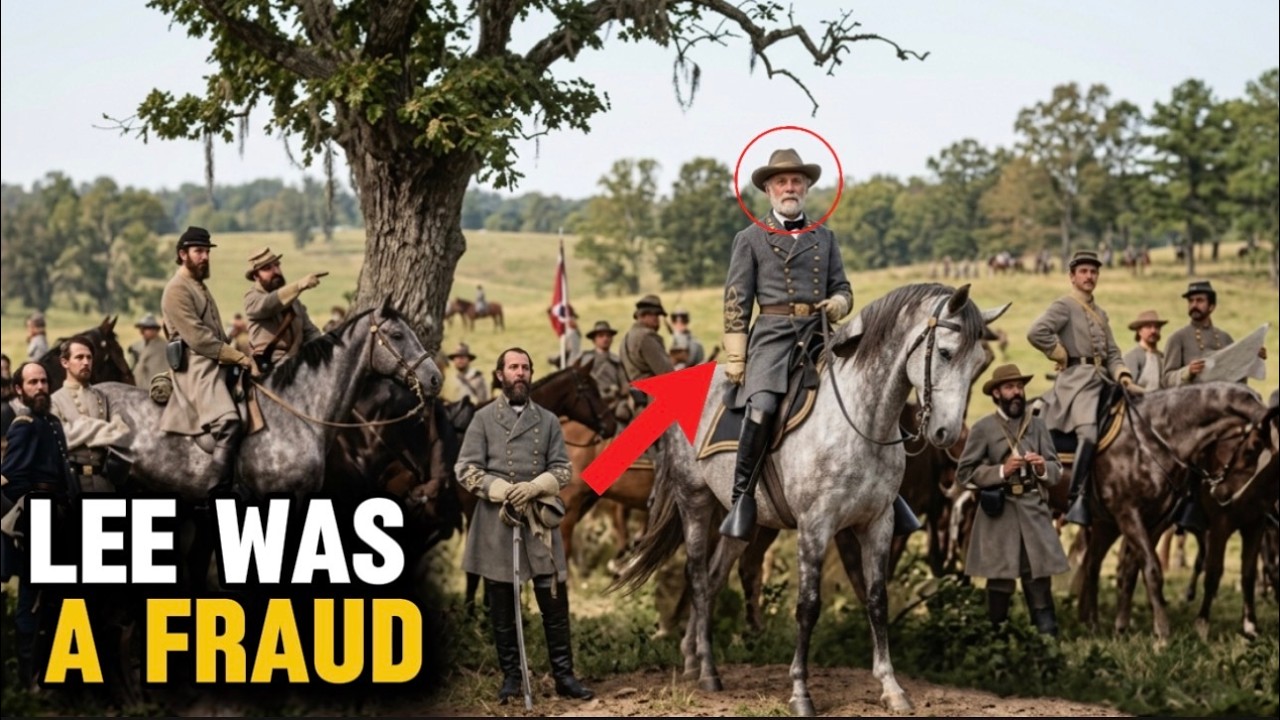
The story told about him, the reluctant warrior, the Christian gentleman, the man who chose Virginia over the Union with a broken heart, became one of the most successful myths ever constructed around a public figure in American history. But myths require maintenance. They require the careful selection of facts and the deliberate burial of others. Beneath the composed exterior, behind the gray uniform and the portrait-perfect dignity, there were cracks running through Lee that no amount of hagiography fully concealed.
Fractures in his psychology, his morality, his command decisions, and in the body that finally gave out on him in that chair. Lee was born in 1807 to a famous father and an almost immediate abandonment. Henry Lee III, Light-Horse Harry Lee, the celebrated cavalry commander of the Revolution and friend of George Washington, turned out to be a spectacular failure at everything that followed his military career. He speculated recklessly in land, went bankrupt twice, was imprisoned for debt, and when Robert was two years old, a mob attacked him in Baltimore and beat him so badly he was disfigured for life.
He left for Barbados shortly after and never came back. Robert never saw his father again. Light-Horse Harry died in 1818 on Cumberland Island, Georgia, on his way back to a family he had effectively abandoned for five years. This was not a small biographical footnote.
It was the central wound of Lee’s life, and almost everything strange about him can be traced back to it. He grew up watching his mother, Ann Carter Lee, deteriorate physically from a chronic illness while managing a household on a shrinking inheritance. Robert became her primary caretaker, helping her in and out of carriages, managing her medications, structuring his entire young existence around being present, reliable, indispensable, everything his father had not been. He was seven years old when he began assuming that role.
That kind of early responsibility teaches a person that their own needs are secondary, that composure must be performed regardless of what one feels, that love is something earned by being useful and never becoming a burden. Lee carried that conditioning to his grave. He graduated from West Point second in his class without a single demerit, a record so perfect it became one of his signature biographical details. But it reveals less about virtue than about terror, a terror of imperfection so acute it functioned like a leash.
A man that controlled is a man with something he desperately needs to keep locked down. In 1831 he married Mary Anna Custis, the great-granddaughter of Martha Washington and heir to Arlington House. The marriage gave Lee social elevation, a prominent estate, and access to a legacy he could drape over the hole his father had left. It also gave him enslaved people, dozens of them.
When Mary’s father, George Washington Parke Custis, died in 1857, his will stipulated that the enslaved people at Arlington were to be freed within five years. Lee, as executor, did not free them. He interpreted the will’s financial provisions in a way that kept them in bondage and worked them intensively to generate revenue. When three of them, Wesley Norris, his sister Mary, and a cousin, attempted to escape, Lee had them caught, returned, and flogged.
Wesley Norris later described how Lee instructed the county constable to lay the whip on hard, and when the constable hesitated, Lee allegedly told him to lay it on harder. Norris also stated that salt brine was poured into his wounds after the flogging. Lee denied the most graphic details, but the escape attempt was real, the recapture was real, the punishment was real, and the delay in emancipation was real. Lee finally freed the Arlington enslaved people in 1862, not out of moral conviction, but because the five-year window in the will had closed and he had no further legal cover to hold them.
He had written in 1856 that slavery was a moral and political evil, a passage quoted approvingly in hundreds of biographies as evidence of his private distaste for the institution. Those biographies tend not to quote the rest of that same letter, in which Lee wrote that the emancipation of the enslaved was a greater affliction for white people than for black people, and that the question was best left to God and time, not human intervention. That is not a man conflicted about slavery. That is a man articulating the standard paternalist defense of it while coding the argument in the language of personal reluctance.
When secession came, he resigned his commission and went with Virginia. The mythology insists this was an agonizing choice, that he wept all night over it. What is harder to accept is the framing in which choosing Virginia over the Union is presented as a kind of nobility. He was resigning from an army he had served for thirty-two years in order to fight against it in defense of a political order whose central, explicit purpose was the perpetuation of racial slavery.
His own vice president, Alexander Stephens, called slavery the cornerstone of the Confederate project in a speech reported nationwide. Lee knew what the cause was. The anguish, if genuine, was the anguish of a man choosing something he knew was wrong, and then committing to it with every resource he had. His generalship in the early years was brilliant.
He took command of the Army of Northern Virginia in June 1862 with Richmond under threat, and inside of three months he had driven McClellan away from the capital, carried the war north into Maryland, and transformed the Confederate military situation so dramatically that European recognition seemed briefly possible. The Seven Days Battles, Second Bull Run, Fredericksburg, these were performances that stunned professional observers on both sides of the Atlantic. But something else was happening simultaneously. Lee was burning through men at a rate the Confederacy could not sustain.
He attacked when he didn’t need to attack. He pursued offensive operations against an enemy with greater manpower and industrial capacity, when a defensive strategy might have prolonged Confederate resistance long enough to break Northern political will. The same suppressed aggression that the spotless years at West Point suggested had to go somewhere. On the battlefield, it went into other men’s bodies.
In March of 1863, Lee suffered what modern cardiologists now believe was a serious cardiac event, likely pericarditis, possibly the first stage of the coronary artery disease that would kill him seven years later. He experienced severe chest pain radiating down his left arm, throat constriction, and a fever that knocked him out of the field for days. He recovered, returned to command, and said as little about it as possible. But those who observed him closely noted changes.
He became slower to process information. He suffered from debilitating fatigue during campaigns. His appetite for detailed operational planning seemed to diminish. Three months later, he was at Gettysburg.
What happened between July first and July third, 1863, has been argued over with more heat than almost any other episode in American military history. The failure was catastrophic and comprehensive. It has been blamed on Stuart’s absence, on Ewell’s hesitation, on Longstreet’s slowness. But Lee had a bad battle, operationally, tactically, and in the most basic function of command, reading the situation and adjusting his plan.
On the first day, when the Federals were concentrating and the Confederate army had stumbled into a general engagement without a plan, the opportunity existed to disengage. Lee pushed the attack. On the second day, when Longstreet’s assault achieved significant gains but failed to break the line, the logical response was to consolidate. Lee ordered a third day’s assault.
Not a probe, not a flanking movement, but a direct frontal attack across nearly a mile of open ground against a fortified position on elevated terrain held by the full weight of the federal army. Nearly every subordinate commander consulted expressed serious reservations. Longstreet was so opposed he could barely bring himself to give the order. Lee gave it anyway.
Roughly twelve thousand Confederate soldiers stepped off Seminary Ridge that afternoon. Fewer than half came back. Watching the survivors return, Lee said, “It is all my fault. ” The admission, often cited as evidence of noble character, was accurate.
What it was not was an explanation. Lee’s health continued to decline through 1864. The Overland Campaign against Grant was a masterwork of defensive fighting, and Lee conducted it brilliantly, inflicting terrible casualties. But Grant kept moving.
He absorbed losses that would have sent McClellan, Burnside, or Hooker back to Washington, and he kept pressing south. The Siege of Petersburg that followed lasted nine months, a static war of attrition the Confederacy could only lose. During the siege, observers noted Lee’s physical and emotional state deteriorating visibly. He was short-tempered in ways his staff found uncharacteristic.
He lost weight. He struggled with fatigue that no amount of rest seemed to cure. He was sixty years old, and his heart was failing. He surrendered at Appomattox on April 9, 1865.
Grant’s generous terms, Lee’s dignity, the exchange between two men of honor, has passed into a kind of secular mythology of reconciliation. Lee became president of Washington College in Lexington, and in the last five years of his life fashioned himself into a symbol of dignified acceptance, publicly urging southerners to pursue reconstruction in good faith. He did not, however, actually repent. He never publicly acknowledged that slavery was the cause of the war.
He never expressed remorse for the lives lost under his command. He never addressed Wesley Norris or any of the enslaved people whose lives he had shaped and constrained and in some cases physically brutalized. The mythology that began forming around him almost the moment he stepped off his horse at Appomattox required a saint. The Lost Cause, the ideological project that reframed the Confederacy’s defeat as a noble, morally coherent struggle against Yankee aggression, needed a figure so beyond reproach that the cause he fought for could borrow his luster.
Lee was perfect for the role because he was genuinely impressive in certain ways, and because he was dead before the myth fully crystallized, unable to complicate it by saying something inconvenient. Douglas Southall Freeman’s four-volume hagiography, R. E. Lee, won the Pulitzer Prize in 1935 and set the interpretive framework for a generation.
The framework held more or less until the Civil Rights Movement forced a genuine reckoning with what the Confederacy had actually been, and with it a reckoning with what Lee had actually been. Robert E. Lee was a man of considerable gifts who put all of them in service of a cause dedicated to human bondage. He was a man of ostentatious piety who held people in slavery against the explicit terms of a will that directed their freedom.
He was a man of personal magnetism who suppressed something volatile beneath that surface, something that came out in blood at Gettysburg, in salt brine in the wounds of people who tried to escape Arlington, in the frailty of a heart that started giving out at fifty-six. He spent his entire life performing rectitude while the actual contents of his interior life remained carefully out of view. The performance was extraordinary. But peace is not the same as resolution, and composure is not the same as health.
The man who issued those orders on July third was not at peace. The man who had runaway enslaved people flogged and then salted was not at peace. The man who lay dying in a chair in 1870 issuing phantom military orders to troops that no longer existed was not at peace. He had been at war his whole life, with his father’s absence, with his own nature, with the moral weight of what he had chosen, with the body that was killing him.
The gray uniform and the serene expression were armor, good enough to fool a continent for over a century. But armor is what you wear when something needs protecting. And what needed protecting in Robert E. Lee was not virtue.
It was the space between who he actually was and who he had decided, at great cost and with tremendous discipline, to appear to be. The statues have been coming down across the South for years now. In Richmond, in New Orleans, in Charlottesville, where a planned Lee monument sparked a rally that left a woman dead. The argument about what those statues mean has forced the country to ask questions the mythology was designed to prevent.
The honest answer is that Robert E. Lee was a brilliant, deeply damaged, morally compromised man who fought with consummate skill for a cause he had to know was indefensible, managed that knowledge through a lifetime of performance and suppression, and died in a chair in the Virginia mountains still giving orders. He was not a simple villain. He was something harder to categorize and harder to dismiss, a man whose gifts and failures were inseparable, wound together so tightly that you cannot pull the general from the enslaver, cannot pull the loving father from the cold correspondent, cannot pull the Appomattox dignity from the Gettysburg catastrophe.
What was very wrong with Robert E. Lee was not a single thing. It was a system of wrongness, interlocking and self-reinforcing, held in place by the same iron will that made him formidable. The boy who decided at seven years old that he would never be his father kept that promise in only the most technical sense.
He didn’t go bankrupt. He didn’t abandon his family physically. But he left behind something nearly as devastating as abandonment, a mythology so durable and so carefully built that it has required the better part of two centuries to seriously dismantle.