On the morning of April 11, 1919, an old woman in a black traveling dress stood motionless on the deck of a British battleship in the harbor at Yalta. The ship was HMS Marlborough, an Iron Duke-class battleship sent into the Black Sea on the personal intervention of the King of England. Below her in the hold and stacked across the decks sat roughly two hundred tons of luggage, a figure recorded by the ship’s first lieutenant, Francis Pridham, who later rose to vice admiral and who watched British sailors load it. Two hundred tons.
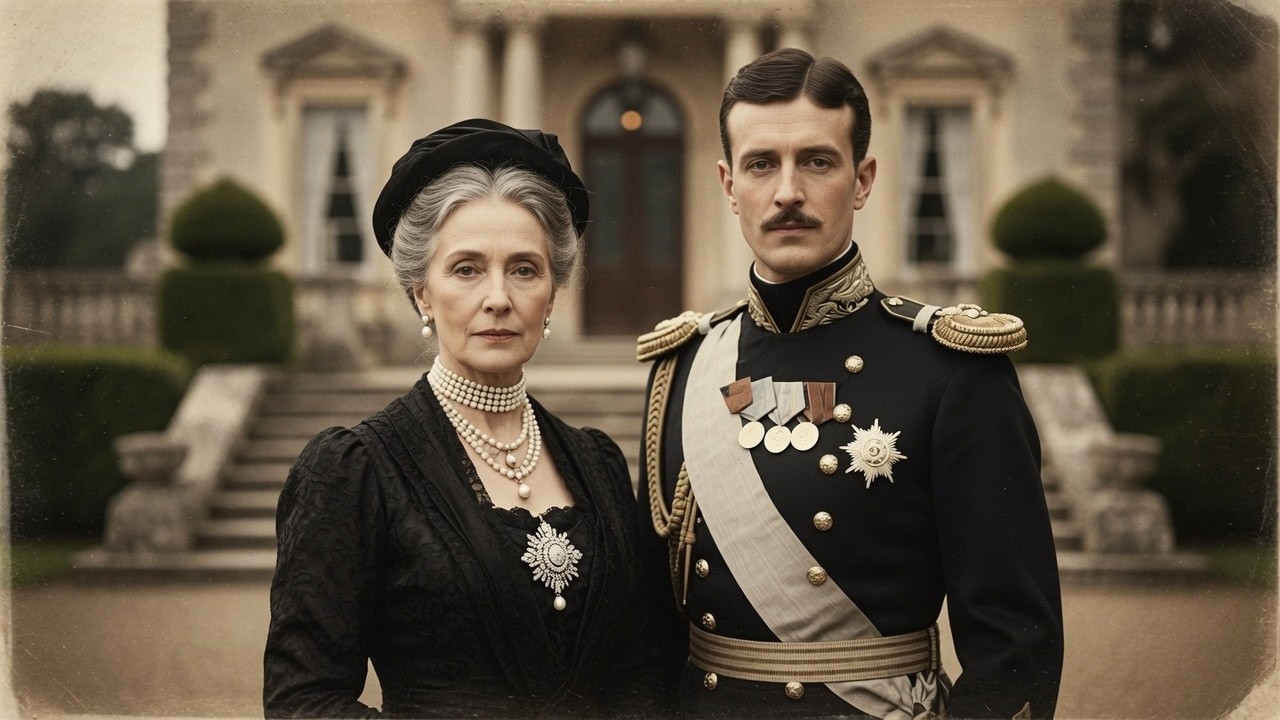
That figure deserves remembering. Around her on the Marlborough stood about twenty members of the imperial family of Russia, twenty-five members of their suite, and thirty-six servants. Naval reports placed the total passenger count somewhere between seventy and eighty-three; the accounts do not agree. Among them were her daughter, Grand Duchess Xenia, several of Xenia’s sons, Grand Dukes Nicholas and Peter Nikolaevich with their families, and the Yusupovs.
Yes, those Yusupovs. She had nearly not come at all. The evacuation was arranged for her personally at the request of her sister, the Queen of England, and she refused to board until the British agreed to take the others too: friends, retainers, the people who had followed her from one requisitioned Crimean estate to the next. Only then did she walk up the gangway.
She walked. She was seventy-one years old. Photographs show her on deck beside the main battery, in black, looking back at the Crimean shore as it receded. She did not weep.
She did not make a speech. Every source that describes her that morning describes the same thing: a stony, unnerving composure held for as long as the coast was visible. There was no dramatic confrontation, no final declaration, no flag. The naval logs record a disciplined embarkation and a woman standing very still while a country went over the horizon.
She would never see Russia again. Not alive. Her name was Maria Feodorovna, born Princess Dagmar of Denmark. She was the widow of one emperor of Russia, the mother of two more, and Nicholas II’s mother.
Most people carry around an image of the surviving Romanovs as a dignified, black-clad diaspora scattered across Europe after 1918, mourning their murdered tsar quietly and with enormous good taste, fading into Paris apartments and taxi-driving legend. That is not a lie exactly. It is about a third of what actually happened. Within six years of the killings at Ekaterinburg, the survivors of that ship and the survivors who never made it onto it had split into rival courts issuing rival proclamations, waging a press war over a throne that no longer existed in a country that had abolished it.
And the most senior Romanov alive was going around telling people, in public and on the record, that nobody had died. The two most important surviving Romanovs both got through the catastrophe the same way: by simply declining to accept the world as it was. The difference between them was only in which piece of reality they refused. She was born in Copenhagen on November 26, 1847, and christened Marie Sophie Frederikke Dagmar.
Her father was not yet a king; he became one, as Christian IX of Denmark, and her mother was Louise of Hesse-Kassel. Together they arranged the most spectacular run of royal marriages in nineteenth-century Europe. Dagmar’s sister Alexandra became Queen of England. Her brother became King of Greece.
The household these children grew up in was, by the standards of the courts her children would marry into, small, informal, and close. That detail mattered enormously decades later. In 1866 she went to St. Petersburg and married the Tsarevich Alexander Alexandrovich.
She was eighteen. She converted to Orthodoxy and became Maria Feodorovna. In 1881 her husband succeeded as Alexander III, and she became Empress of Russia at thirty-three. On November 5, 1894, Alexander III died, and she became the Dowager Empress at forty-six.
That title was the hinge of everything that followed. In the Russian imperial system, the Dowager Empress outranked the reigning empress. Maria Feodorovna, mother of the new tsar, took precedence over Alexandra Feodorovna, wife of the new tsar. She did not stop being the senior woman in the family when her son married.
She was still the senior woman in the family in 1919 on the deck of the Marlborough. And she would still be the senior woman in the family in 1924, when the struggle over the succession finally broke open. On October 12, 1876, in Tsarskoye Selo, a boy was born to Grand Duke Vladimir Alexandrovich, brother of Alexander III, and his wife, Grand Duchess Maria Pavlovna, by universal agreement the most socially formidable woman in Romanov Petersburg. They called him Kirill.
He was Nicholas II’s first cousin, twenty-nine years younger than the woman standing on that deck, and in the strict genealogical arithmetic of the Russian succession, his line stood immediately behind the tsar’s own. He went into the navy. In 1904, off Port Arthur, the battleship Petropavlovsk struck a mine and went down. Kirill was aboard and got out, swimming clear through freezing water while the ship’s own ordnance cooked off around him.
He took wounds to his legs that never properly healed and would kill him thirty-four years later. What he made of the survival is a matter of interpretation, but the escape marked him, and afterwards he was conspicuously alive to the idea of his own destiny. Then he did the one thing a Russian grand duke was genuinely not permitted to do. On October 8, 1905, aged twenty-eight, Kirill married his first cousin, Victoria Melita of Saxe-Coburg and Gotha.
Two problems compounded. She was his first cousin, which the Orthodox Church did not like, and worse, she was the divorced wife of Grand Duke Ernst Ludwig of Hesse, the reigning Empress Alexandra’s brother. Kirill married her without obtaining the prior consent of the emperor, and Nicholas II stripped him of his titles and income and threw him out. The Russian succession operated under the fundamental laws, the Pauline laws set down at the end of the eighteenth century, and they were not vague.
Succession ran by male-preference primogeniture down the senior line. Dynastic rights attached only to marriages the laws recognized as equal, and such marriages required the sovereign’s consent. That was the mechanism Kirill drove straight through in 1905. In 1908, after Victoria Melita converted to Orthodoxy, Nicholas II restored Kirill’s titles and income, and their children were entered in the court calendar.
No instrument, no letters patent, was ever issued afterwards stripping Kirill or his descendants of their place in the succession. Whether the 1905 marriage permanently damaged his line’s dynastic standing is still argued by specialists today. What is not in dispute is that by 1908 he was back, restored, retitled, and in command of the Guards’ Equipage, the naval unit that guarded the imperial family. By March 1917 the empire was collapsing.
On March 15, 1917, by the western calendar, Nicholas II abdicated. His mother was not in Petrograd. She was in Kiev, and she traveled north to Mogilev, to the army headquarters, to see her son. It was the last time they met.
She then went back to Kiev and from there south into the Crimea, where the surviving Romanovs were gathering on a string of estates that would function over the next two years as increasingly formal house arrest. In the same month, in Petrograd, Grand Duke Kirill Vladimirovich walked to the Tauride Palace at the head of the Guards’ Equipage and placed it at the disposal of the Temporary Committee of the State Duma. That much is documented and undisputed. A Romanov grand duke in uniform delivered an armed unit, the unit that guarded the imperial family, to the men taking over the country.
The popular version of the story adds a detail: that Kirill wore a red revolutionary ribbon pinned to his chest, and, by some tellings, raised a red flag over his residence. It appears in émigré memoirs, including those of Vladimir Voeikov, the tsar’s palace commandant, and it produced the most quotable reaction in the entire story. Anna Vyrubova, the Empress Alexandra’s closest confidant, published a memoir in 1923 recording Alexandra’s verdict on Kirill: He has saved himself. He is a traitor.
The revisionist version insists there is no contemporary record of the ribbon, not in the newspapers of March 1917, not in any official report, and the men around Mikhail Rodzianko, chairman of the Duma, who were physically present, did not record it. Kirill himself denied it for the rest of his life, and the accusation did not begin to circulate in earnest until after 1924, the year he claimed the throne. The honest answer is that the ribbon story is likely a fabrication, a post facto weapon manufactured by people who needed to destroy a rival claimant and reached for the most damning image available. But the underlying charge does not need a ribbon.
He took the emperor’s guard unit to the emperor’s enemies. That was documented and undisputed, and it was how the family saw him for the rest of his life. In June 1917, Kirill and Victoria Melita left Russia for Finland. On August 30, their son was born there.
They named him Vladimir. In July 1918, in a cellar in Ekaterinburg, Nicholas II, Alexandra, and their five children were murdered. In the same month, Grand Duke Michael Alexandrovich, Maria’s youngest son, the man who had held the Russian throne for a single day in March 1917, was murdered as well. The reports reached the Crimea, and the Dowager Empress refused them.
Not privately, not as a first reaction that softened over weeks, but publicly, systematically, and as policy. She would not permit requiem services for Nicholas in her household. She rejected the reports as unconfirmed. To her own daughter, when refusing to hold a memorial service, she said, I do not believe it.
They are alive. There was a mechanism inside Orthodox practice that made this something colder than grief: a requiem is a prayer for the dead, and to hold one for a living man is an error against the person you are praying for. Her position, held for a decade, was that praying for her son would be the sin. The Crimea in the spring of 1919 was about to fall to the Red Army.
In London, Queen Alexandra pressed her son King George V to get her sister out. On April 7, 1919, HMS Marlborough began embarking passengers at Yalta and sailed on the eleventh. Two hundred tons of luggage were carried aboard by Royal Navy ratings under the eye of First Lieutenant Pridham, who wrote the figure down. No political manifesto was issued from that ship.
No speech was made. The naval records are logistics, and they record an evacuation that ran on time. She landed in Britain first, and the story acquired its first genuinely petty detail. Maria Feodorovna was the sister of the Queen Mother of England and had every expectation of a permanent home in London.
She did not get one. As Dowager Empress of Russia, she claimed precedence over the reigning queen, over George V’s own wife, Queen Mary. George V granted his aunt a pension of ten thousand pounds a year. He did not grant her a London residence.
So in August 1919 she went home to Denmark, where she had been born seventy-one years earlier, first to Amalienborg and then permanently to Villa Hvidøre, a yellow stucco house at Klampenborg on the coast north of Copenhagen, which she and her sister had bought together years before as a holiday property. It became the court of the senior surviving Romanov. There was a Cossack at the door, her bodyguard Timofey Yashchik, enormous and bearded, who slept across the threshold of her bedroom, armed, for years in a Danish seaside suburb. On her writing desk sat a small glass-topped box containing earth from Kiev.
The room was organized entirely around a country that had stopped existing. In 1921, the All-Russian Monarchist Assembly came to her and asked her to accept the position of locum tenens, a placeholder, a keeper of the vacant throne, the senior Romanov standing in until matters resolved. It was a real offer, formally made to the woman with the best claim to be the family’s head. She refused it.
Her stated ground was the one she never moved from in ten years: her sons might still be alive, and you do not hold a dead man’s place while he is living. Refusing left a vacancy, and vacancies get filled. On August 8, 1922, from Germany, Grand Duke Kirill Vladimirovich declared himself guardian of the throne. Not emperor, not yet.
Guardian. Curator. A man minding something for its rightful owner, a title carefully designed to be unobjectionable and which nobody in the family mistook for modesty. He would spend the next two years assembling the paperwork to prove his claim.
On August 31, 1924, by the Russian calendar, September 13 by everybody else’s, a man of forty-seven sat in a villa in Coburg, Germany, and signed a document. The house was called Villa Edinburgh and was funded largely by his wife’s money. The document was a manifesto. Its terms were precise and not in dispute.
It declared that the deaths of Nicholas II, of the Empress Alexandra, of the Tsarevich Alexis, and of the four grand duchesses were established. It stated that the fundamental laws of the Russian Empire did not permit the throne to remain vacant. And on that ground it said the senior surviving male of the dynasty assumed the title of Emperor of All the Russias. He also elevated his son, Vladimir, born in Finland seven years earlier, making him a grand duke and tsarevich.
There was no cathedral, no crowd, no crown, no anointing, no procession. It was a written proclamation issued from a rented life in a German town nine hundred miles from a country that had shot the last man to hold the title. A man in a study with a pen. Why 1924?
Two things changed, and both were documents. In July 1924, a court in London declared Grand Duke Michael Alexandrovich legally dead. Michael, Maria’s youngest son, murdered at Perm six years earlier, was now dead on paper in an English courtroom. His death mattered structurally because as long as he was merely missing, the senior line had a living member, and nobody behind it had anything to talk about.
The second document was Nikolai Sokolov’s investigation file. Sokolov was the White Army investigator who had gone to Ekaterinburg after the Whites took the city and had spent years assembling what happened in that cellar and at the mine. He interviewed, he excavated, he collected physical remains, and then he carried the whole thing across Europe in a locked valise: the file and a small wooden box holding crushed and charred bone fragments recovered from the site known as the Four Brothers. Kirill saw the Sokolov materials in 1924.
They are the evidentiary basis his manifesto rests on when it says the deaths are established. Sokolov also went to Denmark. He arrived at the gates of Villa Hvidøre with the valise. The staff went inside and informed the Dowager Empress that the investigator who found her son was at the door, and that he had brought what he found.
She refused to receive him. No scene, no shouting, no confrontation. She declined to let him into the room at all. The staff went back out.
Sokolov was turned away from the gate, carrying the bones of her grandchildren in a suitcase. He died in France that same year of a sudden heart attack, exhausted and broke. Three weeks after Kirill’s manifesto, Maria Feodorovna answered it. On September 21 by the old calendar, October 4 by the new, she wrote to Grand Duke Nicholas Nikolaevich, the towering former commander-in-chief of the Russian army, now running his own rival court in France and Kirill’s most powerful opponent in the emigration.
The record shows the substance of what she wrote. Kirill’s assumption of the imperial title was premature, premature because she remained convinced that her sons and her grandson might still be alive, and beyond that, only the fundamental laws, in union with the church and with the Russian people, could designate a sovereign, not a man with a pen in Coburg. She did not deny that Kirill stood where he stood in the genealogy. She never issued a permanent renunciation of his seniority.
Her objection was that the chair he was claiming may not be empty. The lazy version of the story says the family universally rejected Kirill. It did not. Several grand dukes recognized his claim and attached themselves to Coburg.
The opposition was concentrated and formidable: the Dowager Empress in Denmark and Grand Duke Nicholas in France. Two courts, one dead throne, and a war of paper between them that outlived every person who started it. The obvious question about the woman in Denmark is whether she believed a word of it. The public record is unambiguous and never wavers.
From the summer of 1918 to the last weeks of her life, Maria Feodorovna maintained that the reports from Ekaterinburg and Perm were unconfirmed, refused requiems in her household, turned Sokolov away at the gate, and rejected Kirill’s claim in writing on the specific ground that her sons and grandson might be living. In 1927, the New York Times profiled her, an old woman in a Danish villa, still holding the line. She never publicly moved. But there is a second version, and it comes from inside the house.
Grand Duchess Olga Alexandrovna, her younger daughter, who lived through those years beside her, said later that deep in her heart, her mother had accepted the truth long before the end. If it was delusion, she was a bereaved mother who broke and stayed broken for ten years. If Olga was right, she was something colder and considerably more impressive: a woman who had understood by roughly 1919 that her family was dead and calculated that the moment she said so out loud, the throne became legally vacant and the scramble began. Refusing the deaths was the only instrument she had left.
It cost her the funerals of her own children. She died on October 13, 1928, at Villa Hvidøre, at around 8:27 in the evening after weeks of decline. She was eighty. Present in the house were her two surviving daughters, Olga and Xenia, Prince Dolgoruky, and a Russian priest.
There was no deathbed political statement, no designation of an heir, no reconciliation, no final verdict on Kirill, no tearful confession that her sons were gone. She was buried at Roskilde Cathedral among Danish kings, roughly two thousand kilometers from her husband. Then her household was opened up, which brings back the two hundred tons. Everything that came off HMS Marlborough in 1919 had been the physical residue of an imperial life shipped out of a collapsing country by the Royal Navy.
Nine years later, most of what remained in material terms sat in one object: a heavy black iron strong box kept in her bedroom, under the bed. Inside were the Romanov jewels she had carried out of Russia, valued at something in the region of five hundred thousand pounds. She would not sell them, not one piece. Meanwhile, the household at Hvidøre struggled to settle bills with local Danish tradesmen and ran substantially on the ten thousand pounds a year from her nephew in London.
The butcher, the baker, the sums that did not reach: an ordinary domestic scarcity conducted in a house whose owner slept two feet above a fortune. That was the two hundred tons, finally. Not a mystery. A woman who would not liquidate her son’s inheritance because liquidating it meant conceding they were not coming back for it.
Kirill outlived her by ten years, and it did not go well. The claim never converted into anything. No government recognized it. He died on October 12, 1938, at the American Hospital in Neuilly-sur-Seine outside Paris, aged sixty-two, on his own birthday.
The proximate cause ran all the way back to the water off Port Arthur: the leg wounds he took swimming clear of the Petropavlovsk in 1904 had never healed properly, and the infection that killed him traced to them. Thirty-four years between the wound and the death. He was buried at Coburg, and in 1995 his remains were brought to the Peter and Paul Fortress in St. Petersburg.
The rest of the survivors scattered. Olga Alexandrovna, who watched her mother refuse the truth for a decade, ended her life farming in Canada. Xenia, who came off the Marlborough with her sons, lived out her exile under British patronage. Nicholas Nikolaevich kept his rival court in France to the end and never gave Kirill an inch of ground.
The Yusupovs went to Paris. None of them ever went home except one. On September 28, 2006, in the Cathedral of Saints Peter and Paul in St. Petersburg, the remains of Maria Feodorovna were reinterred beside Alexander III in a service led by Patriarch Alexy II, with Danish and British royal representatives present.
She had been in Roskilde for seventy-eight years. The Russian state, which her family had lost, brought her back with full ceremony. The woman who spent a decade insisting she would return to Russia did return, eight decades late, in a coffin, by diplomatic agreement. The fight she refused to settle is still not settled.
Kirill’s granddaughter, Grand Duchess Maria Vladimirovna, born in Madrid on December 23, 1953, styles herself head of the Russian Imperial House, with her son George Mikhailovich, born 1981, styled heir. She lives mainly in Spain and visits Russia often. Ranged against that line is the Romanov Family Association, the male-line descendants of Nicholas I who exclude the Kirillovichi, currently headed by Princess Olga Andreevna. There is no Russian government recognition of any claim and no legal case pending anywhere.
The manifesto signed at Villa Edinburgh has now been contested for over a century by people who were not born when it was written. Judged on both counts, the verdict cuts against Kirill. He handed the emperor’s own guard unit to the men dismantling the emperor’s government, and then spent twenty years demanding from his relatives the absolute loyalty he had not given. That is the gravest charge, and it is not a rumor; the delivery of the Guards’ Equipage to the Temporary Committee of the State Duma in March 1917 is documented and undisputed.
But he did not lunge at the crown. He waited two years as guardian. He waited for an English court to declare his cousin dead and for a criminal investigator’s file to establish the rest, and then rested his claim on a clause that genuinely exists in the fundamental laws. He was, in the narrow legal sense, entitled to argue what he argued.
He simply had nothing else: no country, no recognition, and calling cards. Against Maria: she made the family’s grief unspeakable inside her own house, refused the man who brought her the truth, and blocked with her enormous authority the only thing that might have unified the survivors around anything. She was the last person alive who could have made the throne’s vacancy official, and she declined to do it while there was any doubt, which is a defensible position for a mother and a coherent one for a dynast. She had a sense of proportion where it counted.
She would not board that battleship until the people around her were embarked too. The first Romanov to abandon the tsar became the first to demand that the family treat him as one. And Kirill’s defining trauma was a sinking Russian warship, while Maria’s deliverance was a British one afloat. Fifteen years and one navy apart.
She never let anyone sell the jewels. After she died in 1928, the black iron strong box was still where it had always been, under the bed, locked, in a house that had trouble paying the butcher. A mother who believes her sons are coming back keeps their inheritance locked and waiting.