On the ninth of February 2002, a woman sat at a hospital bedside in London and watched her mother die. The world knew the mother as Princess Margaret, the Queen’s glamorous, wounded sister. Almost nobody knew the daughter at all, and that was exactly how she had wanted it. She had been born into the most watched marriage in Britain, a union that curdled into cruelty and cold silences and photographs the whole country stared at.
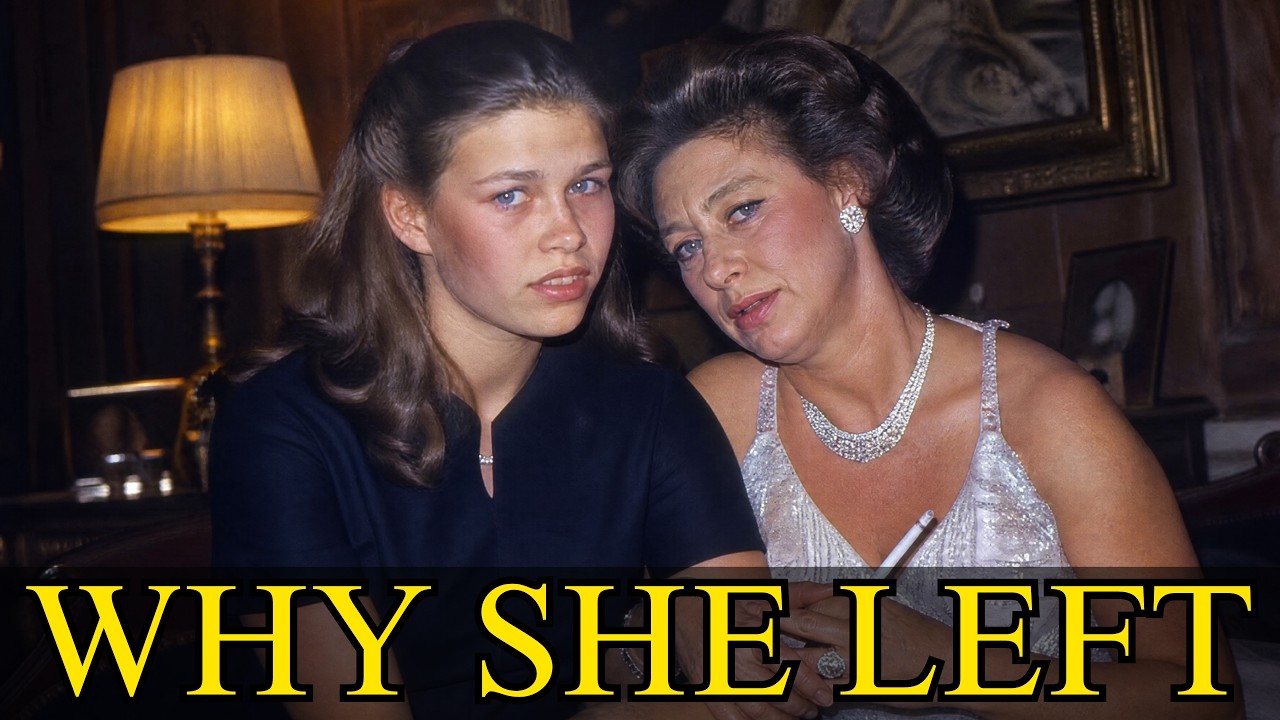
Everyone around that marriage either performed the drama or was broken by it. She did neither. She walked quietly out of the wreckage into paint and a private name and a small church wedding and took no title she did not need. She walked away, and somehow that was the most loyal thing anyone in that family ever did.
She arrived on the first morning of May 1964, seventh in line to the throne, the only niece the Queen would ever have. The place was Kensington Palace in the west of London, and her name was set down in full as Lady Sarah Francis Elizabeth Armstrong-Jones, the second child and only daughter of Princess Margaret, Countess of Snowdon, and of Anthony Armstrong-Jones, the first Earl of Snowdon. From her first breath, she held a position no other child of her generation could claim. She was the sole daughter of the sole sibling of the reigning monarch.
Ahead of her stood the small crowd of cousins and elders who ordered the succession, and the gap between her and the crown was narrow enough that had the world tilted only a little, she might have been carried much nearer to it. Being the only niece of the reigning Queen gave the position a particular sharpness. There were royal cousins in plenty, but no other child could claim to be the single daughter of the monarch’s only sibling. And here is the quiet paradox the whole of her life would turn upon.
The girl born at that center would spend her years moving steadily away from it. As new children were born to the wider family, her place in the line drifted downward, from seventh toward roughly twenty-ninth by the middle of the 2020s, with her own two sons following just behind her. That long, slow drift from the center of the family to its quiet edge is in miniature the shape of her whole life. She began at the heart of the most photographed household in Britain, and she ended it as the member of that household the public knew least of all, by her own steady and deliberate design.
The word placed before her name, lady, was a courtesy title, the kind carried by the daughter of an earl. It was hers from birth, and it asked nothing of her. She had not earned it and could not lose it. In later years, when she married, she would keep it in its plainest possible form, taking her husband’s surname and nothing grander.
She was not the first child in the household. She had an older brother, David Armstrong-Jones, born on the third of November 1961, roughly two and a half years before her. The two children were raised together, close in age and close in temperament, and both would grow into notably private adults who kept their own counsel. There was no sharp division drawn between them that the record can honestly support.
They were simply a brother and a sister brought up side by side inside an extraordinary marriage. Her christening came a little over two months after her birth, on the thirteenth of July 1964, in the private chapel at Buckingham Palace. She was given five godparents, drawn from the households of the monarch and her sister. By any measure of nearness to power, she began as close to the summit as a child could be without being an heir.
The whole drama of her life is that she treated this inheritance as something to step back from rather than something to spend. Four years before she was born, her mother had married a photographer in front of an estimated 300 million people. The date was the sixth of May 1960, and the place was Westminster Abbey. Princess Margaret, the younger sister of the Queen, married Anthony Armstrong-Jones, a man with no title, no great estate, and no drop of royal blood.
Nothing quite like it had happened in living memory, and the whole planet wished to watch. It was the first royal wedding ever broadcast on television, and the choice to open the ceremony to the cameras transformed it from a court occasion into a national and global event. The story of how they came to that altar had begun some years earlier. They had first met in April 1956 when he photographed the wedding of two of Margaret’s friends.
They reconnected in 1958, and the acquaintance became something deeper. He proposed to her at Balmoral, and the engagement was announced on the twenty-sixth of February 1960. For a princess who had a few years before been forced to give up the man she loved, the freedom to choose a husband of her own carried an enormous private weight. In 1955, Princess Margaret had renounced Peter Townsend, the man she loved, and that renunciation had been one of the defining public episodes of her early life.
To stand in the abbey five years later and marry a man of her own choosing was, for a woman who had once been denied that choice, a freedom heavy with everything that had come before it. On the sixth of October 1961, Anthony Armstrong-Jones was created Earl of Snowdon. The timing was deliberate. The title came before the birth of his first child, so that the children of the marriage would themselves carry titles.
His son David arrived the following month, and Sarah would follow in 1964. In those first years, there was a sense that this marriage represented something modern and hopeful for the monarchy. Here was a princess who had chosen for herself and a husband who brought glamour, wit, and a genuine artistic eye into a family often accused of stiffness. The couple moved among photographers and designers and stage people as easily as among courtiers.
Anne de Courcy, whose biography of Snowdon was written with his own cooperation, would later describe it as a passionate marriage before she described its slow disintegration. Whatever the cruelty the years would bring, it grew out of something that had once been ardent and alive. For the child not yet born, this was the foundation stone. The very qualities that made her parents so admired, the glamour, the visibility, the sense of a life lived always in front of a lens, were the qualities that would in time help to pull the marriage apart.
A union conducted so publicly had little room left for the private repair that ordinary marriages depend upon. But in the first years of Sarah’s life, none of that was yet plain. The photographs still showed a handsome couple and their two small children, and the country still believed the fairy story it had watched unfold in the abbey. Her childhood had three addresses, and each one hid a different version of her family.
There was a palace in London, a country house in Sussex, and an island in the Caribbean. The first address and the true home of her early years was Apartment 1A at Kensington Palace, a substantial home of more than twenty rooms. The family had moved into it after a major renovation was completed in 1963, the year before Sarah was born. It was a warm, crowded, beautiful home, arranged by a woman with a real eye.
The second address carried the father’s family in its very stones. It was Nymans near Handcross in West Sussex, the Messel family estate, the ground from which the family’s eye for beauty had grown. After her parents separated, the children spent their weekends, depending on which parent they were with, at either Nymans or Royal Lodge, the Queen Mother’s home at Windsor. The third address belonged to her mother in a way no other place did.
It was the Caribbean island of Mustique and the villa upon it called Les Jolies Eaux. The island had been bought by Colin Tennant in 1958. Around the time of Margaret’s marriage in 1960, Tennant gave her a plot of some ten acres on the island’s southern tip as a wedding present. Margaret called it the only square inch in the world she owned.
Upon that land, Oliver Messel, Snowdon’s uncle and a celebrated stage designer, drew up Les Jolies Eaux in a theatrical, elegant style. The main house was completed in 1972. Mustique was in Margaret’s hands a playground of royals, rock stars, and runaways. Among the documented regulars were Mick Jagger and David Bowie, and the flamboyant host of the whole scene was Colin Tennant himself.
It was also, in time, the place where the most damaging chapter of Margaret’s private life would be played out and photographed. The one thing her father gave her that never hurt anyone was the way he taught her to see. Anthony Armstrong-Jones had come into the royal family as a working artist, and by the time his daughter was old enough to watch him, his name stood among the most celebrated in his trade. That gift, the trained and hungry eye, passed to his daughter as cleanly as it passed to anyone.
She grew up with two visual eyes upon her, one from each parent. Her mother took the children antiquing into galleries, teaching them without lessons how to look and how to judge and how to love a beautiful thing. Her father was the professional, the man for whom seeing was a trade and a triumph. For a watchful, quiet child, this was an education that no school could have supplied.
Where another child in her place might have been pointed at the duties of the family firm, she was being drawn day by day into the world of pictures. When the time came for the qualifications that shape a young life in Britain, she left her school with a single A level, and that single subject was art. The eye her father gave her turned out to be the instrument of her escape. The same father who gave Sarah this untroubled gift was at the same time helping to wreck her mother’s marriage from the inside.
The marriage broke on both sides, and the evidence of it kept arriving in the world as living children. Some of the infidelities had names and birthdays. One of them, Polly Fry, was born months after the 1960 wedding at Westminster Abbey. A DNA test later confirmed that Snowdon was her father.
The betrayals were not a late collapse under strain. They were braided into the union from the start. Margaret was not a bystander to the ruin. The biographers are consistent that she took her own lovers, that the unfaithfulness ran in both directions.
De Courcy’s careful phrase, some, but not all of them, Snowdon’s, was written precisely so that the wife would not be mistaken for a saint married to a sinner. Inside the Kensington Palace apartment, a mother kept finding cruel little notes tucked among her gloves. Lady Glenconner, Margaret’s friend and lady-in-waiting, described how Snowdon would hide cutting notes for his wife to find, slipped inside her books, left in her glove drawer, folded among her handkerchiefs. The cruelty of it lay in the design.
These were not messages flung in anger in front of witnesses. They were planted in the most ordinary and intimate corners of a woman’s day. Craig Brown recorded one of the marriage’s most notorious artifacts. By his account, Snowdon left his wife a list headed with the reasons that he hated her, some tellings render it as twenty-four reasons, others as twenty.
Brown also passed on Margaret’s reported reply that she could not think of twenty-four reasons to hate anybody. The insults were not shouted where the household staff or the children might overhear them. They were written down and hidden. A marriage that had begun as the most public thing in Britain conducted its ending as the most secret thing in the house.
In the winter of 1976, a set of holiday photographs from a Caribbean island ended a royal marriage in public. The man beside Princess Margaret in those pictures was Roddy Llewellyn, a landscape gardener seventeen years younger than she was. She had met him a few years earlier around 1973 through the Tennant set that revolved around Mustique. For a while, the relationship had stayed within that private aristocratic bohemian world.
Then a photographer got the pictures, and the private world ended. They were published in February 1976, and the British tabloids fell on them with an appetite that had been building for years. Margaret was branded a cradle robber. In Parliament, one member called her a royal parasite.
Sarah was eleven, turning twelve, in the winter those photographs ran. Her brother David was then fourteen. She was a child of an age to read a newspaper, to register that the woman being called a parasite in Parliament and a cradle robber on the front pages was her mother. The most public humiliation of Princess Margaret’s life arrived at the exact moment her daughter was old enough to know exactly what was being said.
In March 1976, weeks after the Mustique photographs had run, Princess Margaret and Lord Snowdon formally separated. The divorce itself was finalized in the summer of 1978, when Sarah was fourteen. It was the first divorce of a senior royal in generations, the first in seventy-seven years, reaching back to 1901. No one in living memory had watched a member of that circle do this.
In 1936, a king had surrendered the crown rather than be joined to a divorcee. Forty-two years later, the reigning Queen’s own sister was herself divorced, and the throne stood. The fullest documented statement of what the divorce did to Sarah is a single hedged line reported in coverage of her life, that she was reportedly quite shaken by her parents’ split. That is close to the whole of it.
No interview, no memoir, no first-person account then or in the half century since. Everyone else in Margaret’s orbit narrated the drama. The one person who was arguably owed the most sympathy, the child, said nothing and has gone on saying nothing for fifty years. While the newspapers fought over her mother, she was quietly sitting a single examination in art.
The school was Bedales, a progressive arts school ordered around making things rather than performing rank. She ended her schooling with one qualification to her name, and that qualification was in the discipline she would spend the rest of her life inside. On the twenty-ninth of July 1981, at the age of seventeen, she served as the chief and eldest of five bridesmaids at the wedding of the Prince of Wales and Lady Diana Spencer. For a single day she stood at the visual center of the most photographed royal occasion of the decade.
A different young woman might have taken that day as an arrival. She treated it, by every subsequent act, as the opposite. The grand royal spectacle was offered to her in its purest form, and having stood inside it, she moved deliberately in the other direction. Her first real job was folding other people’s clothes on a film set five thousand miles from the palace.
In the early 1980s, she traveled to India, where her father had a photographic assignment, and there she took a place in the wardrobe department of a film being shot in the heat and dust of the subcontinent. The film was Heat and Dust, made by the Merchant Ivory partnership and released in 1983. Her name appeared nowhere on the finished picture. It was on that set that she met the man she would eventually marry.
He was Daniel Chatto, then a young actor with a small part, born on the twenty-second of April 1957 in London into a family whose whole texture was theatrical and literary rather than royal. His father was the actor Tom Chatto. His mother was Rosalind Chatto, a leading theatrical agent. He had read English at Oxford and built a modest acting career that ran from roughly 1980 to 1988.
When the acting ended, he turned to painting. By the documented account, the romance grew slowly, developing from around 1986. There was no sudden engagement. What the record shows instead is a long, unhurried acquaintance ripening into something more.
Even in these years, she remained the child kept close to her mother. In May 1987, some months after the romance with Daniel Chatto had begun to deepen, she accompanied Princess Margaret and her brother David on an official visit to China and Hong Kong, one of the few occasions on which the private daughter appeared at her mother’s side on the public business of the family. She trained as a painter, won her prizes, and hung her work under a name that carried no crown at all. After school, she went to Camberwell School of Art.
She took a course in printed textiles and fabric design at Middlesex Polytechnic. Then she went to the Royal Academy Schools, where she completed a post-graduate diploma in painting and drawing, with a graduation around 1991. At the Royal Academy Schools, she won the Winsor & Newton Prize in 1988 and the Creswick Landscape Prize in 1990. They were earned at the easel.
When she began to exhibit and sell, she did so under the name Sarah Armstrong-Jones, her maiden and professional name, and she kept it for good. She has exhibited since 1995 with the Redfern Gallery in London and has shown at the Royal Academy summer exhibition and through Cadogan Contemporary. She paints in oil, and her documented subjects are landscapes and interiors. One recorded example is an oil from 2010 titled Interior Scotland, carrying an estimate of roughly two hundred to four hundred pounds.
The modesty of the estimates is the market’s confirmation that she let the association with the crown add nothing to the total. She married in a tiny city church built by Christopher Wren and walked out of it with less grandeur than she carried in. The date was the fourteenth of July 1994. The place was St Stephen Walbrook, one of the churches Wren raised in the City of London.
The ceremony was officiated by the Reverend Chad Varah, the founder of the Samaritans. About two hundred guests were present, and by deliberate arrangement, no children were among them. Afterward, the party moved to a reception at Clarence House. There was no procession through cheering crowds, no balcony, no broadcast to a watching nation.
The gown was by Jasper Conran, white silk georgette with a ruched bodice and a train of around three metres, worn with shoes by Manolo Blahnik and a bouquet of old English roses. On her head she wore the Snowdon floral tiara inherited from Princess Margaret, and she wore her mother’s diamond and pearl drop earrings. The palace’s magnificence reached her wedding only through the woman who had raised her. Then came the detail that gives meaning to the whole choice.
When she married, she became Lady Sarah Chatto. She kept the courtesy style Lady Sarah, which she had always held as the daughter of an earl, and she simply added her husband’s surname to it. Her husband, a commoner, received no title at all. There was no new peerage created for the occasion.
Set the two weddings against each other. Her mother had married at Westminster Abbey before an estimated 300 million people, with a wedding breakfast for 150 guests and a new earldom created for the groom. Her own wedding thirty-four years later was held in a small Wren church before about two hundred guests, with no title conferred on anyone. Three hundred million viewers against two hundred guests.
A televised abbey against a quiet church. A new earldom against a plain surname taken. The daughter had studied the grandest royal wedding of its age, and she built the opposite. Two sons followed the marriage.
The elder, Samuel David Benedict Chatto, was born on the twenty-eighth of July 1996 and would grow up to work as a sculptor and ceramicist. The younger, Arthur Robert Nathaniel Chatto, was born on the fifth of February 1999. The family that came out of the small Wren church would be raised, like everything else about her, largely away from the public eye. The decline of her mother began on the island she loved most, and it took four long years to finish its work.
On the twenty-third of February 1998, while staying at Les Jolies Eaux, Princess Margaret suffered a stroke. It was reported at the time as comparatively mild. In early 1999, she badly scalded her feet in a bath, and the damage to her mobility was severe and lasting. From then on, she needed support to walk, and increasingly, a wheelchair.
As far back as 1985, after decades of heavy smoking, she had had part of her left lung removed. On the tenth of January 2001, she was taken to hospital with difficulty swallowing after another stroke. Through that year, further strokes left her with a partial loss of vision and paralysis down her left side. Through all of it, there was a steady presence at her side.
Her daughter, the quieter of her two children, was there. She had built her whole adult life at a deliberate distance from the machinery of royalty, and yet the woman who had removed herself so carefully from the spectacle was by every documented account close and attentive through her mother’s long decline. The daughter who had walked out of the wreckage was the one who kept coming back to this bedside. She died in her sleep at about six in the morning, three days after the fiftieth anniversary of her own father’s death.
It was Saturday the ninth of February 2002, at King Edward VII’s Hospital in London. Princess Margaret was seventy-one. The final decline had moved fast at the last. She had suffered another stroke on the afternoon of the eighth of February, developed cardiac trouble overnight, and been moved from Kensington Palace at around two in the morning.
Four hours later, she was gone peacefully in her sleep. Her two children were with her. David and Sarah were both in the room. She was there.
She had been there through the four years of strokes and scalds and dark glasses. What passed in her as she sat there is hers, and she has kept it. The private service was held at St George’s Chapel, Windsor, on the fifteenth of February 2002. That date was exactly fifty years to the day after the funeral of George VI in 1952.
Father and daughter buried from the same chapel, fifty years apart to the very day. Margaret was cremated at Slough Crematorium, a rare choice for a senior member of the royal family. On the ninth of April 2002, her ashes were interred in the King George VI Memorial Chapel at Windsor, alongside the parents she had loved. Seven weeks after Margaret died, on the thirtieth of March 2002, the Queen Mother died at Royal Lodge, Windsor, aged 101.
In the years after, the woman who had asked for nothing became the one the Queen wanted nearest. The bond between Lady Sarah Chatto and Queen Elizabeth II had always been real, aunt and only niece. After Margaret died in 2002, it deepened into something the record describes as unusually close. The royal editor Emily Nash put it plainly that Sarah and the Queen had a very close and unique relationship.
With Margaret gone, the Queen took on something of a maternal role toward her sister’s daughter. When Prince Philip died in the spring of 2021, his funeral on the seventeenth of April was held under the restrictions of the pandemic, cut down to only about thirty mourners. Lady Sarah Chatto was among those roughly thirty. Afterward, according to press reports, Sarah stayed with the grieving Queen at Balmoral.
Sarah is godmother to Prince Harry and to Lady Louise Windsor. Her elder son, Samuel, became a sculptor and ceramicist and studied his craft in Japan. Her younger son, Arthur, served as a page of honor to the Queen in his youth and later became a Royal Marines officer, commissioned on the third of June 2022. In August 2020, he took part in the Round Britain rowing challenge, rowing roughly two thousand miles around the coast of Great Britain in a time of forty-two days, and raised more than £21,500 for charity.
Queen Elizabeth II died in September 2022, and her state funeral was held at Westminster Abbey on the nineteenth of September. Sarah was present, as she had been present at Philip’s stripped-down funeral eighteen months before. The girl born seventh in line had spent a lifetime moving quietly toward the edges, and it had made her indispensable. She began at the center of the family and moved year by year toward its quiet periphery, and every step of that movement was in the direction she herself had chosen to travel.
Her mother was the cautionary tale of the twentieth-century monarchy, a woman of real charm and appetite given every privilege except a purpose. Her daughter watched all of it and drew the opposite conclusion. Where Margaret had been trapped by proximity to the throne, Sarah treated distance as the answer. In a family where everyone around her either performed the drama or was broken by it, she did neither.
She walked away. And that withdrawal did not cost her the family. It earned her its trust. The woman who asked for nothing became the one the Queen kept nearest.
By stepping back without ever letting go, by refusing the spotlight while never renouncing the family, she found the one stable position in an unstable house. The walking away and the sitting at the bedside were the same act seen from two sides. Distance from the spectacle, closeness to the person. The child who had asked the family for nothing was the one who gave the most quietly in those rooms.
She sought no camera. She gave no statement. She has never, in all the years since, spoken publicly of her mother’s death. In a family whose every wound was eventually printed, she made her own grief the one thing that stayed private.
Her radical act was to want less. That is the legacy. Not a scandal exposed, but a person who proved that in this family the most loyal thing was to leave quietly and stay.