In the autumn of 1934, a British surveyor named Allaric Vain was working in the high Himalaya. He was 41 years old, a man of the English border country, known for steady hands and a deep belief in the power of maps. His job was to chart a range that had never been properly surveyed, to fill in the blank spaces on official papers with measured, verifiable truth.
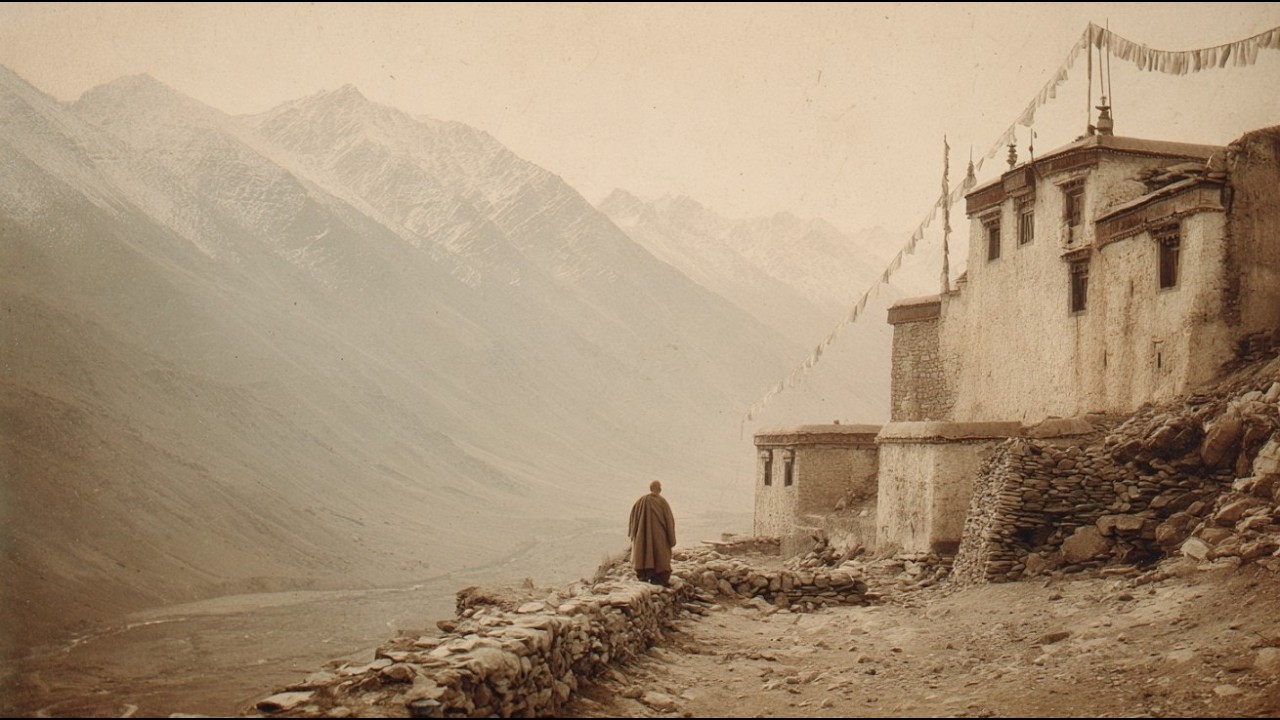
Vain traveled with a local porter named Dora, a patient man of 28 who knew the trails well. They had been climbing for nine days when they came upon a small, ancient monastery. It was a place of old men; Vain counted eleven monks in total, and none of them were young. There were no novices, no students. When Vain asked why, Dora explained that the monks had chosen this. They would not spend a young life on this watch.
The monks welcomed them with tea and shelter. The eldest, a man named Renen, spoke through Dora as translator. That evening, Vain unrolled his map by the fire. Renen’s eye settled on a valley one ridge over, a green oval of blank space that Vain had not yet surveyed. The old monk placed his finger on it. “You will leave that one empty,” he said.
Vain smiled, thinking it was a language problem. He told the monk he would cross it in two days and fill it in. Renen did not smile back. He said that there had once been a village in that valley, a place with a name he refused to speak aloud. “One night it was there,” the monk said. “In the morning it was not. Not burned, not buried, not carried off. Gone the way a word is gone when you stop saying it.”
Renen warned him not to sleep in the valley, not to eat anything growing there, and to walk faster if he heard a bell. The monastery had a great bronze bell that hung silent, with no rope and no clapper. It was not for ringing, the monks said. It was for listening.
In the morning, Dora refused to go with him. He said he would take the long way around, three days over the shoulder of the mountain, and meet Vain at the pass on the far side. He told Vain he would not wait if he was not there in three days.
Vain went over the ridge alone. The valley below was beautiful, green and gentle, sheltered from the wind. It was the kind of place, he wrote later, where anyone would want to build a village. He found the remains of one: nineteen stone houses standing intact, their roofs whole, their doors standing open. Nothing had rotted. Nothing had been taken.
Inside the first house, he found a table set with three bowls of dried porridge. The stools were pushed back, as if three people had risen at once and walked out. In another house, a loom held half-woven cloth. In another, a needle was still threaded, pushed into folded cloth. In one house, he found a game laid out mid-play, one move from finishing. Someone had been winning. Someone had been about to lose.
He went through nine houses before he stopped. The village was not abandoned in the usual way. It was simply paused, as if everyone had stepped out for a moment and never returned. At the head of the valley stood a larger hall, its doors shut and barred from the outside. It was the only door in the valley that no one had walked out of. Vain lifted the bar and opened it, but he did not go in. He saw shapes on the floor, arranged in rows, placed with care. He closed the doors gently and set the bar back in place.
He looked for graves and found none. There were no bones, no markers, no mounds. The people of the village had not gone into the ground, and they had not gone up to the sky.
The light was changing. His watch said he had been in the valley only a few hours, but the sun was already down behind the western ridge. He remembered Renen’s warning and began to walk fast toward the far side. Then he heard the bell: low, single, far off. It came again, closer. A third time, it was behind him, and woven into the note was the sound of many voices.
They were not screaming. They were calling. Warm, welcoming, the way you call someone across a field at dusk. A whole village of voices, men and women, calling out as if they had been expecting him. Some of the voices used his name, Alaric, spoken softly and surely, the way his mother had said it. He understood then how the others must have gone. Not dragged, not seized. Just called gently by name until turning back seemed like the only warm and reasonable thing left in a cold world.
He did not turn around. He counted his steps to keep from listening. Near the top of the ridge, the calling changed. It became a grief so old and enormous it had no bottom. He felt himself begin to turn, and then the wind hit him, cold and clean and alive. It broke the note, and he stumbled over the lip of the ridge.
He looked down into the valley. The houses were still there, gray in the last light, but the warmth was gone. The stream had gone silent. The calling had stopped all at once, the way a held breath stops.
He went down the far side in the dark, fell twice, tore his hands, and kept going. In the small hours, he sat down with his back against a rock and slept. He dreamed of the table with the three bowls. He dreamed he was sitting at it, with two shapes across from him that he could not look at directly. The porridge was warm. His hand was reaching for the spoon. He bit down on his own torn hand until the pain dragged him awake.
At first light, he took out his notebook to be sure it was real. His notes were there. But in the corner of the page where he had sketched the village, someone had written a single word. It was in no alphabet he knew, in an ink that was not his. He understood, with a certainty that had nothing to do with reason, that it was the name of the valley.

Three days later, he came down to the mouth of the pass. Dora was there. The porter took one look at Vain’s face and asked no questions. He gave him food and water and got him down the mountain.
Before they left the high country, Vain made Dora take him back to the monastery. Renen was waiting at the gate, as if he had never stopped. Vain showed him the word in the notebook and asked what was down there, where the people had gone.
Renen told him he was asking the wrong question. “They did not go anywhere,” he said. “They are exactly where they have always been. It is only that the valley has stopped letting the rest of us see them.”
Long ago, there had been a sickness in that valley, not of the body but of the place. The people began to want only to stay. They stopped going to the high pastures. They stopped trading at the passes. They stopped sending their dead up the mountain to the sky, because they could not bear to let anything leave. The valley learned from them. A place learns the shape of the people in it the way a riverbed learns the shape of the water. It learned to keep. One night it kept everything: the people, the food in the bowls, the cloth on the loom, the warmth of the fires. It folded them up inside a single evening, and it has been living in that evening ever since.
Renen had been there that night. He was the youngest then, and now he was the last who saw it. He said his teacher had stopped his chant in the middle of a word and said, “They have decided.” Then the great bell rang once by itself, so deep they felt it in their teeth. They went up to the wall and looked down into the valley. The village was still there, but the light in the windows had gone strange. It did not flicker. It hung steady and gold, the light of an evening that had been caught and pinned and would never be allowed to become night.
One of the old monks said the only true thing any of them said that night. He said, “We must not envy them.” Renen did not understand it then. He was young. He thought they should pity the people caught in their amber evening. It took him forty years to understand that the danger was not horror. The danger was longing. A man who looked too long at that steady golden light might begin to want it, and wanting it is the first step through the door.
In the morning, they took the name off the maps. “Because the name is the door,” Renen said. “As long as no one says it, no one new sits down at the table.”
Renen told Vain why he had come out. “Because you never sat down,” he said. “You never stopped walking. You never listened to the second bell. A place that keeps cannot keep a thing that will not stay still.” But the valley had done the only thing left to it. It had written its name in his book, so he would carry it down, so that someday, somewhere far from there, a man would read it and come looking. “The valley cannot leave,” Renen said. “But it can call.”

Vain left the mountains a week later. On the way down, they passed the cairn with the rusted surveyor’s chain set into its top, built for a surveyor who had gone up years before and never come down. Vain climbed up and set an English coin into the stones beside the chain.
At the bottom, Dora would not shake his hand until Vain insisted. He held it a moment longer than custom. “Go home,” Dora said. “Lock your door at night and do not say the name, not even alone, not even to yourself.” Then he turned and went back up toward the mountains.
Vain went home to the wet green border country. He finished his contract and handed in his survey. On the official sheet, in the place where the valley should have been, he left a blank. He never explained it. The society in London assumed he simply had not reached it.
He lived another thirty-one years. He never went back to the mountains, not those, not any. A man who had spent his whole life chasing high, cold, empty places stayed low. He stayed near other people. He married late. He kept bees. By every account, he was a quiet, gentle, ordinary man.
But there was one thing. His wife mentioned it years later. Every evening just at dusk, Allaric Vain would get up from whatever he was doing, go to the front door, open it, and stand there looking out at the dark coming down over the green hills. After a minute or two, he would close the door again, firmly, lock it, and come back inside. She asked him once what he was doing. He said the only thing he ever said about any of it.
He said, “Just making sure I’m the one who decides.”
The notebook is real. Photographs of the page exist. The word is still there in the corner, small and neat, in an ink that could not be matched to any pen Vain was known to own, in an alphabet that could not be matched to any language at all. The valley is still empty on the maps. Later surveyors left the same blank in the same place, as if every one of them had felt the same cold finger on the page and left the white space alone.
The story ends where it began: with a door, and a choice. Every evening, just as the light goes, there is a moment when it seems reasonable to open it. So far, the door has been closed again, firmly. The one who decides is still the one who decides.