On the 27th of January 1982, a hunter working through a stand of oak and broom in the hills above Lake Fiastra, in the Italian region of the Marche, stopped cold. In front of him lay two sets of human remains, side by side, long exposed to the weather. Scattered among them were the small expensive things that had outlasted the women who wore them: a Cartier bracelet, a hand-wound wristwatch stopped on the 12th of December, a roll of film no one would ever develop. There was no weapon, no note, no sign of what had happened.
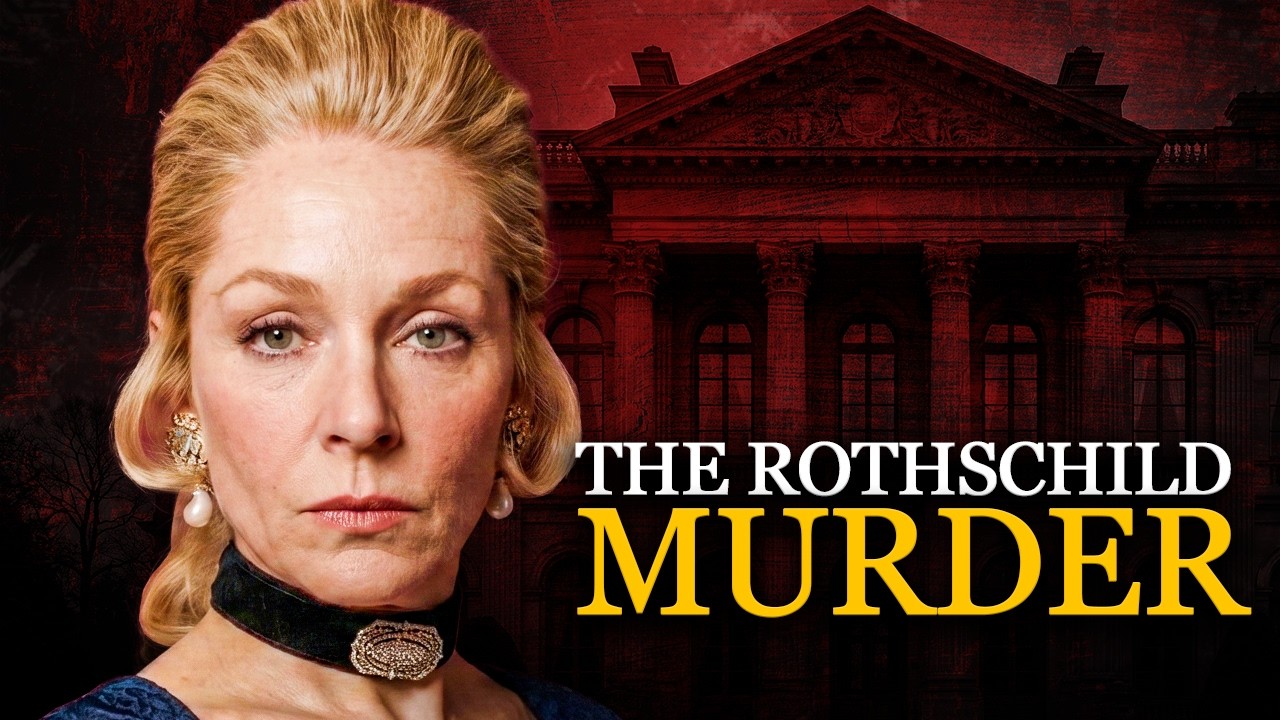
Only the objects, the silence, and the question of how two women came to die there. One of them had once carried one of the most powerful names in European banking. Yet the story of how she and her companion ended on that cold hillside reaches back far beyond the mountains of Italy, to a childhood that had nothing to do with dynasties or estates. Before she was a Rothschild, before she became the subject of a mystery that would endure for more than four decades, she was a girl named Ellen Dorothy Janet Bishop.
The name Rothschild had meant power of a particular scale for over two centuries. Mayer Amschel Rothschild built the family fortune in Frankfurt, and his sons carried their banking houses into the great financial capitals of Europe. One son, Nathan Mayer Rothschild, arrived in England in the late 1790s and founded the London bank that came to be known as N M Rothschild. By the twentieth century, the British branch of the family was woven into the fabric of national life.
To marry a Rothschild, in the world’s imagination, was to marry an institution. Janette came from nowhere near that world. Born in 1940, her father, a sergeant in the Royal Air Force, was killed defusing a bomb while she was still an infant. Her mother, widowed and young, worked as a hairdresser to keep them afloat, and sent Janette, at roughly four years old, to a convent boarding school.
It was a childhood that taught a girl very early that those meant to hold her could disappear, and that she would have to make her own way in rooms that were not built for her. She studied ballet, began modeling at sixteen, moved into television work, and by 1961 was living in central London. A fatherless child of a hairdresser had built a public life out of her own face, discipline, and nerve, with no family money and no connections to open a single door. That was the woman Evelyn de Rothschild met.
Evelyn, born in 1931, was the only son of Anthony Gustav de Rothschild and heir to the London bank. When he and Janette married on the 30th of September 1966 in Arlington, Virginia, he was thirty-five and she was twenty-six. A friend later described the marriage as a genuine love match. Through Evelyn, Janette stepped into country properties, household staff, and an international social circuit.
The marriage lasted about five years, produced no children, and ended amicably in 1971. She was thirty-one, divorced from a Rothschild, with most of her life still ahead of her. She began again, and here the story introduces a second woman. Gabriella Garin entered Janette’s life through work, not through the papers.
Gabriella and her husband Dante had been part of the Rothschild household in Britain during the 1960s, Dante as a driver and butler, Gabriella as a cook. Their son Otavio was born in England, and the relationship between the two families was never as simple as employer and servant. Family stories recalled that Evelyn once allowed Dante to take a Rolls-Royce for a summer journey, and that famous guests such as Sophia Loren passed through those rooms. When the Rothschild marriage ended, the friendship between Janette and Gabriella did not.
Gabriella’s own life had taken a hard turn by then. She and Dante had returned to Friuli in northeastern Italy, and in April 1978 Dante died in a road accident while Gabriella was pregnant. Their daughter Joya was born that September, a child who would never meet her father. That same month, Janette and Steven traveled to Friuli, and Janette became Joya’s godmother, standing beside the new widow and her infant daughter.
A woman who had just lost her husband, and a friend who crossed a continent to stand beside her and take responsibility for her fatherless child. Janette had married again in the mid-1970s. Steven May was not a financier or an aristocrat; he worked in personnel at the department store John Lewis. They chose Italy together, buying an old property near the town of Sarnano in the Marche and throwing themselves into renovating it.
Gabriella, the friend who had crossed a continent for a baptism, began crossing it again to help, lending her Italian and her practical sense to the endless negotiations of restoring a foreign house. On the morning of Friday, the 28th of November 1980, Steven spoke to his wife on the telephone around ten o’clock. She was in Italy, finishing breakfast with Gabriella. She sounded well, relaxed, pleased with the house.
They spoke of ordinary things, and he expected another call on Sunday. Italy was still reeling from the catastrophic Irpinia earthquake five days earlier, which had killed thousands and disrupted communications, but the call itself was untroubled. It was the last completely ordinary moment in the story. The next day, Saturday the 29th of November, a local surveyor spent time with the two women until around a quarter to one in the afternoon.
He understood they meant to drive up toward the mountains. After that, the day stops being clean. Witnesses placed the women in different places at different hours, and the contradictions would never be resolved. Steven later described what his wife had been wearing: green flannel trousers, a green sweater, rubber boots, a light blue windbreaker, and a large tan shoulder bag.
They climbed into a black Peugeot 104 and turned up toward the high country of the Sibillini Mountains. Weather and tire evidence drawn from the case file suggests the car was parked before the major snowfall arrived. The heavy storm came afterward. By the time the worst of the snow fell, the car was already where it would be found, and the women were already gone from it.
When the call Steven expected on Sunday did not come, he traveled to Italy and behaved like a man who intended to find his wife himself. He would spend decades doing exactly that. The search grew enormous and for weeks produced nothing. Then on the 18th of December, a helicopter crew spotted something dark against the white: the black Peugeot, nineteen days after the women had driven it into the mountains.
It sat at roughly nine hundred meters elevation near the Fonte Trocca. The handbrake was engaged, and investigators found no mechanical reason for it to have been abandoned. It started without trouble. No occupants, no blood, no struggle, no note.
Just a functioning vehicle sealed and empty, high on a slope in the falling snow. Roughly five hundred meters from the car sat a disused house, Casa Galubba. Inside, investigators found signs that someone had recently been there: traces of a fire, food, dirty dishes, mattresses dragged together, and hair later considered consistent with the two women. Some journalists later recalled that there had been dishes for four or five people, a recollection that belongs to those witnesses and not to any forensic record.
If the women reached that shelter, the mystery only deepens. Why leave the one place on the mountain that might have kept them alive? Theories multiplied. A cryptic telegram arrived at the hotel where the women had been staying, reportedly instructing someone to wait at an address in Rome, and became associated with a robbery at the auction house Christie’s.
Investigators eventually came to regard the telegram episode as a hoax. A kidnapping theory took hold because Italy of that era was a country where abduction for ransom had become almost an industry, and a foreign woman with a famous former husband and a reputation for money seemed the perfect target. But no authenticated ransom demand ever reached Evelyn de Rothschild, and he denied receiving one. A kidnapping without a ransom is not a kidnapping.
The story grew faster than the facts. The watches stopped at odd times, an antiques dealer named Sergio Vicari was murdered in London in 1982, Scotland Yard found no evidence establishing any relationship to Janette. Nothing ever produced a chain that ran cleanly from a motive to a person to a death. For fourteen months, Janette and Gabriella existed in the worst category a missing person can occupy.
On the 27th of January 1982, fourteen months after they vanished, human remains were found in the countryside near Podalla di Fiastra, close to Lake Fiastra. The examination found no obvious skeletal wounds that would establish a shooting or a stabbing, but the remains had been badly damaged by animals across fourteen months in the open. Janette was identified through dental records, and her jewelry was still with her. A detail that cuts directly against the simplest criminal motive, for people who kill for money do not usually leave the jewelry behind.
One Italian reconstruction reported that a medical examiner believed the women had died substantially later than the day they vanished, perhaps around a month afterward, an estimate that has to be held as one expert’s reading, not a fixed date. Two explanations have fought over this case for more than four decades, and neither has ever won. The exposure theory strains against its own evidence: the car was parked before the heaviest snowfall, the car worked, and investigators themselves struggled to square the theory with the fact that the remains were found in terrain connected to areas already searched. The criminal theory has produced no offender, no authenticated ransom demand, no weapon, and no clear mechanism of homicide.
The investigating judge who closed the case in 1989, Alessandro Iacoboni, ran to 87 pages and refused to choose. He did not write that the women had been murdered, because the proof was not there, but he did not write that they had died by accident either. He described a series of inexplicable anomalies, an obscure and complex affair, signed his name, and let the file go. The case became a legend in Italy, acquiring the name the Giallo dei Sibillini, and taking its place among the enduring cold cases the nation returns to again and again.
It reached television, books, and fiction. The name at the center, Rothschild, guaranteed the story would never fade, and also guaranteed it would keep being told as a story about that name rather than about the two women who had actually died. The person fighting hardest to solve the case after everyone else had turned it into a legend was not a detective or a journalist. It was a woman who had been two years old when it happened.
Joya, Gabriella’s daughter, grew up in the care of her aunt Katarina. She had no memory of her father and only a single fractured image of her mother. She watched her mother disappear a second time into the margins of someone else’s story, relegated to a subordinate clause behind the famous name. As an adult, she said plainly that she now lives in order to obtain justice, not for the baroness whose name swallowed the story, but for Gabriella, the cook from Friuli who had crossed the country to help a friend and never come home.
At the end of 2024, the prosecutor’s office in Macerata reopened the matter as a suspected double homicide, cold case number 2736 of 1980. Investigators summoned witnesses decades older now, their memories thinned by forty-four years, including a testimony marathon that stretched nearly ten hours. Among those called back was the surveyor who had spent that last ordinary Saturday morning with the two women. The reopened investigation ran headlong into the wall that every very old case eventually hits: the witnesses were dying or forgetting, and the evidence did not wait.
The remains had been examined when animals had already had fourteen months with them, and whatever they might once have said, they can say far less now. As of the most recent reporting, the second investigation appeared to be headed for archiving with no named suspect and no established cause of death, the same twin verdict reached in 1989 arrived at again by a new generation of investigators with new tools and the same insufficient facts. The mystery has outlasted almost everyone who tried to solve it. The judge who closed the case is dead.
Evelyn de Rothschild died on the 7th of November 2022 at the age of ninety-one. In the summer of 2026, Giacomo Battaglia, the Carabinieri captain who had commanded the original investigation and questioned Evelyn himself, died at seventy-seven. He held to the plainest explanation to the end, that the women sheltered in the empty house, set out again into the snow in clothing never meant for it, and died of the cold. His closest colleague from those years, Carlo Felice Corsetti, now a general in reserve, never believed a word of it, and says the route through the snow in the shoes they wore never made sense to him.
Two men who investigated the same disappearance together and remained friends until the end held directly opposite convictions about what happened. Joya, a grown woman with a family of her own, once described what the famous name had done to her mother’s memory in the simplest possible terms. It was, she said, as if Gabriella had died twice, once on the mountain and once in the telling. The mountain is still there, and the road up from Sarnano into the Sibillini still narrows into fog in late November, and the fog still turns to snow as the dark comes down early over that high country.
Forty-five years of investigators have driven up that road trying to read the landscape, and the landscape has told them nothing. The Rothschild name gave the story its scale, the money, the rank, the newspapers, the decades of theories about ransom and stolen art and conspiracy. But the name may also be the reason no one ever saw the story clearly.
Strip it away, and what remains is smaller and harder and far more human: two women driving into the mountains on an ordinary Saturday, one of them rebuilding a quiet life after a famous marriage, the other a widowed mother who came along to help a friend, and two families handed remains instead of an explanation and told to live with the difference.