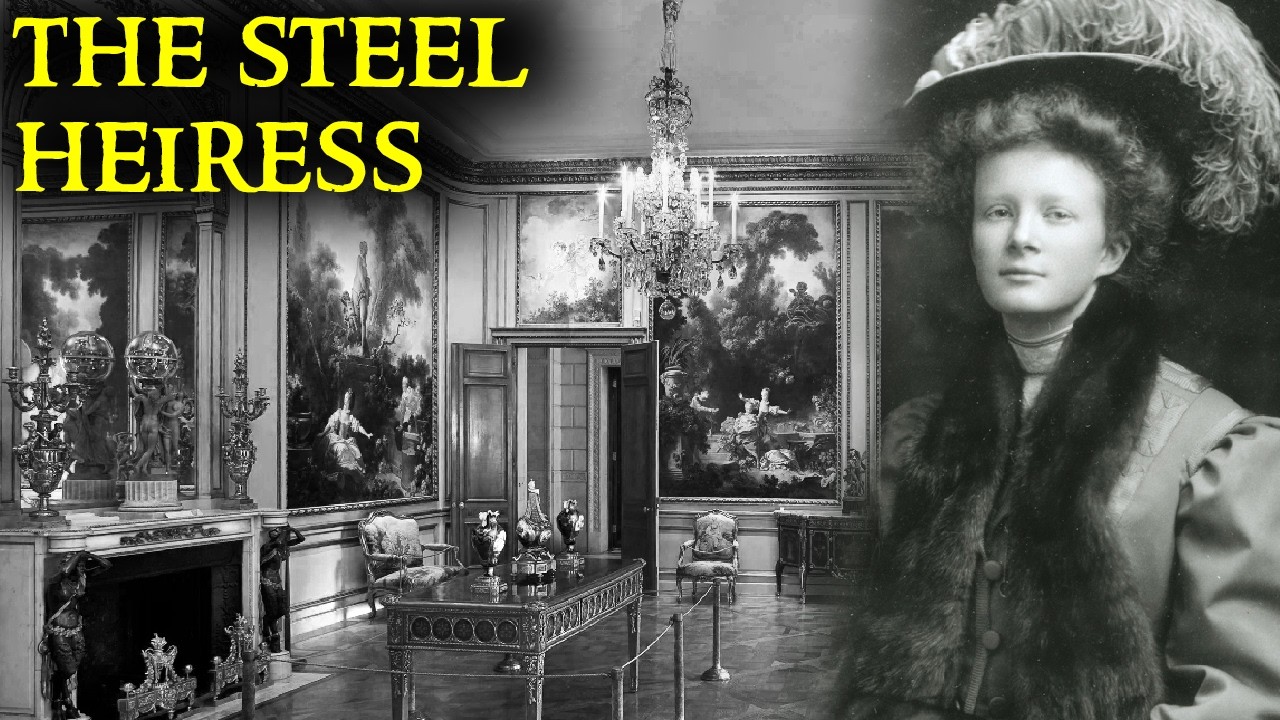
Helen Clay Frick was born on September 2, 1888, in Pittsburgh, the daughter of Henry Clay Frick, the chairman of the Carnegie Steel Company and one of the most controversial industrialists of America’s Gilded Age. Her father had built his empire alongside Andrew Carnegie, but his reputation was defined by his brutal opposition to labor unions, most infamously during the Homestead Strike of 1892, when his decision to bring in strikebreakers led to violence that left ten people dead and dozens wounded. Helen was only three years old at the time, and the strike was not the only tragedy that marked her earliest years. Her older sister Martha suffered from a painful, mysterious illness that her parents blamed on a pin she had swallowed during a family trip to Europe; she died in 1891 at the age of five.
The following year, Helen’s infant brother Henry Jr. died at just three weeks old, in the midst of the Homestead crisis. Her mother, Adelaide, sank into a deep depression, and Helen grew up in a household consumed by grief. The turbulence continued in July 1892, when an anarchist named Alexander Berkman burst into her father’s office and fired two shots at him before stabbing him repeatedly.
Henry Clay Frick miraculously survived, recovering from wounds that spared his vital organs and returning to work within a week. The assassination attempt became another defining shadow over Helen’s childhood, though her life was also one of immense privilege. The family divided their time between mansions in Pittsburgh, Massachusetts, and eventually New York, where they rented a grand house on the Upper East Side. Helen disliked leaving Pittsburgh, which she always considered her true home, but the move to New York was driven by her father’s growing estrangement from Andrew Carnegie and his shifting business interests.
It was in New York that she attended the Spence School, an elite private girls’ school, and it was there that her social debut in 1908 captured the attention of Pittsburgh society. Rather than accepting a lavish piece of jewelry to mark the occasion, she persuaded her father to donate 150 acres to the city, land that became Frick Park, Pittsburgh’s largest municipal park. As a teenager in the early 1900s, Helen traveled to Europe nearly every year, wandering through the Louvre in Paris, the National Gallery in London, the Prado in Madrid, and the Uffizi in Florence. These visits ignited a lifelong passion for Renaissance and early modern European art, and they planted the seeds of the philanthropic vision that would define her later life.
During the First World War, she devoted herself to charitable work in Europe. She had already founded a vacation home for poor female textile workers in Wenham, Massachusetts, in 1910, and in 1917, after the United States entered the war, she established a hospital unit in France in association with the Red Cross, financing it with her own trust money. Over the following year, she sent Christmas gifts to soldiers on the Western Front and petitioned her father to fund an orphanage for children whose parents had died in the war. Her years in France were also marked by heartbreak.
In 1913, a promising young surgeon named Forrest St. John had begun courting her, and friends believed an engagement was imminent. When the war broke out, St. John was called to Europe, and the proposal never came.
Historians have suggested that Helen’s brother may have warned St. John that their father would never approve of the match. St. John went on to serve with distinction on the front lines in Flanders, earning the Distinguished Service Cross, but the distance between them proved insurmountable.
He returned home, married another woman, and became an esteemed surgeon. Helen never married and never had children, a fact that would later become a subject of endless speculation. On December 2, 1919, Henry Clay Frick died at the age of sixty-nine, leaving behind an immense fortune and an enormous responsibility. Helen inherited $5 million in cash immediately, along with more than $30 million in land, business shares, and assets, a fortune equivalent to well over a billion dollars today.
Overnight, she became the wealthiest unmarried woman in America. But her father’s blatant favoritism left her older brother Childs with a comparatively modest inheritance, igniting bitter disputes that shattered their relationship. Her mother, Adelaide, whose mental health had continued to decline, grew increasingly detached, leaving Helen isolated as the head of the family’s vast empire. Years later, after Adelaide’s death in 1931, Helen tried to make amends by bequeathing her share of their mother’s estate to Childs, but the damage had already been done, and the rift between them never fully healed.
One of the key provisions of Henry Clay Frick’s will was that his enormous and extraordinarily valuable art collection should be made available to the public. Over his lifetime, he had acquired some of the most iconic paintings of the Renaissance, the Dutch Golden Age, and the later European eras, including famous portraits by renowned masters, and it was one of the most significant private art collections ever assembled. Helen moved quickly to honor her father’s wishes. In 1920, she incorporated the Frick Collection in Manhattan, housed in her father’s mansion on Fifth Avenue, and after years of careful planning and curating, the collection was opened to the public in 1935.
She became one of the nine original trustees of the board that oversaw its operations, and she used her personal wealth to expand the collection, acquiring works by painters such as Goya, Monet, and Piero della Francesca. In later years, after she retired from the day-to-day management of the museum, she donated sculptures and other objects of cultural and historical significance, broadening the collection beyond paintings alone. Helen also played a central role in developing the Frick Collection into an archive and reference institution. She financed the creation of the Frick Art Reference Library, which opened in 1924 as a wing of the collection and became one of New York’s great libraries for the study of fine art.
She served as its director for nearly six decades, only stepping down in 1983. She could be a fussy overseer, insisting for many years that men were not allowed into the library unless wearing a jacket and tie, but the institution grew into one of the world’s greatest art libraries, today housing 150,000 books, nearly half a million photographs, and approximately 50,000 sales catalogs of art collections. While the management of the Frick Collection was Helen’s greatest act of philanthropy, she engaged in many other charitable endeavors. In the 1950s, she donated the majority of a large estate she had inherited in Westchester County, New York, to create the Westmoreland Sanctuary, which today functions as a publicly accessible nature reserve popular for hiking, summer camps, and a restored nineteenth-century church that serves as a nature center.
In Pittsburgh, she worked with the University of Pittsburgh to fund the creation of a department of fine art, where courses were taught on European art, and she established a separate museum in her hometown, the Frick Art Museum. What made this institution distinct from the Frick Collection in New York was that it housed paintings acquired by Helen herself rather than her father, notably works by Claude Monet and Peter Paul Rubens. She also financed a fine arts building at the University of Pittsburgh, though her relationship with the university later broke down when it began employing German academics. Helen had developed a lifelong prejudice against Germans following her experiences in France during the First World War.
From the 1940s onward, Helen increasingly conducted her charitable giving in a secretive manner, a sign of her humble nature and her preference for working quietly. As she aged, she rarely appeared in public, only occasionally attending major social events in New York, and spent most of her time back in Pittsburgh at Clayton, the family mansion. Some viewed her as reclusive, but her life was less one of isolation than of deliberate privacy. She developed an intense dislike of modern art and had little reason to attend New York exhibitions that celebrated work she detested.
Helen Clay Frick died in Pittsburgh on November 9, 1984, at the age of ninety-six. Because she had no children, her estate, considerably reduced by her charitable efforts but still extremely large, passed largely to her nieces and nephews and to the grandchildren of her brother Childs. Her enduring legacy is the Frick Collection in New York, visited by over 300,000 people every year and regarded as one of the city’s hidden gems, along with the group of museums in Pittsburgh centered on Clayton and the Frick Art Museum, which draw over 100,000 visits annually and stand as a testament to her lifelong dedication to art and philanthropy.