In October 1948, while Princess Elizabeth sat at home in Buckingham Palace eight months pregnant with the future King of England, her husband was out on the town.
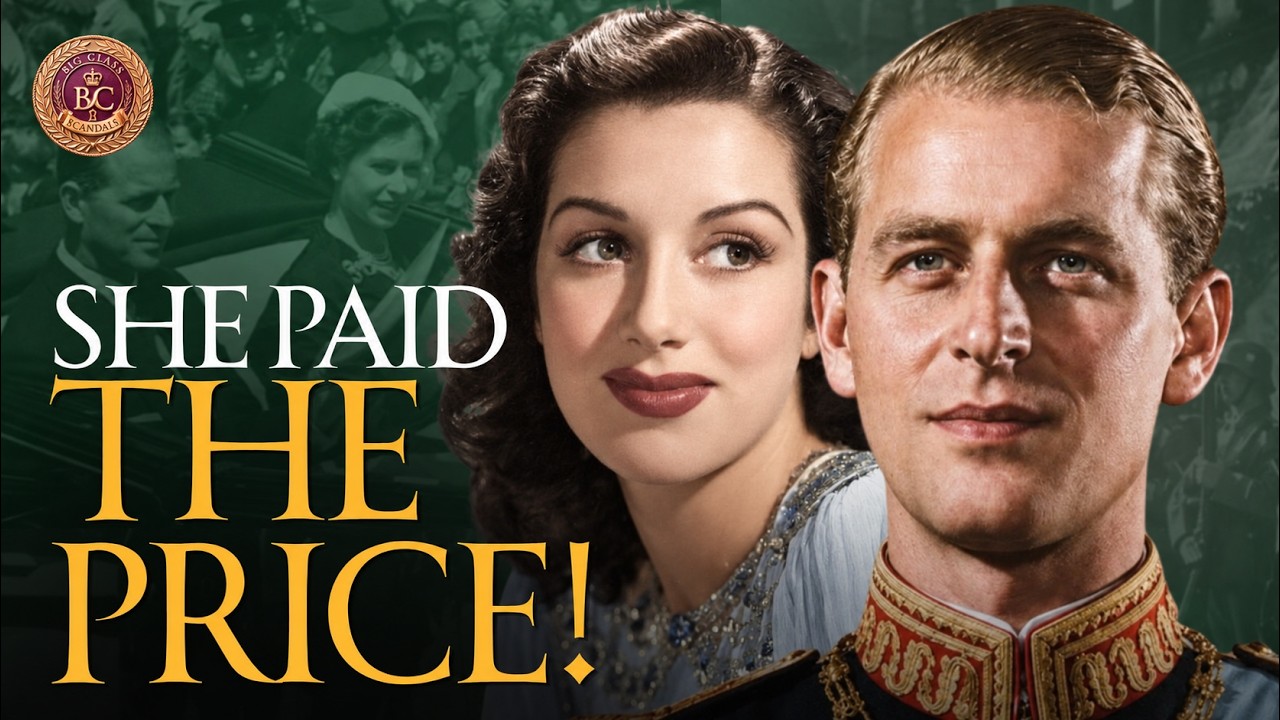
He was in Mayfair, at a nightclub, dancing cheek to cheek until dawn with the most glamorous woman in Britain. Her name was Pat Kirkwood. Her legs had been called the eighth wonder of the world. She had survived the Blitz, conquered Hollywood, and rebuilt herself after a breakdown that nearly killed her.
By sunrise on that October morning, a rumor was born that would follow both of them—the prince and the showgirl—for the rest of their lives.
This is a story about power, about silence, and about who gets protected when the palace walls close in. Because in the 60 years that followed, one of these two people would lose everything: their reputation, their honors, their legacy. And it wasn’t the prince.
Patricia Kirkwood was born on the 24th of February 1921 in Pendleton, a gray, soot-stained working-class corner of Salford, Lancashire. Her father, William Kirkwood, was a Scottish shipping clerk. Her mother, Norah Carr Kirkwood, was cold and critical.
When young Pat once asked her mother whether she was pretty, Norah looked at her daughter and delivered a verdict that would echo through Pat’s entire life. She told her she was irredeemably plain.
Rather than crushing her, that single word became the fuel that powered everything that came after. It made Pat hungry. It made her fierce. It made her desperate to prove she was something more than what a shipping clerk’s daughter from Lancashire was supposed to be.
Three months later, on the 10th of June 1921, on the sun-drenched island of Corfu, Princess Alice of Battenburg gave birth to a son. His name was Philip, Prince Philip of Greece and Denmark. His great-great-grandmother was Queen Victoria.
On paper, Philip’s life should have been golden. But Greece in the early 1920s was a nation in agony. Philip’s father, Prince Andrew, was arrested, court-martialed, and sentenced to banishment for life.
In December 1922, when Philip was just 18 months old, a British warship was dispatched to evacuate the family. The baby prince was carried aboard in a makeshift cot fashioned from an orange box. That was how the future husband of the Queen of England left his homeland.
The family settled in Paris, but there was no stability. Philip’s four older sisters married into German aristocratic families. His father abandoned the family entirely to live with his mistress. And in 1931, Philip’s mother suffered a devastating nervous breakdown and was committed to a sanatorium in Switzerland.
Philip was 10 years old.
From the moment Philip left Corfu in that orange box until the day he moved into Clarence House as a married man in his late 20s, he did not have a single permanent address. He had titles, but no home. He was royalty without roots.
On the other side of the English Channel, Pat Kirkwood was building her own escape route—not from political exile, but from obscurity.
At 14, Pat entered a talent contest during a summer holiday on the Isle of Man. She didn’t merely win. She was so startlingly good that the BBC invited her to sing on Children’s Hour.
A few months later, in April 1936, she made her first professional stage appearance as the “schoolgirl songstress” at the Hippodrome in Salford. She was 15 years old. The audience didn’t see a shipping clerk’s daughter. They saw a star.
By Christmas 1937, she had made it to London. She was 16 years old. Over the next two years, she tore through London’s cabaret circuit, variety shows, and pantomimes. The comparisons to Betty Grable had already begun.
Then the war came. And the war made Pat Kirkwood immortal.
In 1939, the 18-year-old Kirkwood opened in a review called Black Velvet at the London Hippodrome. Night after night, as the Luftwaffe hammered London during the Blitz, she sang Cole Porter’s “My Heart Belongs to Daddy” to packed houses.
The anti-aircraft guns boomed overhead. Incendiary bombs fell so close that the theater walls shook. The audiences refused to leave, and Pat refused to stop performing.
“The sky was bright with searchlights,” she recalled years later. “When bombs fell near the theater, the show went on. No one left.”
That was Pat Kirkwood. While London burned, she sang. The newspapers gave her a title she would carry for the rest of her career: Britain’s first wartime star.
Philip, meanwhile, was fighting a different kind of war. He had joined the Royal Navy in 1939 at 18. He served with extraordinary distinction, mentioned in dispatches for his role at the Battle of Cape Matapan in 1941. By 21, he had been promoted to one of the youngest first lieutenants in the entire Royal Navy.
In July 1939, the 13-year-old Princess Elizabeth had visited the Royal Naval College at Dartmouth. Philip, then an 18-year-old cadet, was tasked with entertaining the royal visitors. He jumped over tennis nets, laughed too loudly, ate too many shrimp—doing everything possible to catch the princess’s attention.
It worked. Elizabeth was smitten completely.
On the 20th of November 1947, Princess Elizabeth married Lieutenant Philip Mountbatten at Westminster Abbey. A nation exhausted by war clung to the fairy tale as if it were oxygen.
But Philip was already chafing. Within months of the wedding, the reality of royal life had closed around him like a velvet cage. He had given up his Greek and Danish titles. He had renounced his family name. He had surrendered his promising naval career to become an appendage of the crown.
In 1948, Britain offered very little comfort to a restless young man trapped in a golden cage. Rationing was still in force. The empire was crumbling. Bomb sites still scarred every major city.
Philip found his escape in the nightlife. He became a regular at the Thursday Club, a raucous weekly gathering of men who met for liquid lunches at Wheeler’s Oyster Bar in Soho. The membership was deliberately eclectic: actors, journalists, photographers, aristocrats, bohemians.
But while Elizabeth’s life was ascending toward its golden destiny, Pat Kirkwood’s had taken a devastating detour through darkness.
In 1944, at the absolute peak of her fame, she had been offered competing seven-year contracts by both MGM and 20th Century Fox. She chose MGM. She arrived in Los Angeles ready to conquer America.
Instead, America conquered her. Her first and only Hollywood film, No Leave, No Love in 1946, was a disaster. The reviews were brutal. MGM shelved her contract.
Alone in a foreign city, thousands of miles from home, with her career suddenly in ruins, Pat Kirkwood suffered a complete nervous breakdown. She attempted suicide. She spent eight agonizing months in a New York sanatorium.
But Pat Kirkwood was not the kind of woman who stayed broken. She dragged herself out of that sanatorium, crossed the Atlantic again, and rebuilt everything.
By 1947, she had landed the lead in a spectacular new review called Starlight Roof at the London Hippodrome. The show opened on the 22nd of October 1947 and was a sensation. It would run for 649 performances.
Among the cast was a 12-year-old girl making her professional debut: a child named Julie Andrews. But in 1947, Julie Andrews was a supporting player. The star was Pat Kirkwood.
By 1948, she was the highest-paid actress on the London stage. The legendary theater critic Kenneth Tynan watched her perform and wrote six words that would follow her forever: that her legs were the eighth wonder of the world.
Cole Porter himself sent her a personal message: “You may sing any song of mine at any time for the rest of your life.”
She was untouchable. She was magnificent. And she was about to walk into a trap she never saw coming.
To understand what happened on that October evening, you need to know about one more person. His name was Baron—just Baron. His real name was Sterling Henry Nahm. He was one of the most talented and well-connected society photographers in Britain.
Baron was Prince Philip’s best friend. They played squash together regularly. They were both members of the Thursday Club. Baron had photographed Philip and Elizabeth’s wedding. He would later be appointed court photographer.
And in October 1948, Baron happened to be romantically involved with Pat Kirkwood.
This is the collision. Two separate worlds—the world of the West End stage and the world of Buckingham Palace—smashed into each other.
It was an evening in October 1948. Princess Elizabeth was at home, eight months pregnant with Prince Charles. Her husband, however, was not at home.
Philip, accompanied by Baron and an equerry, went to the London Hippodrome to see Starlight Roof. After the final curtain, Baron led Philip backstage.
According to Pat Kirkwood’s own account, which she maintained consistently without contradiction for the remaining 59 years of her life, Prince Philip came to her dressing room uninvited. She had not asked for the visit. She had no idea it was happening.
She was still in her stage costume, still flushed from the performance. And there was Philip, 27 years old, tall, blonde, impossibly handsome.
Pat recalled that first impression with remarkable clarity: “He was so full of life and energy. I suspect he felt trapped and rarely got a chance to be himself. I think I got off on the right foot because I made him laugh.”
The foursome—Philip, Pat, Baron, and the equerry—left the theater and headed to Les Ambassadeurs Club in Hamilton Place, Mayfair. It was one of London’s most exclusive establishments, a gilded former Rothschild mansion.
The moment Prince Philip walked into that dining room with Pat Kirkwood, the room went silent. Every eye in the restaurant turned to watch the spectacle of the royal consort escorting the leading musical star of the age.
After dinner, the group moved on to the Milroy nightclub. They stayed for hours. Multiple witnesses later confirmed that Philip and Pat danced together closely, intimately, well into the small hours of the morning.
By morning, the story was loose. And it would never, could never, be contained again.
The newspapers called them “the prince and the showgirl.” The phrase stuck like tar. And the question that would haunt Pat Kirkwood for 60 years was printed in bold type across tabloid front pages: Was there an affair?
According to verified accounts, Philip and Kirkwood met on a total of seven occasions. They corresponded by letter on Philip’s personal stationery from the royal residences, signed in his own hand.
The precise nature of these meetings has never been fully established. But what the historical record does provide in devastating detail is the story of what happened to Pat Kirkwood when the rumors took hold.
Reports suggest that King George VI was beside himself with fury when the rumors reached Buckingham Palace. But the royal household’s response was unmistakable: this would be dealt with.

Dealt with did not mean a public denial. It did not mean an official statement. Dealt with meant silence. Complete, impenetrable, institutional silence.
The palace said nothing. Philip said nothing. The royal family closed ranks and waited for the storm to pass.
The storm did pass for them. For Pat Kirkwood, it never ended.
She denied the affair immediately. She denied it consistently. She denied it passionately for nearly 60 years. Her answer was always the same: Nothing happened. They met. They dined. They danced. Baron arranged it.
But denial in the world of royal scandal means nothing without royal confirmation. And royal confirmation never came.
Pat wrote to Prince Philip directly. She begged him to make a public statement. Philip’s response arrived on his personal stationery, and it was perhaps the most royally unhelpful reply in the history of royal correspondence.
“Short of starting libel proceedings,” he wrote, “there is absolutely nothing to be done. Invasion of privacy, invention, and false quotations are the bane of our existence.”
As if the destruction of Pat Kirkwood’s reputation were merely an inconvenience.
She wrote back to him, her frustration undisguised: “If there had been some support from your direction, the matter could have been squashed years ago instead of my having to battle a sea of sharks single-handed.”
And then she said something to a journalist that became the most quoted line of the entire scandal: “A lady is not normally expected to defend her honor. It is the gentleman who should do that. I would have had a happier and easier life if Prince Philip, instead of coming uninvited to my dressing room, had gone home to his pregnant wife on the night in question.”
The gentleman should have defended her honor. He didn’t.
The damage was catastrophic. Not to Philip. Never to Philip. But to Pat.
The rumors followed her like a second shadow. Every newspaper profile mentioned the scandal. Every magazine interview circled back to the same question. She couldn’t escape it.
Her career didn’t collapse overnight. She was too talented for that. In 1950, Noel Coward wrote the West End musical Ace of Clubs specifically for her. In 1954, she became the first woman in British television history to have her own one-hour series, The Pat Kirkwood Show.
That same year, she broke box office records with a sellout three-month cabaret season at the Desert Inn in Las Vegas. She won awards for her television portrayals of Marie Lloyd and Vesta Tilley. She played Eliza Doolittle in a critically acclaimed production of Pygmalion.
But underneath every achievement, the scandal was quietly corroding everything. Doors that should have opened stayed closed. Honors that she had earned were systematically blocked.
In the year 2000, Pat Kirkwood, by then 79 years old, was recommended for an Order of the British Empire—an OBE. She wasn’t just recommended once. She was recommended twice.
She was rejected. Twice.
Documents later obtained under freedom of information laws revealed that the recommendations had been made. But the government paperwork explaining why she was rejected had been destroyed. Deliberately destroyed.
Royal biographer Margaret Holder later stated what everyone already knew: “Giving Kirkwood an honor would have been embarrassing for the queen, regardless of whether or not the rumors are true.”
It didn’t matter that Pat had denied the affair for 52 years. It didn’t matter that there was no evidence. The mere existence of the rumor was enough to rob Pat Kirkwood of the recognition she had earned across six decades of service.
The prince lost nothing. The showgirl lost everything that should have been hers.
In 1994, 46 years after that fateful evening, Pat Kirkwood made one final dignified attempt to clear her name. She and her fourth husband, Peter Knight, arranged a meeting with Brian McGrath, Prince Philip’s private secretary.
They asked McGrath to convey a message directly to the Queen: the rumors about Pat and Philip were false. They had always been false.
The message was delivered. Philip’s response eventually arrived in a private letter. He described the allegations that had haunted her for nearly half a century as “the mythology of the press.”
After 46 years of silence, that was all she received. Not a public statement. Not an apology. Just a private note unseen by the world.
In 1999, Pat published her autobiography, The Time of My Life, in which she addressed the Philip scandal directly. Nothing happened. The evening was innocent. The rumors were lies.
In her final years, Pat was diagnosed with Alzheimer’s disease. The woman who had dazzled audiences from the London Palladium to the Las Vegas strip slowly, irreversibly faded from the world.

Pat Kirkwood died on Christmas Day 2007. She was 86 years old. She passed quietly at a nursing home in Ilkley, West Yorkshire, with Peter Knight at her bedside.
She was buried without an OBE, without a CBE, without a damehood, without a single official honor from the nation she had entertained through the darkest years of its history.
Peter Knight died in 2010, three years after his wife. And after his death, something extraordinary was revealed.
The letters between Pat Kirkwood and Prince Philip, written over the course of decades on Philip’s personal Buckingham Palace stationery, were entrusted to journalist and royal biographer Michael Thornton.
The instructions attached to the bequest were precise: the letters were to be shown to no one, except the person who would eventually be appointed as Prince Philip’s official biographer, and only after Philip’s death.
Thornton read the letters. Every single one. He confirmed publicly, without ambiguity, what Pat Kirkwood had said for 60 years.
The letters, Thornton wrote, “were written in terms of concerned friendship by two people caught up in a media maelstrom.”
Concerned friendship. Not passion. Not romance. Not guilt.
Nothing in the letters, not a single line, confirmed that anything improper had ever occurred between Prince Philip and Pat Kirkwood.
The most notorious royal scandal of the 20th century was precisely what Pat had always said it was: a single evening organized by a mutual friend, amplified by a press that smelled blood, and left to metastasize by a palace that decided it was easier to sacrifice the showgirl than to protect her.
In 2012, five years after Pat’s death, the story was given new life on stage. Opera singer and actress Jessica Walker wrote and starred in a one-woman show called Pat Kirkwood is Angry.
Walker had been given access to significant excerpts from Philip’s letters. “I’m not using Prince Philip’s letters for sensational reasons,” Walker stated. “But the inescapable fact is that Miss Kirkwood’s meeting with the Queen’s husband, which was not sought by herself, ruined her life and robbed her of official recognition for an outstanding career.”
Prince Philip died on the 9th of April 2021. He was 99 years old. He had served as the Queen’s Consort for 73 years, the longest-serving royal consort in British history.
His obituaries celebrated his naval heroism, his dedication to conservation, his devotion to Queen Elizabeth. Some mentioned Pat Kirkwood in passing. Most didn’t mention her at all.
The letters remain in Michael Thornton’s possession. As of now, Prince Philip’s official biographer has not been publicly appointed. The full contents of the correspondence remain locked away.
And here finally is the question that sits at the very heart of this story: Does it even matter whether they had an affair?
We know that Philip showed up uninvited to her dressing room. We know that he took her to dinner and dancing in two of London’s most public venues while his pregnant wife waited at home. We know that when the inevitable rumors erupted, he did nothing to stop them.
We know that Pat begged for his help and received nothing but indifference wrapped in royal stationery. We know that the palace’s calculated silence destroyed her reputation, cost her the official honors she had earned, and permanently overshadowed a career that deserved to be celebrated.
We know that the letters, when they were finally examined, confirmed nothing improper.
Whether Prince Philip was unfaithful to Princess Elizabeth on that October evening in 1948 is ultimately unknowable. But what is not unknowable is that Pat Kirkwood was treated with breathtaking, unconscionable unfairness by an institution that valued its own comfort above her life, her career, and her dignity.
She was the one who sang through the bombs. She was the one who rebuilt herself after Hollywood broke her. She was the one who performed for 60 years and asked for nothing more than what she had rightfully earned.
And she was the one who paid the price—the only price, the entire price—for a prince’s night out.
Her story became the template for every infidelity rumor that would follow Prince Philip for the rest of his life. After Pat came the whispered links to other women. Every single one of those rumors traced its lineage back to that October night at the Hippodrome.
Pat Kirkwood was patient zero. The first name on a list that would grow longer with every decade. And the only name on the list that was ever publicly punished.
When Netflix released The Crown in 2016, the show dramatized Philip’s alleged infidelities across multiple seasons. Millions of viewers around the world watched actors portray scenes that were inspired in part by the Pat Kirkwood story.
The show won awards. The actors received acclaim. The real Pat Kirkwood, the woman whose life had actually been consumed by these rumors, was already in her grave, unrecognized, unhonored, and largely forgotten.
The scandal that destroyed Pat Kirkwood’s life eventually became entertainment. Her pain became somebody else’s Emmy nomination.
The prince went home to his palace. The showgirl went home to her silence.
And that silence lasted for the rest of her life.