In the summer of 1862, a letter arrived on James Longstreet’s desk carrying the unmistakable weight of a man who had decided he had nothing left to lose by saying exactly what he meant. Ambrose Powell Hill had written it in response to Longstreet’s official report on the Seven Days Battles, the bloodiest stretch of fighting the Army of Northern Virginia had yet endured. Hill found in its pages what he interpreted as a direct assault on his professional reputation. His Light Division had bled at Mechanicsville, helped carry Gaines’ Mill, and fought through the confusion at Frayser’s Farm.
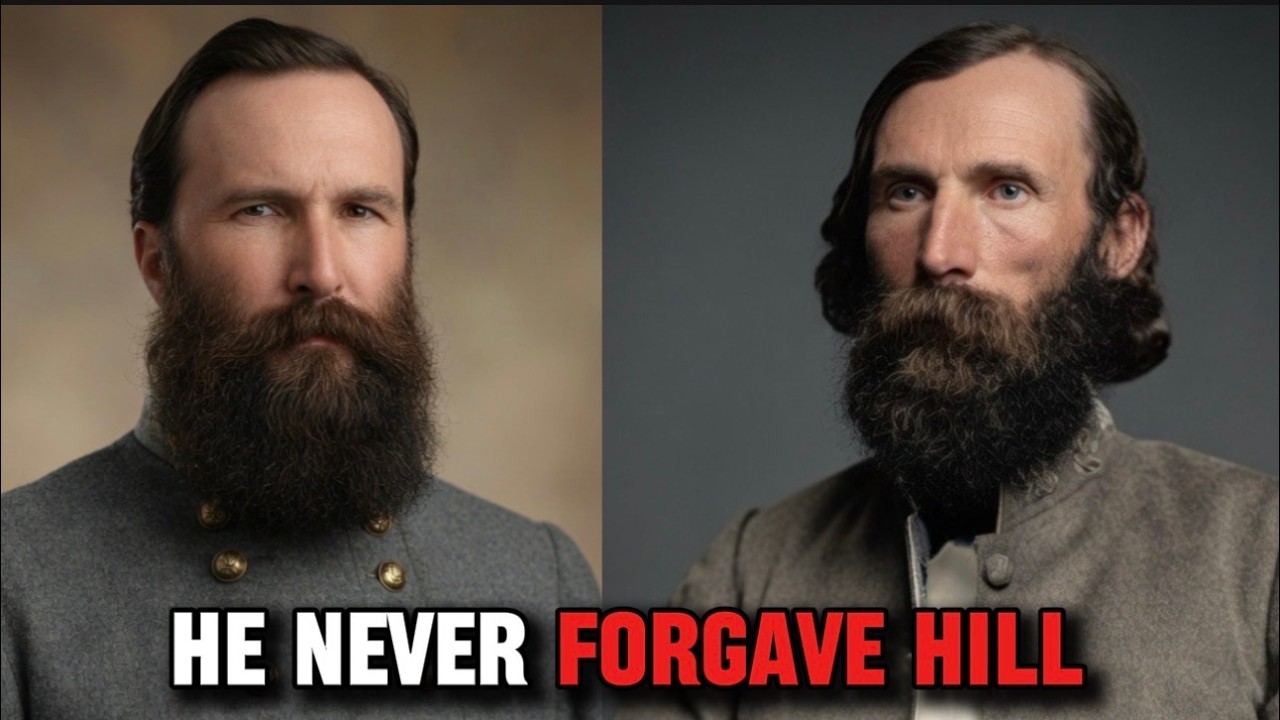
What Hill found in Longstreet’s account was no acknowledgement of that sacrifice. It was blame. Hill demanded an explanation, then a court of inquiry. The exchange between two of the army’s most prominent division commanders escalated so quickly that Robert E.
Lee himself had to step in and stop it before it consumed the command structure of an army still in the middle of a war. The episode is usually treated as a footnote in the history of the 1862 campaigns. It was not a footnote. It is the clearest window available into what Longstreet truly thought of A.
P. Hill, not what post-war Southern memorial culture required him to say, but what he believed as a soldier and an officer, documented in ink while Hill was still alive to read it. Longstreet was born in 1821 in South Carolina and raised in Georgia. He graduated from West Point in 1842, 54th out of 62 in his class, a standing that revealed his character.
He was not a man who wore himself down chasing institutional approval. He fought in Mexico under Zachary Taylor and Winfield Scott, was brevetted for gallantry twice, and was wounded at Chapultepec in 1847. That war gave him an unromantic understanding of what infantry combat truly looked like. He believed in deliberate movement, strong defensive positions, and making an attacking enemy pay in blood for every yard.
He did not trust frontal assaults or the idea that courage could substitute for position and preparation. He thought about war the way an engineer thinks about a structure, in terms of load-bearing fundamentals, not aesthetic ambition. A. P.
Hill was born in 1825 in Culpeper County, Virginia, four years Longstreet’s junior and in almost every important way his opposite. Hill graduated from West Point in 1847 and served in the artillery and infantry before the war. He was a Virginian in the way that carried weight in 1861, shaped by a state whose military tradition had produced Washington, Lee, and Jackson. He brought to battle an energy that was either his greatest asset or his most dangerous quality, depending entirely on the situation.
He was quick to move, quick to engage, and equally quick to take offense. What the two men shared was a particular kind of professional pride worn close to the surface. What they did not share was any common philosophy of war. Longstreet thought in terms of position and timing.
Hill thought in terms of momentum and pressure. Placed in the same chain of command, with Hill’s division answering to Longstreet’s orders, friction between those two ways of thinking about warfare was guaranteed. By the spring of 1862, both men commanded divisions under Robert E. Lee, who had just taken over the army from the wounded Joseph Johnston.
Lee inherited a force that had been defending Richmond with more caution than he found acceptable. He immediately began planning an offensive, and the offensive he settled on, the Seven Days, required his division commanders to execute complicated, coordinated attacks across unfamiliar ground. Above all, it required commanders who could read orders and execute them as written. The Seven Days opened on June 25, 1862.
By June 26, the first major evidence of how A. P. Hill operated under pressure appeared. At Mechanicsville, Hill’s Light Division was supposed to wait for Stonewall Jackson’s command to move into position before advancing.
The whole attack depended on Jackson’s flanking movement going first. Jackson was late. Hours passed with no word from the north. And then Hill did what he almost always eventually did when made to wait.
He moved without the order. He sent his division forward alone, directly against Union positions that had not been flanked because Jackson had not moved. The Union line was intact, manned, and positioned behind Beaver Dam Creek with artillery covering every approach. The Confederate attack broke against those positions repeatedly.
Hill’s division suffered roughly 1,400 casualties in frontal assaults against prepared positions that the original plan had been designed to make unnecessary. It was an unnecessary and expensive failure, the product of a commander who could not hold himself in place once his patience ran out. Longstreet noted it. The following days brought different results.
At Gaines’ Mill on June 27, Hill’s division performed better, contributing to the assault that finally broke the Union defensive line and sent McClellan retreating toward the James River. At Frayser’s Farm on June 30, Hill’s men fought hard through dense terrain in a battle that remained confused from start to finish. It was there that Longstreet’s assessment of Hill hardened into something permanent. The specific controversy is not fully reconstructible from the surviving documents, because both men had reasons to present events in ways that favored their own conduct.
What is clear is this. Longstreet believed that Hill’s division had failed to perform as ordered during a particular phase of the fighting. He believed that this failure had cost the Confederacy an opportunity to inflict greater damage on McClellan’s retreating columns. And he said so in his official report.
Whether Longstreet was correct is a separate question. What matters is that he wrote it, put it in a document that would be read by Lee and the War Department, and sent it up the chain of command. An official report was not a private letter. It was a public judgment.
In the military culture of 1862, among officers drawn heavily from the Southern gentry and its codes of personal honor, this was serious. Hill demanded clarification. Longstreet did not retract. The exchange escalated.
Hill demanded a formal court of inquiry, his right under military law. Longstreet, by some accounts, moved toward placing Hill under arrest for the tone of his letters. The exact sequence of who threatened what is murky, but the direction of the confrontation is not. Two senior Confederate generals were turning a professional dispute into something alarmingly personal.
Lee intervened. He did not resolve the underlying dispute, because no resolution could have satisfied both men. But he managed the consequences with the skill that characterized his handling of difficult subordinates throughout the war. Charges were set aside.
The correspondence was taken off the table. The matter was officially, if not actually, closed. What did not close was Longstreet’s view of Hill. When Lee reorganized the army into two corps that fall, Hill’s Light Division went to Stonewall Jackson’s corps.
The reorganization removed Hill from Longstreet’s direct authority and solved the structural problem. It did not change what Longstreet thought. What happened next is revealing. Hill immediately began having the same kind of dispute with Jackson.
Within months, Jackson had arrested him twice, once during the march to Second Manassas and once during the Maryland Campaign, both times for alleged violations of march orders. According to accounts from officers on both staffs, Hill came close to challenging Jackson to a duel. The dispute was still unresolved when Jackson was mortally wounded at Chancellorsville in May 1863. The charges and countercharges died with him, because pursuing them against the Confederacy’s most beloved martyr was not something anyone was inclined to do.
The pattern is worth sitting with. In roughly a year of active campaigning, A. P. Hill had reached the point of formal confrontation with two of the three most senior generals in the army.
He interpreted criticism from superiors as an attack on his honor rather than an exercise of command authority, and he responded with the full intensity of a man for whom reputation was not separable from identity. Longstreet had seen it up close. Hill’s battlefield performance complicates any simple judgment. He earned his reputation in the Seven Days, at Cedar Mountain, at Second Manassas, and most dramatically at Sharpsburg, where his Light Division marched 17 miles in eight hours from Harpers Ferry on September 17, 1862, and smashed into the Union left at the moment when the Confederate line was on the edge of destruction.
Men who saw it called it the finest fighting march the Army of Northern Virginia ever made. Longstreet acknowledged it in his memoir. He could not have done otherwise. But his acknowledgement had a quality his treatment of other officers did not.
When Longstreet wrote about John Bell Hood or Lafayette McLaws, the men he considered truly great soldiers, there was warmth in the prose, a sense of personal investment in their reputations. That warmth is simply not present when he writes about Hill. In his 1896 memoir, written when he was 75, Longstreet was a man defending his own legacy against decades of Lost Cause accusations over Gettysburg. But the defensive posture does not account for his treatment of Hill, because Hill was not part of the Gettysburg argument.
Longstreet had no strategic reason to undercut him. What he did instead was more telling. He treated Hill’s performance with a level of critical scrutiny he did not apply to officers he admired. At Bristoe Station in October 1863, Hill’s corps attacked a Union position without fully reconnoitering it and suffered heavy casualties against an enemy better prepared than Hill understood.
Lee’s rebuke, “Bury these poor men and let us say no more about it,” became one of the famous moments of the war. Longstreet noted Hill’s conduct at Bristoe Station in the memoir with clinical precision, which was in its own way more damning than anger. What Longstreet truly thought of Hill, assembled from the evidence, was something like this. Hill was a fighter of genuine courage whose aggressiveness was real, whose instincts for offensive action were sometimes brilliant and sometimes catastrophic, with no reliable mechanism for distinguishing in advance between the two.
He was a man whose pride was so tightly wound into his professional identity that he could not receive criticism without interpreting it as an attack. He performed best when given a clear objective and latitude to pursue it, and worst when the situation required patience, precise execution of orders he had not written, or the discipline of restraining his own impulses in service of a larger plan. Hill was killed on April 2, 1865, in the final collapse of the Petersburg lines, shot by Union soldiers near his headquarters in the confusion of the Confederate disintegration. He died eight days before the surrender at Appomattox.
He never had the chance to write his memoir, never participated in the post-war arguments that consumed the surviving Confederate leadership, never placed his own account of the Seven Days dispute on the permanent record. The officers closest to him carried the memory of his version of events, but memory carried by staff officers is not the same as a memoir written by the principal. In the post-war contest over Confederate reputation, the men who wrote books shaped the historical record in ways the men who did not could not match. Longstreet lived until 1904.
He had forty years after the war to shape how posterity understood the conflicts within the Army of Northern Virginia’s command. He used those years aggressively, defending his own record, challenging mythology, and committing his assessment to paper. He saw what he saw, wrote what he wrote, and let the record speak.