When Dwight Eisenhower died in 1969, his family inherited something far heavier than grief. Three separate institutions had already predicted what would become of anyone bearing his name. The public assumed the family would receive pure honor, a clean reward for descending from a five-star general and two-term president, with no cost attached. Historians assumed the Eisenhower name itself would serve as a shield, insulating the family from the scrutiny that had surrounded other military dynasties.
What the family actually received was quieter and more exhausting than either prediction. They inherited a legend that required constant, coordinated effort to maintain, and a set of decisions made years earlier that determined what would stay in the public memory and what would vanish from it completely. The erasure came first, and it paved the way for everything that followed. Kay Summersby had served as Eisenhower’s driver, secretary, and constant companion through three years of the European campaign, present at nearly every fateful decision from North Africa to the German surrender.
When the war ended, Eisenhower chose his career and his marriage over her, and the institutions around him cooperated fully. Her wartime role was reduced in the official record to that of a mere driver. Her name rarely appeared in the early biographies. For three decades, the public narrative of Eisenhower’s war had no place for her at all.
The family never had to actively manage that erasure, because for most of those thirty years there was nothing to manage. The clean version of the story sustained itself. What the family inherited was not a scandal but a vacuum, a deliberately incomplete record with one crucial omission that had already been handled years before Eisenhower’s death by people other than his children. John Eisenhower did not erase Kay Summersby.
He and his mother simply inherited a legacy from which she had already been removed, and their role afterward was to preserve that clean surface for as long as possible. That surface held until 1976, when Summersby’s posthumously published memoirs forced the omission back into public view. By then, Eisenhower had been dead for seven years. The burden of dealing with this shift fell on one person alone at the farmhouse, a woman in her seventies.
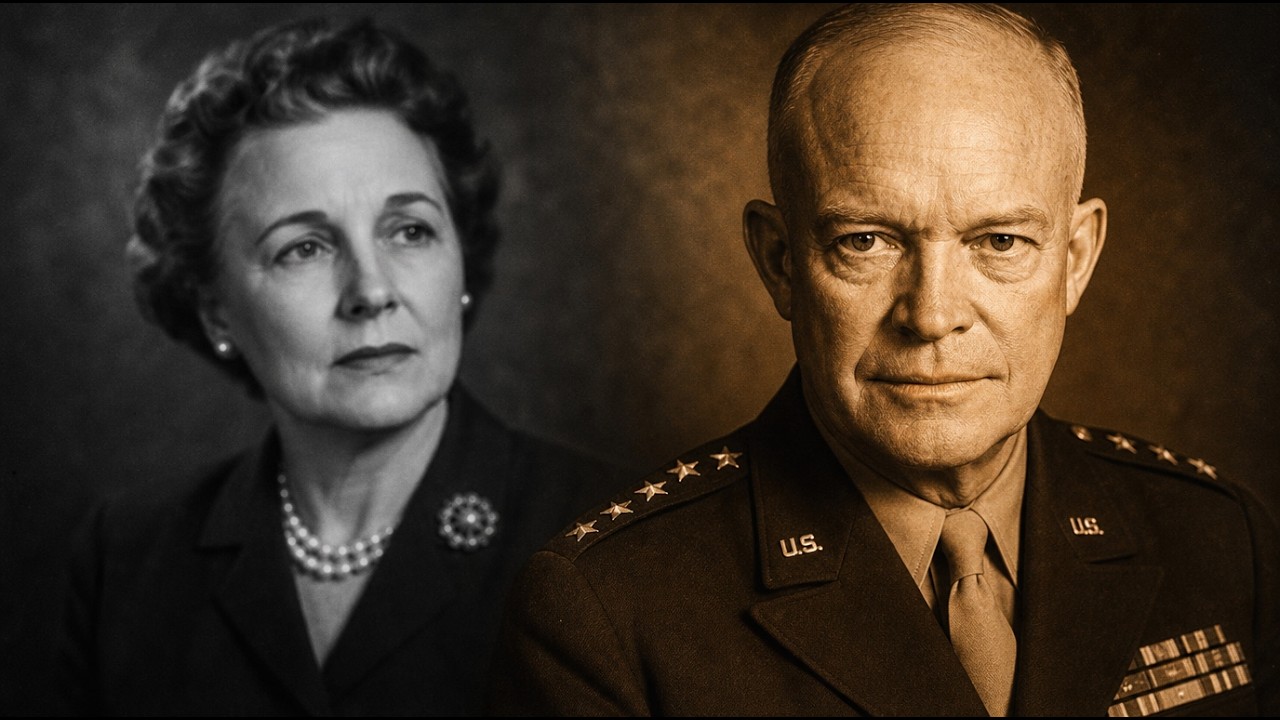
It was a burden the family had never needed to anticipate, because the erasure had worked exactly as designed for three full decades. After 1969, the family structure split into two distinct kinds of work, and neither spouse was ever asked to perform the other’s role. Mamie Eisenhower remained the visible widow, the emotional center of the family, the figure photographed at Gettysburg, the one the public would later hear through National Park Service oral history recordings discussing her personal reaction to the Summersby revelation. Her work was domestic and symbolic.
She cared for the farm, managed personal correspondence, and represented in her public appearances the continuity of a marriage the country had long been asked to believe in completely. John Eisenhower performed an entirely different function. He was not responsible for emotional continuity but for documentary accuracy. As a trained military historian, he wrote serious books, corrected misconceptions where his father’s record had been oversimplified, and served as ambassador to Belgium, building an institutional credibility that had nothing to do with managing grief and everything to do with preserving the family’s standing in serious historical scholarship.
While Mamie’s work centered on appearing steady, John’s work centered on being credible. The two rarely overlapped. The family did not present a unified front for cooperatively managing the legacy. They divided the labor according to temperament and gender role, a common arrangement for the period.
The widow handled the domestic and emotional realm. The son handled the institutional and intellectual realm. This division is what distinguishes the Eisenhower aftermath from the Patton aftermath. This channel had also documented Beatrice Patton burning letters, confronting the American government over a grave site, and personally overseeing her husband’s memoirs within two years of his death.
That was one aggressive, centralized campaign to control a legacy. The Eisenhowers did nothing comparable. There was no similar burning of papers, no public struggle with an institution, no single dramatic act of protection. The Eisenhower legacy survived not through aggressive management but through quiet maintenance sustained over decades, performed separately by two family members who rarely needed to coordinate, because the core legend required little active defense once Kay Summersby had been removed from it.
The third generation then did something neither Mamie nor John had ever attempted in the realm of daily-life documentation. They folded the Eisenhower name directly into another presidential lineage without any deliberate strategy from either side. David Eisenhower, John’s son, married Julie Nixon, Richard Nixon’s daughter, in 1968, a year before his grandfather’s death. Neither family arranged this marriage for political gain in any documented way.
It began as a personal relationship between two young people raised in the same circles of American power. But the structural effect was permanent. From that moment, the Eisenhower name was joined by marriage to the Nixon name, making the family an integrated part of the continuity of twentieth-century American presidential politics instead of a closed and isolated military legacy. This had quiet but specific consequences for how the family legend would be maintained in the future.
The Eisenhower name no longer belonged to the Eisenhower family alone. The family was now structurally linked to the reputation of an entirely different political family, for better or worse, through descendants who would carry both names at once. The stewardship of the legend became, without anyone deciding it, a shared project between two lineages rather than the responsibility of one. What distinguishes the Eisenhower family aftermath from every other family this channel has documented is the absence of crisis.
The Patton family fought the government over a grave and disputed the memoirs of rival generals for decades. MacArthur’s wife spent fifty-six years actively managing a memorial foundation while her son fled into obscurity under an assumed name. The Eisenhowers did none of that. There was no grave dispute.
There was no institutional conflict. There was no son who disappeared entirely. John remained within the family name and made himself useful to it rather than fleeing from it as Arthur MacArthur IV had done. The Eisenhower legacy continued through something closer to inertia than actual struggle.
A clean record established years before Dwight’s death, through the quiet erasure of one woman’s wartime role, then maintained by a widow who was its emotional center and a son who was its documentary center, and later expanded by a marriage that tied the family name to another presidential lineage without prior planning. Compared to all the other families in this archive, this is the least dramatic aftermath of all. And that is precisely the point. The Eisenhower name required less active defense than any legacy this channel has studied, specifically because its most dangerous element, Kay Summersby, had been removed from the official record before the family even began its work of preservation.
Mamie managed the surface. John managed the substance. The grandchildren, without intending it, fused the name into the broader political lineage of the country. What the family inherited was neither simple honor nor crisis.
It was the ongoing, low-intensity work of maintaining a deliberately incomplete record. A legend built on the foundation of a single crucial omission.