In the summer of 1988, inside a dimly lit studio in Nashville, a scene unfolded that looked less like a music session and more like a medical emergency. Surrounded by a fortress of chrome and cables sat Pete Drake, the king of the pedal steel guitar, a man who looked ancient at fifty-five, his skin the color of wet ash. He was tethered to a massive industrial oxygen tank that stood beside him like a grim sentinel. This was the genius who had played on All Things Must Pass and who had handed Peter Frampton the instrument that would define his career.
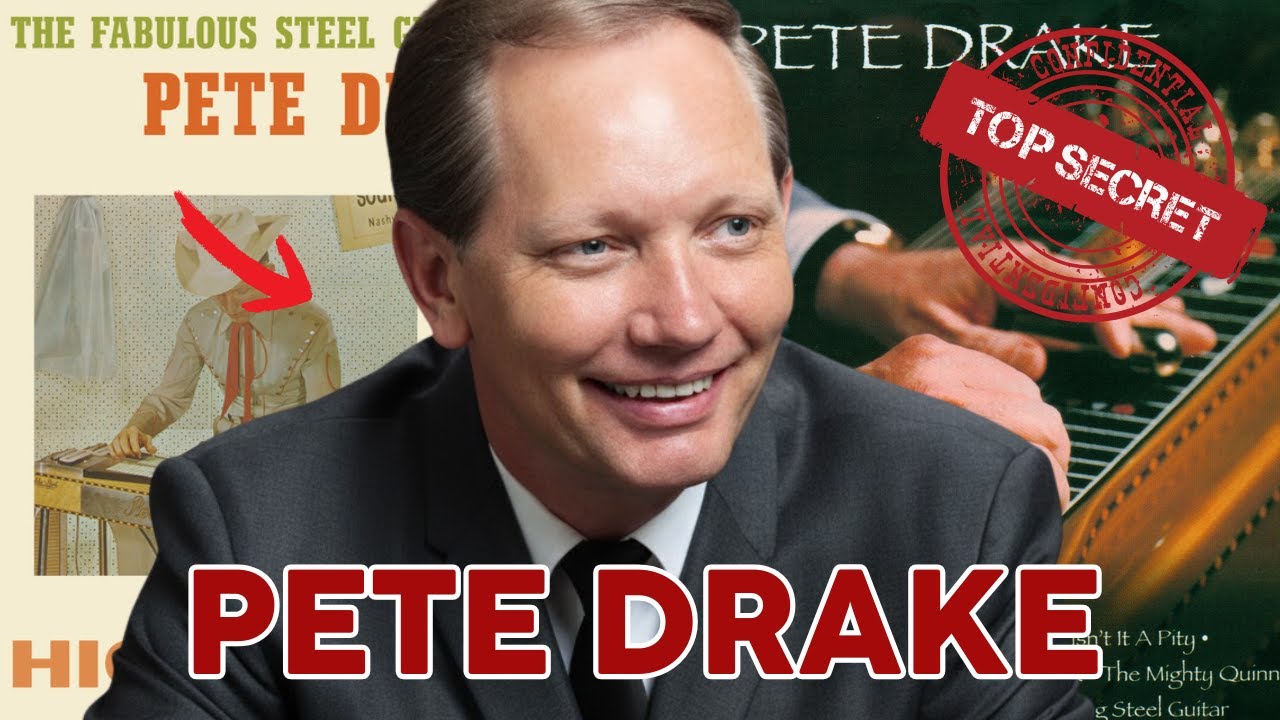
But now, in the cruelest irony in the music world, the man who made air sing was struggling to draw a breath himself. Yet when the red recording light flickered on, Pete did the unimaginable. He tore the life-saving breathing mask from his face, held his breath, and poured the last of his existence into the steel strings for three minutes of flowing, weeping perfection. He made the instrument cry for him, collapsing onto the machine the moment the song ended, flailing in panic and desperation to reach the mask to fill his lungs with air.
This is not just a story about a musician who bridged the gap between Nashville hillbillies and London rock stars. It is the story of a mechanical genius who flew his invention straight toward the sun, trading his breath for a sound that would change music history, paying the heavy physical price for an art that made the machine speak. The American South in 1932 was not a place of opportunity. It was a crime scene.
The Great Depression had hit the country hard, but it struck the South with vengeful anger. In Augusta, Georgia, where Roddis Franklin Drake, known to the world as Pete, was born, the economy had not just been broken; it had evaporated. This was a world built on making do. You didn’t buy things; you fixed them.
If a chair leg broke, you carved a new one. If a radio stopped working, you took it apart, traced its wires, and forced it to speak again. Pete was born into this culture of mechanical survival. His father was a Pentecostal preacher, a man of the cloth who dealt in the currency of faith and fire.
The Pentecostal church in the 1930s was not a quiet place of contemplation. It was a theater of raw emotion. People didn’t just sing hymns; they screamed them. They stomped their feet on rough wooden floors until dust rose in choking clouds.
Young Pete sat in those pews and watched. He absorbed the rhythm. He absorbed the idea that music was not just entertainment; it was a means of moving the soul. But while his father looked to the heavens, Pete looked at the equipment.
He was a restless, troublesome child with a mind that worked like an engineering blueprint. He was obsessed with how things worked. He would stare at the family radio, not just listening to the Grand Ole Opry, but imagining the glowing vacuum tubes inside, trying to understand how a voice from Nashville could travel through the air and come out of a box in Georgia. But church music and radio were about to be overshadowed by a tragedy that would shatter his world.
When Pete was still a young boy, the backbone of his life collapsed. His father, the preacher, the voice of authority, died. In the 1930s, losing a father was not just an emotional shock; it was an economic catastrophe. The Drake family fell from poverty into destitution.
His mother, a woman of hard determination, held the family together. She washed clothes for others. She scrubbed floors. And Pete, now the man of the house, learned the most important lesson of his life: no one is coming to save you.
If you want something, you build it yourself. In that harsh atmosphere of grief and survival, Pete Drake saw the machine that would save his life. He was a teenager wandering the grounds of a local restaurant in Atlanta, where his family had moved. On a small makeshift stage, a band was playing.
They played the popular country songs of the day, but there was one sound cutting through the humid Georgia night that made Pete stop in his tracks. It was a sharp, sliding wail. It sounded human, yet it had sustained metallic properties no human could produce. It sounded like a train whistle crying in a valley.
Pete pushed through the crowd to see where the sound came from. He expected a fiddle. He expected an ordinary guitar. Instead, he saw a man sitting behind a table, but it wasn’t a table.
It was a wooden board on four legs with strings stretched over it. The man held a metal bar in his left hand, moving it up and down the strings while his right hand picked them with metal claws. It was the steel guitar. For the uninitiated, the steel guitar is a frightening, illogical beast.
Unlike a regular guitar where you press a string against a fret to change the note, the steel guitar has no frets. You are in flight. You have to find the note by ear and muscle memory, moving a heavy steel bar to the precise microscopic millimeter where the pitch is perfect. For Pete, it wasn’t just an instrument.
It was a mechanical puzzle. It was a machine that made emotion. He returned home that night with a fire in his heart. He wanted one, but steel guitars were expensive.
Luxury goods in a world where a pair of shoes was a luxury itself. So, true to his upbringing, Pete Drake didn’t buy one; he built one himself. He gathered a piece of hardwood. He found some old guitar tuning keys.
He rigged up a primitive pickup. He found a magnifying glass and used it as a slide until he could find a piece of metal tubing. He sat in his room for hours each day, torturing his family with the sliding, screeching sounds of a boy learning to fly. But Pete had a flaw that became his greatest strength.
He had no teacher. He didn’t know the proper way to play. Most steel guitar players in the 1940s and 50s played in a staccato style, picking the note and cutting it off immediately. Blink, blank, blonk.
It was rhythmic, percussive. Pete didn’t play that way. He wanted the guitar to sound like the singers he heard on the radio. He wanted the guitar to breathe.
He developed a style based on long, flowing, sustained notes. He would slide into the note and hold it, vibrating the bar to create a tremolo that mimicked the human larynx. He was unconsciously trying to make the instrument speak long before he invented the talkbox. By the 1950s, Pete was a professional musician in Atlanta, but the gigs he played were known as “blood bucket” tours.
These were honky-tonks, roadhouses, and cheap bars scattered across Georgia and Alabama. They were places that put chicken wire in front of the stage to catch the beer bottles thrown by customers. The air was thick with cigarette smoke, and you played four sets a night. If a fight broke out, you kept playing.
It was harsh, physical training. It taught Pete endurance. It taught him that music wasn’t about showing off how many notes you could play; it was about connecting with that drunk man in the back row who just lost his job. He formed a band called the Sons of the South, which included future country music legends like Carson West, Jerry Reed, and Joe South.
They were a force of talent, crammed into a family car, eating bologna sandwiches and dreaming of the Emerald City. The Emerald City was 250 miles north. It was a town called Nashville. In the imagination of every Southern musician, Nashville was Valhalla.
That was where the Grand Ole Opry was. That was where songs got recorded. That was where you could make a living without dodging beer bottles. But Nashville was also a fortress.
It was a closed shop. In the late 1950s, the recording industry in Nashville was dominated by a small, elite group of musicians known as “The A-Team. ” These were men like Grady Martin on guitar, Bob Moore on bass, Buddy Harmon on drums, and Buddy Emmons on steel guitar. If Elvis recorded in Nashville, The A-Team played.
If Patsy Cline recorded, The A-Team played. They were the best in the world. They were a fraternity. They protected their turf.
They certainly didn’t need a tall, self-taught kid from Georgia with an innovative style coming to take their jobs. But in 1959, Pete Drake looked at his life in Atlanta. He looked at his empty pockets. He packed his car.
He put his steel guitar in the trunk and drove north on Highway 41, watching the red Georgia clay turn into the rolling green hills of Tennessee. He was driving toward the fortress. He didn’t have a key, but he had a crowbar in the shape of a metal bar, and he was determined to force the door open. Pete arrived in Nashville in 1959.
He was twenty-seven years old. He did what everyone does. He haunted the places. He went to jam sessions.
He introduced himself. He slept in his car or on friends’ couches. The rejection was polite but firm. You’re good, son, but we have Buddy Emmons.
We have Shot Jackson. We don’t need you. His money was running out. His hope was fading.
Then the phone rang. It wasn’t a call to record a hit song. It was just a simple demo session, non-union work for pennies to test a song for a writer. The regular steel player couldn’t make it.
Could you come in twenty minutes? Pete didn’t drive to the studio; he flew. The song was a simple ballad. The producer said, “Just give me something sad in the front.
” Pete looked at the singer. He placed the metal bar on the strings. And he didn’t play a fast lick. He didn’t play a complex melody.
He played a sigh. He slid into the note with that long, weeping vocal vibrato he had perfected in the honky-tonks of Atlanta. It was simple. It was wide and open.
The producer stopped the tape. “Who are you? ” “Pete Drake, sir. ” “Do that again.
” That session led to another. Then another. Word began to spread up and down Music Row. There’s a new player.
He doesn’t play fast, but man, he’s smooth. They started calling his style “the sweet sound. ” It fit perfectly with the changing sound of country music. The “Nashville Sound” was emerging, a smoother, more pop-oriented style.
The staccato steel guitar licks of the 1940s didn’t fit this new plush sound. But Pete Drake did. His big break came quickly. He was booked to play on a session for a singer named Roy Drusky.
The song was called “Anymore. ” It was a hit. And suddenly, the phone didn’t stop ringing. The gate of the fortress cracked and opened.
Pete slipped inside. He was no longer an outsider. He was making real money. He bought a better car.
He bought finer suits. But Pete Drake was not a man who was content to just fit in. The restless boy who took apart radios was still alive inside this successful session musician. He looked at his instrument, the pedal steel guitar, and saw limitations.
He heard sounds in his head that the strings couldn’t make. He started tinkering again. He started messing with electronics. He began to wonder, “If this guitar can cry, why can’t it talk?
” He was about to enter his “mad scientist” phase. He was about to go into his garage and build a device that looked like medical waste. He was about to change the course of music history, but he didn’t know that the invention that would make him immortal would demand the one resource he could never buy, build, or repair once it was lost: his own breath. By 1963, Pete Drake had won.
He had done the impossible. He drove an old car from the red clay of Georgia to the gleaming asphalt of Music Row and cracked the code. He became a first-call player in Nashville’s elite. He was playing four sessions a day.
He was making more money in a week than his father, the preacher, had seen in his entire life. He bought a Cadillac. He bought tailored suits. But perfection had a dangerous side effect: boredom.
The Nashville Sound of the early 1960s was like a well-oiled machine. Producers wanted smooth strings and background vocals. They wanted the steel guitar to stay in the background, providing a nice, quiet texture. No surprises.
Pete Drake was a man who lived for surprises. He was a tinkerer. He would look at a perfectly working toaster and take it apart to see if he could make it toast faster. He sat in those sessions playing the same beautiful sad notes over and over, and his mind began to wander.
He looked at his instrument and felt frustrated. It could cry, moan, and scream, but it couldn’t speak. He remembered an old jazz player who used a throat microphone on his wife while she stood behind a curtain moving her lips to words synchronized with his playing. It was a primitive trick, an illusion.
Pete wanted to do it for real. He didn’t want an illusion. He wanted to fuse the human with the machine. Late at night, after the polished sessions at RCA Studio B, Pete would drive home to his garage in Brentwood.
He’d trade his tailored suit for grease-stained work clothes. He began scavenging for junk. He took an 8-inch speaker, the kind you’d find in a cheap car radio. He built a small, sealed wooden box to put it in.
Then he found a metal funnel of the type used to pour oil into an engine. He mounted the funnel on top of the speaker. Now he needed a conduit. He went to a medical supply store and bought a length of clear plastic surgical tubing.
He pushed one end of the tube into the funnel. The device looked ridiculous. It looked like a piece of plumbing that had gone terribly wrong. But the physics were sound.
When he plugged his steel guitar into an amplifier, and the amplifier into the box, the guitar sound rushed from the speaker, compressed through the funnel, and shot up the tube. If you held the other end of the tube in your mouth, the sound resonated inside your oral cavity. Your mouth became the speaker cabinet. Pete sat in his garage, the smell of solder and dust filling the air.
He put the tube in the corner of his mouth. He clamped his teeth on the plastic. He played a note on the steel guitar. The sound filled his head.
It rattled his teeth. Then he moved his lips. He spoke the word “Hello” with his mouth movements. The guitar didn’t just play a note.
It said, in a strange, gurgling, metallic voice, “Hello. ” It worked. But there was a catch. A physical one.
To make the words intelligible, you had to use your throat. You had to use your diaphragm. You had to push air against the incoming sound to shape the consonants. You were effectively singing, but without making a sound.
You were providing the wind. The guitar was providing the voice. It was physically demanding. It required strong lungs.
Pete Drake, sitting in his garage in 1963 inhaling dust and solder fumes, had no idea that this invention would become the central metaphor and the central tragedy of his life. In 1964, Pete took his talking steel guitar into the studio. He was recording a song called “Forever. ” It was a tender ballad.
As he set up the box, the engineers stared. “Pete, what is that? ” Pete said, smiling with the plastic tube in his mouth, “That’s the future. ” Most session musicians would have been laughed out of the room, but Pete had clout.
They indulged him. He started the backing track. He played the melody on the steel guitar and then leaned toward the microphone. He clamped the tube in his jaw and made the guitar sing.
The sound that came out through the studio monitors was unlike anything anyone had ever heard. It wasn’t human. It wasn’t a synthesizer. It sounded like a ghost trapped inside a radiator.
It was eerie, sad, and strangely beautiful. The engineers stopped laughing. They got chills. “Forever” was released as a single.
Against all expectations, this strange robotic instrumental climbed the charts. It reached number twenty-five on the Billboard Hot 100. It went gold. Suddenly, Pete Drake wasn’t just a session musician.
He was a star. He was the man with the talking steel guitar. But fame in the 1960s moved fast. The Beatles had arrived.
The British Invasion was sweeping away the old guard. Pete should have been swept away too. But Pete had something no one else in Nashville had. He had no ego and no prejudice.
He didn’t care if you were a communist or a redneck. If you could play, you could play. And that attitude was about to put him on a collision course with the most important songwriter of the twentieth century. It was 1969.
The world was on fire. Nashville was a conservative stronghold. The music establishment viewed rock and roll, hippies, and drugs as mortal enemies. Then Bob Dylan came to town.
Dylan was a symbol of everything Nashville feared. In 1966, he had recorded Blonde on Blonde in Nashville, confounding the musicians and producing a masterpiece. Now he decided to return to make a pure country album. He wanted to strip away the psychedelic noise.
He booked the studio. He asked for the best players. The atmosphere during the Nashville Skyline sessions was tense. Bob Dylan, the enigmatic poet, stood in the booth.
The Nashville elite treated him like a ticking time bomb. Except for Pete Drake. Pete walked in, set up his guitar, and looked at Dylan. He didn’t see a prophet.
He saw a man who needed a steel guitar lick. There’s a story, possibly undocumented but carrying a moral truth, that during a break, the silence was suffocating. Pete Drake walked over to Dylan, dusted off his boot, and said, “Hey Bob, you want to hear a joke? ” Dylan looked at him, surprised.
“Sure. ” Pete told him a dirty joke. Dylan laughed. The ice was broken.
From that moment, they were just musicians. The song they recorded together, “Lay Lady Lay,” is one of the most famous recordings in history. It is defined by two things: Dylan’s low, intimate vocal and Pete Drake’s steel guitar. It’s perfect taste.
It’s exquisitely tuned. When Nashville Skyline was released, it stunned the world. Hippies and rednecks were shaking hands. And standing in the middle of that handshake was Pete Drake.
He became the ambassador. Suddenly, every rock star on the planet wanted the Nashville sound. And they wanted that steel guitar. Pete realized the Nashville establishment was too rigid.
They were refusing to work because they didn’t like long hair. So Pete did what he always did. He invented his own solution. He bought a massive Lincoln Continental limousine.
He installed a high-quality sound system in it. He kept his steel guitar in the trunk. He became a roving diplomat. He would pick up rock stars at the airport.
People like The Byrds, Joan Baez, and Ringo Starr. He would take them for tours, buy them drinks, tell them jokes, and make them feel at home in a city that hated them. When Ringo decided to record a country album, he called Pete. Pete essentially produced the album.
He assembled the players himself. He arranged the songs. He finished the album in three days. In London, the Beatles would take three weeks just to get the drum sound right.
In Nashville, Pete Drake had completed the entire album before Wednesday lunch. The most important call was still on its way. It was 1970. The Beatles had officially broken up.
George Harrison, the quiet Beatle, had a stockpile of songs that John Lennon and Paul McCartney had ignored for years. He was ready to unleash a masterpiece. He was recording at Abbey Road Studios in London. He had Eric Clapton.
He had Billy Preston. He had the best rock musicians in England. But he was hearing a sound in his head. He remembered Nashville Skyline.
He heard that weeping, liquid steel sound. He told his producer, Phil Spector, “Get me the guy who played on Dylan’s album. ” The phone rang in Brentwood, Tennessee. The voice said, “Pete, George Harrison wants you in London tomorrow.
” For a boy from Augusta, Georgia, this was the summit. He packed his steel guitar. In the last moment, he looked at the shelf in his garage. He saw the dusty wooden box with the funnel and the surgical tube.
He hadn’t used it much lately. But something told him to take it. He threw the box in his bag. He flew across the Atlantic to meet the most famous musicians on earth.
He was at the peak of his physical power. He had no idea that a curly-haired British kid named Peter Frampton was waiting for him in that London studio, a kid whose destiny was about to be rewritten by the plastic tube in Pete’s bag. He had no idea that the device he was carrying would cement his legacy in rock history, and would also demand a price he ultimately couldn’t pay. Abbey Road Studios in London is not just a building.
It’s a cathedral. By 1970, the white plaster walls of that facility in St. John’s Wood had absorbed the vibrations of Sgt. Pepper.
It was a place where serious men in white lab coats treated microphones as surgical instruments. Into this hushed, sacred atmosphere walked Pete Drake. He wore cowboy boots that clicked loudly on the wooden floors. He carried a pedal steel guitar, an instrument that looked like a piece of farm equipment to the British engineers.
He set up his steel in the main studio and looked around. The room was packed with rock royalty. But once the tape started rolling, the cultural gap vanished. Pete didn’t try to compete with the Wall of Sound.
He pierced it. His steel guitar lines on songs like “Behind That Locked Door” and “I Live for You” were pure liquid emotion. He brought the dust of Georgia to the fog of London. He grounded the mysticism of Harrison’s songs with a touch of Nashville honky-tonk soul.
Harrison loved him. Pete became the jester and the wise uncle of the sessions. But the most important moment of the trip didn’t happen while the recording light was on. It happened during a coffee break.
Sitting in the studio, watching Pete with eyes as wide as saucers, was a young British guitarist. He was only twenty years old, with curly blonde hair and the face of an angel. His name was Peter Frampton. He was a talented youth, a member of the band Humble Pie, but he was still searching for his signature.
He’d spent the week watching Pete play the steel guitar, fascinated by its mechanics. Then he saw Pete reach into his bag and pull out the box, the talking device. Pete set it up to amuse everyone. He wiped the plastic tube, put it between his teeth, played a chord, and looking right at the young Peter Frampton, made the guitar say, “Hello, Peter.
” Frampton nearly fell off his chair. It was magic. It was ventriloquism at 100 watts. It was a guitar sound with human consonants.
“What is that? ” Frampton asked in awe. “It’s a talkbox, son,” Pete said in his slow drawl. “I built it in my garage.
” Frampton asked the question that would define the course of his life. “Can I try it? ” Pete handed the tube to the boy with boundless generosity. Frampton put it in his mouth.
He plucked a chord on his Les Paul. He felt the pressure of air vibrating his teeth. He formed his mouth. And suddenly, his guitar started to talk.
In that moment, a great legacy was transferred. Pete Drake saw the look in the boy’s eyes. He saw the obsession. Later, back in Nashville, Pete built an improved version of the talkbox and sent it to Frampton as a gift.
Five years later, in 1976, Peter Frampton released Frampton Comes Alive. It became one of the best-selling live albums in history. The huge hits “Show Me the Way” and “Do You Feel Like We Do” relied entirely on the talkbox. Crowds went insane when the guitar started to talk.
Frampton became a millionaire and a global icon. Every time he made that tube speak, he was using the lung power technique taught to him by a country genius in Abbey Road Studios. Pete never asked for royalties for his invention. He never properly patented it.
He simply thought it was great that the kid liked it. Pete returned to Nashville a conquering hero. But he was tired of being a hired gun. He was tired of making other people rich.
In the early 1970s, he changed course. He stopped doing so many sessions and started producing. He founded his own record label, Stop Records, and later, First Generation Records. He bought a building on Music Row.
He built his own studio, called Pete’s Place. He was obsessed with work. He discovered new talent. He had an ear for the “outlaw” sound that was beginning to emerge.
He worked with everyone. He produced albums for Ernest Tubb, the Texas Troubadour. He was the bridge between the old guard and the new rebels. To understand what happened next, you must understand the physical environment of a 1970s recording studio.
It was a tightly sealed box. Soundproofing requires mass and airtight seals. No windows could open. The air conditioning recycled the same air over and over.
And in the 1970s, everyone smoked. The musicians smoked, the engineers smoked, the producers smoked. The ceiling tiles were stained yellow. Pete Drake was a heavy smoker.
It was part of his uniform. You’d sit at the steel guitar. You’d play a part. You’d take a drag of your cigarette.
You’d exhale. You’d play another part. It was a rhythm. It was a nervous tic.
It was a way to stay awake through the fourteenth hour of the session. Pete’s lungs were under a double attack. First, there was the smoke, tar, and carcinogens coating the delicate alveoli responsible for transferring oxygen to the blood. Secondly, there was the stress.
He wasn’t just playing anymore; he was running a business. And thirdly, there was the lingering echo of the talkbox. Using that device was an athletic event. You had to push air from your diaphragm through your throat to modulate the sound.
It was like playing the trumpet and singing at the same time. Pete spent years doing this, straining his respiratory system to its limits. The machine that gave him his voice required constant assaults on his breath. It started innocently enough, just a cough.
In the mid-1970s, Pete developed a cough that wouldn’t go away. It wasn’t a cold. It was a dry, hacking cough. He’d joke, “Just a smoker’s cough.
I need to cut back. ” But he didn’t cut back. He couldn’t. Cigarettes were the fuel.
Then came the shortness of breath. He’d climb a flight of stairs carrying a reel of tape and have to stop at the top, leaning against the wall, waiting for his heart to stop pounding. He ignored it. Pete Drake was a man who fixed things.
He thought his body was just another machine he could ignore until the work was done. But the human body is not a steel guitar. You can’t replace the parts. By the late 1970s, the symptoms were impossible to ignore.
He was losing a lot of weight. His energy was fading. He went to the doctor. The diagnosis was a word that sounded like a snake’s hiss: emphysema.
It’s a progressive, incurable disease. The walls of the air sacs in the lungs weaken and rupture. They lose their elasticity. Instead of being like fresh balloons that inflate and deflate easily, they become like old, worn-out grocery bags.
They trap air inside. You can inhale, but you can’t fully exhale. Old, stale air becomes trapped, leaving no room for fresh, oxygen-rich air. You are slowly suffocating from a lack of oxygen.
The doctor told him the harsh truth: “Pete, you have to stop smoking. You have to stop working so hard. You need rest. If you don’t, this will kill you.
” Pete looked at the doctor. Then he looked at his schedule. He had sessions booked. He had albums to produce.
He eventually quit smoking, but the damage was done. The tar had settled. The tissue destruction had begun. As his health deteriorated, Pete Drake found a new mission.
He looked around Nashville and saw a tragedy unfolding. The music industry is cruel to its elders. The legends of the 1940s and 50s were being cast aside by record labels. They were being treated like garbage.
Pete was furious. He was a man who respected history. He launched the First Generation project. His goal was to bring these aging legends into his studio and record their voices with modern technology.
He wanted to preserve their sounds before they were gone. It was a race against time, not just for them. Pete knew his own clock was ticking. He could feel his chest tightening more every month.
He worked with feverish intensity. He spent his own money. He stayed up all night remixing tracks, trying to make these old soldiers sound like kings one last time. He brought in Ernest Tubb, Stonewall Jackson, and Ray Price.
The sessions with Ernest Tubb were heartbreaking and beautiful all at once. Tubb also suffered from severe emphysema. Imagine the scene in that Brentwood studio. Two giants of American music sitting across from each other, one holding a guitar, one behind a steel guitar.
Both connected to oxygen tanks. The air in the room was thin, but the respect was overwhelming. They developed a dark humor about their situation. Between takes, the sound wasn’t the clinking of beer bottles.
It was the sound of breathing inhalers and the hiss of oxygen machines. Pete would look at Ernest and whisper, “You ready, E. T.? ” And Ernest, in his raspy voice, would smile and say, “Let’s roll the tape, Pete.
” They recorded the old songs. Stripped of the glossy production of the modern era and back to the roots. Pete played with a tenderness that was emotionally devastating. He was playing the melody of farewell.
There is a distinct sound to these final recordings. If you isolate Pete’s tracks, you can hear it. You can hear the intake of breath before playing. You can hear the struggle.
But the notes themselves, they were pure. They were pure silver. The physical performance of playing the pedal steel guitar is demanding. It requires coordination of hands, feet, and knees.
But more than that, it requires total concentration. For a man with advanced emphysema, concentration is expensive. Lack of oxygen causes confusion. It causes exhaustion.
It causes panic. There were moments in the studio when Pete would begin to fade. His eyes would glaze over. His hands would tremble.
The lack of oxygen to his brain was making the room spin. His engineers would watch in horror. “Pete, take a break, please. ” Pete would wave them off.
He’d turn up the flow of oxygen on his tank, take deep, desperate breaths, and then nod his head. “Roll the tape. ” He had to adjust his playing to his breathing. He could no longer hold a long note.
He had to learn a new economy of movement. He played shorter phrases. He left longer spaces. And in those spaces, the music became deeper.
With 1988 came the end. Pete’s world had shrunk to his bedroom and his studio. He rarely left the house. But the world kept coming to him.
Musicians made pilgrimages to Brentwood. One afternoon, a car pulled up. It was a rock musician, a friend from the glory days. He walked into the studio and saw Pete.
He was shocked. Pete had withered away. He was a ghost in a denim shirt. But then Pete smiled.
That gap-toothed, mischievous smile was still there. He cracked a joke about his oxygen tank. “Got myself a turbocharger now. ” He refused to be pitied.
He sat down at the steel. He put the bar to the strings, and for ten minutes, the ghost disappeared. The master returned. He played a melody that filled the room with light.
It was the sound of “Lay Lady Lay. ” It was the sound of “All Things Must Pass. ” When he finished, he was utterly exhausted. But his eyes were shining.
He knew he still had the magic. The summer of 1988 was hot in Tennessee. The humidity hung over Nashville like a wet blanket. For a man with emphysema, humidity is torture.
Pete’s condition deteriorated rapidly in July. He didn’t go to the hospital. He hated hospitals. He wanted to be in his home.
He wanted to be near his machines. On July 29, 1988, the struggle ended. Pete Drake, the man who came from Georgia with a homemade guitar, the man who charmed Bob Dylan, the man who taught Peter Frampton how to talk, took his last breath. He was fifty-five years old.
The silence in his Brentwood home was deafening. The oxygen machine was turned off. But in the studio, on the reels of magnetic tape stacked on the shelves, the vibration continued. The news spread across Music Row like a shockwave.
George Harrison heard. Ringo heard. Peter Frampton heard. The man who was the bridge was gone.
The steel guitar that cried for everyone was now silent. But as they prepared to bury him, they realized something profound. Pete hadn’t just left behind recordings. He had left behind a language.
Every time a kid in his garage hooks up a tube to a box and makes a guitar say “hello,” Pete Drake is reborn. At his funeral in August 1988, the church filled with the expected faces, the surviving members of The A-Team, country stars, and producers. But scattered among them were the long-haired rock and roll refugees, the people Pete had sheltered when the rest of the town wanted to cast them out. The eulogies were spoken, but the real eulogy was played.
They weren’t burying just a steel guitar player. They were burying a bridge. Pete was the only man who had a passport to every musical country. Without him, the connection between Nashville and London had been cut.
In the years after his death, a cruel paradox unfolded. Pete Drake’s name began to fade from public consciousness, but his sound became more ubiquitous than ever. Turn on a classic rock station today. You’ll hear Peter Frampton’s “Show Me the Way.
” You’ll hear that robotic, gargling “wah-wah” voice singing the chorus. It’s an anthem. It’s the sound of a decade. Millions know that sound.
But almost none of them know the name of the man who sat in a garage in Brentwood inhaling solder fumes and dust, figuring out how to make it happen. Pete Drake became the ghost inside the machine. He was everywhere and nowhere. He handed the torch to Frampton, Joe Walsh, and countless others.
Every time a musician used a talkbox to distort their voice, they were paying tribute to Pete Drake, not with money, but with breath. The talkbox is not a digital effect. You cannot perfectly emulate it with a software plugin. For it to work, you must interact with it physically.
You have to push your own air through the tube. You have to share your lungs with the machine. It is a covenant with blood. It is the most organic physical effect in the history of rock and roll.
And the man who invented it died because his organic machines failed him. When historians look at the life of Pete Drake, they are often struck by one devastating image. It is the image of the two tubes. In the 1960s, Pete Drake was famous for a clear plastic tube.
He would put it in his mouth. He would push his strong, healthy breath into it. He used it to connect his voice to the world, to make metal speak, to create a sound of joy and wonder. It was a tube for creation.
In the 1980s, Pete Drake was dependent on a clear plastic tube. He would put it in his nose. He used it to draw thin, meager oxygen into his ruined lungs. He used it to stay alive.
It was a tube for survival. The journey from one tube to another is the story of his life. It is the story of a man who spent his breath so generously, so lavishly on his art that he had none left for himself. He traded the breath of life for the breath of music.
He was a mechanic. He knew that machines wear out. He knew that engines blow up. He decided to run the engine at full throttle until it blew rather than let it rust in the garage.
There is another part of his legacy that is often overlooked, but it might be the most heroic. In the aftermath of his death, his widow, Rose Drake, entered the studio. She found the tapes. The First Generation project, the countless hours Pete had spent recording the departing legends of country music, was safe.
He had finished the work. He had recorded their voices before they also went silent. Thanks to Pete Drake, we have pristine, high-quality recordings of the pioneers of the genre, captured in their final years, treated with dignity and respect. He played the archivist.
He was the man standing at the door of the burning library, throwing books out the window to safety before the roof collapsed. He didn’t save himself, but he saved them. In the end, silence descended on Pete Drake’s studio. The equipment was sold or moved away.
The house in Brentwood was just a house again. But sound is a strange thing. It doesn’t really disappear. A recorded sound is a form of time travel.
Drop the needle on a vinyl copy of Nashville Skyline. Close your eyes. You’ll hear Bob Dylan’s voice, strange and low, and then you’ll hear him. That high, weeping, liquid silver sound.
It enters from the right speaker. It slides toward the note, catches it, shakes it with a delicate vibrato, then descends like a waterfall. It doesn’t sound like a machine. It sounds like a human sigh.
That is Pete Drake. He’s not in the grave in Tennessee. He’s in the groove of the record. He is forever thirty-seven, forever healthy, forever blowing his soul into a piece of wood and wire.
The tragedy of his death, the gasping, the oxygen tanks, the fear, all of that is real. It’s the bill that came due. But the triumph of his life is that he cheated silence. He built a machine that could speak.
And because of that, he will never stop talking. In the end, that boy from Georgia who took apart radios to find the voices inside them became, for everyone, the voice inside the radio.