John Crockett named his son for hardship before the boy could even walk. The family called themselves Crockett, but two generations earlier they were Croqueton, French Huguenots who fled Catholic persecution and crossed into the north of Ireland with a new religion and an altered name. In Ireland, they became Ulster Scots. In America, they became frontier.
David Crockett was born near the Nolichucky River in 1786, the fifth of nine children, in a cabin whose replica still marks the ground. His grandfather had been killed by Cherokee raiders before David ever knew him. His father fought at King’s Mountain. By the time David carried a rifle instead of a plow, the family name had survived a revolution, an ocean, and a war.
He carried it once more into Texas, into the walls of a mission called the Alamo, where the Huguenot name that fled one massacre met its last one. Long before the frontier had a name for what he was, Daniel Boone’s family had already tried to become someone else. His grandfather, George Boone, brought the family from Devon, England to Pennsylvania in 1717, Quakers seeking land and quiet. The quiet did not last.
Squire Boone was expelled from the Quaker meeting when his children married outside the faith, and in 1750 he moved his family to North Carolina, unmoored from the community that once anchored them. Daniel grew up on that unmooring, learning to read land instead of scripture. He became one of the first white men to carve a path through the Cumberland Gap, the natural doorway the mountains had guarded for centuries. Two of his sons died defending that passage west, one at just sixteen.
The Boone name, English and Quaker and quiet by origin, became attached to the opening of an entire continent. John Sevier’s grandfather, Don Juan de Xavier, fled France in 1685 after the king revoked the Edict of Nantes and made Protestant worship a crime punishable by death. He crossed to London, married an English woman, and did the one thing that made survival possible. He changed his name.
Xavier became Sevier. Two generations later, in the mountains of Virginia and Tennessee, nobody remembered the sieve maker’s name from Languedoc. They remembered Nolichucky Jack. John Sevier fought at King’s Mountain, helped found the short-lived state of Franklin, and in 1796 became the first governor of Tennessee.
Elected and reelected across three decades of frontier politics, he fought the Cherokee in dozens of engagements and once nearly dueled Andrew Jackson in the street over an insult to his wife. He died on a boundary commission in Alabama in 1815, still working the frontier at seventy. A French Protestant name, buried under an ocean and a persecution, resurfaced as the first governor of a mountain state. Four hundred years before Neil Armstrong stepped onto the moon, his ancestors were the most feared family on the Anglo-Scottish border.
The Armstrongs of Liddesdale were reivers, raiders who moved cattle and grudges across the border with equal ease, headquartered at Gilnockie Tower until their leader, Johnny Armstrong, was hanged by King James V in 1530. Genealogists confirm Neil Armstrong’s direct descent from that same border reiver family, though his biographer has since disputed some of the specific details of how that line moved from Scotland into Ulster. What is not disputed is the surname’s path. Armstrong became one of the defining names of the Scots-Irish migration that filled the Appalachian backcountry, carried by families who traded raiding for farming but kept the same suspicion of distant authority.
In 1972, Neil Armstrong flew to the small town of Langholm, the old Armstrong seat, and was made its only freeman. He had carried a swatch of Armstrong tartan to the moon three years earlier. The reiver’s name reached the one place raiding never could. They rode beside the Armstrongs, and they were hanged beside them, too.
The Elliots were one of the great raiding families of the Anglo-Scottish border, moving in the same raiding parties, marrying into the same feuds, absorbing the same reputation for taking what the law would not give them. When King James VI pacified the border after 1603, ending centuries of reiving in a single stroke of royal will, the Elliots scattered like the Armstrongs did, first into Ulster, then across the Atlantic into the Appalachian backcountry. The name traveled well. It did not need translation, and it did not need explanation, because by the time Elliots were clearing land in the Blue Ridge and the Smokies, half their neighbors carried the same kind of surname, forged on the same violent border, softened by the same ocean crossing.
The reiver’s suspicion of outside authority did not stay behind in Scotland. It rode into the mountains with the name, and it is still there in the fierce self-reliance historians have always tied to the Scots-Irish settlement of Appalachia. The Grahams were never highlanders. That distinction mattered once in a way modern Americans rarely think about.
Scotland was never one culture, and the Grahams belonged to the lowlands and the border country, a harder, flatter, more contested world than the misty glens people picture when they hear the word Scottish. Their name meant something like gravelly homestead, a description of land, not romance. When the great wave of Ulster Scots crossed to America in the eighteenth century, Graham was already one of the most common names among them, alongside Armstrong and Elliott, cousins in migration if not in blood. They came down the great wagon road through Pennsylvania and Virginia into the Shenandoah Valley, and further still into the mountains, where the land finally stopped looking like anything they had left behind.
Grahams put down roots across the Appalachian frontier so thoroughly that the name became a kind of shorthand. The Campbells came from somewhere else entirely. While the Armstrongs and Grahams and Elliotts were raiding the border, the Campbells ruled Argyll, a Highland clan with real territory and real power, the kind other clans feared and envied in equal measure. Their name meant crooked mouth, an old insult that stopped mattering once the family became one of the most dominant forces in Scottish history.
When emigration pulled Highland Scots toward the New World, Argyll sent settlers on the short crossing to Antrim first, then onward to America, joining the lowland and border Scots already filling the Appalachian backcountry. The mixture meant something. Highland clan structure, with its clear chiefs and fierce loyalty, blended into border self-reliance until the distinction barely mattered anymore. Campbell became one of the most numerous surnames in the American South, carried by descendants who mostly never knew their ancestors had once been Highland aristocracy rather than border raiders.
Three Vance brothers landed in Virginia sometime in the 1740s, Scots-Irish immigrants with no way of knowing what the name would become. One line moved into the mountains of Western North Carolina, where Colonel David Vance built a log home after serving with Washington’s army through the brutal winter at Valley Forge. His grandson, Zebulon Baird Vance, was born in that house in Buncombe County in 1830, the third of eight children in a family long on tradition and short on cash. Zeb Vance became North Carolina’s Civil War governor, then a United States senator, one of the most influential Southern political figures of his era, carrying a Scots-Irish surname out of the mountains and into the history books.
Nearly two centuries later, the same surname surfaced again in Hillbilly Elegy, a memoir that put Appalachian identity back into the national conversation, written by a man who would go on to become vice president of the United States. Two Vances, two centuries apart, both defined by the same mountain inheritance. By the 1870s, William Anderson Hatfield was not just a mountain dweller. He was Devil Anse, a successful timber merchant along the Tug Fork employing dozens of men, some of whom were McCoys.
That detail matters because the feud that made the Hatfield name infamous was not simply two tribes at war. It was neighbors, employers and employees, in-laws, tangled together along a river that formed the Kentucky-West Virginia line. The first blood came in 1865 when Asa Harmon McCoy was killed by the Logan Wildcats, a militia that counted Devil Anse among its members. Seventeen years later, Ellison Hatfield was killed by McCoy brothers, and Devil Anse answered by having three of them tied to trees and executed.
The violence peaked in 1888 with an attack on Randolph McCoy’s home that killed two of his children, followed by the Battle of Grapevine Creek and a case that reached the US Supreme Court. Devil Anse fathered thirteen children and lived until 1921, dying a wealthy man, the name Hatfield permanently fused to the deadliest family feud in American history. Randolph McCoy was a Confederate private and a ferry operator, not a warlord, but history remembers him as the man on the other side of the Tug Fork from Devil Anse. His name comes from the Gaelic Mac Aoidh, son of Aodh, an old clan patronymic worn down over centuries into something that sounded American.
McCoy fathered sixteen children with his wife Sarah, and it was his children the Hatfields came for in January of 1888, burning the McCoy home and killing two of them in an act that finally forced legal intervention. Randolph McCoy lived to eighty-eight, outliving the feud and most of the men who fought it, dying in 1914 with the family name permanently bound to Hatfield in the American imagination. The two names still cannot be spoken apart. The feud did not officially end until a truce was signed in 2003, more than a century after the first shot.
Edith Bolling was born in Wytheville, Virginia and married a sitting president in 1915, but her name carried something older than the White House. The Bollings descend through an unbroken line of only children from Jane Rolfe, granddaughter of Pocahontas and John Rolfe, making Edith Bolling Wilson a direct descendant of the Powhatan princess who married into the Jamestown colony three centuries earlier. The name traveled two directions after that. One branch stayed among Virginia’s first families, intermarrying with Jeffersons and Randolphs, and eventually reaching the White House.
Another branch drifted into the mountains, where the name softened into Bolling or Bolen and turned up on the same lists of surnames genealogists associate with Appalachia’s Melungeon communities. Genetic testing has since shown these mountain Bollings and Bolens do not all share the same paternal line as the Pocahontas descendants, a complication researchers call the Blue Bolling question. One surname, one legendary ancestor, and at least two very different bloodlines still arguing about which one is real. She weighed somewhere near six hundred pounds by the time lawmen stopped trying to arrest her.
Mahala Big Haley Mullins ran the finest moonshine operation on Newman’s Ridge in Hancock County, Tennessee, and everyone knew it, including the law. The problem was never catching her. It was moving her. Her cabin sat at the end of a narrow mountain path no wagon could climb, and by the time deputies made the trek, Mahala was too large to fit through her own door.
A judge once asked why she had not been brought in. The officer’s answer became local legend: Your honor, Miss Mullins is catchable but not fetchable. She descended from Melungeon families, the tri-racial mountain communities of European, African, and indigenous ancestry that settled the Tennessee-Virginia border and were often labeled free colored in colonial records, subject to suspicion and legal harassment for generations. Mahala buried a husband and sons on the ridge behind her cabin and kept selling whiskey until her death in 1898, unmovable, unbothered, and by then one of the most famous women in the state.
The name Collins runs straight through the center of the Melungeon mystery. Vardy Collins and Old Ben Collins were among the earliest documented ancestors of the mixed ethnicity communities that settled the isolated hollows where Tennessee, Virginia, and Kentucky meet, families whose racial origins were debated, denied, and sometimes prosecuted for generations. Nineteenth-century Tennessee courts tried Melungeon men for illegal voting, forcing them to prove in front of a judge that they carried no African ancestry, a humiliation that shaped how these families guarded their own history afterward. Theories about where the Collins line truly came from ranged from shipwrecked Portuguese sailors to a lost Welsh expedition.
Then, in 2012, a study published in the Journal of Genetic Genealogy used DNA to cut through the guesswork. The Melungeon families, including the Collins line, descended from sub-Saharan African men and white women of northern or central European origin, admixture that began in colonial Virginia generations before anyone called it Melungeon at all. The mystery had an answer. Not everyone wanted it.
The name Gibson comes from Gib, a medieval short form of Gilbert, and simply means son of Gib, an English and Scottish surname with no exotic origin story at all. That plainness is exactly what makes its Melungeon history strange. Buck Gibson appears among the core progenitor families researchers point to when tracing the mixed ethnicity communities of Newman’s Ridge and the surrounding hollows, families whose English surname sat awkwardly alongside their disputed and often persecuted ancestry. Eighteenth-century Virginia and North Carolina records list Gibsons among the free colored households taxed and tracked separately from their white neighbors, a bureaucratic label that followed the family for generations even as they lived, farmed, and worshipped alongside everyone else in the mountains.
The Gibson name traveled with the broader Melungeon migration into Hawkins and Hancock counties in Tennessee, intermarrying repeatedly with Collins, Mullins, and Goins families until the bloodlines braided into something genealogists still work to untangle today. Jack Goins spent forty years doing what no court record or census form ever bothered to do. He tried to get the Goins family history right. His own ancestors, Edward Goins and his younger brothers, left Tennessee for Pennsylvania coal country right after the Civil War.
And in that move, something quietly happened that happened to Melungeon families again and again. Recorded as white in their new state, the family’s mixed ancestry faded from official memory within a generation, preserved only in oral tradition and old photographs. Goins is one of the oldest documented Melungeon surnames, its origins debated between Welsh, French, and Portuguese roots, though DNA research now points toward the same African and European admixture found across the core Melungeon families. Jack Goins became the driving force behind the genetic research that finally tested the oral history against hard evidence, working alongside genealogists and geneticists until the 2012 Journal of Genetic Genealogy study confirmed what families like his had always half known and rarely been allowed to say openly.
Forty years of quiet research turned a family secret into a documented fact. She was seventeen when her husband, Kingfisher, died beside her in battle against the Muscogee. And instead of mourning from a distance, Nancy Ward picked up his rifle and kept fighting. That single act of courage earned her the title Ghigau, beloved woman, a position of extraordinary authority within the Cherokee Nation that let her speak in council and pardon prisoners already condemned to die.
Born Nanyehi around 1738 in the Cherokee town of Chota, she later warned colonial settlers of planned attacks during the Revolutionary War, choosing diplomacy in a role most expected her to use for vengeance. Her second marriage to a white trader named Bryan Ward gave her an English surname that would carry her Cherokee bloodline into thousands of American families who never think of themselves as having native ancestry at all. Genealogist David Hampton has spent thirty years tracing her descendants and estimates the number today at roughly forty thousand people. One Cherokee woman’s courage in a single battle produced a bloodline that never stopped growing.
John Bell moved his family from North Carolina to a farm on the Red River in Robertson County, Tennessee in 1804, a real settler with a real wife and nine children in what is now the small town of Adams. Thirteen years later, according to the legend that made his name famous, something began tormenting his household. Family accounts describe strange animals in the cornfield, then knocking in the walls, then a voice, a presence capable of speaking, moving objects, and inflicting violence, focused especially on his daughter Betsy. The story was not written down until 1894, decades after it supposedly happened, in a book by newspaper editor Martin Ingram that became the first full account of what history now calls the Bell Witch.
John Bell died in 1820, and family tradition blamed his death on the entity, though no contemporary record from his lifetime confirms any of it as documented fact rather than inherited legend. What is certain is the family, the farm, and the deaths. What remains legend is everything supernatural layered on top. Adams, Tennessee still draws visitors every October chasing a ghost story that outlived the family who inspired it.
Andreas Huber crossed from the German Palatinate to Pennsylvania in 1738, one of thousands of Palatine refugees fleeing a region devastated by repeated French invasions and crushing feudal taxation. He moved to Maryland, then finally settled along North Carolina’s Uwharrie River in 1762, where a mill bearing his name still stands. Somewhere in that migration down the Great Wagon Road, through the German farming communities of the Shenandoah Valley, and into the Southern backcountry, Huber became Hoover, the same Anglicizing pressure that reshaped hundreds of German surnames traveling alongside Scots-Irish settlers into Appalachian territory. It was Andreas’ fourth son, John, who pushed the family further west, first to Ohio, then to an Iowa Quaker community where his descendant Herbert Hoover was born in 1874 and eventually became the thirty-first president of the United States.
A different branch of Hoovers produced J. Edgar Hoover, the FBI director who held the position for nearly fifty years. A German landowner’s name, worn down by an ocean and a frontier, ended up attached to two of the most powerful offices in American government. Dolly Rebecca Parton was born in a one-room cabin in Pittman Center, Tennessee, in Sevier County, the very county that still carries the name of the Huguenot governor two hundred years removed.
She was the fourth of twelve children born to Robert Lee Parton and Avie Lee Owens, and the family was so poor the doctor who delivered her was paid in a bag of cornmeal instead of cash. The Parton line traces back to English and Welsh settlers who arrived in Appalachia in the 1600s, farming families with no reason to expect their name would ever mean anything beyond the mountains they worked. Dolly has said she learned Welsh ancestry ran through her mother’s side, the Owens family, alongside English roots on her father’s, a mixture common to nearly every family in these hills. In 2024, she released an album called Smoky Mountain DNA, tracing both sides of her family back to the British Isles and turning her own bloodline into a five generation musical scrapbook.
A Parton family that once measured survival in cornmeal now measures it in Grammy Awards without ever leaving the same Tennessee ground. Loretta Webb was born in a cabin in Butcher Hollow, Kentucky, the second of eight children raised by a coal miner named Ted Webb and his wife Clara, whose own ancestry carried Cherokee heritage into the family alongside the English name. The community itself, tucked into Johnson County near Van Lear, took its name from a local butcher family, one small hollow among hundreds that produced the coal that built the region and buried the men who mined it. Ted worked the Van Lear mines through the night and their own fields by day, a life Loretta later turned into Coal Miner’s Daughter, the song and the film that made Butcher Hollow a pilgrimage site for country fans.
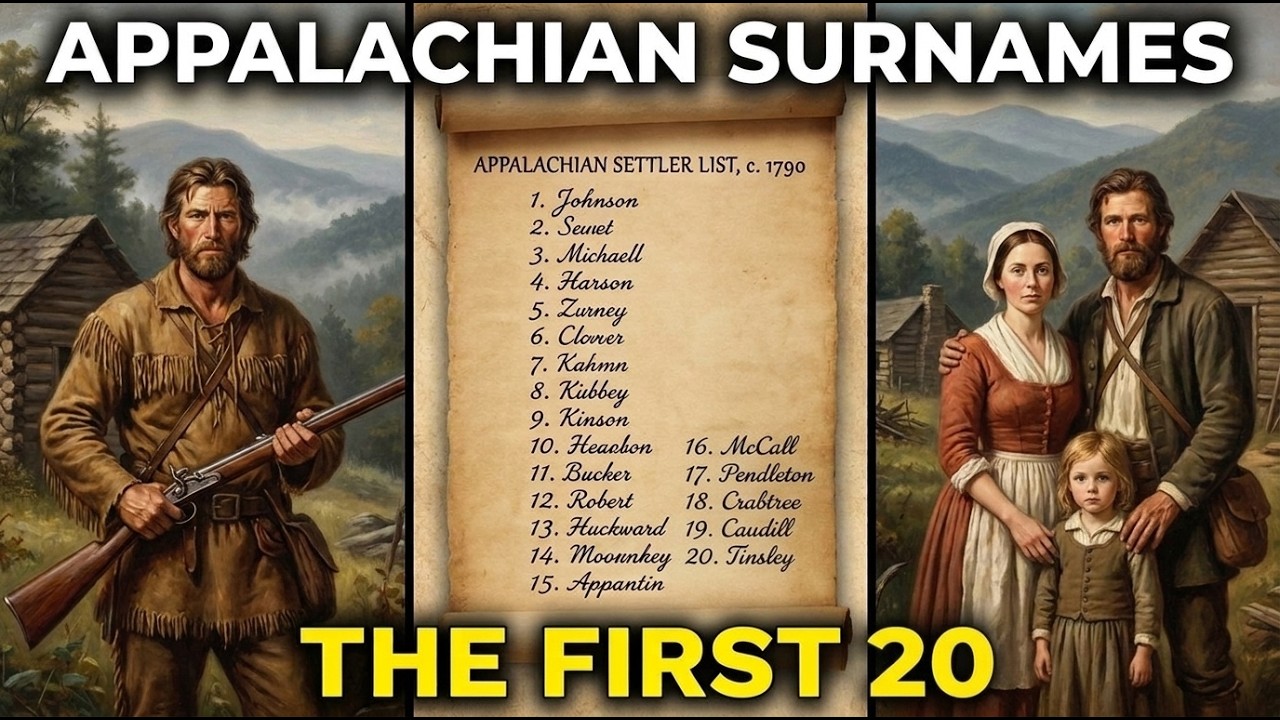
What makes the Webb name remarkable is not just Loretta. Her younger sister Brenda Gayle became Crystal Gayle, and her sister Peggy Sue and brother Jay Lee both had their own recording careers. Four Webb siblings from one coal camp cabin who each found a way into American music. Twenty names.
The Huguenot who died at the Alamo. The Quaker boy who opened the Cumberland Gap. The sieve maker’s son who became a governor. The reiver whose descendant walked on the moon.
The raiding family that rode into the mountains instead of the border wars. The gravelly homestead name that became shorthand for Appalachian roots. The Highland clan hiding in plain sight among border names. Two Vances, two centuries apart.
Two families who turned a river into the deadliest feud in American memory. The princess’s bloodline that split into a first lady and a mountain mystery. The moonshiner too large to arrest. Three Melungeon surnames still untangling their own DNA.
A Cherokee beloved woman with forty thousand descendants who never knew her name. A ghost story that outlived the family it haunted. A German landowner’s name that reached the presidency and the FBI. A cornmeal poor family that became country music royalty.
A coal camp cabin that produced four recording careers. If a family has been in these mountains long enough, one of these twenty names is very likely already its own.