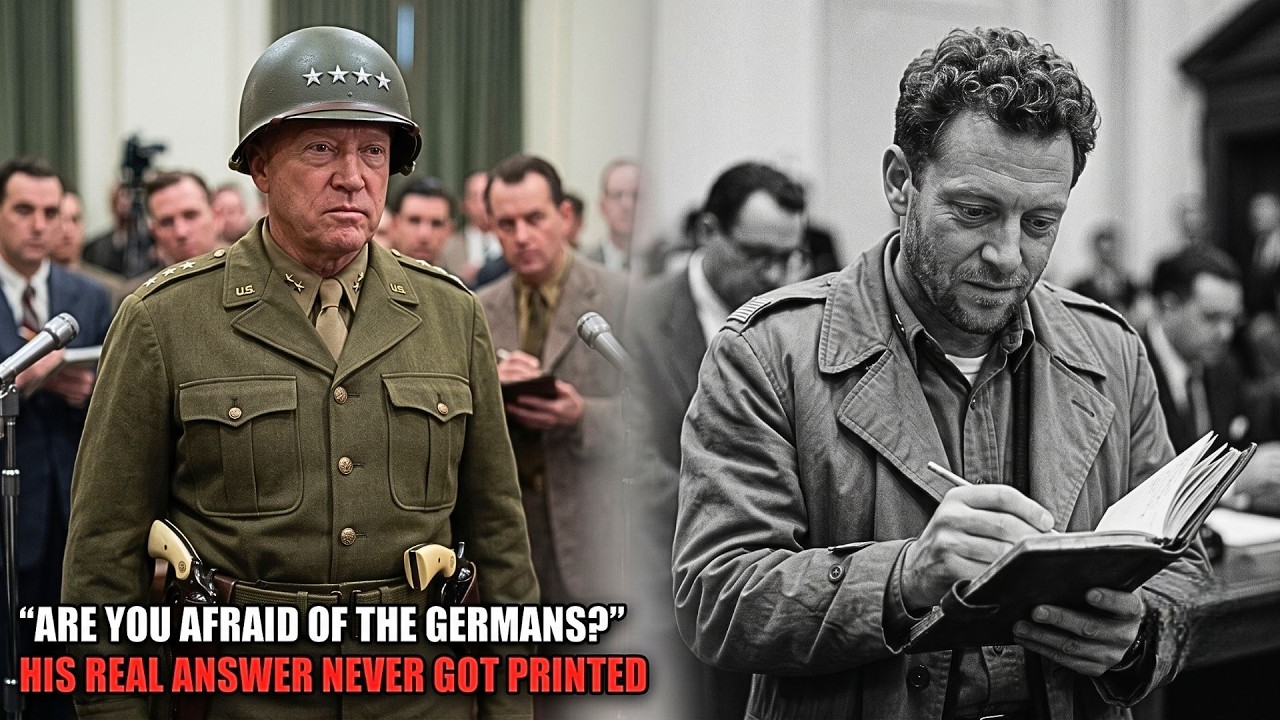
In November 1944, in France, a press briefing at Third Army headquarters had been underway for about 40 minutes when a reporter for one of America’s major newspapers raised his hand. The briefing had covered the usual ground: rates of advance, supply conditions, weather, and the general shape of the campaign that week. The correspondents in the room were experienced war reporters, men who had covered the European front for months and understood both the limits of what they would be told and the value of asking the right question at the right moment.
The reporter who spoke was not trying to embarrass Patton. He had been covering the army since the North African campaign and knew Patton well enough to understand that this particular question might produce something worth publishing. He got permission to speak and asked directly: Had General Patton ever been afraid of the Germans?
The other reporters in the room stopped writing. Patton looked at the man for a moment. He had been asked variations of this question before and had given different answers depending on his mood and his audience.
But this version, asked in front of 20 correspondents in a room where everything he said would be transmitted to millions of readers, was a special kind of question requiring a special kind of answer. And he gave one.
“No, but they are afraid of me, and that is what matters,” he said.
The reporter who asked the question was Thomas Kiernan. He had been covering the U. S.
Army in Europe since the North African campaign in 1943, which meant he had attended enough of Patton’s public appearances to understand the style Patton used when performing for an audience. Kiernan first met Patton in Tunisia, followed him through Sicily, and had been assigned to cover Third Army since its activation in France after the Normandy breakout. By November 1944, he had attended more of Patton’s press briefings than any other correspondent covering the European front.
During that time, he had developed a fairly precise ability to distinguish between the Patton who was delivering publishable material for history and the Patton who was doing something else for the moment.
Kiernan’s question was not entirely spontaneous. He had been thinking about it for weeks, considering different ways to phrase it, and had concluded that the most direct version was also the most useful because it was the least likely to produce a prepared answer. He was right in one respect.
The first part of what Patton said was polished enough that it had been said before, or something very close to it. But he was wrong in another respect he had not anticipated.
Patton paused and then added something that was not included in most of the published accounts that followed, because many of the reporters in the room chose not to include it. They found the first part sufficient, and the second part more complicated to publish.
“I have been afraid before,” Patton said. “Any soldier who tells you he has never been afraid is either a liar or has never been to a place worth being afraid of. The question is not whether you are afraid.
The question is what you do about it. I have found that advancing forward very quickly tends to solve the problem for me and for the Germans alike.”
The reporter who had asked the question wrote down both parts in his notebook while Patton spoke. He sent both parts to his editor in New York the same day in a telegram written to include the full exchange with enough context for the reader to understand why the second part mattered as much as the first. The editor published the first part and deleted the second.
Not because it was inaccurate or unpublishable, but because the first part was the story, the headline, the thing that would sell copies. The second part was the kind of qualification that made headlines harder to write and stories harder to sell.
The version that appeared in newspapers the next day — “No, but they are afraid of me, and that is what matters” — became one of the most frequently repeated Patton quotes to emerge from the European campaign. It was exactly the kind of thing people expected from Patton, which partly explained why it spread so quickly and partly explained why the second part was cut in the first place. An answer that fit the established image of a man was easier to publish than an answer that complicated it.
The second part was less repeatable, not because it was less interesting, but because it required context.
“Any soldier who tells you he has never been afraid is either a liar or has never been to a place worth being afraid of” was a sentence more useful for understanding Patton than anything he said before or after it in that briefing. And that was the sentence that disappeared from the record before most people had a chance to read it.
Kiernan wrote in his memoir that he returned to his notes from that briefing many times in the years that followed and remained convinced that the second part of the answer was not an addition to the first but a correction of it. The remark about the Germans being afraid of him was performance. The honest explanation that followed was the truth.
Presenting one without the other produced a version of the man that was accurate in its details and misleading in its overall effect.
Kiernan published his account of the exchange in a memoir released in 1962, 17 years after the war. He wrote that he was angry at the time about the editor’s decision, not because the deleted sentence was more dramatic, but because it was more honest. He felt that cutting it had transformed a complex answer into a simple one, and a complex man into a simpler version of himself that was easier to print but less accurate in reality.
During his years covering Patton, Kiernan came to believe that the first part of the answer — the bravado, the denial, the sharp quotable line — was what Patton gave to rooms full of people and to the public he knew he was performing for. The second part was what Patton said when he briefly forgot he was still performing, or when he decided that the person asking deserved a real answer and trusted him enough to give one.
Kiernan was not entirely sure which of the two it was. He asked Patton about it directly in a private conversation a few months after the press briefing. Patton looked at him and said he did not remember saying it.
Kiernan took that not as a denial but as a description of the state he had been in when he said it.
Patton was afraid of exactly one thing throughout the war. According to the people who served closely enough with him to observe it over a long period, it was not the Germans. Not in the sense the question referred to.
Not in the sense of physical danger or professional challenge. What he feared, in a specific and consistent way that those close to him recognized, was being removed from the battle. He feared the administrative and political processes that had taken him away from command once before during the slapping incident in Sicily in 1943, and he knew they could do it again if he gave them enough reason.
He feared the mechanisms by which men who had fought wars were sometimes removed by men who had not. He carried this fear with a specific awareness that it could become self-fulfilling if he allowed it to change his behavior in ways that attracted the wrong kind of attention.
This fear was not something he discussed publicly. It appeared occasionally in private letters, in comments directed at trusted aides, and in rare spontaneous moments during conversations that were later recorded by the people present. It was the kind of fear he classified differently from the physical fear he described to the journalists at the briefing — the kind that holds your feet in place while something terrible approaches, rather than the kind that runs through your body while you move forward.
Kiernan wrote that during his years covering Patton, he became convinced that the first part of the answer — the bravado, the denial, the sharp quotable line — was what Patton gave to rooms full of people and to the public he knew he was performing for at every moment they saw him. The second part, the honest description of what fear was and what a soldier does with it, was what Patton said when he briefly forgot he was still performing, or when he decided that the person asking deserved a real answer and trusted him enough to try giving one.
Kiernan asked Patton about it directly in a private conversation months after the briefing, explaining specifically what he meant and asking whether Patton remembered saying it. Patton looked at him for a long moment and said he did not remember saying it. Kiernan took that not as a denial but as a description of the mental state he had been in when he said it — the state in which the manufactured answer and the genuine answer were close enough that the boundary between them was briefly permeable.
Kiernan’s 1962 memoir, which included his account of the briefing and the later private conversation, sold modestly and did not significantly change the established record of Patton quotes left by the war. The first part of the answer, printed in November 1944, remained the most circulated version, available in military quotation collections and in accounts of Patton’s public persona. The second part, which Kiernan had written down, submitted, and watched his editor delete, remained in Kiernan’s notes and in the memoir that relatively few people read.
The version of Patton the public knew was built from the parts that were printed and published. The version of Patton the people around him knew was built from everything else.
The other journalists in the briefing room that day made the same calculations as Kiernan’s editor, and most of them made them independently. Of the 20 correspondents present, four included some version of the second part of Patton’s answer in their reports. The editors of three of those four deleted that part before publication.
The fourth, a correspondent for a smaller regional paper whose editor was less concerned about military quotes making headlines, combined both parts into an article that appeared two days after the briefing and received little circulation. The full exchange existed in the published record. Technically, if you knew where to look.
But most people did not know where to look because most people did not need to. The first part of the answer was enough for what most people wanted from the story: confirmation that Patton was what they already believed he was.
The war produced this effect consistently. The public persona that emerged from press coverage and from the accounts that were printed and broadcast gradually became less complex and more useful as a symbol, and less accurate as a description of the real person who said specific things in specific rooms. Patton understood this process and had complex feelings about it.
He deliberately crafted his public version of himself with great skill, and he resented when that public version was the only version available, which was almost always the case.
Kiernan’s memoir noted in its final reference to the briefing that the last time he saw Patton before his death in December 1945 was at a different press briefing a few months after the November 1944 exchange. He did not ask about fear at that briefing. He asked something about operations and received an operational answer, wrote it down, sent it, and saw it printed.
He wrote that he considered asking the fear question again in a different form but decided not to, on the grounds that the first time had produced the most honest answer he was likely to get, and that asking again would only produce a more prepared version of the same exchange.