In December 1950, a president of the United States threatened to punch a music critic in the nose for insulting his daughter’s singing. America loved it. What that story often leaves out is that the review was accurate, and the outburst stripped away the one thing protecting her career: everyone’s politeness. The concert had taken place at Constitution Hall in Washington, D.
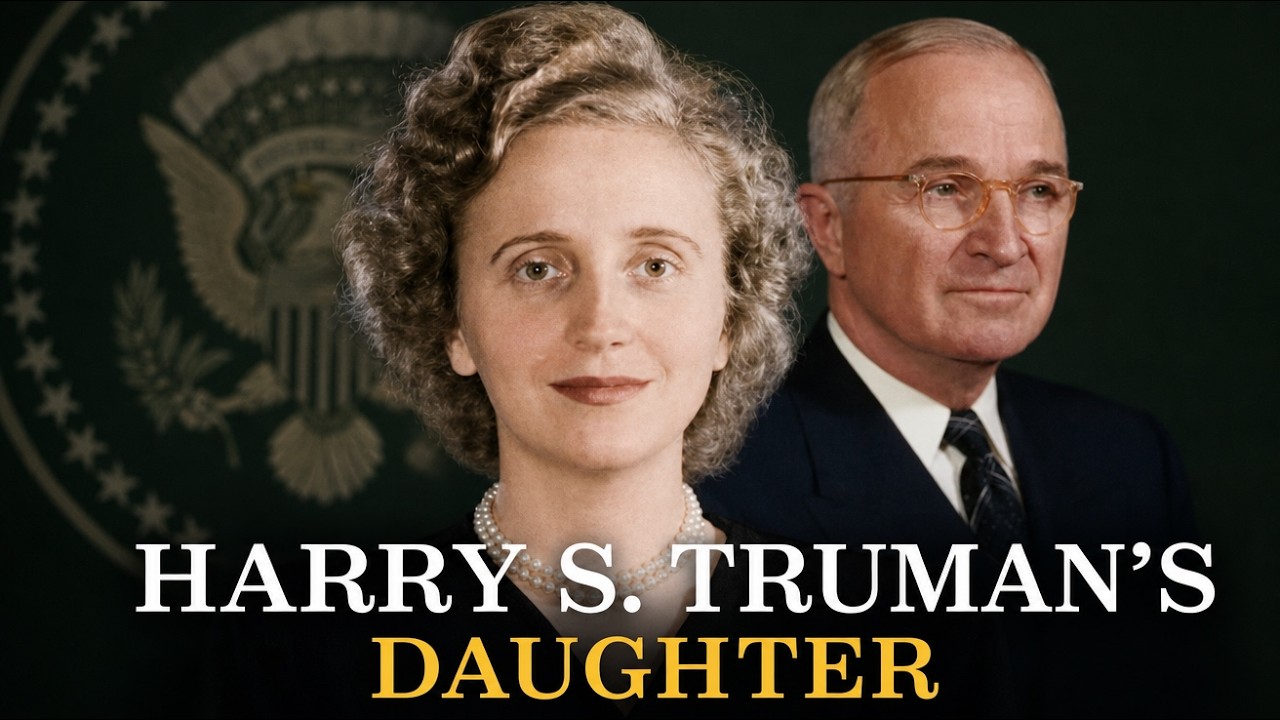
C. , before about 3,500 people. The guest list reflected the fact that her father ran the country. The British Prime Minister, Clement Attlee, was in the capital that week for emergency talks; Chinese troops had just poured into Korea, and the war was collapsing.
He came to hear a 26-year-old soprano sing. Margaret Truman’s mother and father sat in the audience. The applause was warm. Time described her as looking radiant on stage, the kind of sentence that suggests the reviewer wanted to talk about anything except the singing.
Earlier the same day, Charlie Ross had died. Ross was the White House press secretary, the boy Harry Truman had gone to school with in Independence, and Bess’s classmate. He was one of perhaps three people alive who had known the president before anyone had reason to flatter him. After finishing a briefing on the Attlee meetings, he sat back in his chair and was gone.
Truman tried to read a statement to reporters and could not get through it. He walked out of the room crying. Then he put on a dinner jacket and went to hear his daughter sing. The next morning, the Washington Post ran Paul Hume’s review.
Hume was 34, serious about music, and he had run out of ways to be kind. He wrote that Margaret Truman was a unique American phenomenon with a pleasant voice of little size and fair quality, and that she could not sing very well. She was flat a good deal of the time. Truman read it and wrote back the same day, on personal stationery with a 3-cent stamp.
No aide saw it, which was the entire problem, because his staff had spent years intercepting letters exactly like this one. He called Hume an eight-ulcer man on four-ulcer pay, a frustrated old man who wished he had been successful. Then came the line that outlived everyone involved: “Someday I hope to meet you. When that happens, you’ll need a new nose, a lot of beefsteak for black eyes, and perhaps a supporter below.
”
The Post’s publisher refused to print the letter, but Hume showed it around the office. The rival Washington Times-Herald published the story, and within days it was on front pages on both sides of the Atlantic. Margaret’s first public response was to suggest it could not be genuine. Then the White House confirmed it, and she retreated into no comment.
Before that letter, the reviews of Margaret Truman’s concerts had been polite. Not raves. Polite, careful. Several critics later admitted openly that the reason was deference to a sitting president.
She had built a national career on radio hookups and 20,000 people at the Hollywood Bowl, but it existed inside a bubble of professional courtesy that nobody wanted to puncture. Her father punctured it for her. After the letter, criticizing Margaret Truman was no longer rude. It was a small act of press freedom.
She kept performing for another five years, but the protection never came back. Hume behaved better than anyone else in the story. He said publicly that a man who had just lost a close friend and carried the burden of a world crisis ought to be allowed an occasional outburst of temper. Read the letter knowing that Charlie Ross had died that afternoon, and it stops being about a concert.
It is a grieving 66-year-old man swinging at whatever was closest. Margaret Truman was born on February 17, 1924, in a house that did not belong to her father. 219 North Delaware Street in Independence was the Gates house, her mother’s grandfather’s house. Harry Truman moved into his mother-in-law’s home after the war and stayed for decades.
Margaret grew up in a family where the past was not a story you told; it was a liability you managed. Her grandfather, David Willock Wallace, had taken his own life in 1903 when Bess was 18. The subject closed and did not open again for 80 years. When the Democrats put Harry Truman on the ticket in 1944, the fear inside the family was reporters finding a 1903 coroner’s file.
This particular family produced a professional performer. Margaret took a history degree at George Washington University in 1946, and by March 1947 she was making her debut with the Detroit Symphony on a national radio hookup. That August she sang at the Hollywood Bowl before roughly 20,000 people. Carnegie Hall came in 1949.
RCA Victor put out two albums. Time ran her on the cover in 1951. She knew she was an asset. She rode the whistle-stop train in 1948 for weeks and stood on the back platform.
Crowds who had no interest in the Marshall Plan came out to look at her. Decades later, in 1980, she put it plainly: she had lived several different lives, and one of them was over. Some of it was fun. Most of it was not.
After the letter, the polite reviews stopped, and she quietly did what people do when the door they were walking through closes. In February 1951 she signed with NBC and moved to radio and television, where charm counted more than high notes. She did comedy timing with Fred Allen and Goodman Ace. When her father left office in January 1953, she moved to New York alone at 28 and hosted a show called Weekday.
In May 1955, she sat in for Edward R. Murrow on Person to Person and interviewed her own parents on national television. Reporters had been asking her about marriage since she was 21. In 1955, at a New York dinner party, she was introduced to a 43-year-old bachelor newspaperman who had just returned from two years running the New York Times bureau in Moscow.
His name was Elbert Clifton Daniel, Jr. He had started at a small paper in North Carolina, moved to the Associated Press in 1937, then to the New York Times in 1944, with postings in Paris, the Middle East, Germany, and finally Moscow, which in that decade was the closest thing American journalism had to a combat posting. He was the enemy, professionally, categorically. She married him five months later.
The remarkable thing was the silence. They saw each other through the winter of 1955 and into 1956, and the New York gossip columns printed nothing. The romance did not become public until roughly a month before the wedding. Two people who worked in media kept it out of the papers until they were ready.
They were married on April 21, 1956, at Trinity Episcopal Church in Independence, Missouri, the same church where Harry and Bess had married 36 years earlier. She left Manhattan a month early and shut herself inside the house on North Delaware for a week. She wore a gown of antique Venetian lace and pale beige. Single ring ceremony.
No fleet of political guests. For the only child of a president, it was almost aggressively small. It was a privacy treaty, signed in a church. Four months before the wedding, Bess Truman had done something more direct.
Around Christmas of 1955, Harry came home and found her feeding bundles of paper into the fireplace. She was burning her own letters to him, roughly 1,300 of them, 35 years of a marriage gone in an evening. He told her to think of history. She said she had and kept going.
The scene that became famous was first published by Margaret herself, in her own book, Souvenir, in 1956, within months of the wedding and within months of the fire. The daughter chose to tell it. That same year, she stopped performing. Not a farewell tour, not an announcement.
She sang through 1956, and then she was a wife in New York. They took an apartment on Park Avenue and stayed for 41 years. Four sons arrived: Clifton Truman in 1957, William Wallace in 1959, Harrison Gates in 1963, and Thomas Washington in 1966. She had watched her mother incinerate the family correspondence and encoded the entire family into her children.
Her husband climbed, becoming managing editor of the New York Times in 1964. Her oldest son grew up not knowing his grandfather had been president. He found out at school from a classmate and came home to ask if it was true. She confirmed it and treated it as roughly as interesting as any other family fact.
In December 1972, her father died, and the terms changed. In 1973 she published a biography of him, drawing on the archive at her disposal. Three years later came Women of Courage. She took seats on the board of the Truman Scholarship Foundation and the Truman Library Institute and kept them for the next 30 years.
In 1980, at 56, she published a murder mystery: Murder in the White House. It sold. Then came more than twenty more, Murder on Capitol Hill, Murder in the Supreme Court, Murder in the Smithsonian, and so on, a best-selling franchise built on one asset: her name on the cover, over stories set inside the institutions her family had lived in. She was finally, unambiguously, a success at something.
The complication is that people in the mystery world doubted she was writing them. The bibliographer Allen Hubin listed Donald Bain as her ghostwriter. Bain was one of the most prolific ghostwriters in American publishing. In March 2014, in a column in Publishers Weekly, he stopped denying it, writing that he had done 27 novels in the Margaret Truman Capital Crimes series, describing her as his close collaborator.
When he died in 2017, his obituaries went further, saying he had written the 23 that followed the first. The name on those covers was doing work the hands behind it were not. Bess Truman died in 1982 at 97. In 1986, Margaret published a biography of her mother, drawing on roughly 1,500 letters, including her father’s side of the correspondence her mother had tried to erase.
In that book she told the family’s oldest secret: her grandfather’s suicide. Her mother had burned 1,300 letters so strangers could not read the family’s interior. Four years after her mother’s death, her daughter put the interior in a book and sold it. She never wrote a word about her own marriage for the public.
She wrote her father, she wrote her mother, and kept the Daniels. Her husband’s health failed in the late 1990s, and he died at the Park Avenue apartment on February 21, 2000. Six months later, her second son, William Wallace Daniel, a psychiatric social worker at Columbia, was crossing Park Avenue near his mother’s building and was struck by a taxi. He died on September 4, 2000.
She stayed on Park Avenue seven more years. In May 2007 she made plans to move to Chicago, but a hospitalization delayed it. She died in a care facility there on January 29, 2008, at 83, and was buried in the courtyard of her father’s presidential library. Her papers went to that library too: diaries, correspondence, financial records, manuscripts, scrapbooks.
Bess Truman, it turns out, was a careless burner. Archivists found roughly 180 of her letters she had missed, tucked into books and drawers. In 2011, her grandson Clifton Truman Daniel published them, and the stern first lady of American memory turned out to have been funny, gossipy, and sharp. Now go back to the letter.
Of everything in this story, that page is the only document the Trumans never controlled, because Harry mailed it. Hume sold it in 1951 for $3,500. It passed through private hands, hung for years in the Forbes family’s galleries in New York, and went up at Christie’s in March 2002. The Truman Library does not have it.
It was never theirs to keep. The marriage that shaped Margaret Truman was the one she was born into: a family and a public image bound together, performing devotion while conducting a private war over what could be said out loud. Her mother’s answer to history was a fireplace. Her father’s was a letter he could not take back.
Margaret’s was longer, colder, and far more effective. She outlived both of them, and then she wrote the book.