In the winter of 1937, while Joseph Stalin’s secret police were emptying apartment blocks across Moscow, an American heiress sat down to dinner inside the Kremlin. She was the richest woman in the United States, a woman who had inherited a cereal company at twenty-seven, turned it into General Foods, built a 115-room palace in Florida, and married the ambassador whose posting had brought her here. Her name was Marjorie Merriweather Post. For the next four decades, presidents, senators, and kings would not summon her.
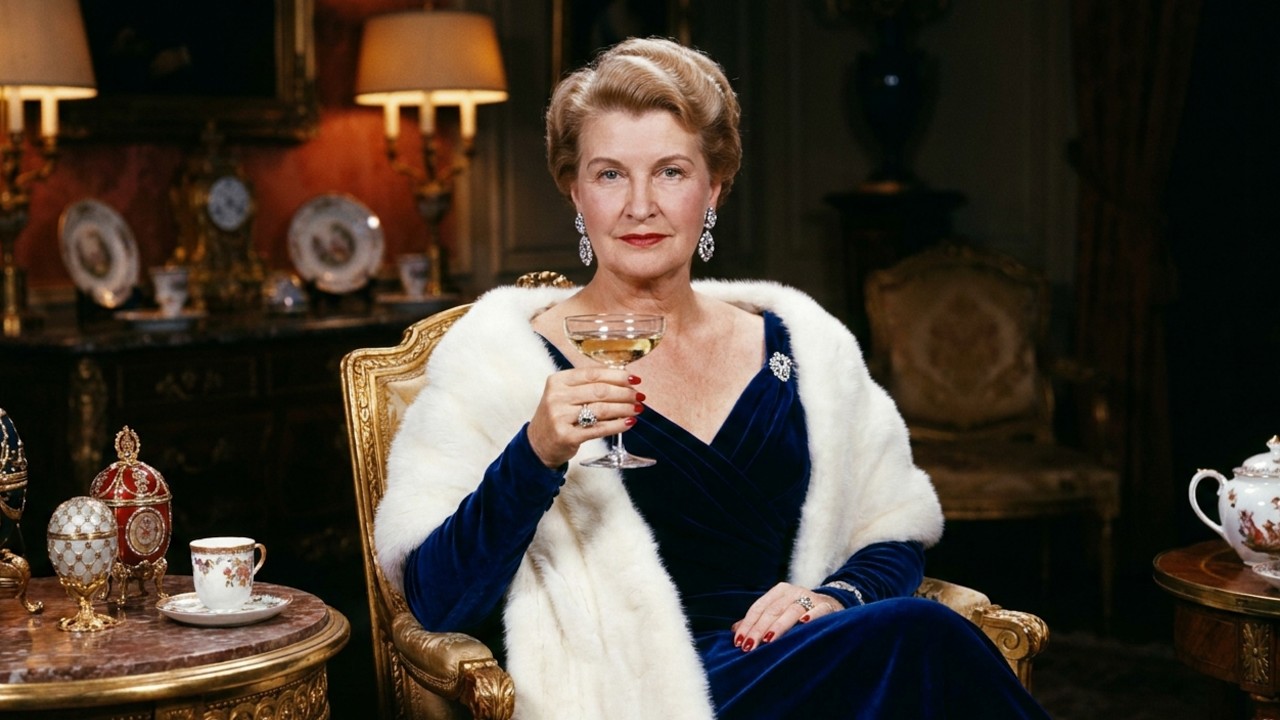
They would come to her. Most heirs were raised to inherit. Post was raised on a factory floor in Battle Creek, Michigan, learning to read ledgers. Her father, Charles William Post, had arrived in that town as a broken man, a former farm equipment salesman whose health had collapsed.
He checked into the famous Battle Creek Sanitarium run by Dr. John Harvey Kellogg, hoping for a cure, and left without one. But he left with an idea: if Americans were this anxious about their health, someone could sell them health in a box. In 1895 he launched Postum, a roasted grain drink marketed as a healthy substitute for coffee.
Two years later came Grape-Nuts, a hard-baked cereal promoted with some of the most aggressive advertising the country had ever seen. The gamble worked beyond all reason. By the early 1900s, the man who had arrived at the sanitarium nearly penniless was earning roughly a million dollars a year. He then made a decision almost no rich man of his era made.
He would train his daughter to run it all. Marjorie was born in Springfield, Illinois on March 15, 1887, his only surviving child. He took her through the factories, taught her how the books worked, how advertising worked, how a deal was structured, and had her sit quietly in the room while business was discussed. She later said her father raised her as the son he never had.
It was not sentiment. It was succession planning, in an era when women could not vote and most boardrooms had never seated one. But C. W.
Post was a tormented man as well as a brilliant one, suffering from chronic illness and crushing depression. On May 9, 1914, at the age of fifty-nine, he took his own life. The empire he built did not pass to a board of trustees or a syndicate of bankers. It passed whole and outright to a twenty-seven-year-old woman, and the men who ran the Postum Cereal Company were about to discover exactly what her father had spent two decades preparing her to do.
She owned the company outright, and the men who ran it would not let her sit at her own table. That was the brutal arithmetic of 1914. Post inherited the Postum Cereal Company and a fortune estimated at twenty million dollars, making her one of the wealthiest women in America almost overnight. Her father had left it to her directly, not locked in a trust managed by men, which set her apart from nearly every heiress of her generation.
Yet ownership and power were not the same thing. American corporate culture simply did not seat women directors. The controlling shareholder of the company was barred by convention from the boardroom her own money paid for. So she governed around the wall.
Her first husband, Edward Bennett Close, a quiet New York lawyer she had married in 1905, became her representative in the company’s affairs. Family and company accounts describe her in those early years listening to board discussions from behind a screen or a door, then directing strategy afterward. The directors spoke. She decided.
It was an absurd arrangement, and she made it work for years while raising two daughters and running an industrial inheritance through an intermediary. She also understood that standing was a currency. When the United States entered the First World War, she funded and equipped a Red Cross base hospital in France at a documented cost of about seventy-five thousand dollars, reportedly selling jewelry to help finance it. The gift was genuine patriotism.
It was also a public demonstration that the Post fortune now had a face, and the face was hers. By 1919 she had reached a conclusion that would define her life. The fortune did not need a guardian. It needed a general.
And Edward Close, gentle, decent, and unambitious, was not that man. In 1919 she divorced him. In 1920 she married Edward Francis Hutton, the charismatic stockbroker who had co-founded the E. F.
Hutton brokerage firm and whose appetite for risk matched her ambition. The press covered it as a society romance. It is more accurately understood as a recruitment. She had identified the executive her company needed, and she married him.
She installed Hutton as chairman of the Postum Cereal Company, and together they rebuilt it into a machine for acquisition. In 1922 the company went public, giving it the capital of the booming stock market to spend, and spend it did. Through the middle of the 1920s, Postum bought its way across the American pantry: Jell-O, Baker’s chocolate, Maxwell House coffee, Log Cabin syrup, Hellmann’s mayonnaise. More than a dozen brands came under the company’s roof in a single decade, assembling piece by piece the first great diversified food corporation in the country.
To the public, this was Hutton’s genius. He was the chairman, the famous financier, the man quoted in the papers. But the controlling stock belonged to his wife, and the strategic partnership between them ran deeper than the public ever saw. The most important business decision in American food history began with a goose served frozen on a yacht.
Sometime in the middle of the 1920s, while sailing, Post was served a goose that had been frozen months earlier. It should have been ruined. Conventional freezing in that era turned food into mush, rupturing it slowly with large ice crystals. This goose tasted fresh.
She demanded to know where it had come from, and the answer led to a man named Clarence Birdseye. Birdseye was an inventor working out of Gloucester, Massachusetts, and his insight had come from the edge of the world. Working in Labrador, he had watched fish pulled through the ice freeze almost instantly in the Arctic air, and he had noticed that those fish, thawed weeks later, tasted as if they had just been caught. Speed was the secret.
Flash freezing locked food in time. Post understood immediately what she was looking at, not a novelty but a revolution in the American kitchen. Frozen food meant vegetables in winter, fish a thousand miles from the sea, meals stored instead of spoiled. She went to her husband, the chairman, and told him the company had to buy Birdseye’s operation.
The men of the board said no. The price was too high. The technology was unproven. Grocers had no freezer cases and housewives had no home freezers.
Hutton himself resisted. The argument lasted years, and she refused to drop it, returning to the question again and again with the patience of someone who had been taught deals by C. W. Post himself.
In 1929 she won. The Postum Company bought the Birdseye operations for approximately twenty-two million dollars, one of the largest sums ever paid for a food enterprise to that point, and renamed itself the General Foods Corporation. Business historians now treat the purchase as one of the most far-sighted consumer acquisitions of the twentieth century. Frozen food did exactly what she predicted.
It remade the way America eats and carried General Foods to the front rank of the world’s food companies. While General Foods rose, she was pouring seven million dollars into the most spectacular private house America had ever seen. She called it Mar-a-Lago, sea to lake, because its seventeen acres of Palm Beach land ran from the Atlantic Ocean clear across the island to the shore of Lake Worth. Construction began in 1924 and consumed three years.
The result was a 115-room palace of stone and gold leaf crowned with a seventy-five-foot tower finished with 36,000 antique Spanish tiles she had imported by the shipload. Fifty-eight bedrooms, thirty-three bathrooms, hundreds of workers on the site for three years, a documented cost of approximately seven million dollars in 1920s money. And Mar-a-Lago was only one address in her portfolio of power. In 1931 she launched the Sea Cloud, a four-masted bark roughly 316 feet long, the largest privately owned sailing yacht in the world, crewed by about seventy sailors.
These houses were instruments. Mar-a-Lago made her the sovereign of the Palm Beach winter season, and an invitation to her table became a ranking system for American society. She spoke of the estate as something more than a house, a place grand enough one day to host the presidency itself. People smiled at the idea.
Decades later, by the strangest route imaginable, it would come true. Before that, the world she had built was about to crack. The chairman she had married, the public face of her empire, was keeping secrets. Edward Hutton’s infidelities had accumulated through the marriage, and documented accounts describe Post assembling proof of them before she acted.
In 1935 she divorced him. The newspapers feasted on it, and the humiliation was real and public. But the outcome mattered more than the scandal. He kept his reputation.
She kept the company. And then she did something that mattered more than any marriage. In 1936, twenty-two years after inheriting the controlling interest in her own corporation, Marjorie Merriweather Post took a seat on the board of General Foods in her own name. No husband as proxy, no screen to listen from behind.
One of the first women ever to serve as a director of a major American corporation, she would hold that seat for twenty-two years. She was forty-eight years old, twice divorced, and in command of one of the great fortunes of the world. She made her next strategic marriage, and this one was aimed not at Wall Street but at Washington. Joseph Edward Davies was a Wisconsin lawyer, a former chairman of the Federal Trade Commission, and one of the Democratic Party’s significant insiders, close to President Franklin Roosevelt himself.
They married in 1935. In 1936, the president appointed Davies United States ambassador to the Soviet Union. The posting was Moscow, the capital of Stalin’s revolution, at the very moment the regime was beginning to devour its own people in the purges. Most American millionaires would have regarded it as a sentence of exile.
Post packed her household, her staff, and crates of General Foods frozen food, and prepared to take her empire into the heart of the most dangerous country on Earth. She arrived in 1937 with frozen vegetables, cases of cream, and footmen into a city living through the purges. Behind the walls of Spaso House, the American ambassador’s residence, she recreated a slice of American abundance. Beyond the walls, the Soviet Union was passing through the most terrifying chapter of its history.
The secret police arrested by night. Apartment doors were sealed, neighbors vanished, and the show trials filled the courtrooms with confessions extracted in advance. Her husband watched those trials from the diplomatic gallery and believed them. Davies took a notoriously credulous view of the Stalin regime, reporting the staged confessions to Washington as if they were legitimate justice.
He would later publish Mission to Moscow in 1941, so friendly to the Soviet government that Hollywood turned it into a wartime film. History has judged his diplomacy harshly, and the judgment is deserved. Post’s position was stranger and more complicated. She was not the diplomat.
She was the hostess of American power in a terrorized city. The embassy entertained the Soviet elite. The couple attended official banquets among the highest leadership of the regime, dining in the Kremlin’s halls while the purges emptied the city around them. And while the diplomats talked, she noticed something in the state commission shops of Moscow.
The Soviet government, desperate for hard currency, was selling the past. Confiscated treasures of the Russian Empire, the porcelain and silver and jeweled objects of the murdered Romanov world, were sitting on shelves with prices attached. Almost no one in the West understood what was available. Marjorie Merriweather Post understood.
She had spent her whole life recognizing undervalued assets before other people did. She had done it with frozen food. Now she would do it with the treasure of an empire. Through the commission shops and state sales of Moscow and Leningrad, she acquired imperial porcelain, icons, silver chalices, jeweled objects, and works by the House of Fabergé.
Piece by piece, she assembled what would become the most important collection of Russian imperial art outside Russia itself, including two imperial Fabergé eggs. Understand how strange this moment was. The objects existed because an empire had fallen. They were for sale because the government that destroyed that empire needed foreign money for factories and weapons.
The churches had been stripped, the palaces emptied, the families that owned these things shot or scattered. A chalice that had stood on an altar for two centuries could be bought for the price of a good coat. She bought beauty at desperation prices in a starving, terrorized country while her husband publicly vouched for the regime that was doing the terrorizing. How much she understood of the purges around her is a question historians still argue.
The fact of the bargains is not in dispute. But she was not decorating. She was preserving. From early on, she treated the collection as a responsibility, something to be cataloged, studied, and ultimately given to the public.
The Soviet state sold its history for tractors. She made sure that history survived. When the Davies posting ended, she came home with crates of an empire’s memory. The marriage that had carried her to Moscow curdled into twenty years of vanity, strain, and a slow, expensive ending.
Davies returned from his embassy a famous man, the author of Mission to Moscow, a confidant of presidents. Accounts of the marriage describe his swelling vanity and her growing disillusionment, two strong-willed people discovering that a partnership built for a mission did not survive the mission’s end. Then the war came, and Post did what she had done in the First World War. She gave her beloved Sea Cloud, the largest private sailing yacht in the world, to the United States government, chartered to the Navy and Coast Guard for exactly one dollar a year.
The pleasure craft of the richest woman in America spent the war as a weather patrol vessel in the Atlantic, her masts stripped, her hull painted gray. It was a gesture worth millions, rendered for a dollar. In 1955, after two decades, she ended the Davies marriage. She was sixty-eight years old.
Three marriages had risen and fallen, each one strategic, each one productive, each one finally outgrown. A sixty-eight-year-old divorcee in 1955 was supposed to subside into quiet grandmotherhood. Instead, in that same year, she bought a twenty-five-acre estate in northwest Washington, D. C.
, and began rebuilding it from the ground up with climate-controlled display rooms and interiors designed around her French and Russian collections. She named it Hillwood. She told people plainly what it was for. It would be her home for now.
After her death, it would become a museum for the nation. From 1957, the most powerful room in Washington was not in the White House. It was her dining room. At Hillwood, Post perfected the form of power she had been rehearsing her whole life.
The dinners were served by footmen on porcelain that had belonged to Russian emperors. The guest lists read like a directory of the American government: Supreme Court justices beside senators of both parties, cabinet secretaries beside ambassadors, generals, first ladies, and foreign royalty. She did not lobby. She convened.
Alongside the imperial formality, she threw famous square dancing evenings that became a Washington institution, cabinet members and justices promenading in her pavilion. She was a major benefactor of the American Red Cross, a principal supporter of the National Symphony Orchestra, a significant donor to the Kennedy Center, and a substantial contributor to C. W. Post College on Long Island, founded in 1954 and named for her father.
Presidents came and went, from Eisenhower to Kennedy to Johnson to Nixon, and the woman at Hillwood remained. She spent her final decades doing what she had always done with money: deploying it. During the Depression she had funded a Salvation Army canteen in New York City that fed thousands of unemployed people year after year. Now, in her last act, she organized the largest deployment of all, the disposition of everything she owned.
There was one more brief marriage, to the Pittsburgh businessman Herbert May in 1958, ended by divorce in 1964. And then she did something quietly radical for a woman of her generation. She resumed her own name legally and permanently. Not Mrs.
Close, not Mrs. Hutton, not Mrs. Davies, not Mrs. May.
Marjorie Merriweather Post. After fifty-nine years of carrying husbands’ names, the empire would end under the name it had started with. Hillwood was cataloged by curators she hired in her own lifetime, every imperial cup and Fabergé egg documented, the estate destined for the public with a ten-million-dollar endowment to sustain it. Mar-a-Lago she willed to the federal government itself as a winter retreat for presidents and visiting dignitaries, the destiny she had imagined for it since the 1920s.
On September 12, 1973, at Hillwood, Marjorie Merriweather Post died at the age of eighty-six, with an estate estimated at between two hundred million and two hundred fifty million dollars. Her houses kept hosting power without her, not always the way she planned. The federal government accepted Mar-a-Lago, then flinched at the roughly one million dollars a year it cost to maintain and handed it back to her foundation in 1981. In 1985 it sold for a reported ten million dollars, furnishings included, to a New York developer named Donald Trump.
It became a private club, and then in 2016 its owner was elected president of the United States. Mar-a-Lago began hosting heads of state as a working presidential retreat, the destiny she had written for the house in the 1920s coming true by the strangest route American history could devise. Hillwood had its own test. The Smithsonian accepted the estate, then concluded the ten-million-dollar endowment was not enough and returned it.
Her foundation took over, and Hillwood Estate, Museum, and Gardens opened permanently to the public in 1977. It operates today, holding the most comprehensive collection of Russian imperial art outside Russia, the treasures she carried out of Stalin’s Moscow, now belonging to anyone with the price of admission. For most of a century, the official story credited her husbands. The newer histories and business scholarship have restored the through-line.
One continuous intelligence runs from the factory floor in Battle Creek to the creation of General Foods to the museum on a Washington hill. Hers. When the boardroom was closed to her, power looked like a marriage. When office was closed to her, power looked like a dinner party.
When history was closed to her, power looked like a museum. She was locked out of her own boardroom, so she governed it through the men it would accept until the day she walked in and took the seat herself. She inherited a cereal company. She left behind an empire, a museum, and a palace that hosts presidents.
The men of her era thought she was throwing parties. She was holding court.