On April 12, 1865, four days after surrendering the Army of Northern Virginia at Appomattox, Robert E. Lee began the long ride home to Richmond. Accompanied by a small escort, the defeated general traveled over one hundred miles to reunite with his family as a paroled prisoner of war. Although he had not been present at the formal ceremony of laying down arms, Lee remained with his men until the end.
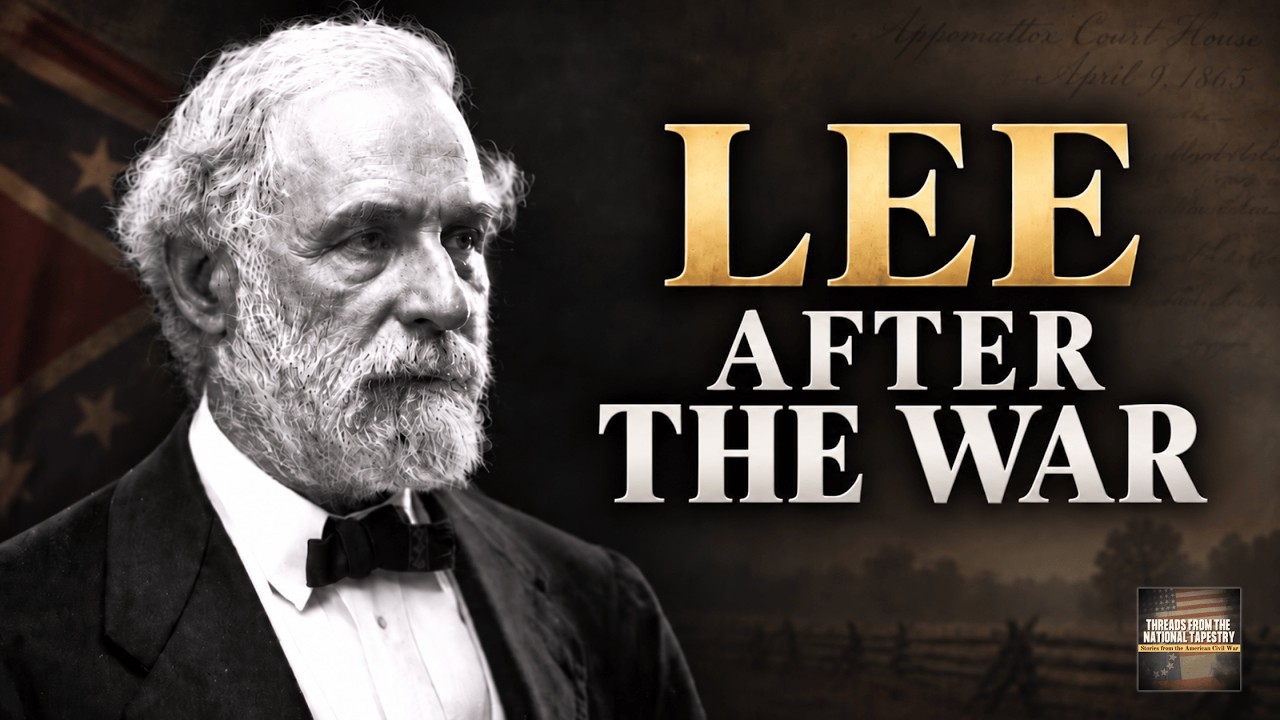
Now, with the war over, the man who had never sought fame and never wanted controversy faced the final chapter of his life, years that would transform him from Confederate commander to college president and, in the eyes of many, cast a long shadow over his legacy. The surrender document, known simply as General Orders Number Nine, had been written by Lieutenant Colonel Charles Marshall, but the sentiments were all Lee’s own. It told his survivors that after four years of arduous service marked by unsurpassed courage and fortitude, the army had been compelled to yield to overwhelming numbers and resources. He explained that he had consented to this result not from any distrust of his men, but because he felt that valor and devotion could accomplish nothing that would compensate for the loss that would have attended a continuance of the contest.
He urged his soldiers to return to their homes and remain there until exchanged, carrying with them the satisfaction that proceeds from the consciousness of duty faithfully performed. Eight days after returning to Richmond, Lee wrote to the exiled Confederate president Jefferson Davis, who had asked whether the fight should continue. Lee advised against it. Guerrilla warfare might persist, he acknowledged, but he saw no hope of achieving separate independence through such means.
To save useless bloodshed, he recommended measures to stop hostilities and restore peace. While Lee accepted the verdict of arms, Davis never did. Lee entered the devastated capital from the south amid heavy April rains. His route took him through the section of the city that had been almost entirely consumed by fire during the evacuation on April 2.
People saw him, stopped, stared, or pointed as he made his way along Main Street. He acknowledged them by raising his hat. Finally, he turned and stopped before a three-story red brick house at 707 East Franklin. There he dismounted from his beloved horse Traveller, handed the reins to another, opened the iron gate, walked up the eight steps to the porch, turned, removed his mud-stained hat, bowed to the crowd that had gathered, opened the door, and disappeared inside.
Within, he was greeted by his ailing fifty-six-year-old wife, Mary Anna Randolph Custis Lee, the great-granddaughter of Martha Washington, along with several of their children. His youngest son, twenty-one-year-old Robert E. Lee Jr. , was not there, having accompanied the fleeing Jefferson Davis, but he arrived two weeks later.
Initially, Lee slept a great deal and rarely left the house. Two days after his arrival, the photographer Mathew Brady called and asked him to sit for a portrait. Lee refused, saying it was entirely impossible while the eyes of the world were upon him as they were that day. Brady retreated tactically but enlisted a mutual friend of the family, Judge Robert Ould, who successfully interceded with Mrs.
Lee. The reluctant Lee eventually posed on the back porch of the house, surrounded by his son Custis and his aide, Lieutenant Colonel Walter Taylor. Visitors came constantly, so many that family members took turns guarding the door to screen those who called. To avoid the crowds, Lee took his walks late at night, often accompanied by his daughter Mildred.
Although the owner of the house, John Stewart, told him he could stay as long as he wished without rent, Lee said he wanted a quiet little home in the woods where he could find shelter and his daily bread, if the victors permitted. He added that he wished to get Mrs. Lee out of the city as soon as possible. That all stopped on Wednesday, June 7, when a federal grand jury in Norfolk, Virginia, indicted him for treason.
Six days later, he wrote to Lieutenant General Ulysses Grant, stating that he had believed the officers and men of the Army of Northern Virginia were protected by the terms of surrender from any disturbance by the United States government as long as they adhered to its conditions. In the same letter, Lee enclosed his request to President Andrew Johnson for pardon. Grant agreed with Lee’s interpretation and stood against the commander in chief, threatening to resign if Johnson forced him to break his word given at Appomattox. On Tuesday, June 20, Johnson yielded, and Grant wrote to reassure Lee that he would not be tried for treason.
Around that time, a letter to his brother Carter revealed something he had kept private, a glimpse of his racial beliefs. Lee offered an opinion on his brother’s use of free Black labor. He wrote that he had always observed that wherever the Black man was found, everything around him deteriorated, and wherever the white man was found, everything around him improved. The war had not changed Lee’s hierarchical assumptions about race.
But in public, his actions spoke quite differently from what he wrote. That same month, an event occurred at St. Paul’s Episcopal Church in Richmond. Once the rector, Dr.
Charles Minnegerode, invited the congregation to come forward for communion, a tall, elegant-looking Black man stood and approached the altar rail. A murmur circulated among the parishioners. Black participation usually took place after all whites had received communion. To break the frozen moment, a man rose from his seat on the left side of the aisle, walked forward, and knelt near the African American man.
It was Lee, and his action broke the ice. The rest of the congregation stepped forward. That same month, Lee finally left Richmond. Elizabeth Randolph Cocke offered the family a vacant house on her property, located roughly halfway between Richmond and Charlottesville.
On Wednesday, June 28, the family moved across the James River to a small landing near the village of Oakland. Lee spent the rest of the summer in a small two-over-two wooden house called Derwent, riding Traveller and beginning to think about writing an account of his campaigns with the Army of Northern Virginia. But a visit in August removed that possibility. Judge John W.
Brockenbrough, the newly elected president of a small school in Lexington, Virginia, came unannounced. Having borrowed fifty dollars for the journey and wearing a borrowed suit, he informed the former general that the Board of Trustees of the small Washington College had unanimously elected Lee as its new president on August 4. It was an ambitious move for the little school that had suffered greatly from the war. In fact, a Pennsylvania regiment was still using some of the college buildings.
Lee listened. For the presidency and teaching a class, he was offered use of a house and garden, a plot of land for vegetables, a share of tuition, and a salary of fifteen hundred dollars, money the college did not have but hoped to raise. It was not the only offer he received. The University of the South and the University of Virginia had made similar efforts.
For Lee, however, none of that was something he seriously considered. Still, he thought about the offer for two weeks and sought many opinions. The former Virginia governor John Letcher, born in Lexington, wrote that Lee could do much good in building up the institution and spreading the benefits of education among the sons of the people. Lee had doubts, particularly about teaching.
He disliked giving speeches, so he wrote to the trustees that perhaps he should decline because he did not feel able to undergo the burden of conducting classes in regular courses of instruction. He also feared bringing hostility upon the college. After writing that, he changed his mind and accepted the position. On August 31, the board saw no problems.
They would not ask him to teach classes and enthusiastically received him as their new president. And so Robert E. Lee, a soldier for nearly all his life, became an educator. Having accepted the position first offered to him while wearing a borrowed suit and traveling with borrowed money, he now began moving his family to a school he had never seen and a place he had never visited.
On September 15, he set out alone on Traveller. On the eighteenth, he arrived at the small mountain town of about two thousand people, named after a town in Massachusetts where another revolution had begun. Two days later, he met with the trustees and then withdrew to the Lexington Hotel, waiting for repairs to the president’s house and the arrival of his family. While college officials were attached to him, others were not.
Upon learning of Lee’s appointment, the New York Independent wrote harshly that as president he must attend to the morals of the young, and if he wished to establish their honesty, he could remind them of the oath he had taken to support and defend the government of the United States and how he had kept that oath for the past four years, calling him the bloodiest and most guilty traitor in the entire South. For the opening day of classes on October 2, the trustees envisioned a brass band, young girls in white, songs, and the like. Lee stopped that too. That day saw only a prayer and a brief welcome.
Lee took an oath, signed a copy of it, and the judge who had visited him earlier handed over the keys to the building on campus. Lee began his work. He had signed another document that day, applying for a special pardon from President Andrew Johnson himself. The former soldier now immersed himself in his duties as the new president of Washington College.
He had about fifty students and made an effort to learn their names and meet each one individually. Many were veterans of the Confederate army. One student remarked that he was impatient to make up for the time he had lost in the army. Lee interrupted him, his face red with anger.
He told the young man that no matter how long he lived or what he accomplished, he would find that the time spent in the Confederate army was the most useful part of his life, and he should never speak again of wasted time in the army. Lee’s schedule was strictly organized. Breakfast at seven in the morning. At seven forty-five, he was in the college hall used as a chapel.
At eight, he was in his office, where he worked until two in the afternoon, which was lunch. After a light supper at seven-thirty, he read newspapers or his small Bible. Friends were free to visit from eight-fifteen until ten in the evening, when the windows were closed and he went to sleep. As an administrator, he granted great freedom to his faculty.
He might appear in their classrooms in the middle of a lecture, stay for a while, then withdraw quietly. As president, he was responsible for discipline and was fair but firm. Once, he sent for a student from Kentucky whose behavior required attention. The student entered Lee’s office chewing tobacco.
Lee told him the habit was highly offensive and ordered him to go out, get rid of the plug, and never appear before him chewing tobacco again. The young man left but soon returned with the same plug still in his mouth. Lee gave him one look, then began writing. When finished, he asked the student to read what would be posted on the college bulletin board in ten minutes.
The notice read: The student named herein is dismissed from Washington College for disrespect to the president. Lee was rarely harsh, but once he made a decision, it was final. By the end of his first academic year, the faculty had expanded from four to fifteen, the college had received over one hundred thousand dollars in donations, and there were now ten departments. A new chapel was planned, and Lee’s salary was doubled.
The former soldier was doing well as a civilian. Politics, however, continued to intrude. When former Confederate leaders arrived in Washington expecting to take seats in Congress, the city erupted. Republicans began questioning the success of Andrew Johnson’s reconstruction plan, and a joint committee of fifteen members was formed.
Lee understood, more than most southerners, that the war was lost. What he did not fully grasp was that the Union of 1865 could not be the Union of 1861. The war had changed the face of the nation. Summoned to testify before the Joint Committee on Reconstruction, Lee arrived in Washington on Friday, February 16, 1866.
He was hesitant to visit old friends, writing that he was now considered such a monster that he hesitated to cast his shadow upon the doors of those he loved, lest he bring them misfortune. The next day, he took the oath, wearing his old gray uniform stripped of all Confederate insignia and buttons, because he owned no other suit. Before the committee, Lee was questioned closely. He testified that he did not believe the freedman was capable of acquiring knowledge like the white man, that they were a friendly and social race who loved ease and comfort and looked more to the present than the future.
He said he believed southerners would oppose a constitutional amendment allowing Black men to vote, and that such a change would excite unfriendly feelings between the races. When asked about southern loyalty, he insisted he had no reason to believe any alliance existed to resume the war. Asked whether a jury in his district would convict Jefferson Davis of treason, he said it was very possible they would not consider it treason. The committee was frustrated.
Lee’s themes of reconciliation and recovery remained steady. At times his own feelings appeared, but not enough to allow the committee to attack him. After two hours on the witness stand, he was excused and returned home content. In March 1867, Congress passed the Reconstruction Acts, and on March 13, Virginia ceased to be a state, assigned as Military District Number One.
In this explosive atmosphere, students at Washington College learned that white speakers from the North would give speeches to African Americans in Lexington. Five angry students decided to attend. One student from Alabama carried a pistol. As they approached, the Alabama student moved to peer through a window, and a Black man came out to intercept him.
Startled, the student drew his pistol until others intervened and pulled the two apart. Later, the students were arrested and jailed, except the one from Alabama. When word spread across campus, many resolved to rescue their comrades. Lee was at home, unaware of the disturbance, but another official intercepted the crowd and calmed the situation.
The four jailed students were released but charged with disturbing the peace. Lee wanted to see them. When they entered his office, the Alabama student was there too, having come voluntarily. He explained that he was the one to blame.
Lee agreed and immediately dismissed him. The other four were placed under observation. In March 1868, a grand fundraising event was planned in New York City, with five hundred prominent and potential donors invited. Everything seemed promising.
Then something happened. His past once again brought a new round of trouble, not only to him, but to the college he served. Lee’s final years were marked by continued devotion to his students and the institution he led, but the shadow of the war and his role in it never fully lifted.
The man who had once commanded an army now commanded a classroom, and the story of his last five and a half years became a testament to a life transformed, a fallen general who became a college president and left an enduring mark on American education.