Dina Merrill was born into one of the most powerful families in America, yet she spent her life trying to step out of its shadow. Her father, Edward Francis Hutton, founded the Wall Street firm EF Hutton. Her mother, Marjorie Merriweather Post, was heir to the Post cereal fortune and a socialite of unmatched influence.
Their winter home was Mar-a-Lago, the Palm Beach estate that would later become a presidential retreat.
Born Nadinia Marjorie Hutton on December 29, 1923, in New York City, Merrill grew up surrounded by palatial homes, art, and staff. But her parents divorced when she was 10, and that early experience shaped her self-reliance. She had two older half-sisters from her mother’s previous marriages, and she was a first cousin to Barbara Hutton, the heiress known as the “poor little rich girl.”
Her father wanted her to study law and perhaps run for Congress. Merrill had other plans. After a year at George Washington University, she dropped out and enrolled at the American Academy of Dramatic Arts in New York.
What made this remarkable was how she paid for it. Even though she was already a millionaire through her father’s investments, she modeled for Vogue magazine at $10 an hour to fund her acting lessons. She later said she would never ask her parents to finance something they did not believe in.
She adopted the stage name Dina Merrill, suggested by her brother-in-law, inspired by Wall Street colleague Charles E. Merrill. It was a deliberate break from the Hutton and Post legacy.
Her Broadway debut came in 1945 in John Van Druten’s “The Mermaid Singing,” where she had three lines. She returned to Broadway in 1975 in “Angel Street” and revived the musical “On Your Toes” in 1983. In 1991, she participated in an off-Broadway reading of “Wit and Wisdom.”
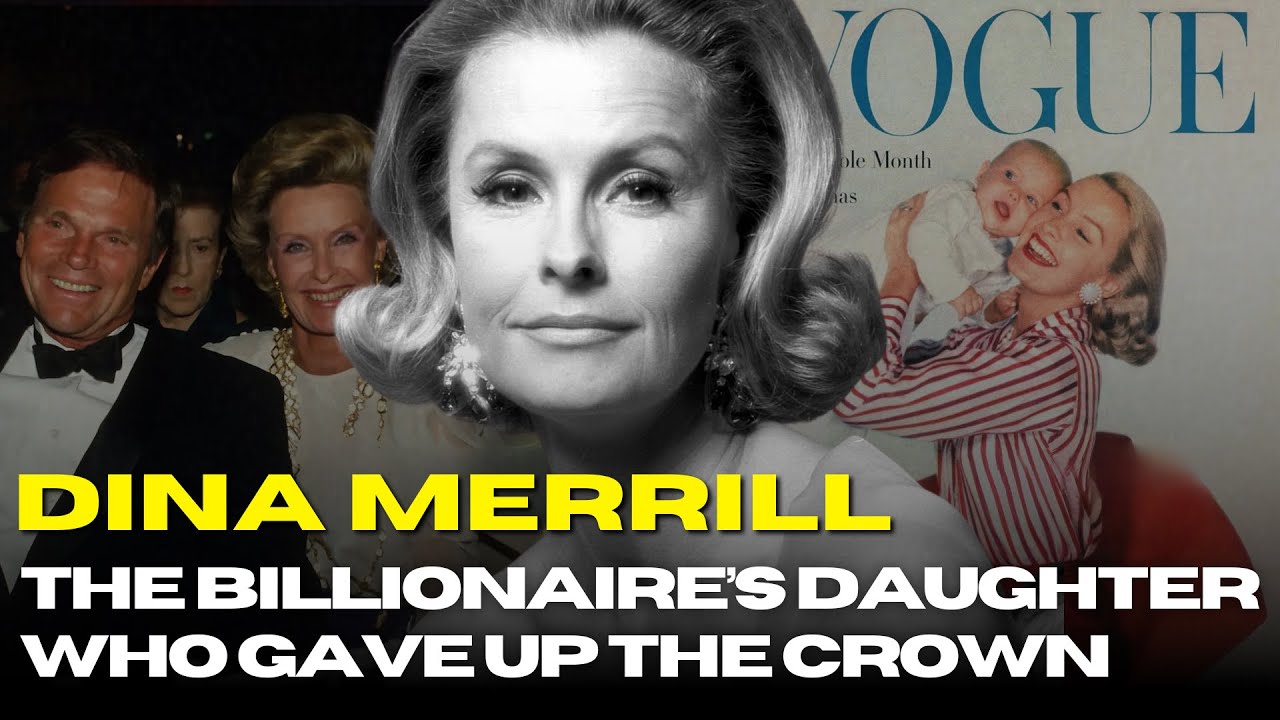
Her film debut came in 1957 with a supporting role in “Desk Set.” With her aristocratic bearing and refined accent, Hollywood cast her as the elegant socialite, the sophisticated wife. In 1959, publications called her “Hollywood’s new Grace Kelly.”
The comparison brought attention but also limited her range, as casting directors saw her as the unattainable upper-crust type.
Her filmography from that era is a classic Hollywood roster. She appeared in “Operation Petticoat” (1959) with Cary Grant, “Butterfield 8” (1960) with Elizabeth Taylor and Laurence Harvey, and “The Young Savages” (1961) opposite Burt Lancaster. Other films included “A Nice Little Bank That Should Be Robbed” (1958), “Don’t Give Up the Ship” (1959), “The Sundowners” (1960), and “The Courtship of Eddie’s Father” (1963).
Decades later, she appeared in “The Player” (1992) and “Shade” (2003).
As the 1960s progressed, film roles became harder to find. Merrill moved to television, where she became a familiar presence on shows like “Dr. Kildare,” “Alfred Hitchcock Presents,” “The Love Boat,” “Murder, She Wrote,” “Roseanne,” and “The Nanny.”
In 1968, she played the villainous Calamity Jan in two episodes of “Batman,” appearing alongside her then-husband Cliff Robertson. She also appeared on game shows like “Match Game,” “To Tell the Truth,” “What’s My Line,” and “Hollywood Squares.” In 1998, she hosted a PBS series called “Decor” about home furnishings.
Beyond acting, Merrill had a sharp business mind. For more than 18 years, she served on the boards of both EF Hutton and Lehman Brothers, a rare achievement for a woman in that era. She was not a figurehead; she was an active participant in the male-dominated world of finance.

Her most surprising venture came in 1989, when she and her third husband, Ted Hartley, acquired RKO Studios and renamed it RKO Pavilion. Merrill served as vice chairman and creative director. Together they established RKO Pictures, which acquired the intellectual property of the original RKO Radio Pictures.
She also served as executive producer for the 1996 film “Milk and Money.”
Her personal life was marked by both joy and profound loss. She married three times. Her first husband was Stanley M.
Rumbough Jr. , heir to the Colgate-Palmolive fortune, from 1946 to 1966. They had three children: Ned Colgate Rumbough, David Post Rumbough, and Stanley Rumbough III.
Her second marriage was to actor Cliff Robertson, from 1966 to 1986, and they had a daughter, Heather. Her third marriage, to Ted Hartley, began in 1989 and lasted until her death.
Two of her four children died before her. Her son David died in a boating accident in 1973, just weeks before his 24th birthday. Her daughter Heather died of ovarian cancer in 2007 at age 38.
These losses were private, not the stuff of tabloid headlines, but they shaped her deeply. A close friend once recalled a quiet moment at Merrill’s home in East Hampton, where she was looking through old family photo albums. When she came across a picture of Heather as a child, she whispered, “She should be here.

They both should be here.”
Her grief influenced her later philanthropy, especially her work with the New York City Mission Society, which aids disadvantaged communities. Her commitment was not a social obligation but a heartfelt response to life’s fragility.
Merrill’s wealth often overshadowed her work. At one point, she was widely described as the wealthiest actress in the world, with a reported net worth exceeding $5 billion, though such figures were difficult to verify given the private nature of family trusts. Some dismissed her career as a rich woman’s hobby.
But her decision to fund her own acting education showed she wanted to earn her way. She worked diligently rather than expecting opportunities to be handed to her.
Her politics were also nuanced. Despite her family’s background, she was a moderate Republican and served as vice chairman of the Republican Pro-Choice Coalition. She campaigned for women’s health issues, showing a willingness to challenge party lines and easy categorization.
In 1994, she received the Living Legacy Award from the Women’s International Center. In 2005, she received a lifetime achievement award from the American Academy of Dramatic Arts.
Merrill’s life bridged old-world aristocracy and new Hollywood celebrity. She moved easily between corporate boardrooms and television studios, embodying a kind of refined American woman that is rarely seen with such authenticity today. Her consistent portrayal of upper-crust characters cemented her place in cinematic history, and her television appearances made her a welcome presence in millions of homes.
Her story is not just one of wealth and glamour. It is a story about identity, resilience, and the quiet pursuit of purpose. She was born into extraordinary privilege but chose to forge her own path, funding her own education, building a career, and navigating business worlds that were not welcoming to women.
She endured private heartbreaks with grace and turned her pain into compassion for others.
Dina Merrill died in 2017 at age 93. She left behind a legacy not just of elegance and cinematic charm, but of a woman who quietly authored her own story. She proved that one could be both a product of one’s environment and a master of one’s own destiny.