On December 17, 1948, at 4:11 in the morning, a fire broke out at 341 Lennox Avenue in Harlem. Three fire engines arrived within minutes, but the fire had already gutted the front of the building. Captain Dennis Marsh of Engine Company 58 noticed something strange: the first alarm had come in at 3:52, a full thirteen minutes before any smoke would have been visible from the street. The call came from a phone booth two blocks away, where no one could have seen the shop at all.
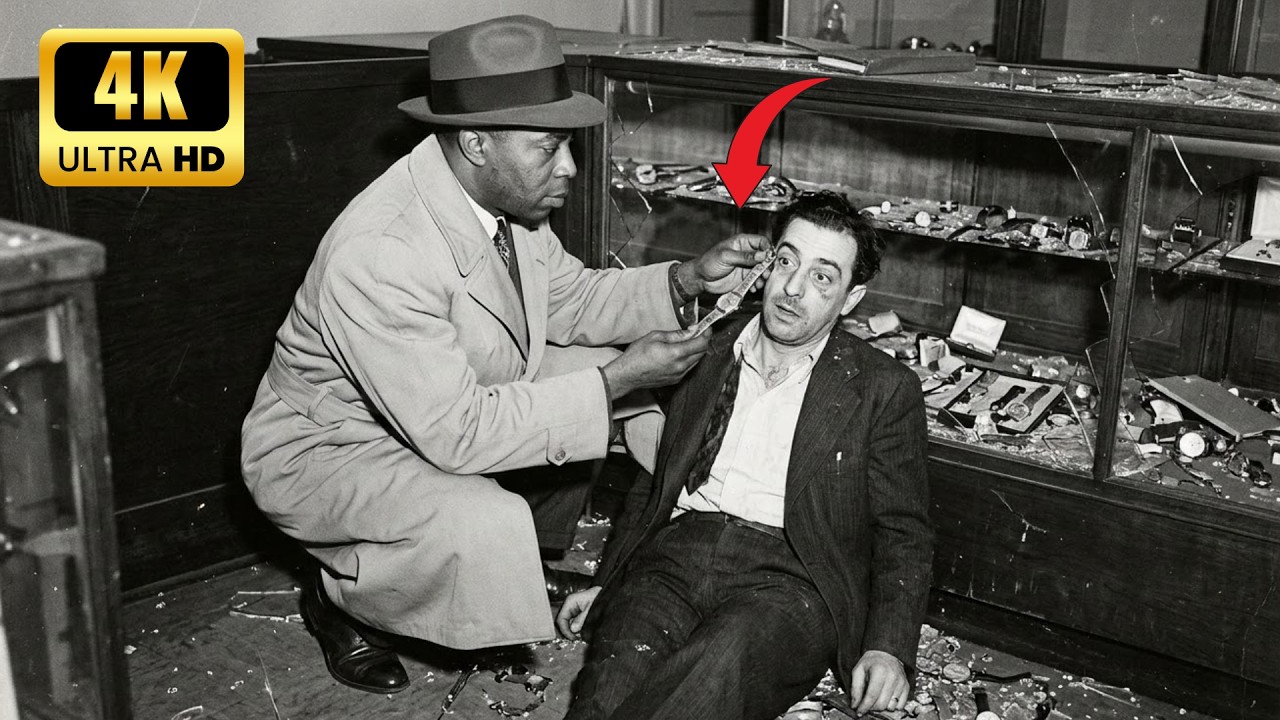
A calm male voice had given the address and the word “jewelers,” then hung up. When Marsh entered the ruined shop, he found the safe open and completely empty. Whatever had been inside had been removed before the fire ever started. The story had begun five weeks earlier, on November 9, when Ellsworth Johnson walked into Bman and Sons, a small jewelry shop that had stood on Lennox Avenue since 1919.
Emil Bman, the 54-year-old proprietor, knew his customer by reputation. Bumpy Johnson was a figure of considerable authority in Harlem, a man whose name carried weight. Johnson said he needed a watch for a friend, an old Pullman porter named Elijah Powers who was retiring after 41 years on the rails. Bman showed him a gold Oyster Perpetual, claiming it came direct from Geneva.
He asked $1,175. Johnson paid in cash, counting out the bills on the glass counter. But even as he accepted the watch, Johnson noticed three small things: the box smelled of fresh varnish, the crown bore a faint scratch, and the warranty card’s dealer stamp sat slightly off its line. He said nothing.
The retirement supper for Elijah Powers was held on December 3 in a church hall on 132nd Street. Sixty-three people attended. Powers opened the box and put the watch on his wrist for the first time in his life. It ran for seven minutes and stopped.
A man named Chester Bole, standing by the coffee urn, called out that it was a Canal Street piece worth eighteen dollars. Nobody laughed. Bole had been standing across the hall all evening and had never touched the watch, yet he produced a price and a place of manufacture with too much certainty. Johnson understood immediately that Bole had been told about the watch in advance.
Someone had deliberately set him up to be humiliated in front of the entire room. He stayed until nearly eleven, poured coffee, helped an old woman with a chair, and left without raising his voice. Everyone assumed he had taken it well. In fact, he was counting.
On December 5, Johnson took the watch to Oscar Weiss, a 71-year-old Viennese watchmaker who worked in a tiny basement shop on 118th Street. Weiss examined it and told him the truth: the case was brass with a gold wash, the dial was silk-screened, and the movement was a seven-jewel Swiss caliber worth perhaps twenty-two dollars. Someone had filed off the serial number. Weiss also revealed that this was the ninth such counterfeit watch to cross his bench in eleven months, all sold to families in the neighborhood.
Then he showed Johnson a mark cut inside the case back: three letters, WBW. When Johnson asked what it meant, Weiss hesitated and said it was a factory mark. Johnson knew he was lying but did not press. That week, Johnson set four quiet operations in motion.
He sent a young man named Juny Tate into Bman’s shop to buy a watch with $400 in bills whose serial numbers had been recorded beforehand, securing a receipt in Bman’s handwriting. He sent Nate Powers, Elijah’s son, through the neighborhood posing as an insurance clerk, checking warranty cards against a supposed theft of Swiss movements. By December 12, he had a list of 41 families who had bought counterfeits from Bman over the previous eleven months, totaling $23,480. Johnson visited seven of them himself.
The seventh was a widow named Delphine Reyes, who had bought a $240 watch after her husband’s death and had engraved his name on the back, never wearing it. She kept it on a shelf beside his photograph. Johnson put the list away and did not sleep well. The last piece came from Chester Bole.
Confronted in a parked car, Bole admitted he had been paid $100, fifty before and fifty after, to publicly expose the watch and then leave early. He had been hired by a large man in a downtown coat who came to a pool room on 125th Street twice a month. Bole never got a name. Johnson understood then that the scheme was not about the money.
Someone had wanted to test whether Harlem actually had a leader, or merely a reputation. If Johnson burned down the shop, he would be exactly what they expected: a brute who could be triggered from two blocks away. If he did nothing, the whole neighborhood would become a target. He chose a third door.
On the morning of December 13, Johnson walked into Bman and Sons alone. He placed a school notebook and $1,175 in cash on the counter. He told Bman the notebook contained 41 names and $23,480 in sales. He said he would buy back every watch at full price, paying the families himself, so that no one could say he got a better deal.
He offered Bman seventy-two hours to go to the doors himself, return the money personally, and reveal his supplier. Bman refused, saying he could not afford it. Johnson left with a single sentence: “Then I don’t need you anymore. ” Three minutes later, Bman picked up the telephone and dialed a warehouse on Water Street.
On the night of December 16, Danny Bman, Emil’s 22-year-old nephew, walked onto the platform of the 135th Street station carrying a ledger inside his coat. He had been assembling counterfeit watches for months under his uncle’s orders, never knowing where they came from. At Weiss’s urging, Johnson had sent word for Danny to come to him. On the platform, a hand took the ledger and replaced it with a newspaper.
Danny boarded the A train, and two men who had been following him stood empty-handed as the doors closed. That night, Johnson read the ledger and the shipping tickets: seventy-odd yellow slips, all from the same warehouse on Water Street, all signed for by the same hand, a man named Vincent Corteese. Harlem was not the operation. It was one-sixth of it.
At 3:47 in the morning of December 17, a panel truck stopped in the alley behind 341 Lennox. Two men with keys unlocked the back door and poured accelerant through the shop. Emil Bman was sleeping there with the refund ledger under his hands. They dragged him out into the alley, burned and coughing.
The fire took the building in forty minutes. Johnson stood across the street watching the crowd, not the flames. The next morning, the rumor went through Harlem: the jeweler sold Bumpy Johnson a bad watch, so Bumpy burned him out. Johnson let it stand.
On December 18, Ruth Kesler of the Amsterdam News found a package on her desk containing a ledger, photographs of shipping tickets, and four typed pages listing 41 names and amounts. The story ran on December 22. It contained no adjectives, no speculation, and one paragraph about the fire. What it had was a list.
The warehouse on Water Street was padlocked on January 2. The six shops named in the distribution line lost their licenses within three weeks. Vincent Corteese was indicted on January 14 on 22 counts of counterfeiting and fraud and convicted on the paper alone. Johnson paid back every family himself, in cash, at their doors, 41 envelopes totaling $23,480 by December 23.
When he reached Delphine Reyes, she told him she did not want the money; she wanted the watch to be real. Taking it to Oscar Weiss, Weiss rebuilt it with a genuine movement and refused payment, saying he wanted one job he had not charged for. Emil Bman never opened another store. He spent the rest of his working life in a linen supply office on Gunhill Road.
Elijah Powers refused Johnson’s second watch, a genuine one bought downtown in daylight. Instead, Weiss gave him his own watch, carried out of Vienna in 1939, a silver-cased wristwatch from 1911 that ran ten seconds slow a day. He had it engraved: “E. Powers, 41 years on the rails.
Never once late. ” Powers put it on his wrist and told Weiss he could owe him the ten seconds. Danny Bman testified in March and was never charged. In April, he opened a repair bench four doors down from Weiss, with a sign that read: “D.
Bman, watch repair. Everything here is exactly what I tell you it is. ” He worked there for 31 years. The story of the burning of 341 Lennox Avenue was told in Harlem for 20 years, and it was told wrong every time.
In every version, Bumpy Johnson burned the shop down in revenge. He never corrected it, not once, not when reporters asked, not when his own people repeated it. A reputation, he understood, is the only thing a man cannot buy back at any price. The fire took a building.
It did not touch a single thing that mattered. And from that winter forward, between 110th and 155th Street, no one sold Ellsworth Johnson a lie again. Not one man tried it twice.