Before he became the 41st president of the United States, before the Persian Gulf War and the endgame of the Cold War, George H. W. Bush was a young Navy pilot who barely survived being shot down over the Pacific. He came home, married Barbara Pierce in 1945, and began a life defined by three relentless tracks at once: oil, politics, and family.
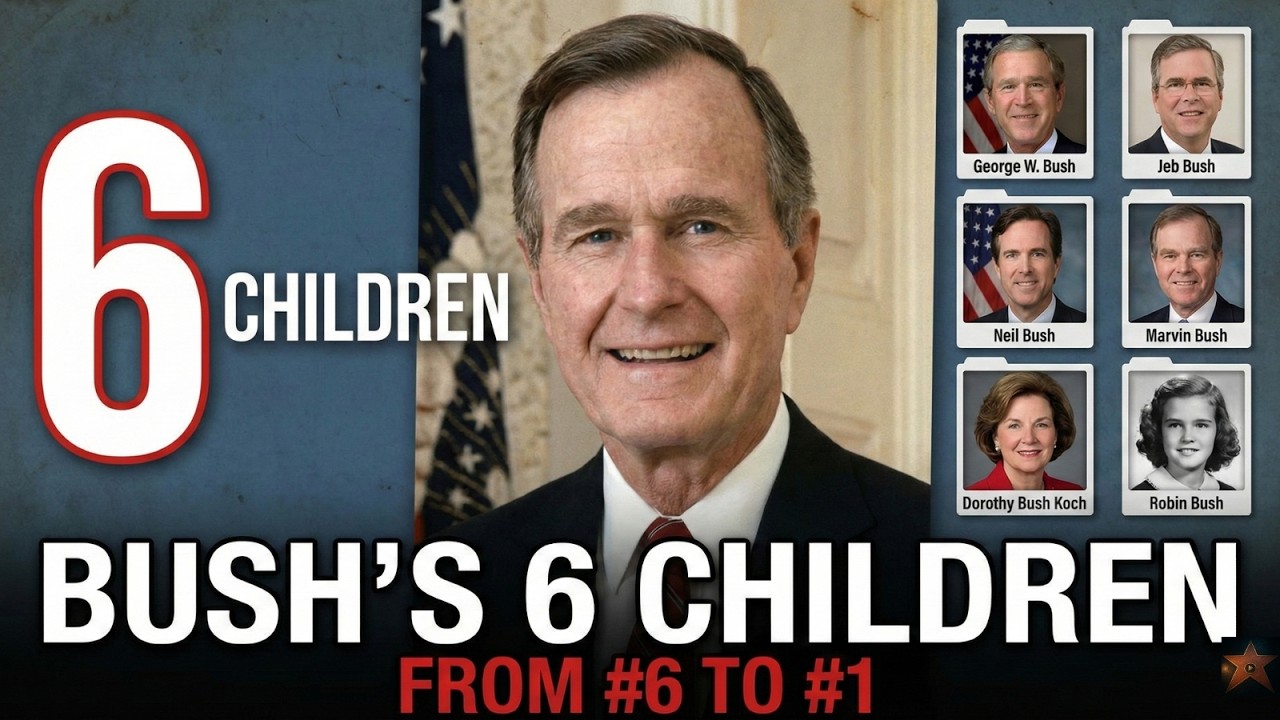
The Bush story is often told through offices and titles, but running beneath that public arc was a second story, the one unfolding in cars packed for another move, in cramped starter houses in West Texas, in hospital rooms and campaign stages. It is the story of six children whose lives traced the full cost of ambition, service, and loss. George and Barbara Bush had six children. Their first, George Walker Bush, was born in 1946 and would one day become the 43rd president, turning the Bush name into a rare American dynasty.
Their second child, Pauline Robinson “Robin” Bush, arrived in 1949 and died of leukemia in 1953, a loss that permanently reshaped the emotional core of the family. Then came John Ellis “Jeb” in 1953, who would rise to become governor of Florida and a presidential contender. Neil arrived in 1955, and his business dealings would drag the family name into financial scandal. Marvin followed in 1956, building a private but controversial career in security and investments.
Finally came Dorothy “Doro” in 1959, the youngest and the only surviving daughter. Their childhood was in constant motion. From Connecticut to California, from Midland and Houston to Washington, the Bush children moved dozens of times as their father chased oil deals, political office, and diplomatic posts. They grew up in a home that tried to be normal, with chores, sports, church, and summers in Kennebunkport, but it was never far from the next campaign or the next crisis.
The family’s first great wound came early. In 1953, Robin was diagnosed with advanced leukemia, a disease almost always fatal in children at that time. The Bushes refused to give up hope. They flew her to New York for treatment, endured endless hospital hours, clung to every small improvement, and suffered every setback.
Barbara later wrote that Robin’s illness pulled her husband closer to their daughter in a way she had never seen before, with George H. W. brushing her hair and carrying her through hospital corridors with a tenderness that astonished even her mother. Robin died on October 11, 1953, just weeks before her fourth birthday.
Her death devastated her parents. George H. W. Bush wept openly, an emotional release he rarely allowed himself afterward.
Barbara’s grief hardened into stoic resilience, shaping the steeliness that later defined her as first lady. For the children who came after, Robin became the defining absence. Photographs of her stood in family homes for decades. Her name surfaced unexpectedly in conversation.
Her loss shaped their mother’s strength and their father’s emotional restraint, and it taught the family early that life could change in an instant. When George H. W. Bush reached the presidency in 1989, his children were already adults carrying their own complicated stories.
One son was the governor of Texas and a future president. Another was steering Florida through hurricanes and contested elections. A third had already stood in the ruins of a failed savings and loan, his business judgment on trial before regulators. A fourth was tied to a security firm whose clients and timing invited endless speculation.
The youngest daughter had become the emotional historian of the family. Doro Bush Koch, born in 1959, was the only surviving daughter. If Robin’s short life became the family’s emotional wound, Doro’s arrival was its quiet renewal. She learned early to adapt to constant changes in her father’s career, from businessman to congressman to diplomat.
As the youngest, she became the emotional thread tying the siblings together. During her father’s ascent to the presidency, she moved between ceremonial duties and private family roles, helping maintain warmth inside the intense rituals of the White House. In adulthood, she chose service, authorship, and philanthropy. She co-authored My Father, My President, one of the most revealing portraits of George H.
W. Bush ever written, capturing his humor, discipline, flaws, and humanity in ways no outsider could. She worked quietly on education and health initiatives, and she preserved the side of the Bush family that America rarely saw: the laughter, the private worries, the tenderness between parents and children. Marvin Bush, born in 1956, moved deliberately outside the political path his father and brothers walked.
He was never drawn to the political arena, instead developing an early fascination with technology, systems, and logistics. In adulthood, he became a partner in investment and consulting firms, and the position that drew the most scrutiny was his role as a director at Securicom, later Stratac, a company involved in security contracts for sensitive sites, including airports and government facilities after September 11, 2001. That connection sparked widespread speculation and conspiracy theories, claims Marvin consistently rejected. He did not retreat, continuing his career in investment ventures while serving on the board of the National Children’s Medical Center and working quietly to support pediatric healthcare.
Within the family, he became known as the reflective brother, the one who could ease tension and bring humor into a room heavy with responsibility. Neil Bush, born in 1955, was the son whose life became most entangled in financial controversy. The turning point came with the Silverado Savings and Loan scandal of the late 1980s. As a director of the Denver-based institution, Neil was present during financial decisions that later contributed to Silverado’s collapse, a failure that cost taxpayers over a billion dollars.
Although he was not criminally charged, regulators found that he had engaged in multiple conflicts of interest, and he was heavily criticized as a symbol of elite privilege. The controversy stained his reputation at the very moment his father was preparing to run for president. Neil’s life after Silverado did not quiet down. He entered global business ventures in Asia and the Middle East, and his marriage to Sharon Bush ended with a public and contentious divorce.
In later years, he remarried and found a new chapter built around philanthropy, serving as a board member of the Barbara Bush Foundation for Family Literacy. Jeb Bush, born in 1953, was the son who most closely mirrored his father’s blend of discipline and policy-minded ambition. If George W. inherited his father’s instinct for retail politics, Jeb inherited his analytical mind.
He approached public service like an architect rather than a performer. The true turning point in his early life came when he traveled to Mexico as a teenager, met Columba Garnica, and fell deeply in love. That cross-cultural marriage broadened his worldview and rooted him in Hispanic communities that later became central to his identity as governor of Florida. After a narrow loss in 1994, he won the governorship in 1998, becoming the most policy-focused and reform-driven member of the Bush family.
He revolutionized Florida’s education system, expanded charter schools, and cut taxes. His most defining national moment came during the contested 2000 presidential election, when Florida became the focal point of a constitutional battle that placed his brother George W. Bush in the White House. Jeb found himself in the unprecedented position of being both governor of the critical state and brother to the candidate whose fate depended on recounts and court rulings.
In 2016, he ran for president as the presumed heavyweight, but in a political era dominated by spectacle, his quiet competence was overshadowed, and his early exit became a striking example of how dramatically American politics had shifted. At the center of the family’s story is George Walker Bush, born in 1946. He was cheerful, outgoing, and mischievous, but beneath the brightness was a quiet pressure. As the firstborn son of an ambitious man, he carried expectations none of his siblings were asked to shoulder.
The turning point in his early life came in middle age, after drifting through business ventures and struggling with alcohol. His religious conversion, coupled with a decision to quit drinking entirely, marked the beginning of the disciplined man who would become governor of Texas. As governor from 1995 to 2000, he cultivated a bipartisan style he called compassionate conservatism. When he ran for president in 2000, he did so not only as the son of a former president, but as a leader who believed he could unite a divided nation.
September 11, 2001, defined his presidency. He led the nation through the invasion of Afghanistan, the global war on terror, and the deeply controversial war in Iraq. Supporters saw a man of moral clarity; critics argued he led the country into costly conflicts. After leaving office, he returned to Texas and reinvented himself as an artist, memoirist, and advocate for veterans, a post-presidential life marked by introspection and humility.
Together, these six children form a mosaic of a family shaped by service, ambition, sacrifice, and reinvention. Presidential legacy is never a solitary achievement; it is a lineage carried by those who bear the name long after the crowds disappear. Robin, who lived only three years, became the emotional core of the family, teaching them fragility and deepening their resilience. Doro inherited the family’s heart and became the guardian of its history.
Marvin represents the enigmatic branch, private yet entangled in the undercurrents of business and security. Neil is the reminder that ambition carries risk. Jeb stands as the intellectual pillar, and George W. represents the culmination of the forces that shaped the Bush family.
Through their triumphs and struggles, we see the full measure of George H. W. Bush, not only as a leader, but as a father whose influence extended far beyond the Oval Office and into the lives of the next generation.