On the morning of January 8, 1953, a 42-year-old man named Harold Blau lay on a bed in the New York State Psychiatric Institute while a doctor injected an experimental chemical into his vein. Harold had voluntarily checked into the hospital about a month earlier, suffering from severe depression after separating from his wife. His treatment, in fact, had been going well. His psychiatrist believed he had improved enough to leave within a few weeks.
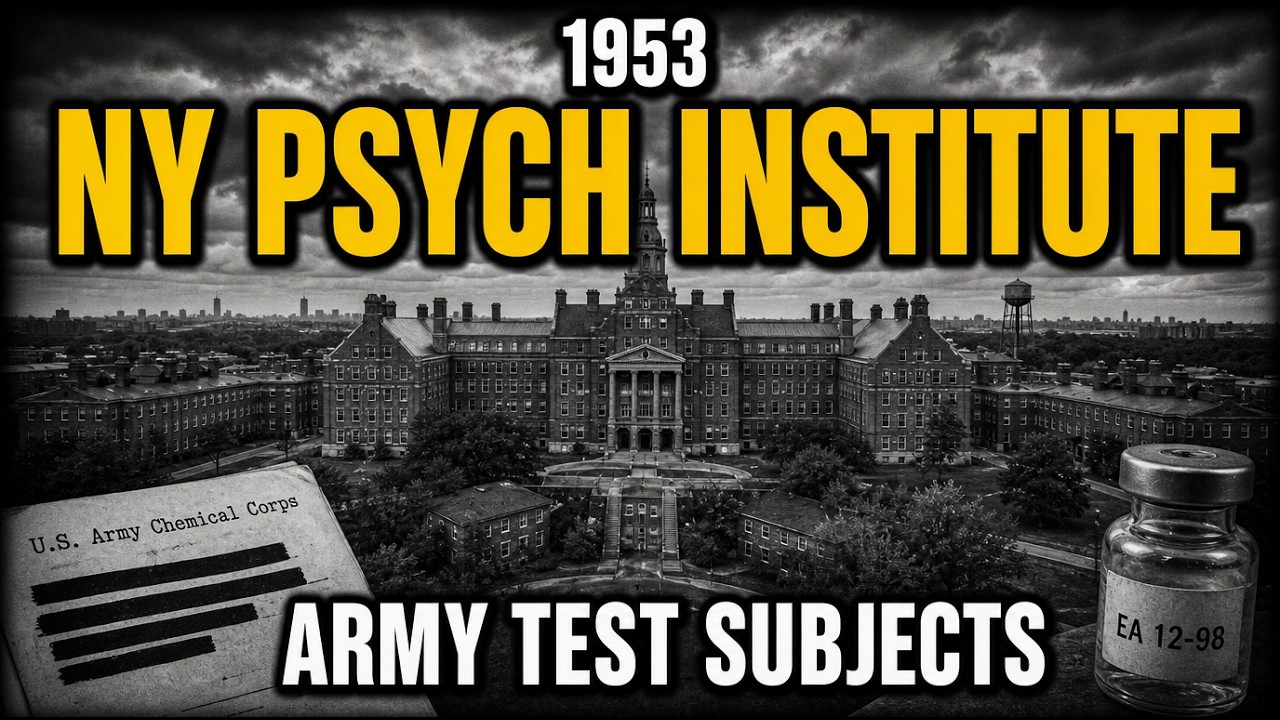
But the injection he received that morning had nothing to do with the treatment that was helping him. The substance was recorded in the files under the designation EA1298. Harold knew he was receiving an experimental drug, but he had not been told that the substance came from the U. S.
Army Chemical Corps. Nor did he know that the Army was paying the psychiatric institute to test chemicals on human beings, seeking information about substances that might be useful in chemical warfare. By that time, Harold had made it clear that he did not want to continue participating in the drug trials. Before an earlier injection, he had asked a nurse to tell the researchers he had a cold, thinking they would not accept that excuse if it came from him personally.
Later, he told his own psychiatrist directly that he wanted to stop. He was told that if he refused to continue, he would have to leave the psychiatric institute and return to one of the asylums where he had been miserable before. And so the experiments continued. That January morning, the dose was far larger than the first time Harold had received the same compound.
His first dose had been 28. 4 milligrams. This time, the doctor gave him 450 milligrams, roughly sixteen times as much. Within minutes, Harold became extremely agitated.
He sweated profusely and moved his arms so violently that a nurse had to restrain him. His body stiffened, his teeth clenched, and foam began to appear at his mouth. For more than an hour, the medical staff recorded what was happening while his condition worsened. Shortly after 11 a.
m. , Harold was still moving and trying to speak. A few minutes later, he stopped talking and began slipping into a coma. By 11:45, the notes described him as deeply comatose.
At 12:15, Harold Blau was pronounced dead. His family would spend more than twenty years without knowing the real reason behind his death. They knew that a drug had killed him, but they were never told that the drug came from the Army, that the injection was part of a secret experiment, or that the research was tied to the Army’s search for chemical warfare agents. That is what makes Harold’s story far larger than a fatal medical mistake.
He entered a psychiatric hospital because he wanted help for his depression. Within five weeks, he had become part of a secret military research program. He tried repeatedly to get out of the experiments, and he was dead. Before he became a patient, Harold had spent years working as a tennis professional.
During the winter, he taught at the River Club in New York, and during the summer, he worked at the Piping Rock Club. He also ran the pro shops at those clubs. He married Amy Fehrman in 1935, and the couple had two daughters, Elizabeth and Belinda. Harold and Amy separated in 1951 and divorced the following year.
Harold received custody of Elizabeth, while Amy received custody of Belinda. The divorce affected him badly. During the final months of 1952, he spent time at Roosevelt Hospital and Bellevue Hospital while suffering from severe depression. Then, on December 5, he voluntarily entered the New York State Psychiatric Institute.
This was not a remote asylum where patients were simply hidden away from the city. The psychiatric institute was closely connected to medical research, and that would matter greatly for what followed. In the early 1950s, the U. S.
Army had become intensely interested in chemicals that could change how people thought and behaved. The Cold War was developing, and military researchers were asking whether a chemical could temporarily confuse an enemy, disrupt normal behavior, or make people unable to perform ordinary tasks. In 1951, the Army Chemical Corps entered into contracts with the psychiatric institute through the New York State Department of Mental Hygiene. The Army would provide experimental compounds while doctors at the institute tested them on humans and reported what happened.
The Army described the work as research into psychochemical warfare agents. Part of the goal was defensive, because the Army wanted to understand substances an enemy might use. But Army documents also discussed offensive possibilities. The psychiatric institute was an attractive place for this kind of research because it already had doctors experienced in studying the effects of drugs on the mind.
The institute would design the clinical protocols and carry out the actual experiments, while the Army was responsible for producing the chemicals and conducting the animal toxicity research needed before giving those substances to humans. The program was secret. Two of the principal doctors at the institute were Paul Hoch, who designed the testing protocols, and James Cattell, who actually injected Harold. In November 1952, the Army delivered several newly created compounds to the institute.
They had code names instead of familiar drug names, and one of them was EA1298, the compound that would later kill Harold. A fundamental safety problem existed before the drug ever reached Harold’s bloodstream. Before giving a new chemical to a human, researchers needed to know how toxic it was. One common method at the time involved testing different doses on animals and trying to estimate the dose that would kill half of them.
For EA1298, the Army tested the compound on rats only. Twenty rats received a low dose and none died. Then ten rats received a much larger dose, and again none died. Finally, five rats received an extremely high dose, and all of them died.
That gave the researchers only two ends of a very wide range. They knew that one dose killed no rats and another killed them all. Normally, they would have tested several doses in between to learn where the danger actually increased. They did not.
Instead, the Army estimated a very broad lethal range and sent the compound to the psychiatric institute, knowing the institute planned to inject it into humans without another round of animal toxicity testing. Decades later, a federal court examined those tests in detail and concluded that the Army’s work was grossly inadequate, even by the scientific standards of the early 1950s. Harold entered the institute only a few weeks after those chemicals arrived. He was diagnosed with a condition then described as pseudoneurotic schizophrenia.
His principal psychiatrist was George Schack, a resident doctor who treated him with talk therapy. Harold improved. That part matters because the experimental injections were not given because his regular treatment had failed, or because the doctors believed they were his last chance. The federal court later found that the injections were not intended to diagnose or treat Harold personally.
Their purpose was experimental, and the primary reason for the research was to supply the Army with information about chemicals. Harold received his first injection on December 11, only six days after entering the institute. The drug was EA1298, and the dose was 28. 4 milligrams.
The research notes indicate that Harold was very anxious and that a great deal of persuasion was needed before he accepted the injection. Afterward, he felt pressure in his head and developed a slight tremor in his right leg. A week later, on December 18, he received a different experimental compound. Then came another injection on December 23.
By that time, the nurses noticed that Harold was becoming increasingly disturbed about the experiments. He asked one nurse whether she would call the drug studies floor and tell them he had a cold. Apparently, he thought the researchers would not believe him if he tried to use that excuse himself. He received the injection anyway, and afterward his whole body shook.
The fourth experiment was scheduled for December 30. This time, Harold told his psychiatrist directly that he did not want to continue with the injections. Under the standards in place at the time, written consent was not required for this type of research, but the court later found that oral consent was required and that a patient had the right to withdraw. The court also found that Harold had the mental capacity to grant or refuse that consent.
Instead of allowing him to stop, Harold was told that if he did not continue the experiments, he would have to leave the psychiatric institute and return to Bellevue or Roosevelt, where he had previously been unhappy. After that, he stopped pursuing his complaint. He received the fourth injection, and his reaction was severe. He suffered violent body tremors and repeatedly sat up before falling backward again.
Harold knew the drugs were experimental in a general sense. This was not a case where doctors told him he was receiving an ordinary vitamin injection. But he did not know the real purpose of the research. He was not told that the compounds came from the Army Chemical Corps, and he did not know the Army wanted the results because it was studying possible chemical warfare agents.
He also did not realize that the injections were not being given for his personal treatment. Then the doctors prepared the fifth experiment. This time they returned to EA1298, the same compound Harold had received during his first injection. But they did not give him another dose of 28.
4 milligrams. They gave him 450 milligrams. The researchers partly used Harold’s reactions to related compounds to determine how much to increase the dose. The problem was that scientists already knew that small changes in a chemical’s structure could make a related compound far more toxic.
Tolerating a high dose of one substance did not automatically mean a similar dose of another substance would be safe. On January 8, 1953, Harold was still complaining about the experiments. At 9:53 that morning, the final injection began. Four minutes later, it was over.
The research notes almost immediately turned into a record of a medical emergency. Harold became extremely agitated, and a nurse had to restrain him while he waved his arms violently. He began sweating heavily. At 10:01, his body stiffened.
His teeth clenched. His breathing became abnormal. Foam started coming from his mouth. The symptoms continued for over an hour.
At 11:05, he was still moving and speaking, although most of what he said was difficult to understand. At 11:17, the notes indicate he stopped talking and began sinking into a coma. At 11:45, he was deeply comatose. At 12:15, he was dead.
Another detail from that morning makes the decision to give Harold the drug harder to understand. At roughly the same time, another patient at the institute was also receiving EA1298. With a new chemical like this, the safest procedure would have been to give it to one person, observe what happened, and then expose another person. Instead, the two injections overlapped.
The second patient’s reaction was also extremely violent. Her injection was stopped after only a third of the planned amount had been given to her. She survived and later described the experience in words that ended up preserved in the court records. She said she had been in hell and wanted to know why they had put her there.
The experiment that killed Harold should have triggered a very simple process. His family should have been told what he had been given, why, who had supplied it, and what the doctors knew about its risks. That did not happen. The day after Harold’s death, James Cattell sent a written report to the New York City medical examiner.
The report stated that Harold had received a derivative of mescaline for diagnostic purposes. That was misleading. The court later concluded that the injections were purely experimental and were not given to diagnose or treat Harold’s condition. The report also did not mention the Army Chemical Corps or the secret research program.
The medical examiner’s autopsy report listed coronary arteriosclerosis and sudden death after an intravenous injection of a mescaline derivative. Meanwhile, people inside the Army already knew there was a much larger problem. Paul Hoch informed the Chemical Corps of Harold’s death on January 9. Army officials then began discussing how to prevent the military connection from being revealed to the public.
A project officer in the Chemical Corps named Amado Marazzi traveled to the psychiatric institute the next day. He gathered information about the injections and ordered the experiments stopped until better safety measures were taken, but he did not recommend ending the research entirely. His report stated that the results collected so far were useful to the Army and recommended the experiments eventually continue. He also recorded that he arranged to keep the records concerning Harold’s death confidential in the medical examiner’s office.
Even Harold’s treating psychiatrist was kept away from most of what happened. George Schack had worked with Harold through talk therapy, but he was not immediately involved in handling his patient’s death. When he tried to get Harold’s file to complete his records, he was repeatedly denied. When the file was finally returned to him, he remembered that it was much thinner than an ordinary patient’s file.
Harold’s ex-wife, Amy, was told he had died from an overdose of a drug. She was not told the Army had supplied the drug, or that Harold had been part of a chemical experiment, or that the research was connected to warfare. Amy contacted lawyers almost immediately. In April 1953, Harold’s estate filed suit against New York State, arguing that the psychiatric institute had been negligent in giving him a dangerously excessive dose.
At that point, the family knew something had gone terribly wrong, but they were still missing the most important part of the story. The documents they needed were being withheld from them. The estate requested hospital records related to Harold’s injections, and the court authorized access to relevant materials. Some records were eventually produced, but the documents that would have revealed Army involvement were not produced.
The family was not simply told those documents did not exist; they were classified as secret. The existence of the Army connection itself remained hidden. Government records later showed how deliberate those efforts were. Army officials were concerned that public knowledge of the experiments on unsuspecting psychiatric patients could cause embarrassment and make it difficult to arrange similar research contracts in the future.
New York State also had an obvious reason to avoid publicity about chemical warfare experiments conducted at its psychiatric institute. During 1954, documents relating to the experiments were removed from New York and sent to the Army Chemical Center in Maryland. An Army legal memorandum specifically discussed placing the records outside the reach of the family’s subpoena power while the lawsuit was still pending. That is not something we have to infer from a conspiracy theory written decades later.
It appeared in documents that eventually became part of the case before the court. The strategy became settling Harold’s case without revealing what the Army had been doing. New York initially negotiated a settlement of $15,000, but the judge handling the claim did not approve that amount, so it was increased to $18,000. The U.
S. government secretly agreed to pay half. Harold’s family was never told that $9,000 of their settlement was coming from the same federal government that was hiding its role in the experiment from them. At the 1955 settlement hearing, Paul Hoch repeatedly described the injections as part of Harold’s diagnosis and treatment.
The federal court later found that parts of his testimony were false and misleading. The estate accepted the $18,000 settlement. Amy signed a broad release that covered everyone who supplied the drug, although she did not know the supplier was the United States Army. Then the case effectively disappeared.
Harold’s daughters grew up believing their father had died from an overdose of a drug during psychiatric treatment. Their mother died in 1974 without ever knowing the full story. Then, in August 1975, everything changed. Representatives of the Secretary of the Army contacted Harold’s daughters and publicly revealed that the Army had been involved in the experiment that took their father’s life.
For the first time, Elizabeth and Belinda learned that the drugs had been supplied as part of military research. Documents relating to the case also began to surface. Some of the records that had been moved out of New York during the original lawsuit were discovered more than twenty years later in a safe at the Army’s Edgewood Arsenal in Maryland. Elizabeth Barrett, Harold’s older daughter, began efforts to reopen the case.
That turned into years of litigation, because the government argued, among other things, that too much time had passed and that the family had already accepted a settlement in 1955. The problem with that argument was obvious. The family had accepted the settlement without being told what had actually happened. Eventually, the case reached federal trial in 1986, more than thirty-three years after Harold’s death.
Judge Constance Baker Motley had to reconstruct the events from old hospital files, military records, testimony, and documents that had remained hidden for decades. Her ruling came in May 1987. The court concluded that the government had deliberately concealed the crucial facts surrounding Harold’s death, which was the reason his daughter had not been able to file the federal case decades earlier. The court also concluded that the Army had been negligent in testing the toxicity of EA1298.
The court was careful about assigning responsibility. The psychiatric institute designed the clinical protocols and carried out the injections, while the Army produced the chemical and performed the inadequate animal toxicity tests. The judge found that if the Army had tested the compound properly, the information would have shown that the dose given to Harold was dangerously high. The United States was therefore held liable for causing the wrongful death of Harold Blau.
The final award to his estate was $702,044, including $500,000 for the physical and psychological suffering Harold experienced during the final injection. No amount of money could give his daughters back the years they spent without knowing what had really happened to their father. But the ruling finally put into the public record something officials had worked hard to keep out of it. Harold did not die because doctors provided ordinary treatment and he had an unusual reaction.
He was used in an experiment. The injections were not intended to help him personally. He tried to stop participating. The compound was not adequately tested for toxicity before the Army supplied it for use on humans.
And after his death, government officials helped hide the military purpose of the research from his family. What stands out most is how ordinary the reason for Harold’s hospitalization was compared to what ultimately happened to him. He was going through a divorce. He became severely depressed and voluntarily went to a place he believed could help him.
His regular psychiatrist was helping him. The court found that Harold’s condition had improved significantly and that he was expected to leave the institute within weeks. He was not near the end of his life. He was forty-two years old.
He had two daughters, and the court concluded he was likely to return to his work as a tennis professional. Instead, five experimental injections were added to his stay. By the third injection, he was trying to find excuses to avoid them. By the fourth, he said directly that he wanted to stop.
By the fifth, he was given roughly sixteen times the dose of the chemical he had first received. A few hours later, he was dead. The New York State Psychiatric Institute continued to operate and remained a psychiatric research institution. Harold Blau’s case does not mean every doctor there was involved, or that every experiment at the institute was unethical, or that psychiatric research itself was the problem.
The problem was what happened when a patient who came for treatment became useful to a secret research program serving goals he never understood and never approved. Then, when that research killed him, the institutions involved had another choice to make. They could have told his family what happened. Instead, the Army connection was kept secret.
Records were moved, misleading explanations were placed in official documents, and the federal government quietly paid half of the settlement while the family remained unaware that it had any connection to Harold’s death. That secrecy lasted far longer than Harold’s treatment did. He entered the psychiatric institute on December 5, 1952, and died on January 8, 1953. The full truth about Army involvement did not reach his daughters until August 1975.
And it was not until 1987 that a federal court formally held the United States responsible for his death. Harold entered the hospital because he wanted to get well enough to go home. By the time his family finally learned why he never did, the secret had been kept for more than two decades.