In 1954, an American institution on a flat stretch of sandy land in the heart of Long Island held more human beings within its walls than any hospital of any kind anywhere on earth. It was not a civilian medical center or a wartime field hospital treating thousands of wounded. It was a psychiatric hospital built specifically for the mentally ill, housing 13,875 patients at one time, cared for and administered by a staff of more than 4,000 people. To put that number in perspective, it exceeded the population of most small American towns confined behind the same fence within the sprawling brick complex.
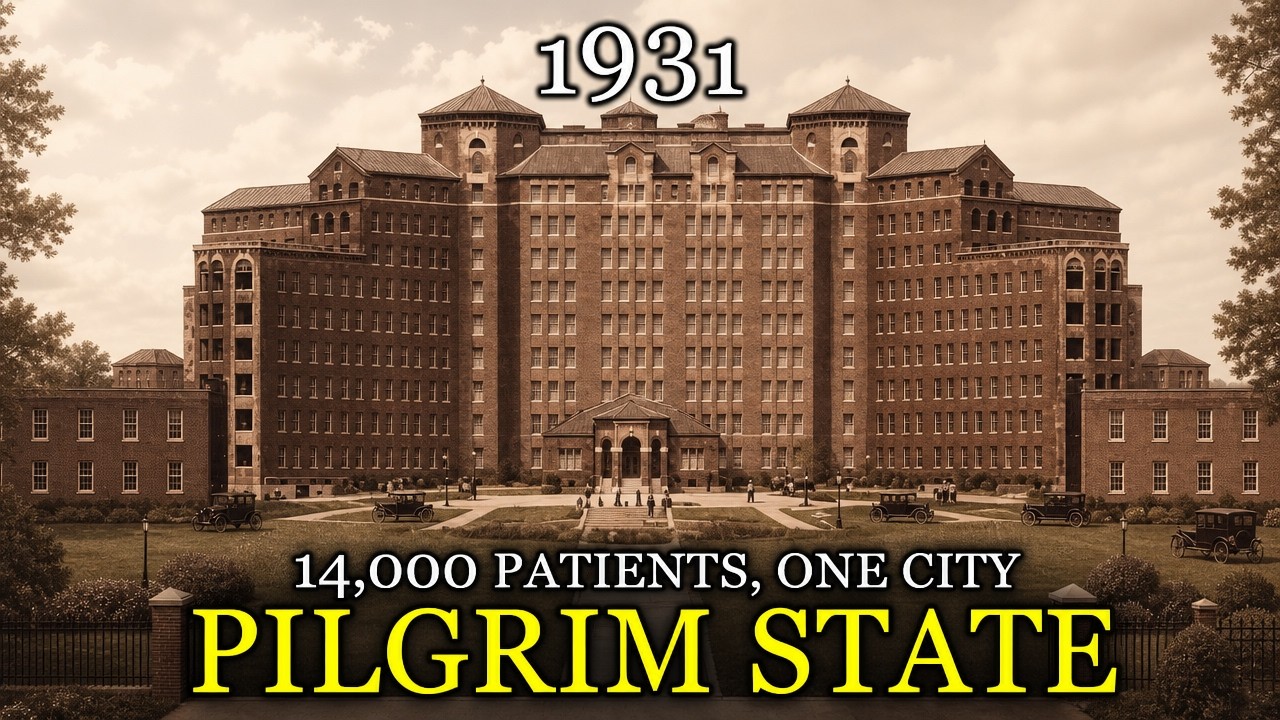
The hospital had its own police force, its own fire department, its own working farm, its own post office, its own courthouse, its own church, its own cemetery, and its own station on the Long Island Rail Road—a train stop that existed for the sole purpose of moving people to and from an institution most of them would never leave. It generated its own electricity. It contained a network of underground tunnels connecting dozens of buildings, allowing staff to move between them without ever going outside. It was not built to treat psychiatric patients from a single town or county.
At its peak, it was a self-contained city whose only industry was containment. Inside a particular building, on the upper floor, in an operating room with a panoramic view of the entire campus, doctors performed between one and two thousand lobotomies—roughly one out of every twenty-five such procedures performed in the United States during the era in which the operation was popular. Some of those who underwent the surgery were never again able to live a normal life. Some of them are buried today on hospital grounds under a number instead of a name.
This was Pilgrim State Hospital. It was once the largest psychiatric institution the world had ever seen, a record that remains unbroken more than seventy years later. To understand how a mental hospital in Brentwood, New York, came to hold more people than almost any other institution in American history, it is necessary to go back to a crisis that had nothing to do with Pilgrim State at all, but rather with two other hospitals that preceded it and failed in the same way Pilgrim would later fail, on a far larger scale. In the late nineteenth century, New York City’s mental hospitals were in a state that reformers of that era described, with little exaggeration, as a genuine crisis.
The city’s asylums, built to hold a population that had long since exceeded their capacity, were full to bursting. The state’s solution, drawn from a reform movement gaining momentum across the country, was what planners called the farm colony model. The theory held that patients removed from the noise, poverty, and crowding of the city and placed instead on open rural land, where they could farm, tend animals, and work with their hands, would recover faster than patients confined in overcrowded urban wards. The idea was not, in itself, cynical.
It reflected a genuine, if naïve, belief that fresh air and honest labor could serve as medicine. New York established two such farm settlements on Long Island before Pilgrim existed. Kings Park State Hospital opened first in the autumn of 1886 to relieve pressure on Brooklyn’s asylums. Central Islip State Hospital followed in 1889, taking patients from Manhattan.
Its earliest residents literally cleared the land, built their own housing, sewed their own clothes, and raised their own livestock as part of the new therapeutic model. Both institutions began small. They were sincerely intended as a humane alternative to the overcrowded hospital wards of the city, but within a few years they had become just as overcrowded as the hospitals they had been built to replace. The farm colony model contained a fatal design flaw embedded in its basic premise.
No one had established a mechanism to stop admitting patients once a colony reached its planned capacity, and the courts and asylums of New York City kept sending people regardless. By the 1920s, the state was facing the same overcrowding crisis for the third time, and the governor of New York—a man not yet famous nationally but destined to become one of the most important presidents in American history—made public appeals to secure funding for yet another facility. That governor was Franklin Delano Roosevelt. The legislature responded in 1929 by appropriating a budget for a third farm colony on Long Island.
This one was planned from the start to be the largest of the three, designed to hold up to 10,000 patients. That number would have made it, at the time the plans were first drawn, the largest mental hospital ever built anywhere on earth before a single patient set foot on its grounds. The state purchased roughly a thousand acres in the village of Brentwood and named the new institution after a man who had devoted his career, in his own way, to preventing the very crisis the new hospital was built to solve. Dr.
Charles W. Pilgrim had served as New York State’s Commissioner of Mental Health in the early years of the twentieth century and had been an advocate for expanding and modernizing the state’s approach to psychiatric care. The bitter irony of this story is that the hospital named in his honor would become the clearest testament in American history to what happens when a system built on expansion has no mechanism for restraint. Construction began in 1929, and on October 1, 1931, Pilgrim State Hospital officially opened, receiving its first 100 patients transferred from the already overcrowded wards of Central Islip.
Nine months later, the patient population had risen to just over 2,000, and it continued to climb throughout the next two decades. Consider what that rate of growth truly meant in practical terms. A hospital that opened its doors with a hundred patients and reached two thousand within nine months was not growing through natural gradual accumulation. It was absorbing a massive backlog of patients that the state’s older asylums had been struggling to contain for years, and channeling that backlog into a single new campus as fast as trains and ambulances could move people.
Pilgrim was never allowed the gradual, orderly opening its planners may have originally envisioned. From its first year, it functioned as a safety valve for a psychiatric crisis that had been building for decades. And a safety valve, by nature, does not know the meaning of full. What Pilgrim became over the next decade of construction and expansion is difficult to conceive of from the outside using the word hospital at all.
The physical design reveals plainly what the state’s planners had in mind. Buildings were arranged in clusters called quads, consisting of four residential buildings arranged around a central kitchen and dining hall, a pattern repeated dozens of times across the campus, so that the complex from the air looked more like a fully planned city divided into identical repeated blocks than a single institution. Underground, an extensive network of steam tunnels connected the buildings to one another and to the hospital’s own power plant, allowing staff, supplies, and if necessary, patients themselves to move across the vast campus without ever stepping outside. A single connected group of treatment buildings might contain six separate structures.
When this pattern was repeated in the reception buildings, the medical-surgical complex, staff housing, recreation halls, the church, and the farm, it became clear how a facility built for 10,000 people required not a campus in the traditional sense but a complete municipal infrastructure built from scratch on former farmland. Because Pilgrim State did not merely house patients; it fed, clothed, guarded, employed, buried, and administered them, forming a fully self-contained community. It accomplished all of this through its own institutional apparatus. It had its own police department, with officers whose jurisdiction extended only to hospital grounds.
It had its own fire department, fully equipped and staffed, capable of responding to fires across a campus that eventually spanned parts of four separate townships: Islip, Babylon, Smithtown, and Huntington. It had its own post office, its own courts, its own working farm supplying food to the kitchens, its own power plant generating electricity independently of the surrounding grid, and its own station on the Long Island Rail Road whose only purpose was to move people and supplies to and from hospital grounds. The hospital even had its own cemetery, set apart from the main campus, where patients who died inside and were never claimed by family, or whose families simply chose not to claim them, were buried under numbers instead of names. By the late 1930s, according to the hospital’s remaining mortality statistics, Pilgrim State averaged one death per day.
That rate, sustained over a full year, meant the ten-acre cemetery behind the campus water tower received more than 300 new burials annually, the vast majority marked by simple headstones bearing a patient number rather than a name. In 1938, Life magazine, less than two years old, sent photographer Alfred Eisenstaedt to document conditions inside Pilgrim State in a photo essay published under the title Shadow of Madness. Eisenstaedt’s images, still striking today for their delicate balance between documentary honesty and genuine compassion for the patients, show patients undergoing what was then called continuous bath therapy. Bodies covered in grease, immersed for hours at a time in slowly flowing warm water, intended to calm them through prolonged physical submersion rather than any pharmaceutical means, because in 1938 there were no meaningfully effective drugs.
This was one of the first national publications to show the American public, in precise photographic detail, what daily life inside one of the country’s largest psychiatric institutions actually looked like, years before the more famous revelations of the 1940s that would later help drive reform. Daily life for the average patient inside this self-contained city followed a rhythm dictated almost entirely by the needs of the agricultural and industrial institution, rather than anything resembling individual medical treatment. Patients capable of physical labor worked on the hospital farm, tending livestock and harvesting crops that went directly to the hospital kitchens to feed the rest of the campus. This was a direct continuation of the farm colony philosophy that had inspired Pilgrim’s construction in the first place.
Others worked in the hospital laundry, sewing rooms, and maintenance shops, performing jobs that would have been paid labor at any facility outside psychiatric institutions. Within Pilgrim’s walls, it was simply called occupational therapy, and it kept the hospital’s fully self-sufficient economy running at a fraction of what the state would have paid for the work. The wards themselves, especially as patient numbers passed 10,000 in the late 1940s and early 1950s, bore no resemblance to anything a modern visitor would recognize as a therapeutic space. Dormitory-style rooms designed to hold a set number of patients routinely held two or three times that number.
Beds were so close together that privacy of any kind was structurally impossible. The staff-to-patient ratio, strained from the moment the institution opened, grew worse as admissions increased faster than any subsequent hiring, until the daily reality for most patients was long unstructured hours with extremely limited individual contact from anyone qualified to treat their condition, punctuated by group interventions such as hydrotherapy, insulin, electricity, or even surgery, all common in that period. By World War II, Pilgrim State had become one of the largest employers in all of Long Island, with a workforce in the thousands even before patient numbers reached their peak. Recognizing that it had not solved the overcrowding problem even with an institution of this size, the state acquired more land to the southwest and established a satellite facility, Edgewood State Hospital, specifically to relieve the pressure Pilgrim could no longer absorb.
Then the war reshaped the campus in a way no one could have predicted in 1929. In the early 1940s, the U. S. War Department took direct control of Edgewood and three newly constructed buildings at Pilgrim itself, numbered 81, 82, and 83, still visible from the Long Island Expressway today.
The army built additional temporary structures on the seized land and converted the entire complex into what was known as Mason General Hospital, a psychiatric facility dedicated to treating American soldiers suffering from what medical terminology of the time called battle fatigue, later to be known as PTSD. In 1946, acclaimed film director John Huston, commissioned by the Army Signal Corps during the war, produced a documentary inside Mason General titled Let There Be Light, depicting the devastating psychological toll of combat on the young men being treated in the same complex built to house civilian psychiatric patients on Long Island. The footage, by all contemporary accounts, was extraordinarily powerful and deeply controversial. Military censors deemed the material too shocking for public release and suppressed the film for decades.
The suppression continued, in one form or another, until the 1980s. That meant some of the most painful documentary evidence of industrial warfare’s effects on the human mind remained locked in government vaults for nearly forty years, in the same place where thousands of civilian patients at that very moment were undergoing treatments history would later judge with equal harshness. Huston’s film followed soldiers through group therapy sessions, individual psychiatric interviews, and in its most striking footage, recorded the process of men recovering their function, their speech, their memory, and even their basic ability to walk without trembling, faculties taken from them by the trauma of combat. Seen today, what stands out is not drama but a kind of tender clinical patience.
Soldiers treated as individuals whose suffering deserved meticulous personal care. The film was shot in the same institutional setting where thousands of civilian patients were simultaneously receiving care that bore no resemblance to that individual attention. In effect, the army established two different standards of psychiatric treatment on the same site. One for soldiers, whose trauma the state was willing to acknowledge and treat with genuine regard, and one for mentally ill civilians, whose suffering the same state had decided could be managed on an industrial scale.
After the war ended, Pilgrim’s civilian population resumed its climb and surpassed anything the institution had ever seen. The return of soldiers, the expansion of the city, and a psychiatric system with no real alternative to institutionalization for anyone considered severely mentally ill meant that the courts and hospitals of New York City continued to feed a steady stream of new patients into Brentwood year after year, with no ceiling anyone in Albany ever thought to impose. By 1954, Pilgrim State Hospital held 13,875 patients and employed more than 4,000 staff. It had by then decisively surpassed every psychiatric institution ever constructed anywhere on earth, and it would hold that record forever.
No mental hospital built before or since, anywhere in the world, has ever housed that many people at one time. Some historical accounts of the campus, based on internal population statistics from certain periods of its history, suggest the true peak was even higher, closer to 16,000, though the more conservative and better-documented 1954 figure remains the one historians consistently cite as Pilgrim’s confirmed maximum. Imagine the enormous logistical challenges that number meant in practice. Nearly 14,000 people needing to eat three times a day from kitchens supplied partly by the institution’s own farm.
14,000 people needing beds, blankets, and laundered and mended clothing, and medical care provided by a staff spread across dozens of buildings on land spanning four separate townships. A single treatment ward designed decades earlier for a completely different and much smaller population now routinely held two or three times the number of patients its original designers planned for. The farm colony idea that had inspired Pilgrim’s founders in 1929, where patients would heal themselves through honorable agricultural labor in a quiet rural setting, had by the early 1950s transformed into something resembling human warehousing on an industrial scale. A facility so vast that individual patient care, the basic premise of the therapeutic model, had become structurally impossible.
It was precisely in this environment, of unmanageable scale, that the most invasive and irreversible psychiatric procedure of the twentieth century found its way to Brentwood, and found in Pilgrim’s vastness a nearly inexhaustible supply of candidates. Lobotomy was first performed in Portugal in 1935 by neurologist Egas Moniz, then reached American psychiatry through a Washington, D. C. neurologist named Walter Freeman, who, with neurosurgeon James Watts, performed the first American lobotomy in 1936 on a Topeka housewife named Alice Hood Hammatt.
Freeman became the procedure’s most fervent national advocate and later developed a faster, simpler version he called the transorbital lobotomy, in which a sharp surgical instrument resembling an ice pick was driven through the thin bone at the back of the patient’s eye socket to sever the connections between the frontal lobe and the rest of the brain. Freeman could perform it in under ten minutes without a surgeon, often without general anesthesia, sometimes in his converted van, which critics bitterly accurately dubbed the lobotomobile. Freeman’s own numbers are difficult to read without discomfort. The annual count of lobotomies nationwide rose from about 150 in 1945 to more than 5,000 by 1949, a thirtyfold increase in four years, driven by a firmly held though catastrophically mistaken belief among doctors and desperate families alike that this was the best available solution to overcrowded wards and otherwise untreatable suffering.
Eighty percent of early American lobotomy patients were women. Freeman himself operated on patients as young as four. Pilgrim State was not the first hospital in the country to perform lobotomies, but once the state hospital system embraced the procedure as a solution to its severe overcrowding, Pilgrim, simply because it housed more patients than any institution in America, became one of the largest centers for the operation in the United States. Nationally, the case of Rosemary Kennedy, sister of a future U.
S. president, remains the most famous individual lobotomy case. She underwent the procedure in 1941 at the direction of her father, Joseph Kennedy, without the knowledge or consent of her mother or siblings. Freeman performed the operation himself, permanently and severely disabling the 23-year-old for the rest of her long life.
When her story became public decades later, it did more than any single revelation to turn American public opinion against a procedure that had enjoyed, for years, the implicit endorsement of one of the most powerful families in the country. Pilgrim’s estimated 2,000 cases enjoy no such historical fame. Virtually none of the patients lobotomized in Building 23 had a brother who would become president, or a family with the resources and public standing to force the nation to reckon with what had been done to them. Instead, they had case numbers and a hospital administration that documented their outcomes in aggregate clinical statistics rather than individual histories.
The surgeries at Pilgrim were performed primarily in a single building, designated Building 23 in the state’s numbering system, a plain number for what survivors, historians, and urban explorers who documented the campus’s gradual decay over the decades have called by one name: the Lobotomy Building. Upstairs, in an operating room whose windows overlooked the sprawling campus, doctors performed between one and two thousand lobotomies over roughly two and a half decades, beginning around 1946, with the operations continuing in markedly diminished numbers into the 1970s, long after most American psychiatrists had begun to realize the procedure was a catastrophic mistake. Investigative reports, compiled from hospital records, indicate that one in every twenty-five lobotomies performed anywhere in the United States during the procedure’s peak occurred at Pilgrim State alone. Three men oversaw this program for most of its history.
A surgeon named Widgerson, who performed the cutting and drilling, and two psychiatrists, Joseph Wortis and Henry Brill, who selected patients for the operation and supervised the program as a whole. Brill’s career embodies the strange and troubling arc this story returns to again and again. He arrived at Pilgrim in 1932 as a 25-year-old trainee physician, rose through the institution’s ranks for more than two decades, and by 1958 had become its director, a position he held until 1974. Brill and his colleagues were the ones who ultimately documented the program’s fundamental failure in the hospital’s clinical reports, in a candid style that reads almost as an indictment of the very procedure they continued to perform.
In their published evaluation, the three doctors wrote: “The major drawback of lobotomy is its failure to produce any improvement in about a quarter of the cases operated upon, and only limited improvement in less than half of the remaining cases. In spite of these limitations,” they concluded, “the operation appears to be therapeutically effective and fills a real need until a better treatment is found. ” Read that sentence again. The doctors performing the surgery documented, in their own words, that it failed completely in roughly a quarter of cases and produced only slight improvement in most of the rest, and yet they continued performing it because the alternative—an institution already severely strained by 14,000 patients—offered nothing better to wait for.
The standard frontal lobotomy, as practiced at Pilgrim during the 1940s and 1950s, involved drilling or cutting holes in the skull on both sides of the patient’s head, then inserting a blunt surgical instrument to sever the neural connections between the prefrontal cortex, the seat of personality, judgment, and impulse control, and the rest of the brain. Surgeons relied heavily on intuition and educated guesswork rather than any precise repeatable anatomical map, because no such map existed. The transorbital version, popularized by Walter Freeman, used a simple instrument resembling a household ice pick driven through the thin bone above the patient’s eye. Individual cases, wherever records survive, are so specific as to be difficult to bear.
Beulah Jones, a young mother from Long Island, began hearing voices in the late 1940s, insisting she was the long-lost Queen of Scotland. Her husband, Herbert, faced a wife whose behavior had become completely unmanageable, and with no realistic alternative offered by the treating doctors, consented, in evident despair if not malice, to the lobotomy recommended by the hospital board. Her daughter, Janice, recalled decades later that her father was told the operation would remove violence from her mother and that she would become docile afterward. It did exactly that, and little else.
Beulah Jones, according to hospital and family records covering her institutional stay from 1952 to 1972, was left permanently and severely disabled, unable for the rest of her life to perform basic tasks such as bathing or using the toilet even with assistance. She spent two decades at Pilgrim after the operation that was supposed to help her leave. She was one of between 1,000 and 2,000 patients. The speed of these operations was documented in the doctors’ own contemporary reports, and the numbers, read plainly, describe something closer to an assembly line than to medical practice grounded in individual patient consultation.
Brill and his colleagues recorded, with what reads today as genuine professional pride, that they performed 350 lobotomies over just two years in the late 1940s, a rate of roughly one operation every two days, week after week, month after month. Each one was an irreversible surgical alteration of a human brain, performed on a patient population so vast and a medical staff so small that no careful review of individual cases was possible for most of them. By 1991, decades after the practice had officially ended, more than 200 former lobotomy patients were still living in Pilgrim’s wards, permanently incapable of independent life. They were a living testament to a treatment the medical establishment had entirely repudiated, and no facility outside the institution that had harmed them in the first place had any real capacity to provide the lifelong specialized care their condition required.
Lobotomy was never the only surgical treatment employed in Pilgrim’s wards. It was simply the most irreversibly damaging, entering an institutional culture that had already developed the habit of treating the human mind as something to be shocked, drugged, or physically broken into submission, because there was no time, staff, or space to do anything gentler with 14,000 people at once. In the hospital’s early years, during the 1930s, the primary tool for managing agitated or sleepless patients was hydrotherapy: prolonged immersion in warm baths, or tight wrapping in cold wet sheets for hours at a time, designed to induce sedation through extreme physical exhaustion and discomfort. Before long, insulin coma therapy appeared, in which patients were injected with doses of insulin large enough to induce seizures and unconsciousness, and in a significant number of documented cases nationwide, death, all in pursuit of a poorly understood theory that forcing the brain through repeated comas might somehow reset whatever was producing the patient’s symptoms.
Metrazol, a chemical convulsant derived from camphor, induced seizures so violent they caused bone fractures in patients, yet was favored by some physicians of the era specifically because it spared them the need to physically restrain the patient. Electroconvulsive therapy arrived at Pilgrim on November 1, 1940, according to the hospital’s surviving clinical records, with an electric current delivered directly across the patient’s skull to induce a controlled seizure. In the early years of the treatment, it was administered without any anesthesia or muscle relaxant whatsoever. Contemporary accounts from state hospitals across the country describe entire wards of patients receiving shock therapy on the same morning, one after another, with the treating physician sometimes spending less time with a single patient than it took to attach the electrodes to their temples.
It took more than a decade for anesthesia and muscle relaxants to become standard practice, eliminating the violent whole-body convulsions that characterized the first generation of the treatment. None of this happened in secret, and none of it happened because the doctors administering it were uniquely cruel. It happened because an institution built to hold 10,000 people, and ultimately holding nearly 14,000, had exhausted all humane and individual alternatives, and tried every fast violent physical intervention available in mid-century psychiatry in sequence on a population too large for anyone to see them as individuals, only as cases to be managed before the next patient arrived from the city. Physical restraint in its literal sense remained a routine and normalized part of daily ward management throughout most of this period.
Straitjackets and mechanical restraints were not used as a last resort but as a practical low-staff solution for controlling agitated patients in wards where the staff-to-patient ratio made any more attentive calming approach structurally impossible. Dr. Henry Brill himself, the same director who co-authored the clinical evaluation acknowledging lobotomy’s high failure rate, would later admit, reflecting on his decades at Pilgrim, that lobotomies, electroshock, and straitjackets alike had in fact served more as an obstacle than a genuine help to the patients who underwent them, a conclusion he apparently reached gradually, and only after spending most of his career as one of the physicians most responsible for applying all three methods. Here a correction to a myth is warranted, because the story of Pilgrim is often reduced by internet ghost-hunting enthusiasts to a single homogeneous horror narrative that misses the more unsettling real shape of what happened.
Pilgrim was never designed, at any point in its history, as a place of deliberate cruelty. Its founders in 1929 sincerely believed in the farm colony model. Its early superintendents sincerely believed that hydrotherapy and fresh air offered something better than the county poorhouses and city jails that, for much of American history, had been the default destination for anyone whose mental illness had gotten beyond their family’s control. Even the lobotomy program, despite its horrifying outcomes, was run by physicians who documented in their published clinical writings that the procedure failed utterly in nearly a quarter of cases, and yet continued applying it, not out of sadism, but because Pilgrim’s sheer scale made any slower, more individualized form of care structurally impossible.
Pilgrim’s tragedy is not that it was designed as a torture chamber, but that good intentions, applied on a scale of 14,000 human beings with a staff that could not keep up, produced results barely distinguishable from cruelty in their actual effect on the people inside. This distinction matters, and it connects directly to the institution located just 15 kilometers to the northeast that this same narrative has previously examined: Kings Park Psychiatric Center. Kings Park opened first, in 1886, as the model institution Pilgrim was later built to relieve. It too became a self-contained city, complete with its own power plant, farm, and rail line.
It too filled beyond sustainable capacity and resorted to the same aggressive mid-century treatments once individual care became impossible. Pilgrim and Kings Park are not two separate horror stories that happen to exist in the same region. They are one identical institutional failure repeated twice on the same stretch of Long Island sand, separated by 15 kilometers, because New York State kept applying an identical flawed solution to a single unsolved problem: too many patients and a complete refusal to impose a limit. By the mid-1950s, the same decade in which Pilgrim’s population reached its record of nearly 14,000 patients, the treatment landscape that had produced that number finally began to shift.
It shifted because of a drug, not because of any reform movement, lawsuit, or exposé. Chlorpromazine, marketed in the United States under the trade name Thorazine, reached American psychiatric hospitals in 1954. Its effect on institutions like Pilgrim was almost immediate, and without any precedent. For the first time in the history of American psychiatry, doctors had access to a medication capable of effectively suppressing the most severe symptoms of conditions like schizophrenia, using only a daily pill, without surgery, seizures, or induced comas.
Patients who had spent years, sometimes decades, confined to locked wards because their symptoms made independent life impossible became, with regular medication, often functional enough to be considered for discharge into supervised community care. The effect on Pilgrim’s population was not gradual; it was closer to collapse. Patient numbers, which had risen almost continuously for two and a half decades, began to fall almost as soon as chlorpromazine and the antipsychotic drugs that followed became routine practice throughout the state hospital system. Over the following decades, as deinstitutionalization accelerated into formal state and federal policy during the 1960s, 1970s, and 1980s, driven by a firm belief that community care represented both a moral and financial improvement, the census at institutions like Pilgrim dropped year after year, until it became a fraction of its former size.
The scale of this collapse, viewed at the state level rather than at a single institution, is difficult to absorb. At its peak, the New York State psychiatric hospital system, of which Pilgrim was always the largest component, operated more than 90,000 beds statewide. According to the most recent available government statistics, that number is approximately 3,500 beds across all the psychiatric centers New York still operates. That includes adult, child, and forensic psychiatric beds combined.
Ninety thousand beds, reduced by more than 96 percent over roughly sixty years. Pilgrim alone, at its peak, held nearly 14,000 of those beds. Today, the entire state system holds fewer than that single institution did by itself. This collapse in bed capacity did not simply mean patients received better care, though modern community-based outpatient care has genuinely worked for a significant number of them.
It also meant, according to researchers who have tracked the aftermath for decades, that the population once housed at Pilgrim and similar institutions did not disappear; it moved. Some individuals with serious mental illness, who would have spent decades inside a facility like Pilgrim in an earlier era, instead ended up in homeless shelters, then in the criminal justice system, and in New York City specifically, in Rikers Island jail, which at any given time holds more than a thousand people with serious mental illness, according to the most recent statistics. That facility thus effectively functions, whether intended or not, as the closest existing equivalent to the psychiatric bed capacity that was eliminated. Whether deinstitutionalization succeeded or simply relocated the same crisis to different, less visible institutions remains one of the most contentious questions in American public health policy, and Pilgrim’s empty wards sit at the center of that still-unresolved debate.
The debate reshaped the entire psychiatric landscape of Long Island in stages stretching across nearly two decades. Edgewood State Hospital, the satellite facility built specifically to relieve Pilgrim’s overcrowding, closed in 1971 and was demolished in 1989, its features so completely erased that only old photographs remain. Central Islip Psychiatric Center, one of the two original farm colonies from which Pilgrim’s construction was directly inspired, closed in 1996. Kings Park followed shortly after.
The remaining patients and programs from both institutions were consolidated into Pilgrim, which, despite having lost the vast majority of its population by that time, remained the last of Long Island’s four great state hospitals still standing and operating. Today it is called Pilgrim Psychiatric Center, operating under the New York State Office of Mental Health, and it continues to admit and treat patients, though on a scale nothing like its former self. It is unrecognizable to anyone who worked there at its 1954 peak. Current state statistics indicate its licensed capacity is a tiny fraction of what a single original continuous treatment ward once held.
It is distributed across 11 inpatient units, four outpatient clinics, and specialized programs covering addiction treatment, geriatric care, and assertive community treatment teams designed specifically to keep patients out of institutional beds as much as possible. This represents a radical reversal of the philosophy on which Pilgrim was founded in 1929. Before the final consolidation in the 1980s, the state made a decision about part of the Pilgrim campus itself that briefly threatened to erase the line this entire history draws between institutions built for treatment and institutions built for punishment. Buildings 81, 82, and 83, the same three buildings the War Department had seized during World War II for Mason General, were converted for a period in the 1980s into a correctional facility.
A real prison operating on the grounds of what had previously been, and would later become again, a psychiatric hospital. The move drew immediate and sustained community protest from both Brentwood residents and mental health advocates, who argued, rightly, that having a prison and a psychiatric hospital on the same active campus blurred the very distinction the entire post-war American mental healthcare reform movement had spent decades trying to establish. Faced with that opposition, the state backed down, and the buildings were returned to psychiatric hospital use. But for a brief period in Pilgrim’s history, the same walls that had treated shell-shocked soldiers contained convicted criminals—an eerie and uncomfortable echo of the institutional overlap this narrative has documented in prisons that held mental patients and asylums that functioned in practice as minimum-security jails.
The remaining campus, once patients no longer needed most of its original space, became a genuine liability rather than an asset. Dozens of buildings stood empty and decayed, and by the 1990s they had become a growing hazard, attracting vandals, scrap collectors, and the urban exploration community whose photographs and videos, over the following decades, became the primary way most people outside Long Island learned about Pilgrim’s history. In 2002, a real estate developer named Gerald Wolkoff purchased 462 acres of the former hospital land, roughly half the original campus, for $21 million, and announced a proposal that reflected, in its own way, Pilgrim’s founding ambition, with an irony almost too obvious to believe. He called it Heartland Town Square, a $4 billion development promising more than 9,000 apartments, millions of square feet of office and retail space, and, in Wolkoff’s own words at the time, a small self-sufficient walkable city, a smart growth community where people could live and work without having to leave.
The vocabulary of self-sufficiency with which Pilgrim was built in 1929 had literally returned to describe what would replace it. Demolition of the abandoned hospital buildings began in 2003 and continued in phases for nearly a decade. The dormitories were removed in 2011, and the old medical-surgical building, the male and female reception buildings, and the original administration building were demolished in 2012. The demolition included the medical complex itself that had housed the upstairs operating room in Building 23, roughly 50 buildings in total.
Yet the demolition did not pave the way for anything resembling the promised city. More than two decades after Wolkoff’s purchase, Heartland Town Square, according to the most recent reports, remains largely unbuilt. The scope of what was originally proposed was an almost exact echo of Pilgrim’s founding ambition: 9,000 residential units, 3 million square feet of Class A office space, 1 million square feet of shopping and entertainment space, and 25,000 permanent jobs, all arranged according to the developers’ marketing materials in a pedestrian-friendly design explicitly compared to a small slice of Manhattan transplanted to suburban Long Island—where Pilgrim’s planners in 1929 had placed their design. Their vision promised a self-sufficient farm colony that would cure psychiatric patients through honest labor and rural isolation.
Heartland’s twenty-first-century planners promise a self-sufficient urban village that will cure Long Island’s eroding tax base and shrinking young professional population through generous walkable spaces and corporate offices. The two visions, separated by nearly a century, share the same firm belief that enough ambitious planning, applied to vast acreage, can solve a social problem simply by building bigger than anyone has built before. Zoning battles, environmental reviews, community opposition, and outright administrative delay—according to critics who organized public petitions about the site’s condition—stalled the project for more than 15 years, in what one industry observer called political foot-dragging, before the Islip Town Board approved a scaled-down first phase in 2017. According to a community assessment conducted in 2025, the majority of the 462 acres Wolkoff purchased remains unchanged, and the rubble piles left by the demolitions of 2003, 2011, and 2012 remain in place, still shaped like the buildings they came from, more than two decades later, never actually removed.
And still, the project continues its slow and contentious progress. Development coverage published in spring 2026 confirmed that the Wolkoff family, now run by the second generation after Wolkoff’s death, remains determined to acquire the site, negotiating with Suffolk County officials over tax financing structures, describing a vision for the property that has now outlived the developer who originally proposed it. The historical record of the institution fared no better than its buildings. Building 45 in the still-active portion of the campus houses the Long Island Psychiatric Museum, a modest collection of artifacts rescued from Pilgrim, Kings Park, and Central Islip alike.
Photographs, patient records, medical instruments, newsletters, fragments of an era that official state archives never preserved completely. In 2020, a flood swept through the museum, destroying a substantial portion of that collection—a loss that historians and former hospital staff who worked with the museum are still cataloguing and restoring where possible, years later. The irony of that particular loss is worth reflecting on. An institution that spent decades documenting patients by numbers instead of names, and burying its dead under headstones devoid of any individual identity, finally built a museum to restore some of that lost identity, preserving photographs, letters, and records that restored real names and faces to an institutional history that spent most of the twentieth century erasing them.
Then, in a single flood, a large portion of that work was lost in hours, as water overwhelmed what decades of institutional neglect had nearly erased, destroying the record before anyone could finish writing it. The cemetery remains set apart from the hospital grounds, and according to the community petition documenting the demolition rubble, receives little to no maintenance. The men and women buried there—patients who died inside an institution that was supposed to heal them, unclaimed by families either unwilling or unable to bring them home—lie today under headstones bearing numbers instead of names, on land now legally owned by a private real estate developer, awaiting a $4 billion development that has yet to begin construction more than two decades after it was announced. Among the descendants still searching for those headstones today are people whose family stories reflect the institutional pattern of identity erasure documented throughout this history.
On an online forum dedicated to genealogy research in the New York State hospital system, one woman described how she spent years piecing together the fate of her grandfather, a man admitted to Manhattan State Hospital in 1926 and transferred to Pilgrim shortly after it opened, where he remained until his death in 1971—45 years of institutional residence. Her family had told her throughout her childhood that her grandfather had simply died, gone before she was born. When she finally obtained the hospital records decades later, she found that at his death he was listed as having no known family, even though his wife had admitted him in 1926, and the couple had three children, one of them the woman’s mother. It was not the hospital that erased him from family records; it was the family itself, which chose over two generations to remain silent rather than acknowledge him, until his granddaughter, who grew up believing her grandfather had died before her birth, spent years of her life searching for his medical records, a photograph of him, and finally his grave number.
So that she could stand at his grave and place a marker bearing his real name. Taking the broader view beyond Pilgrim, the trajectory of the story is the same one this narrative has traced across numerous prisons and asylums. But Pilgrim represents something close to the maximum of that pattern: the point where good intentions and vast scale collide with catastrophic force. Someone builds an institution to solve a genuine human problem.
Overcrowded city hospitals, patients held in conditions everyone agreed were inhumane. The institution is designed according to an ideal model, based on farming and fresh air, rather than confinement and restraint. Then no one, at any point in the founding legislation, the architectural planning, or the annual budget appropriations that kept expanding the campus decade after decade, establishes a mechanism to indicate when the hospital is full. The courts of New York City kept sending patients.
Pilgrim kept building wards. And by 1954, an institution founded on the belief that size and self-sufficiency could produce humane care had produced the largest gathering of human suffering under a single administrative roof in the recorded history of psychiatry. The lobotomies were not an anomaly within that system; they were its logical endpoint. A medical institution facing more patients than any medical staff could treat individually seeks out the fastest and most permanent interventions available, and continues to seek them out even after its own published research demonstrated failure in a quarter of cases.
None of the people performing those operations believed they were committing an atrocity. They believed, with the same misplaced confidence that had driven the farm colony model twenty years earlier, that they were providing the best available option for people whom the system had already failed in every other conceivable way. There is a version of the Pilgrim story that ends happily. The drugs arrived, the population declined, the buildings were emptied, the state learned its lesson, and modern community psychiatric care replaced a brutal mid-century mistake with something more humane.
That version is not entirely wrong. Chlorpromazine and the drugs that followed genuinely allowed tens of thousands of people who would have spent their adult lives behind Pilgrim’s walls to live, work, and remain connected to their families and communities. That is not nothing, and there is no stake in pretending the farm colony model, or insulin comas, or lobotomies represented a lost golden age worth mourning. But progress in this particular story did not come through replacing something worse with something better; it came in the form of withdrawal, reducing statewide bed capacity by 96 percent over 60 years, with little investment in the community mental health infrastructure that was supposed to absorb the population Pilgrim and its sister hospitals once held.
Some of that population found genuine stability in community care. A large portion of it did not, ending up in homelessness, emergency rooms, or jails never designed or equipped to function as psychiatric facilities—institutions that have quietly, with limited resources, absorbed a version of the same crisis Pilgrim was built to solve in 1929, without any of its infrastructure, and without anyone in Albany calling it by its real name. Now the buildings are gone, most of them, reduced to rubble left untouched by a private real estate developer for more than two decades, on land that once held the largest number of psychiatric patients in history, and that is now slated, once financing, permits, and environmental reviews are secured, to host luxury apartments. Long Island in 2026 does not lack projects promising to build a small self-sufficient city on former institutional grounds.
What it has consistently lacked, over a century spanning the farm colony era, the lobotomy era, and the luxury apartment design era, is any actual plan for what happens to the people the previous version of that city failed. The cemetery still stands. The numbers on those headstones, if still legible, belong to people who were promised a farm colony, a quiet rural setting, honest work, and healing. And who instead received a lobotomy, a coma, an electric shock, or simply decades in a ward so overcrowded that no one on staff had time to learn their name.
Pilgrim State was never intended to become the largest asylum on earth. It became that by accident, one admission at a time, because the state that built it never once, over 25 years of continuous expansion, stopped to ask whether an institution of that size could, in any real sense, function as a hospital at all. By the time anyone in Albany asked that question, the answer had already been written—not in a policy document, but in the records of 2,000 lobotomy patients, and in a cemetery of numbered graves around which no housing development has yet built walls. Somewhere on that cemetery ground behind the brick water tower, under a marker that may or may not still be legible after a century of Long Island winters, lies the man whose granddaughter spent years tracking down a photograph and a grave plot number, only to discover that his name had been correct all along.
He is one of an unknown number of patients whose families are still searching, even now, through genealogy forums and obscure state records, trying to find out what actually happened to a relative the family at some point simply agreed to stop mentioning.