Wallis Simpson, the Duchess of Windsor, died on April 24, 1986, in a shuttered house in Paris. She was 89 years old, and she died alone. No visitors came, no voice answered. She had lost her ability to speak years before.
Her wedding ring had grown too loose for her arthritic fingers to hold. The woman history remembers as the reason a king gave up his throne had spent her final decade invisible, bedridden, and isolated from the world. She was born Bessie Wallis Warfield on June 19, 1896, in Blue Ridge Summit, Pennsylvania. Her parents had traveled there hoping to cure her father, Teackle Wallis Warfield, of tuberculosis.
The cure failed. He died months after her birth, leaving his widow, Alice Montague Warfield, impoverished and dependent on wealthier relatives. Wallis grew up in Baltimore partly supported by her uncle, Solomon Davies Warfield, who paid for her schooling at the most expensive girls’ school in the state. She grew up as the poor relation, close enough to wealth to understand it, never secure enough to take it for granted.
That experience shaped her ambition and her hunger not just for comfort but for belonging. Her first marriage, in 1916, was to Earl Winfield Spencer Jr. , a Navy aviator and an alcoholic. The marriage deteriorated through years of separation and misery, ending in divorce in December 1927.
Her second marriage, to shipping executive Ernest Aldrich Simpson, took place in London in July 1928. It was more stable, more practical, but Wallis was not made for stability alone. She met Edward, Prince of Wales, on January 10, 1931. Edward, the heir to the British crown, was charming, restless, and emotionally fragile.
He found in Wallis someone who would not be dazzled by his title, someone who spoke plainly, challenged him, and managed him. By the time he became King Edward VIII on January 20, 1936, following the death of his father, King George V, Wallis was already at the center of his life. She was still married to Ernest Simpson. The British press stayed silent about the affair while foreign papers ran with it.
In July 1936, Wallis filed for divorce. Prime Minister Stanley Baldwin made clear that the government could not sanction the king’s marriage to a twice-divorced woman. Edward’s response was unprecedented in British history. On December 10, 1936, after less than a year on the throne, he signed the instrument of abdication.
In a radio broadcast heard around the world, he explained that he could not carry the burden of kingship without the help and support of the woman he loved. His brother became King George VI. Edward was given the title Duke of Windsor, and the exile began. Wallis’s divorce was finalized in May 1937, and she married Edward at the Château de Candé in France on June 3, 1937, becoming the Duchess of Windsor.
But the new king issued letters patent, with the unanimous support of the dominion governments, denying her the title Her Royal Highness. No member of the royal family attended the wedding. The wound of never quite being accepted opened at the very moment she must have believed she had finally arrived. For the next three and a half decades, the Duke and Duchess lived a life that looked like a glamorous holiday and felt increasingly like a gilded exile.
They traveled constantly, shuttling between Paris, New York, the South of France, and the Bahamas. During World War II, Edward was appointed governor of the Bahama Islands in July 1940, a posting widely interpreted as a way of keeping the Windsors far from the action. Wallis hated it, calling it their Saint Helena, a reference to Napoleon’s island of exile. During this period, the couple came under government scrutiny for their apparent sympathies with Nazi Germany.
In 1937, without government approval, they visited Germany and were received by Adolf Hitler. The visit happened, and it permanently damaged their reputation with the British establishment. What it meant in terms of ideology remains a subject of historical debate. After the war, the Windsors settled in Paris.
Their home was exquisite and their social life relentless, but Edward grew increasingly melancholic. He missed England. He had given up his country, his throne, and his identity in exchange for a life of beautiful, purposeless wandering. In 1971, he was diagnosed with throat cancer, the consequence of a lifetime of smoking.
Queen Elizabeth II visited the couple at their Paris home in May 1972, days before Edward died on May 28, 1972. They had been married for nearly 35 years. At 75, with her health already failing from arteriosclerosis, Wallis was left alone. During Edward’s funeral in June 1972, a telephoto lens captured her watching the Trooping the Colour ceremony from a window at Buckingham Palace.
She looked utterly bereft. She had spent her entire married life as the woman who was almost royal, almost accepted, almost enough. Now the man whose love had justified all of it was gone. Back in Paris, the parties stopped.
The wit and the vivacity that had defined her social reputation began to dim. Her arteriosclerosis caused mental confusion. As the 1970s progressed, she suffered several falls and broke her hip. She broke it again.
By the late 1970s, she was largely confined to her home. After Edward’s death, Wallis had granted power of attorney to her French lawyer, Maître Suzanne Blum. Blum had spent years in Hollywood representing major studios and stars and had negotiated the record divorce settlement for actress Rita Hayworth. She was sharp, relentless, and utterly devoted to the Duchess.
What happened next remains one of the most disturbing and contested chapters in the story. In 1980, the London Sunday Times commissioned a major feature on the aging Duchess. Photographer Lord Snowdon was sent to take pictures, and journalist Lady Caroline Blackwood was commissioned to write the article. What Blackwood found was a locked door.
Blum refused her access to the Duchess entirely. Blackwood could not speak to the Duchess, could not see her, and could not verify anything about her condition firsthand. What she learned from old friends was troubling. One friend, an Austrian baron, had received an alarming phone call from Wallis in 1978.
He traveled to Paris and was refused access. When he finally glimpsed her, he reported that she had shriveled to less than half her size, curled up as though reverting to a fetal position, unconscious, her skin darkened by illness. This account comes from Blackwood’s book, The Last of the Duchess, written in 1980 but not published until 1995, after Blum’s death, because Blum had threatened legal action against anyone who published material critical of her. What is verified is that by 1980 Wallis had lost her ability to speak.
She was bedridden for the final years of her life and received no visitors apart from her doctor and nurses. Blum sold items belonging to the Duchess, including valuable possessions, to her own friends at below market value, a practice later condemned by royal biographer Hugo Vickers. When Blackwood was working on her article, Blum gave wildly contradictory information. In one conversation, she said the Duchess was in a coma.
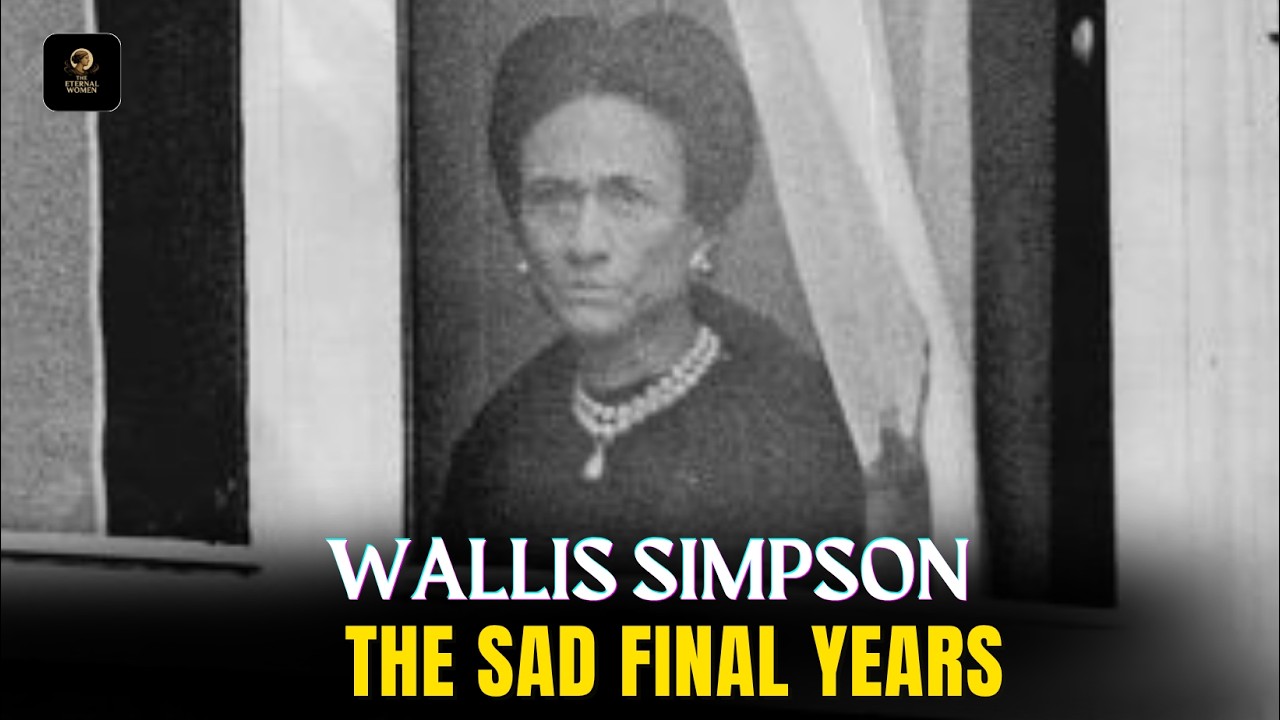
In another, she said the Duchess sat cheerfully by the window listening to Cole Porter records. An Italian photographer using a telephoto lens captured photographs through the bedroom window showing a deeply pitiful situation. Blum told Blackwood that if she wrote one derogatory word, she would not sue her. She would kill her.
Wallis died on April 24, 1986, at her home in the Bois de Boulogne, Paris, of bronchial pneumonia. She was 89. Her final years had been consumed by strokes, mental derangement, and grief at the loss of her husband, who had died 14 years before. Diana, Lady Mosley, one of her close friends, said at the time, It wasn’t really a life at all.
I’m delighted to hear she has died. I wish she’d died many years ago. She was not speaking out of malice. She meant that what Wallis had endured, the immobility, the silence, the isolation, was so far beyond living that death was a mercy.
On April 27, Wallis’s remains were flown from Paris to RAF Benson by an aircraft of the Queen’s Flight. Flags flew at half-mast on government buildings. Her funeral was held on April 29, 1986, at St. George’s Chapel, Windsor Castle.
One hundred seventy-five mourners attended, including members of the royal family: Queen Elizabeth, Prince Philip, the Queen Mother, Charles and Diana, Princess Anne, and others. Margaret Thatcher and Neil Kinnock were present. Princess Margaret, Prince Andrew, and Prince Edward were not, as they had barely known Wallis. Per Wallis’s own wishes, there was no funeral address, no eulogy, no direct references to the Duchess during the ceremony.
Only once, in a prayer, did the Canon of Westminster refer to her as our sister. The woman who had spent her life being discussed by others chose, in death, to make them stay silent. Her coffin was carried by eight Welsh Guards, with a single wreath from Queen Elizabeth II on top, white, orange, and yellow lilies picked at Windsor Castle. The silver plaque read, Wallis, Duchess of Windsor, 1896-1986.
The burial at the royal burial ground at Frogmore, beside Windsor Castle, was private, attended by only 15 people. Wallis was laid to rest next to her husband, exactly as he had wished. The Queen Mother did not stand at the graveside, on the advice of the Queen. Diana, Princess of Wales, said afterwards that it was the only time she had ever seen the Queen weep.
The woman who had been denied a royal title for 50 years was given a royal burial by the family that had shut her out for half a century. She was laid to rest to the sound of Elgar’s Nimrod, in a country that had spent decades trying to pretend she did not exist. Wallis Simpson was not a simple woman. She was not a villain and she was not a victim, though she was made to play both roles.
She was formed by early loss and relentless ambition, capable of extraordinary brilliance and of breathtaking political misjudgment. The Nazi visit of 1937 cannot be erased from her biography, and neither can the genuine devotion of 35 years of marriage. What happened to her at the end, the isolation, the silencing, the invisible years in that shuttered house in Paris, was in some ways a final act of what her life had always been. She existed at the edges of power, close enough to feel its warmth, never allowed fully inside.
She died having never been truly embraced by the institution whose history she had indelibly altered. And still, more than a century after her birth, her story is still told, her letters were published and read, her jewels went to auction for millions, and her funeral was among the most consequential the monarchy had ever held. The woman who asked for no eulogy at her funeral received one anyway, in the accounts of her life that continue to be written with their beauty and their shadows both intact.