For nearly eighty years, Elizabeth Kalhammer kept silent. Hired in 1943 as a teenager to work as a maid in Adolf Hitler’s private residence, she answered a job advertisement unaware that she would spend the next two years cleaning floors at the Berghof, Hitler’s Alpine fortress in Bavaria. In her old age, she finally broke her silence. “Before I die, I must speak,” she said.
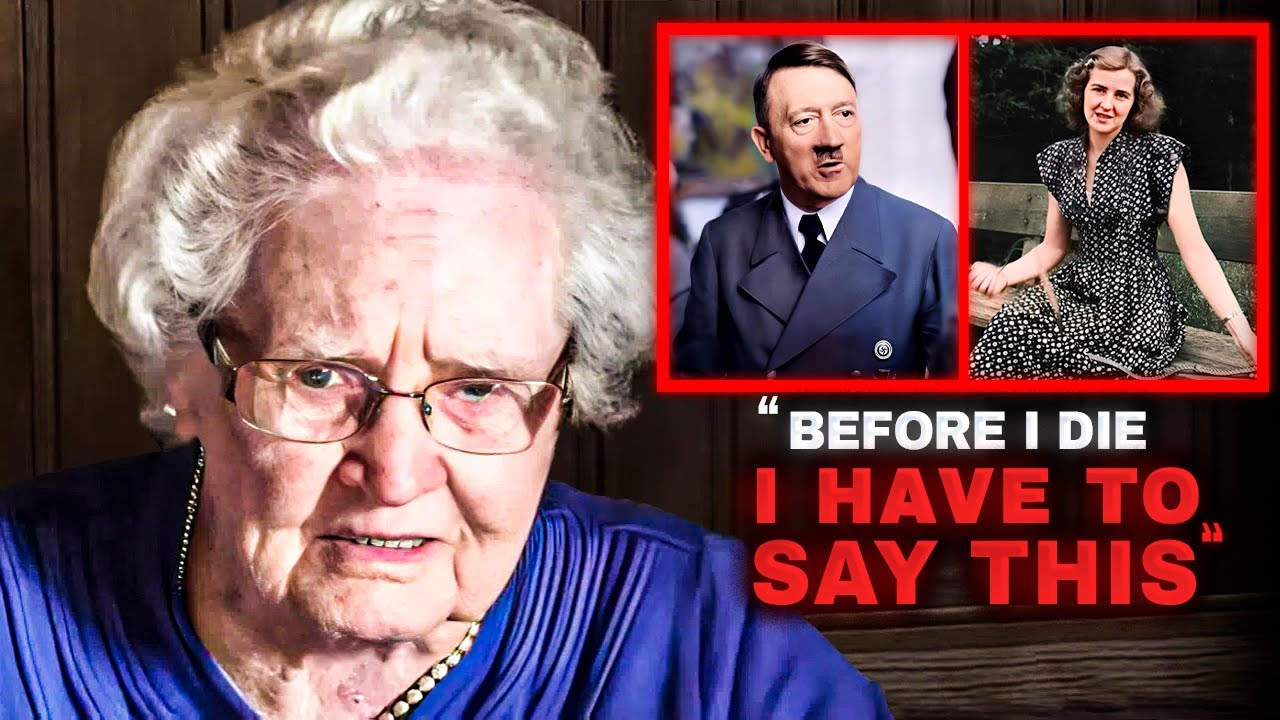
What she revealed was a world of secret midnight meetings, whispered orders, and an atmosphere marked by fear. She was warned from the start not to speak about what she saw, or she would disappear like so many others. She couldn’t look Hitler in the eye, and claimed his presence could be felt even without entering the room. While Europe burned, she made tea and swept halls decorated with stolen art, just feet away from the men making decisions about invasions and exterminations.
Kalhammer was barely twenty-two when she arrived at the Berghof near Oberzalzberg. Born in 1923 in Salzburg, Austria, she came from a modest family and had no fervent political affiliation. She completed commercial training and was looking for work when she learned that female staff were needed at an important residence in the Bavarian Alps. Candidates were not told the workplace would be Hitler’s private residence, and discretion was absolute.
Her mother signed the consent form, and only after she was admitted was she officially informed that she would be working for Adolf Hitler. The arrival was, in her words, shocking. The structure dominated the mountainside, offering spectacular views of the Alps, and operated as a closed universe with strict organization. Kalhammer joined a group of around twenty young women employed in administrative tasks, cleaning, or cooking.
Her role was primarily that of an office assistant, typist, and logistical support. She didn’t have constant access to Hitler, but she saw him almost daily as he wandered the halls, gave instructions, or appeared at meals. One of her first impressions was the contrast between Hitler’s public image as a powerful leader and the almost domestic nature he displayed at the Berghof. In her words, “He was surprisingly kind in his everyday dealings.
He never shouted or raised his voice. He behaved toward us with a courtesy that no one expected. ”
She observed his meticulous habits. He dressed soberly inside the residence, ate light meals, usually vegetarian dishes, and often held long evening conversations with his closest collaborators, among them Martin Bormann, Eva Braun, and occasionally Albert Speer.
Kalhammer never witnessed political decisions or war discussions, but she noticed the growing tension as the war progressed. In 1943, there was still a certain calm at the Berghof. In 1944, the atmosphere became more serious, more closed off. One of the most striking aspects of her account is her description of Eva Braun.
Kalhammer was one of the few employees who had direct visual contact with her. She described her as a reserved woman, very concerned about her appearance, who rarely interacted with lower staff. In a 2014 interview, Kalhammer stated, “Eva Braun had no authority over anyone. She didn’t even seem very interested in exercising any power role.
She was like a figurehead, but Hitler treated her with great affection. ”
The female presence at the Berghof was greater than many believed. Women worked in the kitchen, laundry, and administrative offices, many of them very young, mostly Austrian and South German. None were party members, and all knew they were to maintain complete confidentiality.
The training included a key warning: never ask questions, never express political opinions, and never initiate conversation with Hitler unless he did so first. Although Kalhammer was not part of Hitler’s inner circle, she recalls several brief encounters with him. Some were banal exchanges; other times she directly received a work order. One of the moments that most affected her was when Hitler entered the office and personally thanked her for her work.
He walked in, stood in front of her, and said, “Good work. I’ve heard you’re very efficient. ” She felt completely paralyzed. “It was impossible not to feel the weight of who he was.
”
She also recalls his presence on nights when films were being shown. Hitler had a private cinema at the Berghof and enjoyed watching films, often German or captured Swedish and American productions, accompanied by Eva Braun and his aides. The technical staff and some secretaries were allowed to attend. Elizabeth attended on several occasions, but recalls the atmosphere as more solemn than festive.
“It wasn’t fun. It was like attending a ritual. No one laughed. No one spoke.
You could tell everyone wanted to please him. ”
As the eastern front crumbled and Allied bombing intensified, the Berghof ceased to be a peaceful refuge. In 1944, Kalhammer noticed an increase in visits from high-ranking military officials, and the atmosphere became increasingly tense. Rumors circulated, the postal service slowed, and restrictions became stricter.
In the spring of 1945, the Berghof was evacuated. Kalhammer was sent back to Salzburg just before Allied forces began bombing the area. Shortly after, the Berghof was partially destroyed by British air raids and subsequently demolished by American forces to prevent it from becoming a neo-Nazi sanctuary. After the war, Elizabeth Kalhammer remained silent for decades, not because she feared reprisals, but because she didn’t feel her role had been historically significant.
Furthermore, the stigma of having served in Hitler’s private residence was difficult to overcome in postwar Austria. She worked as a teacher and later as a travel agent. It was only in her old age, already retired, that she began to recount her memories, participating in several television interviews mainly in Germany and Austria between 2005 and 2018. In one for the German channel ZDF, she explained, “For a long time I wondered whether I should say something.
But then I thought, if people like me don’t tell what it was really like, others will make up stories. ”
Her testimony stands out for its measured tone. Kalhammer doesn’t seek to justify or accuse. She simply describes what she saw and experienced without drama or omissions.
“I didn’t see crimes. I didn’t see violence. But I did see how a regime could wrap everything in an aura of order, cleanliness, and efficiency. And behind that facade, the horror of the outside world was hidden.
”
Elizabeth Kalhammer lived to ninety-six. She died in 2023, leaving behind an unusual legacy of oral memory, that of someone who worked very closely with Hitler without being an accomplice or direct victim, and who knew how to maintain the emotional distance necessary to recount her experience clearly. In her final interviews, she reiterated that she didn’t regret telling her story. “It was only one year of my life, but it’s lived with me for all the rest.
”