For a man who built an entire political movement on image, Adolf Hitler’s own appearance was remarkably unremarkable. While his second-in-command, Hermann Göring, paraded in flamboyant uniforms, white jackets, and ceremonial batons, the dictator of Nazi Germany deliberately dressed in what many would call dull clothing. He favored a simple brown or black suit, a long trench coat that covered it entirely, and a military-style cap. The contrast was striking: Göring glittered with medals, while Hitler presented himself as austere, disciplined, and focused.
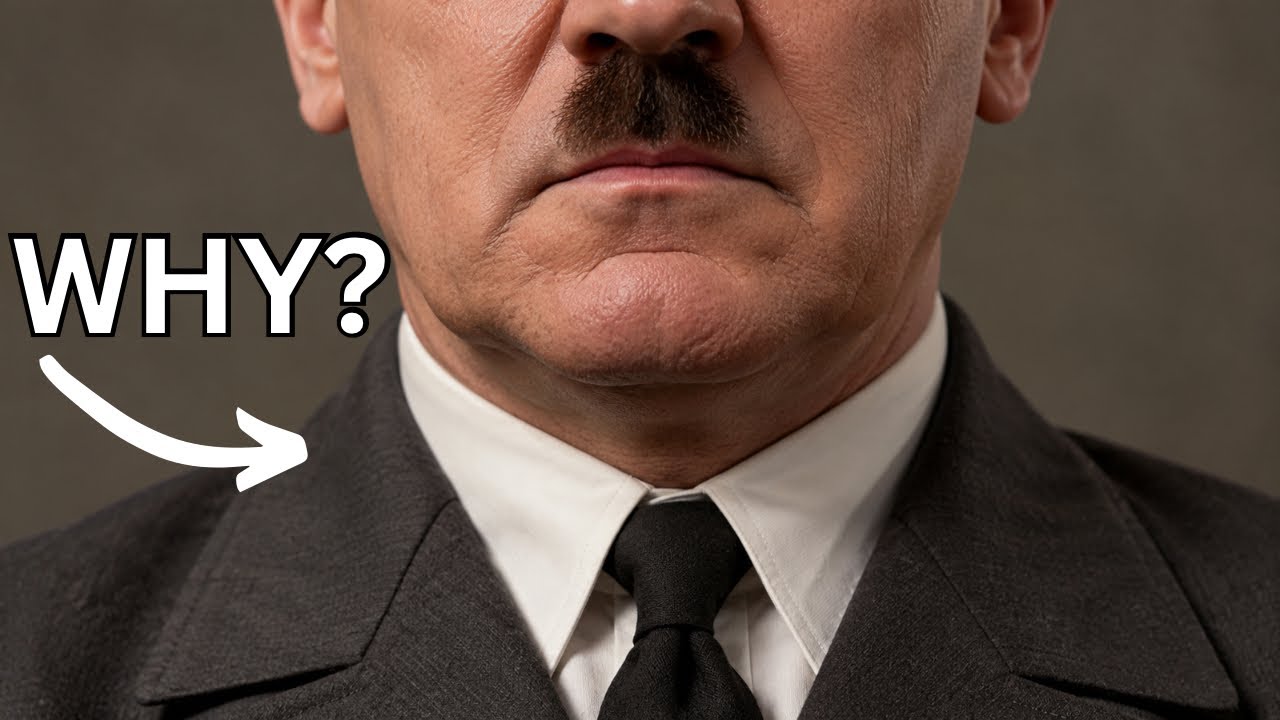
But the simplicity was itself a carefully crafted weapon. By the time Hitler had consolidated his power in the 1930s, he understood that his clothing was not a matter of personal taste but a tool of political identity. Before he became dictator, he had been photographed in a variety of outfits: ordinary civilian suits, trench coats, traditional Bavarian clothes, and even lederhosen. Once he became a major political figure, that variety disappeared almost entirely.
His wardrobe became rigidly controlled, and in public he cycled through a very limited set of uniforms that were meant to define him for the German people. During the early 1930s, the most distinctive outfit was the brown Nazi Party uniform: a brown jacket, black trousers, black boots, a leather belt, and the swastika armband. This was the look of the rising political movement, instantly recognizable and closely tied to the party’s rallies and street presence. But when Germany invaded Poland in September 1939 and the Second World War began, Hitler shifted his image once again.
He began appearing regularly in a simple field-gray military jacket with dark trousers. To most observers, it seemed he wore the same thing every single day. This wartime wardrobe was not an accident. In his speech to the Reichstag on September 1, 1939, Hitler announced that he had put on the uniform he held most sacred and that he would not take it off until victory was achieved.
It was pure political theater, but the message was clear. The field-gray jacket tied him visually to the German armed forces and to his own service in the First World War. He was no longer just the party leader; he was the commander-in-chief, leading Germany through its greatest military struggle. Hitler’s wartime uniform was deliberately plain.
He avoided loading himself with displays of medals and honors, especially when compared to Göring, whose chest was covered with enough decorations to rival an entire Olympic team. Hitler wore only a few consistent awards: the Iron Cross First Class, which he had earned during the Great War and placed on his left breast pocket, along with a wound badge and the golden Nazi Party badge. He could easily have awarded himself a much more impressive array of honors, but he chose not to. The restrained selection reinforced the narrative he wanted to project: that he was a common soldier of the First World War who had risen to lead the nation.
That wartime background, engraved in his few medals, was central to his public persona. The repetition of his uniform served another critical purpose: instant recognition. Hitler understood the power of visual branding long before the age of modern media. The Nazis exploited cinema, photography, posters, and mass rallies to spread their leader’s image.
A leader who looks nearly identical in thousands of photographs becomes instantly identifiable. There was little incentive for Hitler to change his appearance, because repetition was the very essence of his image. The uniform, the sideways-combed hair touched with shine, and the famous mustache together formed a silhouette that the German public and the world could recognize at a glance. Hitler was also acutely aware of how displays of wealth could damage his carefully curated reputation.
He had grown enormously wealthy and lived in luxury, with access to expensive residences and properties, including his mountain retreat in Bavaria. Yet Nazi propaganda consistently portrayed him as a simple man entirely devoted to Germany. If he had appeared constantly in new, flashy, expensive suits, that image would have collapsed. The plain jacket suggested discipline, military duty, seriousness, sacrifice, and steadfastness—traits he wanted the German people to see in their Führer.
During the war, this choice became even more important. While German soldiers fought and died across Europe, and eventually while Germany itself was bombed from the air, Hitler appearing in lavish civilian clothing would have created an embarrassing contradiction. The simple gray jacket said, in effect, “I am at war too. ” It was essential propaganda.
It allowed him to present himself not as a distant dictator enjoying the fruits of power, but as a leader sharing the burdens of his soldiers. Yet the familiar image was not the whole truth. Behind closed doors, Hitler dressed differently. Photographs from the Berghof, his mountain residence in Bavaria, show him in civilian jackets, shirts, ties, and other casual clothing.
He had given up the lederhosen years earlier, but once the cameras and the public were out of sight, his clothing was far less militaristic. The strict uniformity was reserved for public consumption, where every appearance was calculated to project a specific identity. The reason Adolf Hitler always seemed to wear the same clothes is simple: he wanted the public to recognize his role rather than focus on his outfit. As his dictatorship evolved, his wardrobe grew increasingly standardized.
During the war, the repeating field-gray jacket allowed him to appear simultaneously as Führer, soldier, and supreme commander. The few medals he chose to wear emphasized his First World War record, while the complete absence of changing fashion reinforced the propaganda image of an ascetic leader supposedly consumed by his mission to save Germany. It was not an eccentric clothing habit; it was a calculated transformation of a man into a visual symbol. Once that image had proven effective with the German public and the world at large, there was no longer any reason to change it.
And that is precisely why Hitler deliberately wore the same dull clothes, day after day, for as long as he held power.