In the summer of 1944, the German front in the east was collapsing under the weight of the Soviet summer offensive, Operation Bagration. Launched in late June, the offensive had shattered Army Group Center and driven German forces westward across Belarus, Latvia, and Lithuania. Near the Latvian border, in the sector held by the men of Heavy Panzer Battalion 502, the pressure was becoming unbearable. Columns of Soviet armor moved steadily forward, probing for gaps, expecting to brush aside whatever resistance remained.
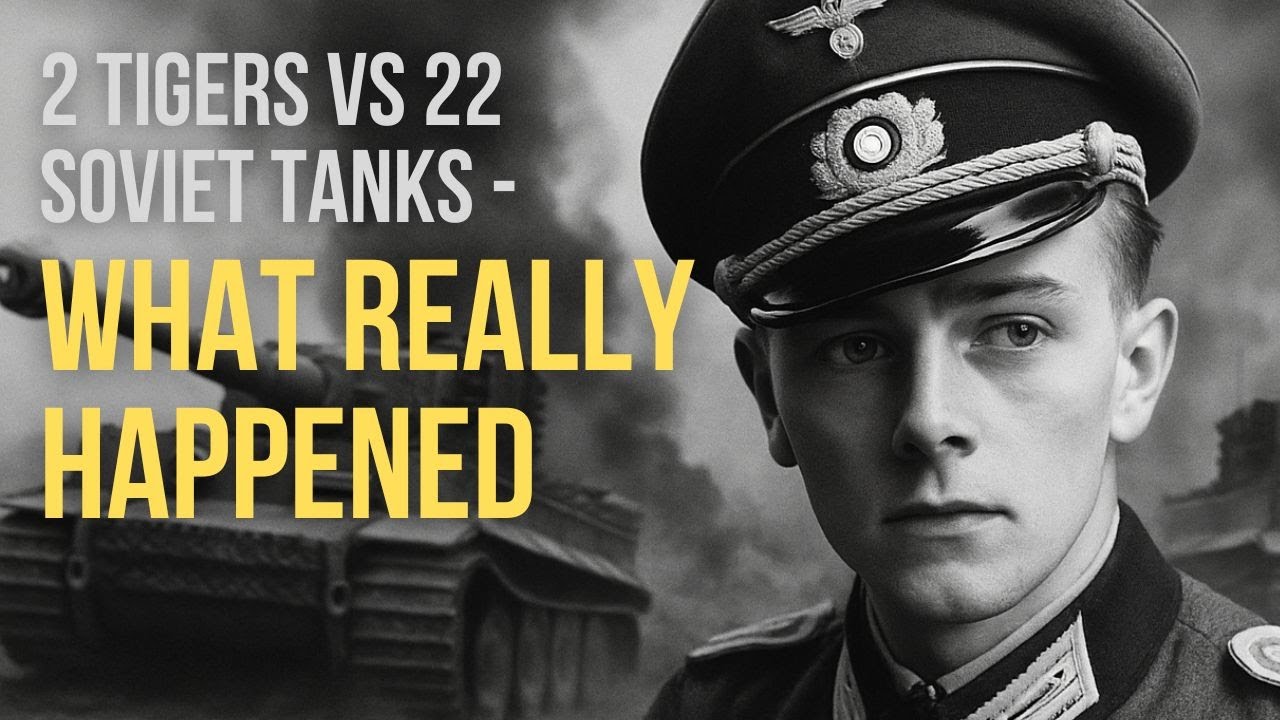
Two Tiger I tanks sat concealed behind a tree line near the village of Malinava. Their engines were off. Their crews watched in silence. Beyond the field ahead, a column of Soviet armor was advancing, including IS-2 heavy tanks and T-34s, unaware that they were being observed.
Inside one of the Tigers sat Otto Carius, a young but already heavily decorated tank commander. What he and his fellow crewmen witnessed in the next fifteen minutes would become one of the most discussed armored engagements of the war: two Tigers versus more than twenty Soviet tanks. When the firing stopped, Carius reported that seventeen IS-2s and five T-34s had been knocked out. The remaining Soviet units pulled back.
The German Tigers had suffered no losses. Carius was born on May 27, 1922, in Zweibrücken, Germany. He joined the Wehrmacht in 1940 and was assigned to Panzer units, eventually becoming one of the most effective tank commanders of the war. He first saw combat on the Eastern Front during Operation Barbarossa, and by 1943 he had transferred to Heavy Panzer Battalion 502, a unit equipped with the formidable Tiger I.
By the time of the Malinava engagement, he was already a recipient of the Knight’s Cross and had taken part in dozens of armored confrontations. Unlike many wartime memoirs, Carius’s postwar accounts, particularly in his book Tigers in the Mud, are noted for their technical precision and unembellished tone. He did not glorify war. He described it as exhausting, terrifying, and full of chance.
His detailed descriptions have become essential reading for students of armored warfare. On the morning of the ambush, reconnaissance had revealed the Soviet armored column advancing toward Malinava. Carius and the commander of the second Tiger decided to attack from a concealed position. The Tigers, with their powerful 88 mm KwK 36 guns and thick armor, were well suited for the strike.
Stationed in defilade behind trees and brush, they had both cover and elevation. When the first IS-2s rolled into range, the Germans waited until the optimal moment, then opened fire. Many of the Soviet tanks were hit before they could react. At short to medium range, the Tiger’s gun was capable of penetrating the frontal armor of the IS-2, one of the most feared tanks in the Soviet arsenal.
Confusion spread quickly among the Soviet crews. Some T-34s attempted to maneuver or retreat, but the field offered little protection. Within fifteen minutes, the action was over. The exact numbers have been debated, and wartime reports should always be viewed with caution, but even conservative estimates suggest that the effectiveness of the two Tigers in this encounter was extraordinary.
Historians have noted that such dramatic kill counts often reflect a combination of factors: advantageous terrain, surprise, crew experience, and the fog of war. Some have questioned whether all the tanks destroyed were indeed IS-2s or whether a portion were misidentified T-34s or other models. Others have pointed out that Soviet crews in 1944 were often young and undertrained due to the war’s attrition, particularly in fast-moving offensives where logistical coordination was strained. Still, the technical matchup cannot be ignored.
The Tiger I, despite its mechanical complexity and weight, was a formidable vehicle. When operated by experienced crews in defensive or ambush roles, it could dominate engagements even when outnumbered. Carius never claimed personal glory. In interviews and writings, he stressed the unpredictability of war, the fear that even elite crews faced, and the thin line between tactical success and disaster.
His descriptions of Malinava were factual, almost clinical. Yet the image of two tanks halting an armored assault endures as a symbol of both the Tiger’s power and the chaos of the Eastern Front. The story of Otto Carius at Malinava is often repeated in discussions of World War II armored warfare. But beyond the numbers and battlefield mechanics, it invites a broader reflection on how such events are remembered, interpreted, and mythologized.
Was it a masterclass in tactics or an outlier shaped by timing and terrain? Was it proof of German engineering superiority or simply a moment when experience, training, and circumstance aligned in the chaos of war? The truth likely lies somewhere in between. In war, clarity is rare, and moments of apparent triumph are often surrounded by loss and uncertainty.
Carius himself never romanticized the encounter. He emphasized the burden of command, the strain on men inside metal hulls, and the unpredictability of survival. After the war, he became a pharmacist and avoided the spotlight. His writings remained one of the most grounded and technically accurate records of armored warfare in the twentieth century.
He passed away in 2015, but his accounts remain a valuable resource not only for what they report, but for how they report it. In remembering stories like Malinava, we also remember the people inside the machines. Their decisions, fears, and discipline shaped outcomes far more than any single weapon system. Whether two Tigers really halted an entire Soviet column is perhaps less important than what the story tells us about the realities of war: the mixture of fear and calculation, chaos and structure, memory and myth.
When Carius wrote about his experiences, he was not simply recording data or cataloging victories. He was confronting memory. Every shell fired, every command shouted through metal intercoms, every enemy silhouette caught in the scope left marks on the tanks, on the landscape, and on the minds of those who survived. He was candid about this weight.
He did not glorify the Tiger as invincible. He spoke of its mechanical faults, its slow turret traverse, its vulnerability in open terrain. But he also emphasized that its real power lay not in steel but in the mindset of the crew. Discipline, coordination, calm.
These were the traits that made a tank like the Tiger more than just a weapon. They made it an instrument of decision in a world ruled by uncertainty. The engagement at Malinava, in that light, becomes more than just an ambush. It becomes a case study in how machinery, terrain, and human judgment intersect under pressure.
Not every unit would have acted as swiftly. Not every commander would have had the nerve to hold fire until the precise moment. And not every crew would have walked away unscathed. Today, the image of a Tiger tank is often wrapped in myth.
Models sit in museums. Digital reconstructions fill documentaries. Few of these capture the claustrophobic interior, the frost on the hatch handles, or the long seconds between sighting and firing. That is what Carius’s account restores: a human context within a mechanical world.
What we choose to remember, and how we remember it, defines our understanding of history. In his case, it was not only about the tanks he destroyed. It was about the limits of man and machine, and what it means to act under the cold, unrelenting weight of war.